Key Points
- The historic chocolate firm of Fry’s had been set up way back in the late 18th century in Bristol and expanded to be one of the biggest employers in the area.
- After the merger of the company with Cadbury and subsequent acquisition by Kraft, the last batch of chocolates was produced in the Keynsham factory in 2011.
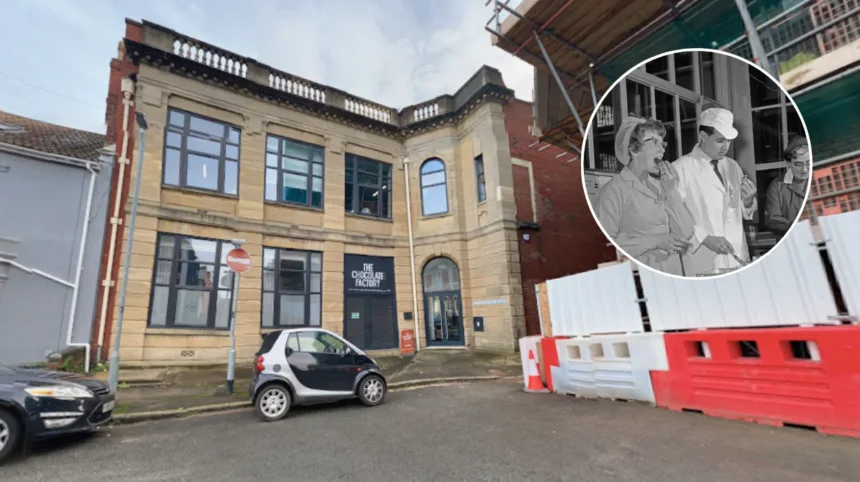
- The renowned factory of Fry’s located in Keynsham, which had been built in the 1920s, was fully converted by the Bristol-based charity group ‘St Monica Trust’ into the Chocolate Quarter.
- The Chocolate Quarter was officially launched in 2017 to serve as a hub of the community.
- Other historical structures had been the Fry’s factory located at The Pithay, Bristol city center, which was demolished in 1961.
Keynsham (Bristol Express News) September 12, 2026 — As reported by journalists Jackie Butler and Pete Gavan of Bristol Live, the storied history of the Fry’s chocolate company dates back to its foundation in Bristol in the late 1700s, expanding over generations to become one of the city’s most significant and largest employers. The enterprise, which became a cornerstone of local industrial heritage and working-class employment, eventually underwent major corporate changes following a merger with Cadbury and a subsequent takeover by Kraft. These corporate shifts culminated in the final Fry’s chocolate products rolling off the Keynsham production line in 2011, marking the end of an era for confectionery manufacturing in the area.
As detailed in the historical archives and pictorial reviews highlighted by Bristol Live, the sprawling Fry’s factory in Keynsham was originally constructed in the 1920s. For decades, it sustained thousands of jobs and produced household names like the Fry’s Chocolate Cream, 5 Boys milk chocolate bars, Crunchie, and various other confectionery favourites. However, following the cessation of manufacturing activities in 2011, the future of the vast industrial site required a new vision to prevent urban dereliction and to preserve its local significance.
What Was the Redevelopment Process Led by the St Monica Trust?
The extensive transformation of the former industrial grounds was undertaken by the Bristol-based charity St Monica Trust. According to documentation compiled by Bristol Live editors Jackie Butler and Pete Gavan, the charity completely redeveloped the 1920s-built factory infrastructure to establish what is formally described as a retirement community.
The resulting development, officially opened in 2017, was christened the Chocolate Quarter. Journalists Jackie Butler and Pete Gavan noted that the project was specifically conceived to serve as a fresh, vibrant community focal point for local residents, blending modern care and residential living spaces with nods to the site’s rich manufacturing past. Archive imagery maintained across historical retrospectives shows scenes from the factory’s heyday—including panels of chocolate tasters in 1967, packing lines for Crunchies, and historic delivery logistics—contrasting sharply with the modern architectural layout of the current retirement village.
Explore more Local Brsitol News:
Free Heritage Open Days Events Showcase Bristol Landmarks 2026
Housing Block Residents Plagued By Severe Rat Infestation In Bedminster 2026
Where Else Did Fry’s Have a Presence in Bristol City Centre?
Beyond the prominent Somerdale factory site in Keynsham, the operational footprint of J. S. Fry & Sons extended deeply into central Bristol. As documented by Bristol Live, another major Fry’s factory building previously stood at The Pithay in Bristol city centre before it was ultimately demolished in 1961.
Further historical context provided through media archives illustrates how deeply embedded the brand was in everyday Bristol life. Public transport, such as Bristol trams in the 1930s, regularly carried prominent advertisements for Fry’s chocolates. Furthermore, archival records from September 1932 captured women from J. S. Fry & Sons loading what was believed to be the first delivery aeroplane in Britain with a consignment of chocolate destined for London, demonstrating the company’s pioneering role in both British confectionery and commercial distribution.
Background of the Particular Development
The evolution of the Keynsham site reflects broader structural changes in British manufacturing and urban planning during the late 20th and early 21st centuries. The Fry’s brand, deeply intertwined with Quaker entrepreneurial history in Bristol, eventually lost its independent corporate identity through successive mergers—most notably with Cadbury, which itself became subject to multinational acquisition.
When the Keynsham plant (often referred to locally as the Somerdale factory) was phased out by Kraft in 2011, it threatened to leave behind a massive industrial brownfield void. The intervention of the St Monica Trust repurposed the heritage-laden location into specialized residential and retirement infrastructure, balancing the preservation of local architectural memory with the pressing regional demand for specialized care accommodation and community facilities.
This development highlights a growing trend of converting historic industrial manufacturing sites into mixed-use or specialized residential communities. For local residents, former factory workers, and the wider Bristol and Keynsham community, the transition from the Somerdale production lines to the Chocolate Quarter ensures that the physical heritage of J. S. Fry & Sons is not entirely lost to demolition.
For prospective residents and older adults in the region, the development provides specialized housing options embedded within a localized historical context, though it also serves as a poignant reminder of the shifting economic landscape away from heavy local manufacturing toward service and care sectors.