Key Points
- Corrosion of Steel Structure & Jamming of Hydraulics: A recently disclosed FOI report indicates that the absence of waterproof sealants in between decking planks led to rainwater seeping into Pero’s Bridge and causing corrosion of its steel structure, along with jamming of its hydraulics.
- Prediction Turned Reality: In December 2025, consultants from Arup performed an inspection on the bridge and predicted that the middle section might be misaligned, jump tracks, or lose support during a lift. It is the same situation that became true during a test lift conducted in August 2026.
- Underwater Engineering Equipment & Pit Flooding: The harbour engineering equipment, including electrical and hydraulic power packs situated inside a pit behind the harbour wall, exhibited signs of submergence by water and hence equipment malfunction.
- Long Reopening Time Period: While the contractors are preparing to demolish and transport the structure for offsite repair work, the local council authorities have informed that the refurbishment and reinstallation will take place in spring 2027.
Bristol (Bristol Express News) October 14, 2026 A newly published inspection report has revealed that severe structural corrosion, seized bearings, and inadequate waterproof sealants were the primary factors behind the operational failure of Bristol’s landmark Pero’s Bridge. The bridge, which has remained closed and fenced off following a failed test lift in August 2026, suffered years of rainwater ingress. Local council officials have confirmed that extensive refurbishment works are underway, with the footbridge expected to return to service in spring 2027.
- Key Points
- Why Did Bristol’s Pero’s Bridge Fail During a Test Lift?
- What Did the Arup Inspection Report Discover Below the Surface?
- How Did Equipment Flooding Contribute to the Mechanism Failure?
- Did Inspectors Warn Council Officers About the Risk of Structural Misalignment?
- What Is the Timeline for Repairing and Reopening Pero’s Bridge?
- Background of the Particular Development
- How This Development Can Affect Local Stakeholders and the Community
Why Did Bristol’s Pero’s Bridge Fail During a Test Lift?
As reported by Alex Seabrook, Local Democracy Reporter for Bristol Live, a newly revealed inspection report has shed light on the structural degradation that caused the prominent city centre footbridge to fail and become stuck at a wonky angle during a test lift in August 2026.
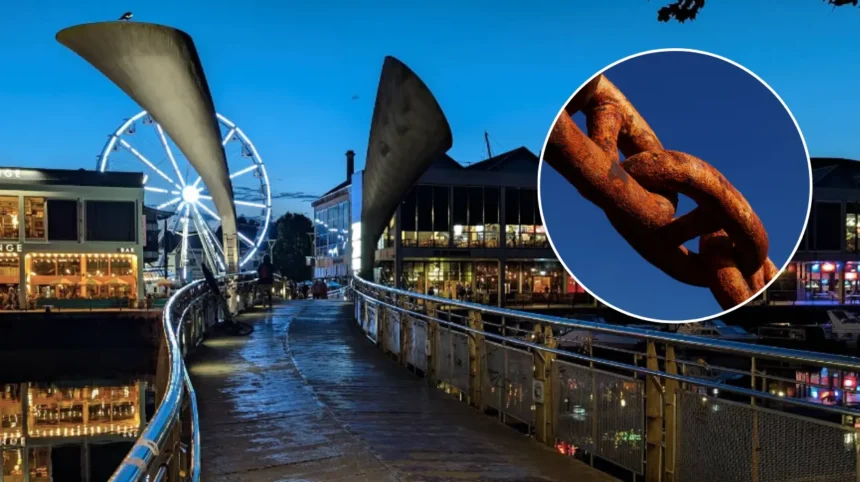
The pedestrian bridge, which links Queen Square and Millennium Square across St Augustine’s Reach outside the Watershed, has been completely fenced off with large wooden hoardings prior to contractors dismantling and removing the structure for extensive repairs.
According to Seabrook, the footbridge originally opened in 1999 and is constructed in three separate sections. The two outer spans remain fixed, while the central bascule section is designed to lift hydraulically to allow vessel traffic to navigate the harbour. However, inspection findings published following a Freedom of Information (FOI) request show that rainwater gradually penetrated the inner mechanisms over a prolonged period due to a lack of waterproof sealant between the topside decking planks.
What Did the Arup Inspection Report Discover Below the Surface?
As detailed by Alex Seabrook of Bristol Live, Bristol City Council commissioned engineering consultancy firm Arup to assess the structure in December 2025 after harbour engineers observed severe signs of deterioration. During previous lifting attempts, harbour personnel had noted a “significant quantity of rust-stained water” pouring from the central section of the bridge.
In the report cited by Seabrook, Arup engineers noted that the presence of rust-stained water indicated that the bridge’s hollow internal sections were not properly sealed during assembly. Water pooling inside the hollow elements acted to “expedite the corrosion of the steelwork,” raising concerns that internal structural damage could be significantly worse than visible surface assessments suggested.
Furthermore, Seabrook highlighted that engineers inspecting the structure from a boat identified “severe corrosion” on the western section of the bridge, on the Millennium Square side. Key findings from the inspection report included:
- Worn Waterproofing: Sealant between the upper timber deck planks had completely worn away, allowing persistent water ingress.
- Structural Instability: Pedestrians and runners using the bridge could feel a noticeable “slight bounce” as they crossed.
- Surface Degradation: Non-slip safety surfacing across the walking area had degraded significantly.
- Seized Components: Hydraulic lifting bearings had completely seized up due to continuous exposure to moisture.
How Did Equipment Flooding Contribute to the Mechanism Failure?
As reported by Alex Seabrook of Bristol Live, the primary lifting apparatus for Pero’s Bridge relies on a hydraulic system, with the power pack and electrical pumps housed inside an underground pit behind the harbour wall. Access to this chamber is via a street-level steel hatch.
The Arup report revealed that groundwater and rainwater regularly entered and flooded the chamber. Although drainage pumps had historically been used to clear water from the pit, inspectors found that the hydraulic power pack was heavily corroded and displayed clear evidence of having been repeatedly submerged in water.
A trial lift conducted by Arup during their December 2025 site visit failed when the mechanism stalled due to seized bearings.
Did Inspectors Warn Council Officers About the Risk of Structural Misalignment?
As Seabrook recorded in his coverage for Bristol Live, the Arup inspection report contained an explicit and prescient warning regarding the exact mechanical failure that ultimately occurred eight months later in August 2026.
The report documented technical feedback from the local harbour engineering team:
“The harbour engineering team explained that if the lift is stopped part way through the lifting arc, the inertia of the bridge combined with the abrupt stop cause the bascule to rock and the rolling beams to jump free from the teeth on the roller track.”
Arup’s consultants cautioned that such an event presented a significant operational hazard, noting:
“This is not witnessed on site but is plausible. There is a potential risk of the bascule span becoming misaligned in such an event, or at worst, losing support.”
This prediction materialised during the August 2026 test lift when the bridge’s middle section jammed mid-motion, coming to rest at a skewed angle and forcing the immediate closure of the pedestrian thoroughfare.
What Is the Timeline for Repairing and Reopening Pero’s Bridge?
As reported by Alex Seabrook of Bristol Live, contractors are currently preparing to fully dismantle the central span and remove it from St Augustine’s Reach for comprehensive off-site restoration.
Initial estimates had hinted at a potential reopening target of March 2027. However, addressing the long-term timeline, Liberal Democrat Councillor Andrew Brown, chair of Bristol City Council’s economy and skills policy committee, provided an official update on the project status.
As quoted by Seabrook, Councillor Andrew Brown stated:
“We understand that the closure of Pero’s Bridge is an inconvenience for people visiting and travelling through the area and that some local businesses are affected.”
“We appreciate everyone’s patience while we take the necessary steps to progress the works needed. When we return the bridge to service, which is planned for spring 2027, it will be fully refurbished with significant upgrades made to how it operates, improving the bridges’ reliability and functionality.”
Explore more Bristol Council News:
Bristol Council Plans Extended Library Hours and Fine Abolition Bristol 2026
Bristol Council Faces Heat Over City Leap Vattenfall Sale 2026
Background of the Particular Development
Pero’s Bridge was constructed in 1999 as part of the extensive regeneration of Bristol’s Floating Harbour and docks area ahead of the millennium. Named in honour of Pero Jones, an enslaved African man who lived in Bristol during the 18th century, the pedestrian footbridge serves as a major architectural feature and key traffic arterial for pedestrians moving between Queen Square, the Watershed arts centre, and Millennium Square.
Designed as a bascule-type drawbridge, its distinctive twin trumpet-shaped counterweights were engineered to allow the central deck to lift vertically, permitting historic boats and commercial pleasure craft to access St Augustine’s Reach.
Over its two decades of operation, the bridge has been subjected to continuous exposure to tidal harbour environments, heavy foot traffic, and severe weather. The gradual breakdown of protective seals and maintenance access points over years of public use culminated in progressive water retention within the hollow structural members, resulting in the mechanical lockup and structural displacement observed during 2026.
How This Development Can Affect Local Stakeholders and the Community
The ongoing closure and prolonged repair schedule for Pero’s Bridge through to spring 2027 will impact several key groups within the Bristol city centre ecosystem:
Impact on Local Businesses and Waterfront Trade
The footbridge acts as a direct pedestrian funnel connecting the bustling public space of Queen Square with the hospitality, cinema, and cultural venues situated along Millennium Square and Canon’s Road (including the Watershed, the We The Curious science centre, and nearby restaurants). The disruption of direct foot traffic forces pedestrians onto longer detour routes around the perimeter of the harbour basin. Local hospitality operators, cafes, and retail establishments along the direct approach corridors may experience reduced spontaneous customer footfall during the extended closure period.
Impact on City Commuters and Pedestrian Mobility
As one of the highest-density pedestrian links across St Augustine’s Reach, the closure disrupts daily commuting paths for thousands of workers, residents, and leisure walkers moving between the city centre, Harbourside residential complexes, and Temple Meads station routes. The requirement to use alternative bridges adds travel time and increases pedestrian congestion on adjacent walkways, particularly during peak rush hours and weekend events.
Financial Implications for Local Governance
With the complete removal, off-site structural rebuilding, replacement of hydraulic power assemblies, and re-installation of the bridge required, Bristol City Council faces substantial capital expenditure. The full remediation plan requires addressing not only the visible mechanical components but also replacing damaged internal steelwork and installing robust waterproofing and drainage systems to prevent recurrence, placing additional demands on municipal infrastructure budgets.