Key Points
- Bristol Waste Company and Bristol City Council have collaborated to support Keep Britain Tidy’s Fight Fly-Tipping Fortnight, which will take place between October 12 and 25, 2026.
- This anti-fly tipping campaign, under the theme of “Don’t Fall for a Rubbish Deal,” informs the citizens about the activities of rogue waste collectors using professional online advertising, fake good reviews and extremely low prices.
- Last year, 11,588 cases of flytipping were registered by the Bristol City Council, a rise of 12 per cent from the previous year.
- It cost Bristol residents £1 million to clean the illegal dumping in the city, with dumped waste comprising fridge freezers, mattresses, sofas, and rubble sacks dumped on the streets and public places.
- Nationwide, local authorities reportedly spent about £150 million clearing up flytipped waste last year.
- As Abi Finch, chair of Bristol City Council’s environment and sustainability committee stated, flytipping affects communities severely and offenders will face fines as well as legal prosecution.
- According to Ricky Gayfer, director of operations at Bristol Waste, everyone needs to share responsibilities and check waste carrier licences, as well as report dumping cases using FixMyStreet.
Bristol (Bristol Express News) October 22, 2026 – Bristol’s council-owned waste operator and local authority have launched a coordinated public campaign to confront escalating illegal waste dumping following a 12 per cent surge in local incidents. The initiative, aligning with Keep Britain Tidy’s national fortnight, cautions residents against fraudulent waste removal services operating online, while highlighting that clear-up operations cost local council taxpayers £1 million annually.
- Key Points
- Why Are Bristol Authorities Launching the ‘Fight Flytipping’ Campaign?
- How Do Rogue Waste Traders Deceive Unsuspecting Residents Online?
- What Are the Exact Financial and Environmental Costs of Flytipping in Bristol?
- How Can Residents Verify Waste Carriers and Report Illegal Dumping?
- Background of the Particular Development
- Impact on the Particular Audience
Why Are Bristol Authorities Launching the ‘Fight Flytipping’ Campaign?
The relentless rise of illegal waste dumping has prompted municipal leaders and waste management professionals to take decisive public action. As reported by Milan Perera of Bristol24/7, Bristol Waste Company and Bristol City Council have combined efforts to support Keep Britain Tidy’s Fight Fly-Tipping Fortnight, a national initiative running from October 12 to 25, 2026.
The core message of the local campaign, titled “Don’t fall for a Rubbish Deal,” is designed to educate residents and property owners on how to avoid hiring unscrupulous operators who illegally discard household and commercial waste. Commenting on the severity of the issue, as reported by Milan Perera of Bristol24/7, Abi Finch stated that
“Fly-tipping has a real impact on communities in Bristol and is a deep source of frustration.”
Expanding on the environmental and social degradation caused by these illegal acts, as reported by Milan Perera of Bristol24/7, Abi Finch further stated that:
“Not only is it a blight on our local environment, with everything from old mattresses dumped in parks, waste piling up on pavements and dangerous items like gas canisters left cluttering lanes, it costs Bristol’s taxpayers thousands in clear-up costs.”
Explore more Bristol Council News
Bristol Lamp Post Flags Drop to 371 After Council Removals 2026
Bristol Plans 200 New E-Scooter and E-Bike Parking Bays to Tackle Pavement Clutter
How Do Rogue Waste Traders Deceive Unsuspecting Residents Online?
The campaign sheds light on the sophisticated tactics employed by illegal operators to trick members of the public into handing over household waste. According to findings highlighted in the report, rogue traders frequently deploy professional-looking online advertisements, fabricate positive customer reviews, and offer suspiciously cheap prices to masquerade as legitimate, licensed waste removal businesses.
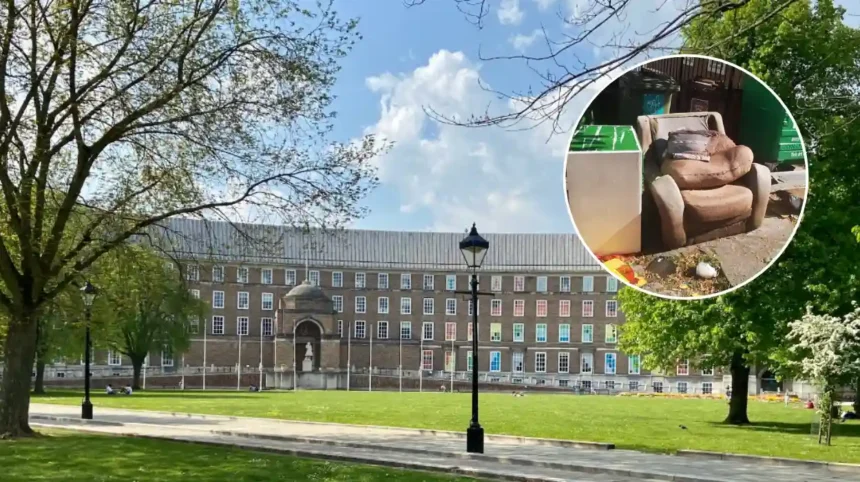
Unsuspecting residents hiring these fake operators often assume their discarded items will be disposed of legally at authorized recycling facilities. Instead, these operators routinely dump the collected refuse in residential streets, public parks, alleys, and pavements across Bristol. The debris left behind encompasses a wide range of bulky household items, including fridge freezers, old mattresses, worn-out sofas, and heavy sacks of building rubble.
What Are the Exact Financial and Environmental Costs of Flytipping in Bristol?
The economic burden of illegal waste dumping on local public finances remains substantial. Official data cited in the report reveals that Bristol City Council recorded 11,588 flytipping incidents throughout 2025, marking a significant 12 per cent increase from the preceding year.
Consequently, the physical removal and disposal of this illegally dumped waste cost Bristol’s council taxpayers £1 million last year alone. This local financial strain mirrors a broader national crisis. As detailed in the coverage, local authorities across the United Kingdom spent an estimated £150 million clearing up flytipping over the same period—funds that municipal leaders argue could otherwise have been directed toward essential public services such as schools, local parks, hospitals, and adult social care.
Addressing the council’s enforcement stance, as reported by Milan Perera of Bristol24/7, Abi Finch noted:
“We know clean streets are important to the residents of Bristol, so we’re taking decisive action against this unacceptable behaviour and will investigate the evidence available, issuing a fixed penalty notice or taking an offender to court when there is a clear link to who is responsible.”
How Can Residents Verify Waste Carriers and Report Illegal Dumping?
To counter the proliferation of illegal waste disposal, waste management executives are urging every resident to exercise due diligence before hiring third-party clearance services. The campaign advises citizens to explicitly ask waste removal firms to present a valid waste carrier licence, verify its authenticity on the Environment Agency’s public register, and demand an official receipt for the transaction.
Operational leaders have stressed that community vigilance and swift reporting mechanisms are vital components in intercepting flytippers. As reported by Milan Perera of Bristol24/7, Ricky Gayfer stated that:
“Fly-tipping is a growing issue, and we welcome Bristol City Council’s clear focus on tackling it.”
Elaborating on operational responses, as reported by Milan Perera of Bristol24/7, Ricky Gayfer added:
“With dedicated fly-tip resource, a rapid response through FixMyStreet and close working with enforcement officers, we’re acting on what residents tell us.”
Emphasizing individual accountability, as reported by Milan Perera of Bristol24/7, Ricky Gayfer concluded:
“But everyone has a role to play: check your waste carrier is licensed and report dumping through FixMyStreet.”
Background of the Particular Development
The launch of the “Don’t fall for a Rubbish Deal” campaign in October 2026 arrives against a backdrop of escalating tensions between urban residents and local authorities regarding municipal waste management, recycling centre accessibility, and street cleanliness. Over recent years, cities across England have grappled with legislative and financial pressures affecting local authority budgets, leading to increased scrutiny over public realm maintenance.
Bristol has experienced consecutive years of rising illegal dumping cases, culminating in 11,588 recorded incidents in 2025 and a £1 million annual cleanup bill. Environmental charities such as Keep Britain Tidy have consistently lobbied for stricter enforcement of household waste duty of care laws, which legally obligate residents to ensure that anyone taking away their household waste is authorized to do so. Failure to verify a waste carrier can result in hefty fines for homeowners if their waste is subsequently found dumped illegally, establishing the legal and civic framework that necessitated the current fortnight-long educational push by Bristol Waste and Bristol City Council.
Impact on the Particular Audience
For Bristol residents, local taxpayers, and property owners, this intensified enforcement and public awareness campaign is projected to yield both short-term adjustments and long-term behavioural changes. In the immediate future, heightened public scrutiny and streamlined reporting via FixMyStreet are expected to accelerate council response times for clearing reported blackspots, reducing the visibility of dumped waste in local neighbourhoods.
However, the campaign’s success hinges on whether everyday citizens consistently adopt the habit of checking Environment Agency registers before employing waste contractors. If successful, the initiative could significantly reduce rogue trader activity, thereby saving the local authority hundreds of thousands of pounds in clearance expenditures that can be reinvested into core public services. Conversely, if enforcement officers ramp up investigations and issue fixed penalty notices linked to traceable household waste found in flytipped piles, careless residents who fail to verify their waste handlers may face unexpected legal penalties and financial fines, driving home the personal legal responsibility associated with household waste disposal across the city.