Key Points
- Bristol City Council has issued a cease-and-desist letter to the person it believes is the city’s most prolific flag erector.
- Councillor Stephen Williams said the letter is the first stage of a potential legal process.
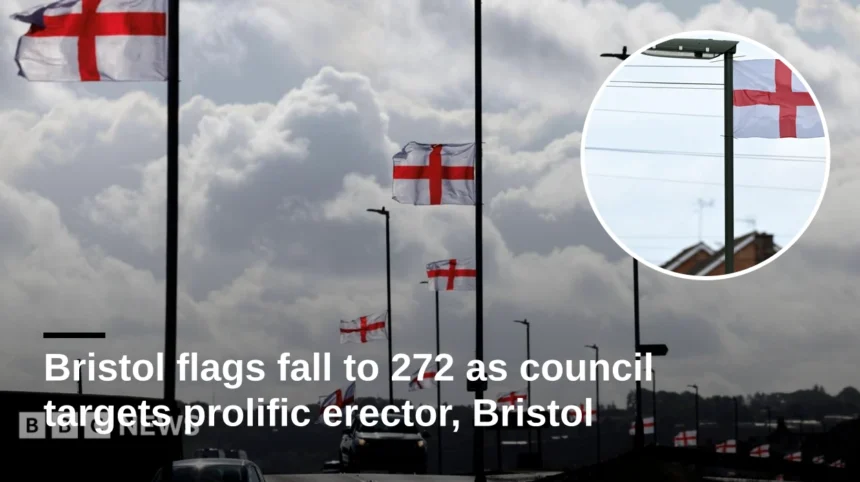
- There were 272 flags on Bristol lamp-posts in November, down from more than 1,000 in June.
- Birmingham City Council has secured an interim High Court injunction covering unauthorised flag attachments to public infrastructure.
- Bristol’s legal action concerns flags on public lamp-posts and does not prohibit displays on private property.
Bristol (Bristol Expess News) November 24, 2026 – Bristol City Council has issued a cease-and-desist letter to the person it believes, alongside Avon and Somerset Police, has erected the most flags on public lamp-posts across the city. Liberal Democrat councillor Stephen Williams said the notice is the first stage of possible legal action. The move follows a reduction in flags from more than 1,000 in June to 272 in November, while concerns remain about unauthorised attachments to highway structures.
- Key Points
- Why has Bristol City Council issued a legal warning?
- How many flags remain on Bristol lamp-posts?
- What legal precedent is Bristol following?
- What does the law say about attaching flags?
- Background: how did the flag displays develop?
- What could the Bristol action mean for legal action affecting flag activists?
Why has Bristol City Council issued a legal warning?
As reported by BBC News on November 24, Councillor Stephen Williams confirmed that Bristol City Council had sent a cease-and-desist letter to the individual believed to be responsible for the highest number of flag installations on public lamp-posts.
“I can now confirm that we have sent a cease and desist letter,” Stephen Williams said, describing it as “the first stage of the legal process”.
According to Bristol Live, Williams told councillors at a Public Health and Communities Policy Committee meeting on November 20 that he and Bristol City Council leader Tony Dyer had lost patience with a gradual approach to the issue.
The individual has not been publicly named. The council’s action follows concerns about flags being attached to public infrastructure without highway authority consent.
How many flags remain on Bristol lamp-posts?
BBC News and Bristol Live reported that the latest November count recorded 272 flags on lamp-posts across Bristol, compared with more than 1,000 in June. Most wards recorded reductions, although Hengrove and Whitchurch were reported as exceptions.
More than 2,000 people previously petitioned Bristol City Council to remove the flags immediately. The petitioners said the displays reflected growing anti-immigrant sentiment associated with protests against asylum hotels. Those claims are attributed to the petitioners and do not establish that every flag display had the same purpose.
What legal precedent is Bristol following?
Bristol City Council’s action follows developments in Birmingham. BBC News reported that Birmingham City Council secured an interim High Court injunction on November 18 against Ryan Bridge, Ben Cullen and people unknown who attach unauthorised flags or other items to street furniture and highway infrastructure.
Birmingham City Council said a breach of the sealed order could result in imprisonment for up to two years, a fine or seizure of assets for contempt of court. The order applies to unauthorised attachments to public infrastructure and does not prevent residents from displaying flags on private property.
The Birmingham order also restricts associated conduct, including encouraging others to attach flags or interfering with contractors removing unauthorised items. Its geographical scope is Birmingham and it is not a court order against Bristol residents.
What does the law say about attaching flags?
BBC News reported that the Highways Act 1980 makes it an offence to affix items to structures on the highway without the highway authority’s consent. Bristol City Council has not announced that it has obtained an injunction or begun court proceedings against the unnamed Bristol individual.
Background: how did the flag displays develop?
Flags began appearing across cities and towns in 2025 as activists described the displays as expressions of patriotism. In Bristol, the number of flags later exceeded 1,000 before falling to 272 by November.
Bristol City Council said it had spent about £50,000 removing flags by August and warned that continued unauthorised installations could lead to serious legal consequences.
The issue has been linked by petitioners to protests against asylum hotels and concerns about anti-immigrant sentiment, although the council’s legal action is focused on attachments to public infrastructure.
Birmingham’s High Court injunction has provided a recent example of a council seeking court protection against unauthorised flag installations.
What could the Bristol action mean for legal action affecting flag activists?
The cease-and-desist letter places the unnamed Bristol individual on formal notice before any potential court application. If further flags are erected and the council can establish responsibility and a legal basis, Bristol City Council could consider additional enforcement or civil proceedings.
The Birmingham case shows that a council may seek an injunction restricting unauthorised attachments, encouragement and interference with removal work. However, Birmingham’s order does not automatically apply in Bristol, and Bristol City Council has not confirmed that it will seek identical terms.
For people involved in installing flags on Bristol lamp-posts, the immediate issue is whether they have highway authority consent. Displays on private property remain legally distinct from attachments to public street furniture.