Bristol is internationally recognised as the hometown of Banksy, the anonymous British street artist whose politically charged murals transformed public walls into globally recognised works of art. Banksy locations in Bristol attract visitors, photographers, street art enthusiasts and cultural researchers interested in the artist’s early career and the city’s creative identity.
- What Is the History of Banksy’s Street Art in Bristol?
- How Did Bristol Influence Banksy’s Artistic Development?
- Why Is Bristol Important to Banksy’s Legacy?
- Where Can Visitors See The Mild Mild West in Bristol?
- Where Is Banksy’s Well Hung Lover Located in Bristol?
- Where Can You Find Girl with a Pierced Eardrum in Bristol?
- What Makes the Harbourside Location Important?
- How Can Visitors Photograph Girl with a Pierced Eardrum?
- Where Is Banksy’s Grim Reaper Displayed in Bristol?
- Where Can Visitors See Banksy’s Paint-Pot Angel in Bristol?
- Where Was Banksy’s Valentine’s Day Mural Created in Bristol?
- Why Is Barton Hill Connected with Banksy’s History?
- What Should Visitors Know Before Visiting Marsh Lane?
- Where Was Banksy’s Aatchoo Mural Located in Bristol?
- Where Can Visitors Find Banksy’s Police Sniper in Bristol?
- How Can Visitors Explore Banksy Locations on a Bristol Walking Tour?
- Why Have Some Banksy Artworks in Bristol Been Removed or Protected?
- What Is the Difference Between Preserved and Outdoor Banksy Art?
- How Does Vandalism Affect Banksy’s Murals?
- Why Is Street Art Conservation Important?
- How Has Banksy Influenced Bristol’s Wider Street Art Culture?
- Why Is Stokes Croft Important to Bristol Street Art?
- What Is Upfest in Bedminster?
- What Is Nelson Street Known For?
- How Many Banksy Artworks Are Located in Bristol?
- What Should Visitors Know Before Visiting Banksy’s Locations in Bristol?
- Are Banksy’s Bristol Murals Free to Visit?
- Can Visitors Photograph Banksy’s Artworks?
- Are Guided Banksy Tours Available?
- What Is the Best Time to Explore Bristol’s Street Art?
- Why Are Banksy’s Bristol Locations Important to the City’s Tourism?
- How Does Banksy Attract International Visitors?
- How Do Banksy’s Locations Support Local Culture?
- What Is the Future of Banksy’s Bristol Artworks?
- Where Should Visitors Start Exploring Banksy Locations in Bristol?
The city’s Banksy artwork includes famous murals such as The Mild Mild West, Well Hung Lover and Girl with a Pierced Eardrum. These works appear across different neighbourhoods, including Stokes Croft, Park Street, Bristol Harbourside and Hanover Place. Their locations connect Banksy’s artistic development with Bristol’s music, graffiti and independent cultural scenes.
Exploring Banksy’s Bristol locations provides insight into the relationship between street art, urban identity, public space and cultural preservation. Some original murals remain visible, while others have suffered damage, been removed or received protective treatment. Understanding their history helps visitors distinguish surviving artworks from historic locations that no longer display the original piece.
What Is the History of Banksy’s Street Art in Bristol?
Banksy’s Bristol street art developed during the 1990s and early 2000s, when the artist emerged from the city’s underground graffiti culture. His stencil-based technique, political commentary and distinctive visual language established Bristol as a central location in his early artistic career.
Banksy is an anonymous British street artist associated with stencil graffiti, political satire and public interventions. His identity remains publicly unconfirmed, although Bristol is widely recognised as his hometown and the location of several important early works.
Bristol already had an established graffiti culture before Banksy became internationally famous. The city’s music venues, independent creative communities, alternative publications and urban environments provided an active setting for graffiti artists during the late twentieth century.
Banksy initially worked within the freehand graffiti tradition. He later developed stencil techniques that allowed him to produce recognisable images more quickly. Stencils also helped him create detailed compositions with consistent outlines and strong contrasts.
The artist’s early work frequently addressed political authority, consumerism, militarism, inequality and social behaviour. His visual approach combined familiar everyday objects, animals, police officers and children with unexpected situations.
How Did Bristol Influence Banksy’s Artistic Development?
Bristol’s underground music and graffiti scenes influenced the development of Banksy’s visual identity. The city had strong connections with trip-hop, sound-system culture, independent art spaces and experimental street culture.
The Stokes Croft neighbourhood became particularly important to Bristol’s alternative creative identity. Its independent businesses, music venues, community spaces and street murals established an environment where graffiti and public art became visible parts of everyday urban life.
Banksy’s association with Bristol also connects with the DryBreadZ Crew, commonly abbreviated as DBZ. This graffiti collective formed part of the city’s wider graffiti scene during the 1990s.
Why Is Bristol Important to Banksy’s Legacy?
Bristol provides an important historical setting for understanding Banksy’s development before his international recognition. The surviving murals demonstrate how his visual language evolved through public experimentation and engagement with urban environments.
The city also demonstrates the challenges of preserving street art. Unlike paintings displayed in museums, outdoor murals face weather damage, redevelopment, vandalism and disagreements about ownership.
Banksy’s Bristol artworks therefore have two forms of significance: their artistic value and their connection with the city’s social and cultural history.
Where Can Visitors See The Mild Mild West in Bristol?
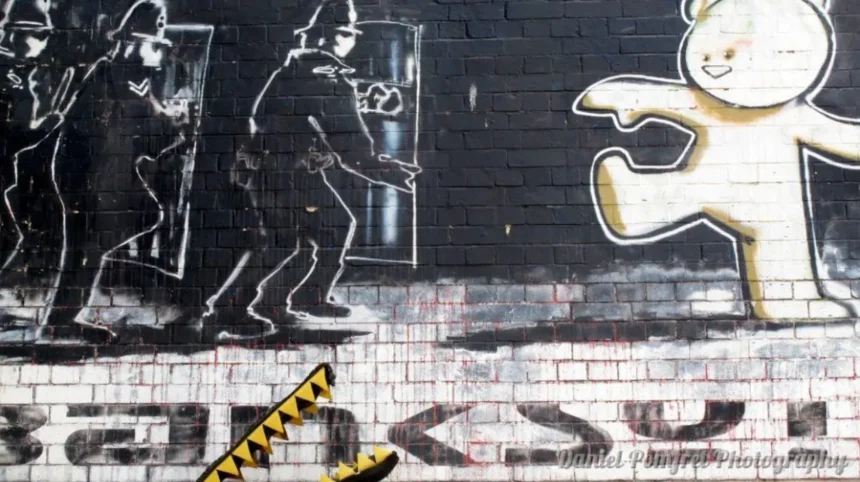
The Mild Mild West is located at 80 Stokes Croft, Bristol, BS1 3QY. Painted in 1999, this famous mural depicts a teddy bear throwing a Molotov cocktail towards three riot police officers. It remains one of Bristol’s most recognisable Banksy artworks.
The Mild Mild West is situated in Stokes Croft, a neighbourhood north of Bristol city centre known for independent businesses, alternative culture and street art. The mural occupies a prominent exterior wall and is visible from the surrounding street.
The artwork presents an unusual confrontation between a soft toy and armed police officers. The teddy bear holds a bottle representing a Molotov cocktail, while three riot police officers stand opposite it with protective equipment.
Banksy created the mural in 1999. Its imagery is commonly associated with tensions surrounding police responses to unlicensed parties and underground rave culture in Bristol during the 1990s.
What Does The Mild Mild West Represent?
The mural explores the relationship between authority, protest and public resistance. The teddy bear represents an apparently harmless character placed in a confrontational situation.
The contrast between the toy and riot police creates political satire. It questions the scale of police responses to gatherings and challenges conventional representations of authority.
The artwork also reflects Bristol’s alternative cultural identity. Stokes Croft became associated with independent music, graffiti, community activism and creative experimentation.
How Can Visitors Find The Mild Mild West?
Visitors can reach the mural by walking from Bristol city centre towards Stokes Croft. The artwork is close to independent shops, cafés and The Canteen, a popular cultural and hospitality venue.
Stokes Croft is also a suitable starting point for exploring other Bristol street art. The surrounding streets contain works by local and international artists, making the neighbourhood an important destination beyond Banksy’s original mural. The official Visit Bristol guide identifies The Mild Mild West as one of the city’s principal Banksy attractions.
Where Is Banksy’s Well Hung Lover Located in Bristol?
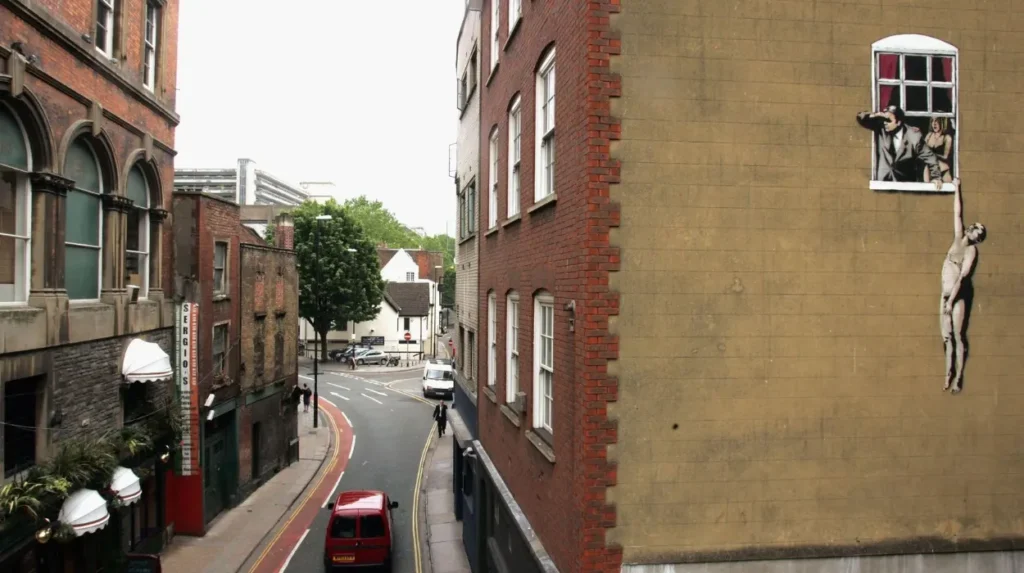
Banksy’s Well Hung Lover is painted on a building overlooking Frogmore Street, Bristol, BS1 5NA. Visitors can see the artwork from the pedestrian bridge on Park Street. Created in 2006, it is one of the artist’s best-known Bristol murals.
Well Hung Lover is one of the most photographed Banksy locations in Bristol. The mural features a naked man hanging from a window ledge while a suited man looks out from a nearby window. A woman stands beside him.
The composition suggests a confrontation involving an affair and a suspicious partner. The hanging figure creates the central visual joke, while the other characters establish the implied relationship.
The artwork uses a real architectural feature as part of its composition. This integration between the painted figures and the building creates the impression that the scene extends beyond the wall.
Why Is Well Hung Lover Significant?
Well Hung Lover is significant because it became an important example of the relationship between street art and public acceptance.
The mural appeared in 2006 and attracted considerable attention because of its subject matter and prominent location. Its presence generated discussion about whether unauthorised graffiti should be preserved when it becomes culturally significant.
The work also experienced vandalism. Paint was thrown over parts of the original composition, changing its appearance. The remaining artwork still provides an opportunity to understand Banksy’s original design and the challenges associated with outdoor conservation.
What Is the Best Viewing Point for Well Hung Lover?
The pedestrian bridge connecting the Park Street area provides the most useful viewing position. Visitors can look towards the building on Frogmore Street and see the mural from an elevated angle.
Park Street itself is a major shopping and cultural route connecting the city centre with the Clifton area. Visitors can combine the mural with nearby College Green, Bristol Cathedral and Bristol Museum & Art Gallery.
The artwork is free to view from public space. Visitors should remain on pedestrian routes and avoid obstructing traffic while photographing it.
Visit Bristol identifies Frogmore Street as the mural’s location and the Park Street bridge as its principal viewing point.
Where Can You Find Girl with a Pierced Eardrum in Bristol?
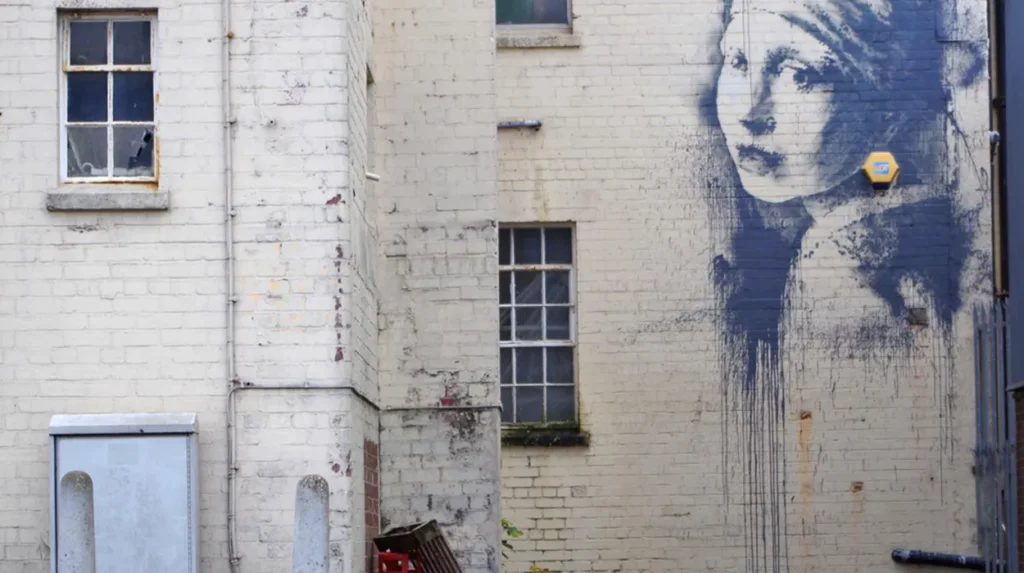
Girl with a Pierced Eardrum is located at Hanover Place, Bristol, BS1 6UT, near Albion Dockyard on the Harbourside. Banksy created this mural in 2014, adapting Johannes Vermeer’s famous painting Girl with a Pearl Earring.
Girl with a Pierced Eardrum is one of Banksy’s most recognisable Bristol artworks because it reinterprets a famous historical painting through contemporary street art.
The original inspiration is Girl with a Pearl Earring, a seventeenth-century painting by Dutch artist Johannes Vermeer. Vermeer’s work depicts a young woman wearing a large pearl earring.
Banksy’s version replaces the traditional jewellery with an existing security alarm mounted on the building. This real object becomes part of the painted composition.
The mural demonstrates how Banksy incorporates surrounding architectural details into his artwork. Rather than simply reproducing a famous painting, he changes its visual meaning through an unexpected modern object.
What Makes the Harbourside Location Important?
Hanover Place is situated near Bristol’s historic harbour and Albion Dockyard. The surrounding area combines maritime heritage, converted industrial buildings, museums, restaurants and waterfront walkways.
The location connects the mural with Bristol’s history as an important port city. Its industrial surroundings provide a contrasting background to the artwork’s reference to classical European painting.
Visitors exploring the Harbourside can also visit M Shed, Bristol’s city history museum, and walk along the waterfront.
How Can Visitors Photograph Girl with a Pierced Eardrum?
The mural is visible from the surrounding public area, although access arrangements and nearby barriers can affect the viewing angle.
The best approach is to walk towards Hanover Place from the Harbourside and observe the building’s exterior. Visitors should avoid entering restricted property or attempting to touch the painted surface.
The official Visit Bristol attraction listing confirms the Hanover Place address and identifies the artwork’s connection with Vermeer’s painting.
Where Is Banksy’s Grim Reaper Displayed in Bristol?
Banksy’s Grim Reaper is displayed at M Shed museum on Bristol’s Harbourside. The artwork originally appeared on the hull of Thekla, a former cargo ship converted into a music venue. It was transferred indoors to protect it from environmental deterioration.
The Grim Reaper is another important part of Bristol’s Banksy history. The artwork originally appeared on Thekla, a ship permanently associated with Bristol’s alternative music and nightlife culture.
The painting depicts the Grim Reaper, a traditional personification of death, inside a bumper car. Its unusual subject combines familiar imagery with an unexpected modern setting.
Thekla operated as a music venue and became an established part of Bristol’s cultural landscape. The ship’s connection with alternative music made it a fitting location for Banksy’s provocative artwork.
Why Was the Grim Reaper Removed from Thekla?
The original outdoor position exposed the painting to weather, moisture and other environmental risks. These conditions threatened the preservation of the artwork.
The decision to remove it allowed the original painted section to receive protection in a museum environment.
The Grim Reaper is now displayed at M Shed, where visitors can view it as part of Bristol’s cultural heritage.
What Can Visitors Explore at M Shed?
M Shed is a museum dedicated to the history of Bristol and its people. Its collections explore the city’s maritime, industrial, social and cultural development.
Visitors can combine the Banksy artwork with exhibitions covering Bristol’s docks, transport, working communities and historical industries.
M Shed is particularly relevant because the Grim Reaper demonstrates how contemporary street art becomes part of the city’s museum collections. The work is no longer simply an outdoor mural; it is also a preserved cultural object.
Where Can Visitors See Banksy’s Paint-Pot Angel in Bristol?
Banksy’s Paint-Pot Angel is displayed in the ground-floor entrance hall of Bristol Museum & Art Gallery on Queens Road. The sculpture was created for the artist’s 2009 exhibition and remains an accessible example of his work inside a public museum.
Paint-Pot Angel differs from Banksy’s outdoor murals because it is a three-dimensional installation rather than a traditional wall stencil.
The artwork features an angel figure with a paint pot placed over its head. The combination of classical sculpture and graffiti equipment creates a visual reference to the relationship between established art institutions and street culture.
Its museum setting is significant. Banksy began his career in an environment where graffiti existed outside traditional galleries. The 2009 exhibition brought his work directly into one of Bristol’s established cultural institutions.
What Happened During Banksy Versus Bristol Museum?
Banksy Versus Bristol Museum opened in June 2009 at Bristol Museum & Art Gallery. The exhibition included more than 100 artworks and installations.
The exhibition was organised under strict confidentiality before its opening. It attracted substantial national and international attention and brought large visitor numbers to the museum.
The exhibition combined traditional artistic formats with Banksy’s unconventional approach. It included installations, paintings, sculptures and satirical objects.
Paint-Pot Angel became one of the lasting physical reminders of the exhibition.
Where Is Bristol Museum & Art Gallery?
Bristol Museum & Art Gallery is located on Queens Road in Clifton, close to Park Street and the University of Bristol.
Its collections cover art, archaeology, natural history and world cultures. Visitors can include the museum in a wider Banksy walking route that also covers Well Hung Lover.
The museum’s official visitor information lists Banksy’s Paint Pot Angel among the ground-floor displays.
Where Was Banksy’s Valentine’s Day Mural Created in Bristol?
Banksy’s Valentine’s Day mural appeared on Marsh Lane in Barton Hill, east Bristol, in February 2020. The artwork depicts a young girl firing red flowers from a catapult. It became widely recognised for its connection with Valentine’s Day and its use of floral imagery.
Valentine’s Day is an important example of Banksy’s later work in his hometown. The mural appeared shortly before Valentine’s Day in February 2020.
The image shows a girl using a catapult to launch a collection of red flowers. The flowers spread across the wall and create a strong contrast with the surrounding building.
The composition combines a familiar image of childhood play with an unusual visual action. The red flowers connect the artwork with romance, affection and the symbolism associated with Valentine’s Day.
Why Is Barton Hill Connected with Banksy’s History?
Barton Hill is an area in east Bristol with a strong community identity and a history of working-class neighbourhood development.
The Valentine’s Day mural appeared close to a youth club associated with Banksy’s younger years. This connection strengthened public interest in the artwork because it linked his later success with his early life in Bristol.
The mural also demonstrated that Banksy’s relationship with Bristol extended beyond the well-known central locations.
What Should Visitors Know Before Visiting Marsh Lane?
Visitors should check the artwork’s current visibility and access before making a dedicated journey. Residential street art does not have the same visitor infrastructure as a museum attraction.
Respecting residents, avoiding private property and keeping public pathways clear are important when viewing the location.
The mural’s original appearance is documented in photographs and reporting, while the official Visit Bristol guide records its 2020 appearance on Marsh Lane.
Where Was Banksy’s Aatchoo Mural Located in Bristol?
Banksy’s Aatchoo mural appeared on Vale Street in Totterdown, Bristol, in December 2020. It depicted an elderly woman sneezing so forcefully that her dentures and personal belongings appeared to fly through the air. The original artwork has since been removed.
Aatchoo became one of Banksy’s most discussed Bristol artworks because of its unusual location and visual humour.
The mural appeared on a residential building on Vale Street, a steep street in Totterdown. The composition showed an elderly woman sneezing, with the force of the sneeze exaggerating the movement of objects around her.
The artwork used a familiar everyday experience to create a humorous visual scene. Its title referred to the sound associated with sneezing.
Why Did Banksy Choose Vale Street?
Vale Street is known for its steep gradient and distinctive residential environment. Its unusual slope provided an opportunity to incorporate the physical landscape into the artwork.
The mural attracted attention from residents, visitors and media organisations shortly after its appearance.
However, the artwork was subsequently removed. Visitors should therefore treat Vale Street as a historical Banksy location rather than a guaranteed place to see an original surviving mural.
The original work remains relevant to Bristol’s street art history because it demonstrates Banksy’s continued use of his hometown as a location for new public artwork.
Where Can Visitors Find Banksy’s Police Sniper in Bristol?
Banksy’s Police Sniper is associated with Park Row, close to Park Street and the Bristol Royal Infirmary. The artwork is another example of the artist’s use of police imagery and public architecture to explore authority, surveillance and urban life.
Park Row is located in central Bristol, within walking distance of Bristol Museum & Art Gallery, Park Street and the University of Bristol.
The Police Sniper artwork is particularly relevant to Banksy’s recurring interest in policing and public authority. Police officers appear in several of his works, often in situations that challenge traditional representations of law enforcement.
The mural also adds another location to Bristol’s wider Banksy trail. Visitors exploring Park Street can combine the area with Well Hung Lover and Paint-Pot Angel.
The current Visit Bristol street art guide identifies Police Sniper as a Banksy work associated with Park Row. Visitors should check its present visibility before making a separate journey.
How Can Visitors Explore Banksy Locations on a Bristol Walking Tour?
Visitors can explore Bristol’s main Banksy locations through a self-guided walking route connecting Frogmore Street, Stokes Croft, Hanover Place and the city’s museums. The route combines surviving outdoor murals with preserved indoor artworks and historical locations.
A self-guided Banksy walking tour provides a practical way to understand the relationship between the artist and Bristol’s urban environment.
The route can begin in central Bristol and extend towards Stokes Croft and the Harbourside. Visitors can also include museum displays to see works that have been moved indoors.
Which Banksy Locations Should Visitors Include?
A useful route includes the following locations:
- Well Hung Lover, Frogmore Street: Start near Park Street and view the mural from the pedestrian bridge.
- Paint-Pot Angel, Bristol Museum & Art Gallery: Visit the museum on Queens Road to see the preserved installation.
- Police Sniper, Park Row: Explore the surrounding streets near the Bristol Royal Infirmary.
- The Mild Mild West, Stokes Croft: Continue towards the famous teddy bear mural.
- Girl with a Pierced Eardrum, Hanover Place: Finish at the Harbourside near Albion Dockyard.
- The Grim Reaper, M Shed: Visit the museum to see the preserved artwork originally displayed on Thekla.
How Long Does a Banksy Walking Tour Take?
The time required depends on the number of locations included, museum opening hours and walking speed.
A shorter outdoor-focused visit can cover the central murals in approximately two hours. A more comprehensive experience including Stokes Croft, the Harbourside and museum collections requires a longer half-day visit.
The route is suitable for visitors interested in photography, contemporary art, Bristol history and independent cultural spaces.
The official Visit Bristol tourism website also provides information about self-guided Banksy trails, street art tours and dedicated audio experiences.
Why Have Some Banksy Artworks in Bristol Been Removed or Protected?
Banksy’s outdoor artworks face deterioration from weather, pollution, vandalism and building maintenance. Bristol has preserved some important works in museums, including the Grim Reaper and Paint-Pot Angel, while other original murals remain exposed to outdoor conditions.
Street art is different from conventional museum painting because it frequently exists on buildings that were not originally designed to display permanent artworks.
Rain, wind, sunlight and temperature changes gradually affect painted surfaces. Human activity also creates preservation challenges through graffiti, deliberate damage and unauthorised alterations.
What Is the Difference Between Preserved and Outdoor Banksy Art?
Outdoor artworks remain attached to their original architectural locations. Well Hung Lover, The Mild Mild West and Girl with a Pierced Eardrum are examples of famous Bristol works associated with their original outdoor settings.
Museum-preserved works are removed from their original surroundings or displayed in controlled indoor environments. The Grim Reaper demonstrates this approach because its painted section was removed from Thekla and transferred to M Shed.
Paint-Pot Angel is another example of Banksy’s work displayed within a museum.
How Does Vandalism Affect Banksy’s Murals?
Vandalism changes the original appearance and historical condition of street art. Well Hung Lover experienced paint damage, which affected parts of its composition.
Some Banksy artworks have also received protective barriers or other conservation measures. These interventions help reduce physical contact and damage but can influence how visitors experience the original artwork.
Why Is Street Art Conservation Important?
Conservation protects artworks that contribute to local identity and cultural history. Banksy’s Bristol murals have become part of the city’s international reputation.
Preservation also creates questions about ownership, public access and the responsibilities of property owners. An artwork painted on a private building can become a major tourist attraction, creating competing interests between residents, owners, visitors and cultural organisations.
The transfer of the Grim Reaper to M Shed illustrates how a temporary outdoor artwork can become a preserved museum object.
How Has Banksy Influenced Bristol’s Wider Street Art Culture?
Banksy helped establish Bristol’s international reputation as a centre of street art, but the city’s creative culture extends beyond his work. Neighbourhoods such as Stokes Croft, Bedminster and Nelson Street display murals by numerous local and international artists.
Bristol’s street art culture includes graffiti, stencil art, large-scale murals, commissioned public artworks and community-led creative projects.
Banksy’s international success increased attention towards the city’s existing graffiti culture. However, Bristol’s contemporary street art scene includes artists with independent styles, techniques and subject matter.
Why Is Stokes Croft Important to Bristol Street Art?
Stokes Croft is one of Bristol’s best-known street art neighbourhoods. Its streets contain murals, independent creative businesses, music venues and community spaces.
The Mild Mild West is an important attraction in this area, but visitors can also discover work by other artists.
Stokes Croft demonstrates how street art contributes to neighbourhood identity and local cultural activity.
What Is Upfest in Bedminster?
Upfest is a major street art festival based in the Bedminster area of south Bristol. It brings artists together to create large-scale public murals and celebrate contemporary urban art.
North Street and the surrounding streets contain numerous works produced through festival activity.
Upfest provides an important opportunity to understand the development of Bristol’s street art beyond Banksy’s original murals. Its international participation also connects Bristol with wider urban art communities.
What Is Nelson Street Known For?
Nelson Street became an important location for large-scale street art through the See No Evil project.
The project brought artists together to decorate buildings in central Bristol with extensive murals. It helped establish the area as a major destination for visitors interested in contemporary public art.
These locations demonstrate that Bristol’s street art identity does not depend on a single artist. Banksy is an important part of its history, while the wider creative community continues to shape its streets.
How Many Banksy Artworks Are Located in Bristol?
VisitBritain identifies approximately 10 to 12 original Banksy street artworks in Bristol. However, the number of murals visitors can actually see is lower because some works have been removed, damaged, relocated or preserved inside museums.
The number of Banksy artworks associated with Bristol depends on the definition used. A complete historical count includes original works that no longer exist, while a visitor-focused count considers only accessible surviving artworks.
The distinction is important for anyone planning a Banksy sightseeing route.
Which Banksy Works Are Still Important to Bristol’s Art History?
The best-known works include:
- The Mild Mild West in Stokes Croft.
- Well Hung Lover on Frogmore Street.
- Girl with a Pierced Eardrum at Hanover Place.
- The Grim Reaper at M Shed.
- Paint-Pot Angel at Bristol Museum & Art Gallery.
- Valentine’s Day on Marsh Lane, Barton Hill.
- Aatchoo on Vale Street, Totterdown, as a historical location.
- Police Sniper near Park Row.
These examples include both surviving works and locations associated with artworks that are no longer available in their original outdoor form.
Why Do Artwork Counts Differ?
Different sources use different criteria when documenting Banksy’s work. Some include removed murals, while others count only original pieces that remain visible.
Attribution also affects historical records. Not every stencil or graffiti image associated with Banksy’s style has been officially confirmed as his work.
For visitors, the most reliable approach is to distinguish between original surviving murals, museum-preserved pieces and historical locations.
VisitBritain’s guide provides an approximate figure of 10–12 original Bristol works, rather than a definitive number of currently viewable murals.
What Should Visitors Know Before Visiting Banksy’s Locations in Bristol?
Visitors should check artwork visibility, museum opening hours, access restrictions and local conditions before exploring Banksy locations. Most famous outdoor murals can be viewed without an admission ticket, while museum displays depend on individual venue opening arrangements.
Bristol’s Banksy attractions are spread across several neighbourhoods. Planning a route reduces unnecessary travel and makes it easier to visit both outdoor and indoor artworks.
Are Banksy’s Bristol Murals Free to Visit?
The principal outdoor murals are visible from public streets and do not require admission tickets. Visitors can photograph accessible works without purchasing museum or gallery entry.
However, indoor displays such as Paint-Pot Angel and the Grim Reaper are located within museums. Visitors should check the relevant museum’s opening information before travelling.
Can Visitors Photograph Banksy’s Artworks?
Photography is generally possible from public viewing areas. Visitors should respect surrounding residents, businesses and pedestrians.
Some murals are located on private buildings. Their visibility from public space does not grant permission to enter the property or touch the artwork.
Are Guided Banksy Tours Available?
Bristol offers guided street art experiences and self-guided routes. Guided tours provide information about the city’s graffiti history, Banksy’s artistic development and other local artists.
Self-guided routes are suitable for visitors who prefer to explore independently.
What Is the Best Time to Explore Bristol’s Street Art?
Daytime visits provide better natural light for viewing murals and photographing details. Museum visits should be planned around published opening hours.
Visitors should also consider the weather because Bristol’s outdoor artworks are exposed to changing conditions throughout the year.
Explore More Area Guide
Street Art in Bristol: Banksy, Murals and Famous Art Locations
Independent Galleries in Bristol: Best Art Spaces to Explore
Why Are Banksy’s Bristol Locations Important to the City’s Tourism?
Banksy’s Bristol locations contribute to the city’s cultural tourism, international recognition and creative identity. They attract visitors interested in contemporary art, urban history and independent culture, while supporting wider exploration of neighbourhoods, museums and public spaces.
Banksy’s influence extends beyond individual murals. His work has helped establish Bristol as an internationally recognised destination for street art.
Visitors travel to Bristol to see the original artworks and understand the cultural environment that influenced the artist. This interest also benefits nearby attractions, independent businesses, cafés and cultural venues.
How Does Banksy Attract International Visitors?
Banksy’s international reputation creates demand for authentic locations associated with his early career.
Visitors interested in contemporary art frequently include Bristol in their cultural travel plans. The city’s connection with Banksy provides an opportunity to explore original street art rather than viewing reproductions in galleries or online collections.
How Do Banksy’s Locations Support Local Culture?
Banksy’s murals contribute to Bristol’s public art identity. They encourage visitors to explore neighbourhoods outside traditional tourist attractions.
Stokes Croft, Bedminster and the Harbourside demonstrate how public art connects with independent businesses, creative communities and local heritage.
The wider street art scene also creates opportunities for emerging artists to display their work and participate in community projects.
What Is the Future of Banksy’s Bristol Artworks?
The future of Banksy’s Bristol artworks depends on conservation, property decisions and public interest.
Outdoor murals require ongoing attention because their condition changes over time. Museum preservation provides a way to protect selected works for future generations.
Bristol’s wider street art culture also continues to develop through festivals, commissioned murals and independent artistic projects.
Where Should Visitors Start Exploring Banksy Locations in Bristol?
Visitors exploring Banksy locations in Bristol should begin with The Mild Mild West in Stokes Croft, Well Hung Lover on Frogmore Street and Girl with a Pierced Eardrum at Hanover Place. Museum visits to M Shed and Bristol Museum complete the experience.
Banksy’s connection with Bristol is an important part of the city’s contemporary cultural history. His murals document the development of an artist whose work transformed public graffiti into internationally recognised contemporary art.
From the teddy bear in Stokes Croft to the hanging figure above Frogmore Street, each surviving artwork provides insight into Banksy’s visual language and relationship with urban environments.
Visitors can explore these locations independently, join guided street art tours or combine Banksy’s murals with Bristol’s museums and wider creative neighbourhoods.
Understanding which artworks remain outdoors and which have been preserved indoors helps visitors plan a more accurate and rewarding Banksy trail. Bristol remains an essential destination for anyone interested in the history, development and cultural influence of British street art.
Where can you see Banksy’s famous artwork in Bristol?
Visitors can see famous Banksy artworks at Stokes Croft, Frogmore Street, Hanover Place and Bristol’s Harbourside. The Mild Mild West, Well Hung Lover and Girl with a Pierced Eardrum are among the best-known locations.