Key Points
- The presence of thick foam and a foul smell was initially noted by Wednesday, 2nd September at the Brislington Brook area of St Anne’s woods.
- However, by Thursday night, 3rd September, community members noted that there were several animal carcasses in the brook, such as fish, eels, and a bird.
- The community organization Friends of Brislington Brook called on the local community to avoid sending their children or pets near the water, although the surrounding trails are still safe.
- Wessex Water has confirmed that the pollution event may be associated with a fire that happened on nearby Emery Road on Tuesday, 1st September.
- Campaigners have suggested that firefighting foam that seeped through the drainage systems caused oxygen depletion or toxicity for the aquatic life forms.
Brislington (Bristol Express News) September 5, 2026 — Questions are being raised by local residents and conservationists following a serious pollution event that has left a trail of dead wildlife along a natural watercourse in St Anne’s woods.
What Caused the Sudden Wildlife Deaths at Brislington Brook?
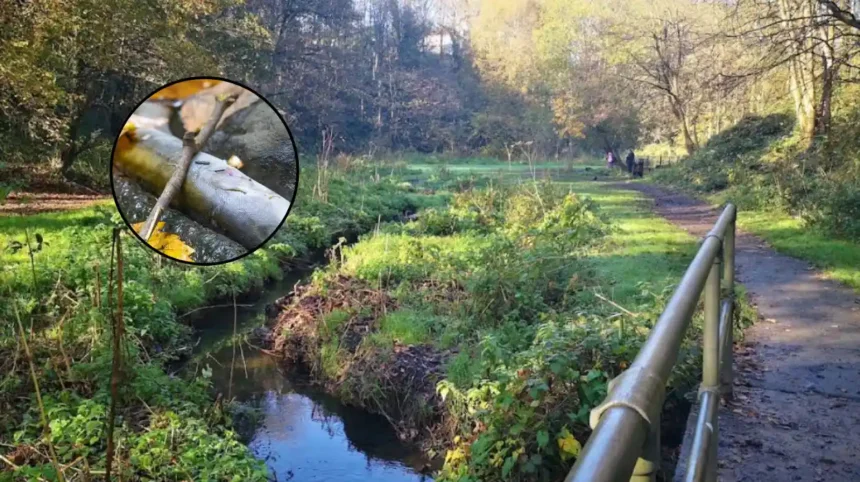
The environmental incident first came to light when the community organization Friends of Brislington Brook noted multiple public reports regarding foam billowing along the water surface accompanied by a strong smell. Initial notices posted by the group highlighted that while the status of the brook in nearby Nightingale Valley was yet to be fully verified, conditions were expected to be similar across the connected water system.
Group representatives initially stated:
“We won’t yet know if this is sewage or something else but please take care with kids and dogs in the water. We will keep an eye on the situation and share if we find anything out.”
The situation deteriorated rapidly by the following evening, when volunteer monitors discovered dead aquatic life and wild fowl floating in the affected stretch of water.
A updated public statement issued by Friends of Brislington Brook confirmed the severity of the ecological impact:
“Along with foam there seems to be a concerning amount of dead animals visible in the brook today. Eels, small fish and a bird. Not a good sign. Please keep clear of the water with your dogs and little ones. The trails and banks seem ok still. The EA [Environment Agency] has been contacted and Wessex Water have announced they believe this to be related to the fire on Emery Road on Tuesday. We don’t know more yet. But it’s obviously very sad and worrying.”
How Did the Firefighting Foam Enter the Local Drainage System?
Further details regarding the potential cause of the contamination have been highlighted by local environmental representatives examining the infrastructure around the nearby industrial area.
A spokesperson for the Friends of Brislington Brook group explained the technical factors believed to have contributed to the catastrophe:
“It is unclear what foam concentrate was used in the proportional units that pump foam concentrate into the water hose hole line. What is clear is that the run off from the foam concentrate — AFFF (aqueous film forming foam) AR-AFF (alcohol-resistant aqueous film forming foam) or a Class A synthetic foam — overwhelmed the archaic Wessex Water storm drains and tanks, which were already full to capacity, causing the wholesale destruction of wildlife in Brislington Brook.”
The spokesperson further elaborated on how the chemical compounds affect aquatic ecosystems:
“The wildlife was either starved of oxygen (foam concentrate has an oxygen starving quality) or poisoned by the toxins in the foam.”
Highlighting standard environmental safety protocols for emergency services, the spokesperson added:
“The fire service is well aware of the dangers posed by foam concentrate. It’s a necessary requirement for them to create an Incident Response Plan which includes measures for protecting the environment. This is achieved by temporarily blocking drains or using a containment barrier to prevent firewater from escaping. The fire service needs to be held to account.”
Background of the Particular Development
Brislington Brook runs through urban nature reserves and wooded green spaces in East Bristol, including Nightingale Valley and St Anne’s Woods. These waterways serve as crucial urban wildlife corridors, supporting populations of European eels (Anguilla anguilla) — a critically endangered species — as well as various coarse fish species, invertebrates, and native riverbirds.
Industrial sites near Emery Road sit in close proximity to the surface water drainage network that feeds directly into the brook catchment area. During major fire incidents, large volumes of water mixed with fire-suppression foam concentrates can create hazardous firewater run-off. Standard protocols require emergency services and site operators to deploy containment booms, drain mats, or temporary suction systems to intercept run-off before it enters combined drainage networks or natural watercourses, particularly during periods when local drainage infrastructure is operating near capacity.
Prediction: How This Development Can Affect the Local Community and Environment
This pollution event is expected to have significant short-term and long-term impacts on both the local community and the surrounding natural ecosystem:
- Ecological Recovery Time: The loss of key aquatic species, particularly bottom-dwelling eels and young fish, will disrupt the local food chain. Re-establishing stable populations within Brislington Brook could take several years, requiring environmental monitoring by regulatory authorities to ensure sediment and water quality return to baseline levels.
- Public Safety and Recreational Use: Local park visitors, dog walkers, and families with young children will face ongoing advisories to avoid direct contact with the brook water until formal water sampling by the Environment Agency confirms that chemical residues have fully dispersed.
- Scrutiny of Emergency Protocols: The event is likely to trigger investigations into emergency firewater containment practices. Emergency services and local water utilities may face calls to review containment measures and upgrade drainage infrastructure around nearby industrial estates to prevent future run-off incidents from entering vulnerable urban streams.