Key Points:
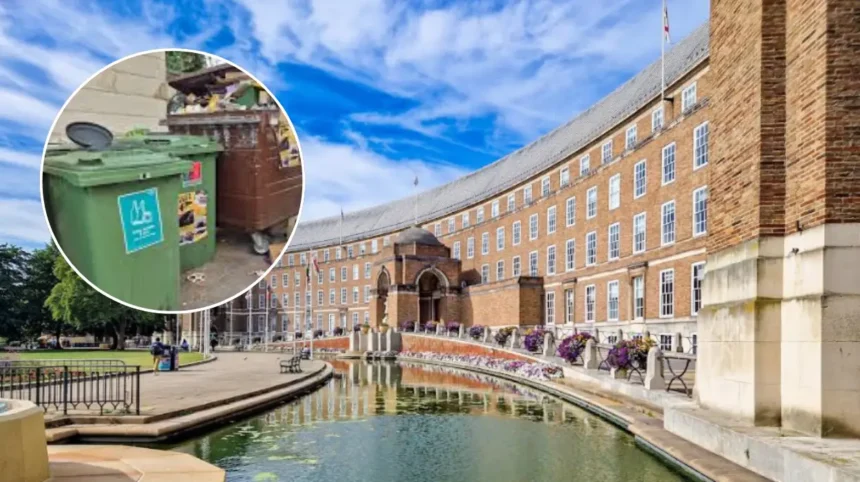
- There is still a build-up of rubbish around large communal bins and small-scale recycling facilities within St Paul’s and Montpelier, in spite of the calls for change made by the locals.
- According to Bristol24/7 reporter Alex Seabrook, there is a cul-de-sac located in Montpelier where the road is too small for standard-size bin lorries to fit, prompting City Hall bosses to look into purchasing “ultra-narrow” rubbish trucks.
- Pavlos Kyriacou, a local resident, criticised the scheme at an environment policy committee meeting, noting that the communal bins were effectively acting as skips that enabled a culture of fly tipping, as well as allowing HMOs to make clear outs a free process.
- The chief of waste at the council Ken Lawson pointed out that standard general waste lorries require a clearance of at least 1.95 to 2.25 meters, and narrow roads tend to be obstructed by parked cars.
- Abi Finch, who is a Green councillor and chairwoman of the environment committee, said that it was currently easier to dispose of general waste using bins rather than recycle.
Montpelier (Bristol Express News) September 28, 2026 – Rubbish continues to accumulate heavily next to large communal bins and mini-recycling centres across St Paul’s and Montpelier, prompting renewed scrutiny over local waste collection strategies, street access limitations, and landlord accountability.
Why Are Communal Bins Causing Persistent Fly-Tipping in St Paul’s and Montpelier?
According to reporting by Alex Seabrook of Bristol24/7, Bristol City Council originally introduced communal bins 15 years ago to combat a lack of space for individual black bins outside every house, which officials warned would otherwise become overcrowded and untidy. However, local residents argue that these centralized systems have devolved into breeding grounds for illegal dumping.
Pavlos Kyriacou, a resident living on Albany Road in Montpelier—where individual black bins were replaced with large communal containers back in 2011—spoke out at an environment policy committee meeting on Thursday. As detailed by Alex Seabrook of Bristol24/7, Kyriacou stated:
“What effectively they did was put a skip at the end of everyone’s street. By putting a skip at the end of everyone’s street and then emptying it twice a week, they created a culture.”
He added:
“People leave what I call ‘gifts’ for the council next to the bins, and then the council calls it fly-tipping. It’s not fly-tipping, it’s something created by the council, and they won’t deal with it.”
Kyriacou previously urged councillors back in February not to let St Paul’s become the United Kingdom’s first green slum. Although subsequent workshops and a service review were conducted, he claimed the resulting improvement plan merely amounts to an automatic daily collection of fly-tipping rather than tackling the root cause. Furthermore, Kyriacou pointed out that much of the discarded furniture, household goods, beds, and mattresses stem from HMO landlords rather than local students, noting that landlords exploit the bins as a free clearance service once or twice a year.
What Obstacles Prevent Bin Lorries From Accessing Narrow Residential Streets?
Addressing why standard refuse vehicles cannot service streets like Albany Road, council officials pointed directly to physical space constraints and vehicle dimensions. As highlighted by Alex Seabrook of Bristol24/7, Ken Lawson, the council’s head of waste, explained:
“The narrowest vehicle we’ve got is two metres and 25cm. We need a vehicle that is about one metre 95cm to be able to service that road, because the gap is not wide enough. When we were there on site, there were vans parked, they were wonky, they were blocking, they were outside the white lines.”
To resolve this issue, the council and Bristol Waste are looking to purchase a replacement fleet prioritizing an “ultra-narrow access vehicle.” This specialized truck is designed to squeeze down narrow residential lanes across Bristol, overcoming long-standing problems tied to narrow rights-of-way and obstructive parking.
While narrow streets in areas like Bedminster, Barton Hill, and St George often see drivers parking partly on pavements to maintain roadway clearance, Albany Road sees less of this behavior, partly due to the presence of a school at the end of the road. St Barnabas Primary School closed down in 2023 following declining pupil numbers, leaving the site empty, though future use could demand strict pavement clearance to keep pedestrians and school children safe.
Explore more Bristol Council News:
Bristol Council Faces £14m Bill for Pay Top-Up in Bristol 2026
Bristol Council Rules Out Residents-Only Rat Run Scheme In Bristol 2026
How Are Housing Densification and Recycling Rates Impacting the Local Street Scene?
The challenge is further magnified by urban densification, socio-economic factors, and contrasting waste disposal methods. The council is currently a third of the way through a 12-week roll-out of new blue and red recycling sacks to 175,000 households. Yet, in areas like St Paul’s, residents utilizing communal bins retain the convenience of discarding significantly more refuse in black bin bags than households managing individual containers.
Green councillor Abi Finch, who chairs the environment committee, acknowledged the behavioural hurdle, telling Bristol24/7 reporter Alex Seabrook:
“I guess that’s always going to be the case that throwing things in the bin is easier than recycling them. That is the reason why we really need to promote recycling and need to communicate to residents of Bristol why recycling is so important.”
Adding to this, Ken Lawson noted that the division goes beyond simple waste collection, stating via Bristol24/7 reporting:
“In St Paul’s and some areas we have greater challenges because it’s not seen as an easy option to recycle, because of their own personal circumstances. In St Paul’s, densification of housing is creating challenges. You’ve got an urban environment that has deprivation, diversity, densification, HMOs, lots of challenges around street scene and no storage. It needs to be cross-council to address some of these challenges. My service is picking up waste, and the waste it’s picking up is a result of how people are living in the city.”
Despite these systemic problems, conditions can fluctuate rapidly; following the committee meeting, bins on Albany Road were reported by Alex Seabrook to be spotless and clear of fly-tipping, while mini-recycling centres on nearby Drummond Road continued to display overflowing bins and discarded rubbish piles.
Background of the Particular Development
The waste management and fly-tipping disputes in St Paul’s and Montpelier represent long-standing structural issues tied to urban regeneration, housing conversions, and municipal infrastructure limits in Bristol. Over the past decade, inner-city districts have experienced significant housing densification, with large traditional properties frequently subdivided into flats and Houses in Multiple Occupation (HMOs). This transition drastically concentrates population density without expanding domestic storage or waste management infrastructure.
The installation of communal Euro-bins and mini-recycling hubs 15 years ago was conceived as a practical compromise for terraced streets lacking alleyways or front-garden space for individual wheelie bins. However, without secure access controls, enforcement against illegal dumping, or physical barriers, these communal points frequently attracted commercial-scale fly-tipping and bulk waste from unscrupulous landlords seeking to bypass disposal fees. Previous community campaigns and council reviews have repeatedly grappled with how to balance service efficiency, narrow Victorian-era street dimensions, and equitable refuse collection across socio-economically diverse neighbourhoods.
This ongoing development will likely exert direct pressure on Bristol City Council’s upcoming capital expenditure decisions, specifically regarding the planned procurement of ultra-narrow access waste vehicles. If the council successfully introduces and deploys these narrower trucks into restricted cul-de-sacs like Albany Road, residents could see the reinstatement of regular, direct waste collections, thereby reducing the reliance on vulnerable communal bin sites.
However, for local residents and community stakeholders in St Paul’s and Montpelier, the operational change alone may not resolve the broader cultural and enforcement gaps. Without increased enforcement against landlords engaging in illegal bulk dumping and more robust educational outreach on recycling initiatives, localized fly-tipping is likely to persist around high-density communal hubs. This could force the local authority to consider more radical restructuring, such as gated bin enclosures, smart-lock compactors, or targeted landlord licensing penalties to protect community hygiene and street aesthetics.