Key Points
- There were also reports of a large soundsystem seen in the area next to Pero’s Bridge in Bristol prior to the bridge’s final collapse.
- According to engineers, they were able to feel the “vibrations” caused by the sound system near the bridge.
- Councillor Andrew Brown, chair of Bristol’s Harbour Committee, said that vibration from outside sources such as road traffic, strong winds, or music from the shore may have been one reason for the structural damage to the bridge.
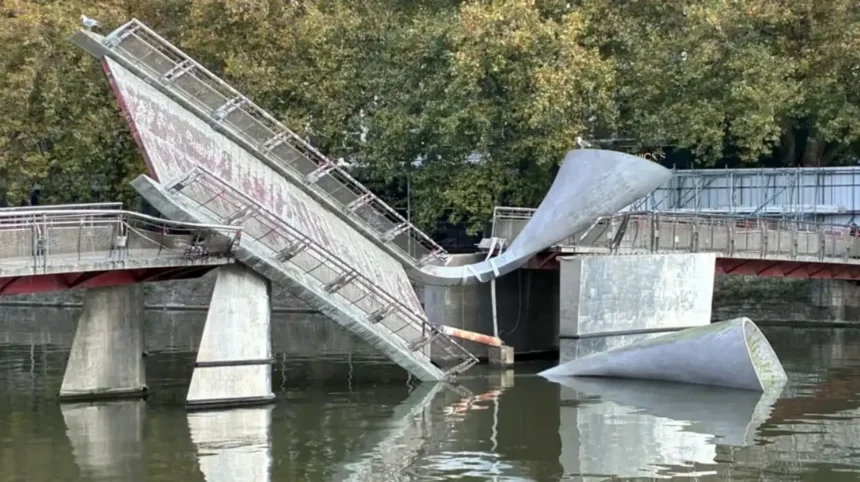
- Pero’s Bridge had first experienced partial failure back in August 2026 before collapsing into the floating harbor during Halloween.
- Previous structural assessments conducted by engineering company Arup found that there was steel corrosion, degraded waterproof coatings, and water within the hollow sections of the bridge.
- Weight from years of unofficial “love locks” hung around the railing of the bridge also weakened the lift mechanism and structural integrity.
Bristol (Bristol Express News) November 13, 2026 — A large soundsystem positioned directly next to Pero’s Bridge on the night it gave way has drawn scrutiny from municipal engineers and local officials examining the catastrophic collapse of the prominent city centre footbridge.
- Key Points
- How Did a Large Soundsystem Come to Be Connected to the Collapse of Pero’s Bridge?
- What Were the Underlying Structural Vulnerabilities Identified Prior to the Incident?
- How Did the Final Collapse Unfold on Halloween Night?
- Background of the Particular Development
- Impact on the Particular Audience
How Did a Large Soundsystem Come to Be Connected to the Collapse of Pero’s Bridge?
As reported by Maxine Denton of Bristol Post, municipal engineers examining the wreckage of the landmark crossing noted that a large soundsystem was positioned immediately next to Pero’s Bridge on the night it collapsed into the harbour. Technical specialists working on the site stated that they could distinctly “feel the vibrations” emanating from the equipment. Elaborating on these findings, as reported by Maira Butt of The Independent, Councillor Andrew Brown, the Liberal Democrat chair of Bristol’s Harbour Committee, addressed the municipal inquiry by highlighting that external vibrational forces could have played a catalytic role in destabilising the already compromised structure. Councillor Brown stated that “external vibrations”—potentially stemming from environmental factors such as severe gusts of wind, heavy vehicular road traffic, or heavy bass and music broadcast through shoreside speakers—were flagged by engineering consultants as plausible stress vectors.
What Were the Underlying Structural Vulnerabilities Identified Prior to the Incident?
As reported by Alex Seabrook of Bristol Post, a comprehensive engineering inspection report compiled by structural consultants Arup revealed extensive pre-existing defects across the 1999-built bascule bridge. Inspectors discovered “severe corrosion” on the western section adjacent to Millennium Square, alongside degraded waterproof sealants between the timber planks that permitted rainwater to seep directly into internal steel box girders. Prior maintenance logs noted that during previous mechanical test lifts, a “significant quantity of rust-stained water” poured from the inner structural cavities, pointing to historical sealing failures. Furthermore, as reported by Tristan Cork of Bristol Post, the structure had accumulated tonnes of unofficial “love lock” padlocks over decades. This heavy unauthorized metallic burden added several tonnes of dead weight, severely straining the operating mechanism and rendering standard maintenance lifts impossible long before the bridge stuck at a wonky angle in August 2026.
How Did the Final Collapse Unfold on Halloween Night?
As reported by Paul Greaves of Bristol Post, the crippled footbridge suffered a terminal structural failure overnight during a busy Saturday Halloween crowd at the harbourside. Following its initial partial failure in August, which had already prompted the installation of wooden security hoardings and public closures, the central steel span snapped and crashed completely into the floating waters of St Augustine’s Reach. Eyewitness accounts and reader photographs shared with local media captured the distinctive horn-shaped lifting counterweights twisted and submerged beneath the waterline. In response to public concern regarding the timeline of restoration, Bristol City Council reaffirmed that while a £1.54 million comprehensive repair package was approved earlier in the year, the projected return-to-service date has been extended from spring 2027 to summer 2027 to accommodate full structural upgrades.
Explore More Local Bristol News
Bristol City Council School Cyber Attack Causes Teacher Burnout in Bristol 2026
Bristol Then and Now: Railway Stations, Churches, and 1930s Fashion in Bristol 2026
Background of the Particular Development
Pero’s Bridge is a notable pedestrian bascule bridge opened in 1999 to connect Queen Square with Millennium Square across St Augustine’s Reach within Bristol Harbour. Designed as part of the broader 1990s harbourside regeneration scheme, it was officially named in honour of Pero Jones, an African man enslaved in the 18th century who lived and worked in the city. Over two decades, the crossing evolved into a heavily trafficked public thoroughfare and a popular tourist landmark. However, cumulative wear, recurring water ingress due to failed deck sealants, progressive internal steel corrosion, and the unmonitored accumulation of thousands of heavy love locks gradually compromised its mechanical integrity. These latent structural weaknesses culminated in a mechanical jam during a test lift in August 2026, subsequent fencing off by local authorities, and the final dramatic collapse into the harbour waters on October 31, 2026.
Impact on the Particular Audience
The findings surrounding vibrational stressors and structural degradation will directly impact local residents, daily commuters, local businesses, and nightlife operators around the Bristol Harbourside district. For pedestrians, cyclists, and local workers who rely on the crossing to commute between Queen Square and the central cultural venues like the Watershed, the extension of closure timelines to summer 2027 means prolonged detours across alternative bridges such as Centenary Bridge or Pero’s neighbouring crossings. For hospitality venues, bars, and event organizers operating along the waterfront, the official spotlight on shoreside soundsystems and acoustic vibrations raises valid concerns regarding future noise restrictions, licensing regulations, and public event compliance in open public spaces. Furthermore, local council taxpayers face heightened scrutiny over infrastructure spending and maintenance accountability, as municipal authorities navigate the £1.54 million financial commitment required to deliver a fully refurbished and resilient crossing by mid-2027.