Key Points
- Emergency repairs to the famous Pero’s Bridge in Bristol have finally been sanctioned by the city council after it collapsed due to mechanical failure in August 2026.
- The company KML Limited will be awarded the contract without going through a competitive tendering procedure due to the “extreme and unavoidable urgency” according to the council.
- The span of the bridge will be transported by barge to Albion Dry Dock and undergo vital repair and refurbishment work.
- There is no additional money budgeted for the repairs; all costs will be withdrawn directly from the original capital project budget of £1.35 million plus an extra £160,000.
- It was warned that using funds for this urgent salvage work will mean there are less resources left for the overall refurbishment process; any shortfalls will need further council approval.
- The bridge had already come under pressure from heavy padlocks put there by the couples leading to the “love lock” removal in July 2025, no-lift notice and prohibition of crossing by police horses.
Bristol (Bristol Express News) September 29, 2026 – Emergency repairs to Bristol’s iconic Pero’s Bridge have been officially approved by Bristol City Council, though local authorities have confirmed that no extra money has been allocated to cover the mounting costs of the urgent project.
- Key Points
- Why Did Bristol City Council Bypass the Competitive Tender Process for Pero’s Bridge?
- How Will the Emergency Repairs Impact the Existing Project Budget?
- What Caused the Initial Decline and Structural Strain on Pero’s Bridge?
- Background of the Particular Development
- How This Development Affects Bristol Residents, Commuters, and Harbour Users
As reported by Adam Postans of Bristol Live, the decision follows a dramatic structural failure after the pedestrian bridge failed a stress test lift in August 2026, leaving its middle section broken and jammed at an awkward angle over the Floating Harbour.
Pero’s Bridge—situated between Queen Square and Millennium Square—has faced compounding operational challenges over recent years. Last March, the harbour committee initially voted to allocate £1.35 million for necessary repairs amid longstanding concerns regarding the structure’s health. This figure was subsequently topped up with an additional £160,000 sourced from another council budget.
However, with the bridge now completely compromised and posing active safety hazards, Bristol City Council executive director of growth and regeneration John Smith took swift executive action. As detailed by Adam Postans of Bristol Live, the authority bypassed standard competitive tendering protocols, granting an emergency contract directly to marine salvage specialists KML Limited.
Why Did Bristol City Council Bypass the Competitive Tender Process for Pero’s Bridge?
As reported by Adam Postans of Bristol Live, the decision to appoint KML Limited directly without a standard competitive procurement process was enacted due to what the local authority formally classified as an “extreme and unavoidable urgency”.
The official council decision notice, highlighted by Adam Postans of Bristol Live, stated:
“Due to the immediate safety risks presented by the damaged structure, the ongoing closure of a strategic harbour navigation route and the requirement to prevent further deterioration of the bridge, the removal works constitute an ‘extreme and unavoidable urgency’.”
Furthermore, the document emphasized that
“There is insufficient time to undertake a full competitive procurement process without materially increasing operational, safety and financial risks.”
Officials maintained that the award was based on unforeseeable events completely “not attributable to the council”.
As part of the approved emergency protocol, KML Limited—a specialist marine salvage contractor possessing the requisite heavy equipment, availability, and marine expertise—will remove all the bridge spans as quickly as possible. These sections will be loaded onto a barge and transported directly to Albion Dry Dock to undergo extensive repairs and comprehensive refurbishment.
How Will the Emergency Repairs Impact the Existing Project Budget?
A major point of concern highlighted in the local governance reports is the financial structure of the emergency operation. As reported by Adam Postans of Bristol Live, the council has confirmed that no extra funds are being injected into the project to cover the unexpected salvage and emergency phase.
Instead, the local authority stated that the financial costs associated with the emergency removal operation will be met entirely from the existing approved Pero’s Bridge repairs capital project budget.
According to the official decision notice cited by Adam Postans of Bristol Live, this approach carries a clear financial caveat:
“The emergency works will reduce the funding currently available for the wider refurbishment project and any resultant funding shortfall required to complete the repairs will be the subject of a future approval process.”
This means that while the immediate crisis of removing the broken, jammed structure from the waterway is being addressed, the long-term restoration may face a funding deficit that will require subsequent political debate and budgetary sign-offs from Bristol City Council.
What Caused the Initial Decline and Structural Strain on Pero’s Bridge?
The structural integrity of Pero’s Bridge has been under scrutiny for a considerable period. The crossing, which serves as a vital pedestrian artery across the Floating Harbour, previously became famous for couples attaching heavy padlocks—known as “love locks”—to its metallic railings as a permanent symbol of commitment.
However, the cumulative physical weight of these thousands of padlocks placed severe, unforeseen strain on the bridge’s delicate internal mechanisms and hydraulic systems. Recognizing the mounting structural risks, the council intervened in July 2025, orchestrating a full removal of the padlocks after major structural problems were first diagnosed.
Those initial engineering warnings resulted in a strict no-lift notice being imposed on the bridge, alongside a precautionary ban preventing police horses from crossing. Despite these preventative measures, the underlying mechanical stresses culminated in the severe failure during August’s stress test lift, ultimately resulting in the current collapse and emergency salvage operation.
Explore more Bristol City Centre News:
St Nick’s Market Overhaul Plans Announced in Bristol City Centre 2026
Bristol City Centre Considers £4m Bus Upgrade for City Centre 2026
Background of the Particular Development
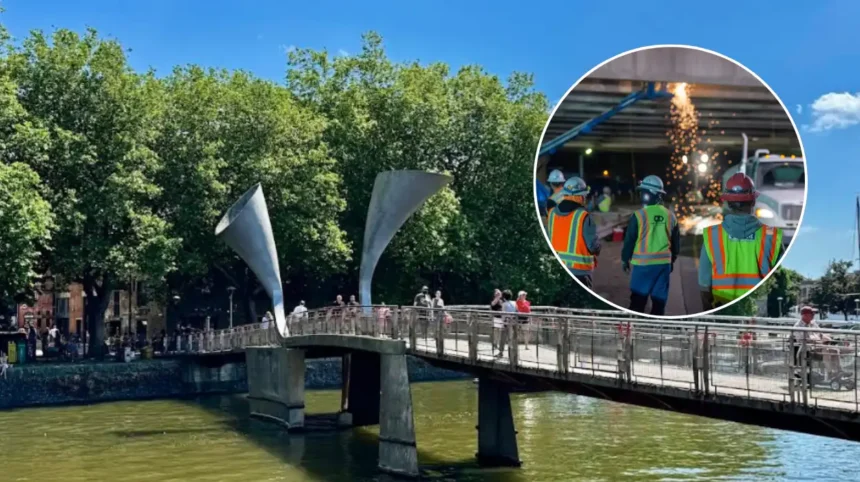
Pero’s Bridge is a notable landmark in Bristol, named after Pero Jones, an enslaved African man who was brought to Bristol in the 18th century by slave merchant John Pinney. Designed by artist Eilis O’Connell and structural engineers Ove Arup and Partners, the opening bridge features two distinctive curved horn-like spans that lift to allow vessels to pass along the Floating Harbour. Opened in 1999, it has served as a central pedestrian link connecting Queen Square to the Millennium Square and Harbourside developments.
Over the past two decades, the bridge has experienced heavy footfall, becoming a focal point for tourists, commuters, and weekend visitors. However, movable bridges over marine environments require rigorous, costly maintenance programmes. The combination of intense public usage, mechanical wear, structural aging, and external pressures—such as the heavy loads from love locks—gradually compromised its operational capacity. The structural failure in August 2026 and the subsequent emergency intervention by KML Limited represent a critical turning point in the local authority’s management of municipal waterfront infrastructure, highlighting the delicate balance between preserving historic public assets and managing constrained civic budgets.
How This Development Affects Bristol Residents, Commuters, and Harbour Users
The emergency removal and protracted repair of Pero’s Bridge will have immediate and tangible consequences for the local Bristol community, particularly pedestrians, cyclists, local businesses, and marine operators.
For pedestrians and commuters who rely on the direct thoroughfare between Queen Square and Millennium Square, the extended closure prolongs journey times and forces foot traffic onto alternative routes around the Floating Harbour. This disruption directly impacts local footfall for surrounding retail businesses, cafes, and cultural institutions in the Harbourside and Hotwells areas, which depend heavily on seamless pedestrian connectivity.
For the marine community, the closure of this strategic navigation route has disrupted boat traffic and water-based operations within the harbour. Although KML Limited’s intervention aims to clear the waterway by removing the jammed spans to Albion Dry Dock, the timeline for full reinstallation and restoration remains uncertain, pending future funding approvals.
Financially, because Bristol City Council has refused to allocate fresh capital for the emergency phase, taxpayers and council stakeholders face the distinct possibility of future funding shortfalls. This could necessitate contentious budget reallocations away from other local public services to ensure the complete restoration of the bridge. Ultimately, the development underscores the vulnerability of municipal infrastructure to unexpected maintenance crises and sets the stage for upcoming political debates regarding capital expenditure priorities in Bristol.