Key Points
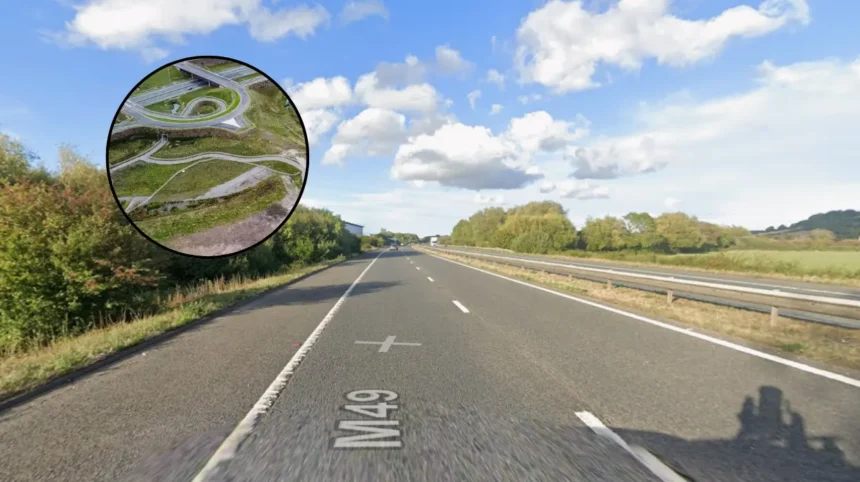
- The M49 motorway junction near Bristol, constructed seven years ago, remains entirely unused by traffic, earning it the title of a ‘ghost’ junction.
- Official records indicate government authorities and National Highways were aware of critical safety defects months prior to informing the public about further opening delays.
- Local residents and community leaders report feeling “heartily fed up” over the persistent inaction and lack of operational connectivity.
- The junction was originally designed to relieve severe heavy goods vehicle congestion across the local road network and service the nearby Severnside distribution park.
- Failure to connect the junction to the local road grid stems from prolonged disputes over land ownership, planning obligations, and missing infrastructure connections.
- Severe safety and engineering defects now require extensive remediation work before any vehicular traffic can safely utilise the route.
Severnside (Bristol Express News) August 19, 2026 – Government ministers and Highways England officials held knowledge regarding severe structural and safety defects at the M49 ‘ghost’ junction for months before publicly disclosing that the opening of the £40 million scheme would face further significant delays. Built seven years ago to serve the vast Severnside industrial area and alleviate pressure on surrounding village roads, the junction has yet to carry a single motor vehicle.
- Key Points
- Why Has the Junction Remained Unopened Seven Years After Construction?
- What Safety Defects Were Identified by Government Officials?
- How Are Local Residents and Communities Responding to the Delays?
- Who Is Responsible for Funding and Executing the Remedial Works?
- Background of the M49 Junction Development
- Predictions: How This Development Will Impact Local Residents, Businesses, and Taxpayers
The multi-million-pound infrastructure project sits entirely isolated, lacking the necessary connecting link road to tie the motorway slip roads into the local highway network. Recent official disclosures confirm that internal engineering assessments had identified substantial technical deficiencies on the constructed elements months prior to any official public acknowledgment regarding the extended timeline.
Why Has the Junction Remained Unopened Seven Years After Construction?
The primary catalyst for the multi-year stalemate involves a complex breakdown in coordination between local authorities, national highways agencies, and commercial land developers responsible for constructing the connecting road. While the main motorway roundabout and elevated slip roads were completed on schedule, the critical piece of joining infrastructure across private land was never built.
As reported by local investigative reporters, South Gloucestershire Council, National Highways, and private developers Delta Properties have been locked in negotiations regarding financial liability, land transfers, and planning enforcement. The failure to secure binding agreements prior to the primary construction phase left the junction stranded without access to the local network.
What Safety Defects Were Identified by Government Officials?
Recent technical reports highlight that the physical structures built nearly a decade ago have suffered deterioration and fail to meet current national highway safety standards. Remedial assessments indicate issues involving surface drainage, structural integrity of the embankment access points, and alignment compliance.
As reported by regional infrastructure correspondents, internal briefings revealed that engineers detected significant sub-surface defects and safety compliance failures. These findings mean that even if the missing link road were constructed immediately, the junction itself cannot legally or safely accommodate heavy commercial traffic without extensive and costly reconstruction works.
How Are Local Residents and Communities Responding to the Delays?
Residents in neighbouring villages such as Easter Compton, Hallen, and Pilning report severe disruption as heavy freight traffic continues to navigate narrow local roads rather than using the dedicated motorway access. Community representatives have expressed deep frustration over the prolonged inaction and perceived lack of transparency from public bodies.
As reported by local community journalists, residents stated that they feel “heartily fed up” with the continuous delay tactics and excuses offered by governing bodies. Local hauliers and logistics managers operating out of the Severnside industrial hub have similarly expressed dismay, noting that the absence of the link road adds unnecessary transit time, fuel costs, and environmental pollution to daily operations.
Who Is Responsible for Funding and Executing the Remedial Works?
Disagreements persist regarding which entity bears the financial responsibility for rectifying the engineering defects and completing the missing roadway link. National Highways maintains that its primary mandate was the delivery of the motorway junction itself, while the local access infrastructure remains the duty of third-party developers and the local council.
As reported by regional news correspondents, local council leaders stated that public funds should not be used to bail out private developers who failed to fulfill original planning obligations. Conversely, commercial partners argue that shifting regulatory requirements and altered highway standards have artificially inflated the cost and complexity of the required remediation works.
Background of the M49 Junction Development
The M49 junction project was formally conceived in the mid-2010s as a vital infrastructure upgrade designed to unlock economic potential within the Severnside and Avonmouth industrial zones. Situated along the five-mile M49 motorway link connecting the M4 at Severn Bridge to the M5 at Avonmouth, the junction was intended to provide direct motorway access for thousands of heavy goods vehicles visiting distribution hubs daily.
Construction on the main junction scheme commenced in 2017 under National Highways (then Highways England) and was substantially completed by late 2019. However, planning approvals for the surrounding commercial developments dictated that the final link road connecting the junction roundabout to the local road network at Gold Cliff Way was to be built by private developers under a Section 106 agreement.
Due to land access disputes, legal disagreements over ransom strips, and shifting commercial priorities, construction on the connecting link never commenced. Over the subsequent seven years, the completed bridge decks, slip roads, and roundabouts remained fenced off, falling into disuse. Over time, lack of maintenance, combined with evolving highway safety regulations, resulted in the gradual degradation of the existing structures, leading directly to the current safety defect classification.
Explore More Local Bristol News
South Bristol School Fields Sold For Homes And New Primary School Hengrove 2026
Jet2 Bristol Flight Delayed After Palma Ground Stairs Strike 2026
Predictions: How This Development Will Impact Local Residents, Businesses, and Taxpayers
The ongoing delay and required remediation work will have marked consequences for several key stakeholder groups across the Bristol and South Gloucestershire region:
- Local Residents: Communities in Easter Compton, Hallen, and surrounding areas will continue to bear the burden of heavy commercial traffic. Air quality degradation, noise pollution, and elevated road safety risks will persist on minor rural roads that were never designed to accommodate 44-tonne freight vehicles. Real estate desirability and local road maintenance in these residential zones will remain negatively impacted until the junction becomes fully operational.
- Logistics Operators and Businesses: Companies operating within the Severnside distribution parks face ongoing operational inefficiencies. Transport managers will incur higher fuel overheads, increased vehicle wear-and-tear, and prolonged driver journey times due to sub-optimal routing. The lack of direct motorway connectivity may also deter future commercial investment in the area, limiting localized economic growth.
- Taxpayers and Local Authorities: The overall cost to resolve the impasse is expected to rise significantly. With structural defects now requiring extensive intervention, public bodies may ultimately face political pressure to step in with public funding to break the developer deadlock. This risks diverting capital resources away from other regional transport projects to fix an avoidable administrative and engineering failure.