Key Points
- Andy Burnham is preparing for a November 20, 2026, UK-European Union summit in Brussels.
- Proposed agreements cover youth mobility, food and drink trade, emissions pricing, energy and Erasmus+ participation.
- Negotiators remain divided over quotas, tuition fees and the timetable for the youth scheme.
- The European Union has become more focused on security, strategic independence and protection of supply chains since Brexit.
- Longer-term British options, including closer customs or single-market ties, are not expected before the next general election.
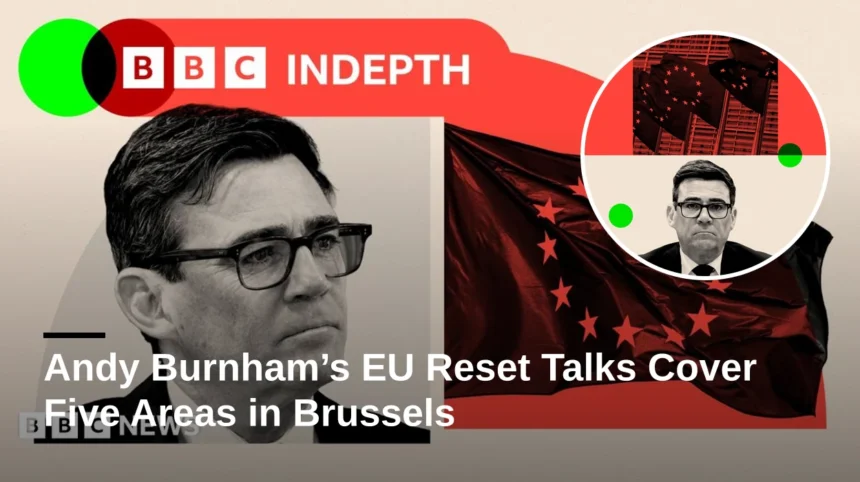
Brussels (European Union) November 18, 2026 – Prime Minister Andy Burnham is due to meet European Union leaders in Brussels on November 20 for a proposed reset of relations between Britain and the 27-member bloc. The talks are expected to address a youth work and mobility scheme, food and drink trade, emissions pricing, energy cooperation and possible British participation in Erasmus+. The summit is intended to deliver limited practical agreements rather than reopen Britain’s membership of the European Union. Several details, including participation limits, tuition fees and implementation dates, remain unresolved.
- Key Points
- What agreements are being prepared for the summit?
- Why are the negotiations still unsettled?
- How has the European Union changed since Brexit?
- Does the European Union want Britain to rejoin?
- What could the reset mean for Britain and the European Union?
- Background: Why is Britain discussing a closer European relationship?
- What is the likely direction of UK-European Union relations?
What agreements are being prepared for the summit?
As reported by the BBC, the proposed package includes a youth work and mobility arrangement, an agreement on cross-Channel carbon emissions pricing and measures to make food trade easier. The European News Network reported that energy cooperation and a plan for young people to work for limited periods in Britain and the European Union are also expected to feature.
A draft arrangement reported by The Week would aim to apply the youth scheme by 2028, with opportunities available no later than January 2030. The proposal could allow participants aged 18 to 34 to live, work, study or travel in the other territory for up to three years, according to EU Insider.
The Independent reported that negotiations were continuing over the total number of participants. European Union member states may retain control over how many people can enter each country, while Britain is seeking an annual limit of about 100,000 European arrivals. The Telegraph reported that the package may also provide for cheaper tuition fees for European students in Britain in return for wider participation in European programmes.
Why are the negotiations still unsettled?
The central dispute concerns the scale and administration of youth mobility. The Independent reported that talks over a cap had reached a critical stage, with the European Commission and individual member states holding different responsibilities.
Tuition fees also remain unresolved. EU Insider reported that the draft refers to equal treatment but gives negotiators six months to complete the details. The same report said Britain’s return to Erasmus+ from 2027 was close to agreement, although the cost and conditions for European students had not been finalised.
Burnham has described the process as a step towards closer cooperation, while saying that Britain is not currently seeking to rejoin the European Union. The European News Network reported that existing political commitments also rule out rejoining the bloc’s customs union or single market for goods, services and workers before the next general election.
How has the European Union changed since Brexit?
The European Union that Burnham is eyeing up is very different to the one Britain left. The BBC reported that the Covid-19 pandemic exposed supply-chain dependence on China, Russia’s full-scale invasion of Ukraine increased concern over energy security, and changing United States policy encouraged European governments to strengthen their own defence capabilities.
The bloc has also become more receptive to industrial policy, protection of strategic supply chains and joint borrowing. These changes have encouraged greater cooperation among member states but may make the European Union less attractive to a British government seeking regulatory flexibility and national control.
British policy has also shifted in some areas. The BBC reported that Britain introduced steel measures similar to European Union safeguards against Chinese imports and was considering comparable action on Chinese electric vehicles. Charles Grant of the Centre for European Reform said Britain and Europe had become more alike in their willingness to protect domestic industries.
Does the European Union want Britain to rejoin?
European officials have expressed support for practical cooperation but limited enthusiasm for reopening the wider post-Brexit settlement. The BBC reported that many European diplomats were comfortable with the existing trade agreement and preferred incremental changes to a comprehensive renegotiation.
Former European Union Brexit negotiator Michel Barnier said the single market could not be selectively accessed without weakening the rules applied to other non-member countries. He also described Britain as an important ally and trading partner.
Dr Ilke Toygür of Madrid’s IE University said Britain’s military role might not provide decisive leverage because European countries already cooperate with Britain through NATO and support for Ukraine. An anonymous European diplomat quoted by the BBC said Britain needed the bloc more than the bloc needed Britain because the United Kingdom was a middle-ranking power between the United States and China.
What could the reset mean for Britain and the European Union?
In the short term, the agreements could reduce selected barriers affecting young people, food exporters, students and carbon-market participants. The measures would not restore freedom of movement or amount to British re-entry into the European Union.
The BBC reported that some European figures see an opportunity for Britain to present proposals that offer benefits to the bloc, including resources, innovation and financial capacity. Economist Heather Grabbe of Bruegel said shared challenges such as climate change, ageing populations and Russian hybrid warfare could create an eventual drift towards closer cooperation.
That opportunity may narrow if nationalist and Eurosceptic parties gain influence in major member states. The BBC reported that a possible future French government led by Marine Le Pen could trigger internal disputes over the European Union’s powers, budget and support for Ukraine, potentially pushing British negotiations down the political agenda.
Background: Why is Britain discussing a closer European relationship?
Britain voted to leave the European Union in 2016 and completed its withdrawal from the bloc in 2020. The post-Brexit relationship has left businesses, students and workers facing new administrative and movement restrictions. Burnham has argued that Britain gained less from Brexit than supporters promised, while maintaining that immediate re-entry is not under consideration. The current reset therefore focuses on limited agreements rather than reversing the wider settlement.
What is the likely direction of UK-European Union relations?
The immediate outcome is likely to be a gradual expansion of practical cooperation rather than a rapid return to membership structures. A youth scheme, Erasmus+ participation and improved food trade could build trust if both sides resolve the remaining disputes over quotas, fees and implementation.
For the European Union, Britain remains valuable as a security partner, trading country and source of economic capacity, but officials appear unwilling to grant selective access to the single market. For Britain, closer cooperation may reduce economic friction, although it would require sustained political commitment and a clear explanation of what it offers European partners.
The longer-term relationship will depend on the next British election, the strength of Eurosceptic parties in Europe and whether both sides can maintain support for incremental agreements. Any movement towards customs-union, single-market or membership discussions would represent a separate and more politically consequential stage.