Key Points
- National Police Chiefs’ Council chairman Gavin Stephens backed fewer, larger police forces and a new National Police Service.
- He warned policing cannot rely on “complacent nostalgia” amid financial pressures, changing crime and workforce strain.
- Norfolk Chief Constable Paul Sanford said nine forces had sought exceptional financial support, although Norfolk later withdrew its request after Home Office assurances.
- Stephens said England and Wales’ 43-force structure creates inconsistent access to technology, intelligence and specialist support.
- He cited officer exhaustion, burnout, online harms and violence against women and girls as urgent reform priorities.
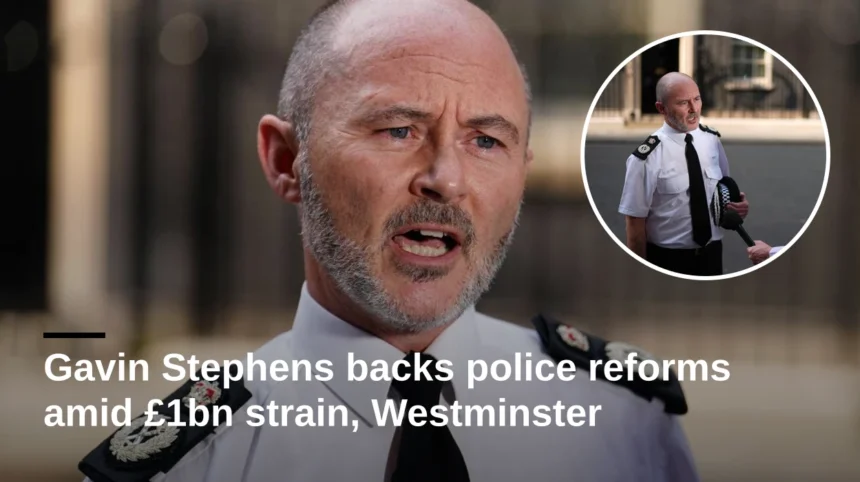
Westminster (The Independent) November 17, 2026 – Chief Constable Gavin Stephens, chairman of the National Police Chiefs’ Council, has warned that police forces cannot afford “complacent nostalgia” as he backed major structural reforms. Speaking at the annual conference of the National Police Chiefs’ Council and the Association of Police and Crime Commissioners, he supported Government plans for fewer, larger forces alongside a National Police Service. His intervention came amid warnings that nine forces were seeking exceptional financial support and that officers were being forced to retreat from frontline policing.
Why did Gavin Stephens call for policing reform?
As reported by The Independent, Stephens said the service must adapt to changing threats rather than preserve the system it inherited. He argued that the current 43-force structure produces duplicated and incompatible systems, making it harder to share intelligence, obtain digital forensic results and access specialist support.
“We cannot afford a complacent nostalgia. We must reform policing to keep pace with threats to our safety,” Gavin Stephens told delegates.
Stephens said local teams should remain responsive to community needs, while officers across England and Wales should receive the same access to equipment, technology and expertise. He said the existing arrangements had become increasingly unsuitable after years of savings made within separate force boundaries.
Which forces sought exceptional financial support?
According to reports by The Independent and The Guardian, Norfolk Chief Constable Paul Sanford, who leads the National Police Chiefs’ Council’s finance work, said nine forces had sought exceptional financial support from the Government. The forces named were Bedfordshire, Cleveland, Durham, Gloucestershire, Greater Manchester, Lincolnshire, Norfolk, South Yorkshire and Wiltshire.
The Eastern Daily Press later reported that Norfolk Police was no longer pursuing the request after receiving Home Office assurances about a possible grant. The BBC reported that the Government said forces had already received additional funding in real terms.
What wider pressures did the speech identify?
Stephens said crime increasingly crossed regional boundaries and often involved digital activity. He referred to online algorithms and platforms that can amplify violence, misogyny, hatred and exploitation, and cited research indicating that almost three-quarters of children aged 11 to 17 encountered potentially harmful online content during a four-week period.
He also described violence against women and girls as a national emergency. Stephens said police needed to improve the identification of repeat perpetrators, victim protection and cross-border investigations.
Research cited in the speech by the Police Federation indicated that more than half of officers regularly felt physically exhausted and 45% reported burnout. Stephens said reform should include simpler systems, manageable workloads, effective technology and stronger support for staff.
What is the Government proposing?
Government plans reported earlier in 2026 would place counter-terrorism, some fraud and serious gang crime under a new National Police Service while reducing the number of local forces. The proposals are intended to improve national coordination and reduce duplication, but Shadow Home Secretary Chris Philp argued that fewer, larger forces could reduce the number of crimes solved.
The Telegraph separately reported that Stephens said the Government’s commitment to increase frontline policing would be difficult to meet without additional funding, a longer implementation timetable or reforms that reduce bureaucracy.
What is the background to the policing dispute?
England and Wales currently operate through 43 territorial police forces, each with its own systems, budgets and operational structures. Stephens said years of separate savings had left policing fragmented and financially strained. The reform debate has intensified alongside Government proposals for national coordination and force mergers. It also follows warnings from chief constables that some forces may not remain operationally viable without exceptional support.
How could the changes affect communities and officers?
If implemented, the reforms could give local teams wider access to national technology, intelligence and specialist services while reducing duplicated systems. Larger forces could also change how communities engage with senior police leadership and local accountability. For officers, standardised systems and additional support could reduce administrative pressure, but restructuring could create transitional costs and uncertainty. The immediate effect will depend on funding decisions, the final design of the National Police Service and the Government’s timetable for changing local forces.