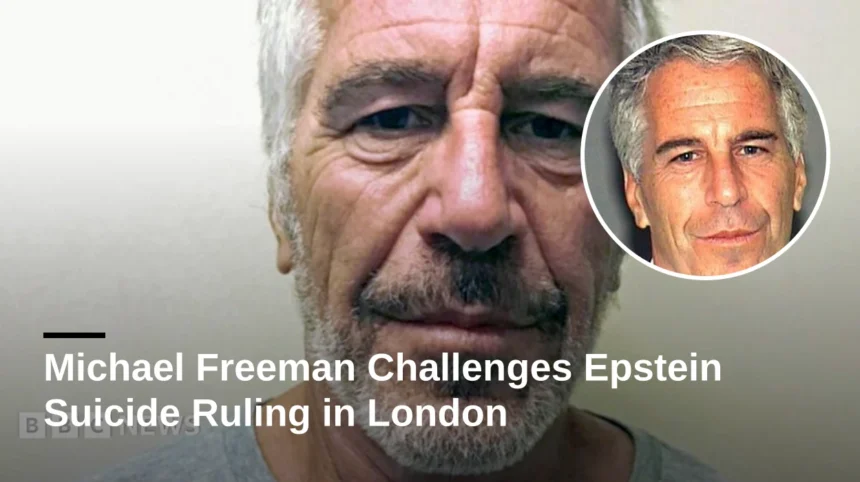
Key Points
- Forensic expert Michael Freeman says Jeffrey Epstein’s injuries are more consistent with homicide than suicide.
- Freeman presented his analysis in London after reviewing autopsy records, photographs and a biomechanical reconstruction.
- The New York City Office of Chief Medical Examiner continues to stand by its 2019 suicide ruling.
- Other experts and investigations have said the available evidence does not conclusively establish homicide.
- Failures involving prison records, cameras and evidence preservation continue to complicate the case.
London (CBS News) November 16, 2026 – Forensic medicine professor Michael Freeman has said Jeffrey Epstein’s 2019 prison death was more likely a homicide than a suicide, challenging the official ruling in New York. Freeman told CBS News that injuries documented in autopsy records and photographs were inconsistent with suicidal hanging and were better explained by strangulation from behind. He presented the analysis in London after working with Anders Eriksson and Itiel Dror, while acknowledging that forensic evidence can be interpreted differently by credible specialists.
Why does Michael Freeman question the suicide ruling?
As reported by CBS News, Freeman reviewed previously unpublished autopsy records supplied by Epstein’s brother, photographs and a three-dimensional biomechanical reconstruction. He said two separate marks on Epstein’s neck, injuries to the shoulder and back, and other abrasions were not adequately explained by hanging.
Freeman said the injury pattern was consistent with an assault and a struggle followed by homicidal strangulation using a narrow, knotted fabric ligature. He also said a piece of torn orange prison fabric found in Epstein’s cell could fit the markings more closely than the ligature identified by investigators.
BBC News reported that Freeman believes the ligature may have been used first to strangle Epstein and then to suspend his body from the bunk bed. Freeman said his conclusion was independent and that he was not paid by Epstein’s brother.
What is the official position on Epstein’s death?
The New York City Office of Chief Medical Examiner ruled in 2019 that Epstein died by suicide. A spokesperson said the office stands by that determination and did not directly respond to Freeman’s detailed claims.
Reporting by The Boston Globe noted that several investigations have failed to produce evidence that anyone other than Epstein was involved in his death. The newspaper also reported that the broader circumstances have been assessed by investigators as pointing to suicide.
Previous outside scrutiny came from forensic pathologist Michael Baden, who was hired by Epstein’s brother in 2020. Baden said injuries to Epstein’s neck raised doubts about the official finding and appeared more consistent with murder than suicide.
What problems affected the death investigation?
CBS News reported that Epstein’s body was removed from his cell soon after it was found, the cell was not sealed for a full forensic examination and many cameras in the prison wing were not operating. Investigators also did not immediately interview all relevant prison staff.
Justice Department records showed that some prison officers falsified records or lied about their activities. Corrections officer Michael Thomas, who found Epstein’s body, was interviewed only after he faced criminal charges and agreed to co-operate in exchange for leniency.
Freeman used Thomas’s later account, including his description of Epstein hanging from a bedpost, in the biomechanical reconstruction. Freeman said the investigation may have overlooked deep tissue bleeding in Epstein’s shoulder and other injuries.
What does the new analysis mean for the public debate?
The analysis is likely to renew public debate among people who question the official account of Epstein’s death, but it does not establish a new legal finding or identify a suspected killer. Freeman acknowledged that his report had been rejected by an academic journal and that he planned to resubmit it.
The New York Times previously reported, after reviewing newly released documents and Epstein’s handwritten notes, that there were indications he intended to end his life. It also found that nearly all forensic experts consulted believed the medical evidence alone could not conclusively determine whether the death was suicide or homicide.
Background
Jeffrey Epstein was found dead in a federal detention cell in Manhattan in August 2019 while awaiting trial on sex-trafficking charges. The New York City Office of Chief Medical Examiner conducted the autopsy and classified the death as suicide by hanging. The case was followed by investigations into prison staffing, falsified logs, malfunctioning cameras and evidence handling. Those failures fuelled continuing doubts even though no official investigation has overturned the suicide ruling.
What could the findings mean for the audience?
Freeman’s analysis may increase public demands for transparency and renewed examination of the evidence surrounding Epstein’s death. It may also intensify claims that the death was not suicide, despite the absence of a confirmed homicide finding or identified perpetrator. The conflicting interpretations show why the case remains disputed and why conclusions should distinguish between a forensic hypothesis and an official determination. Any formal change would require new verified evidence and action by the relevant investigative or medical authorities.