Key Points:
- Pedro’s Bridge in Bristol Harbour has been closed to pedestrians and maritime traffic following a major structural failure during routine testing.
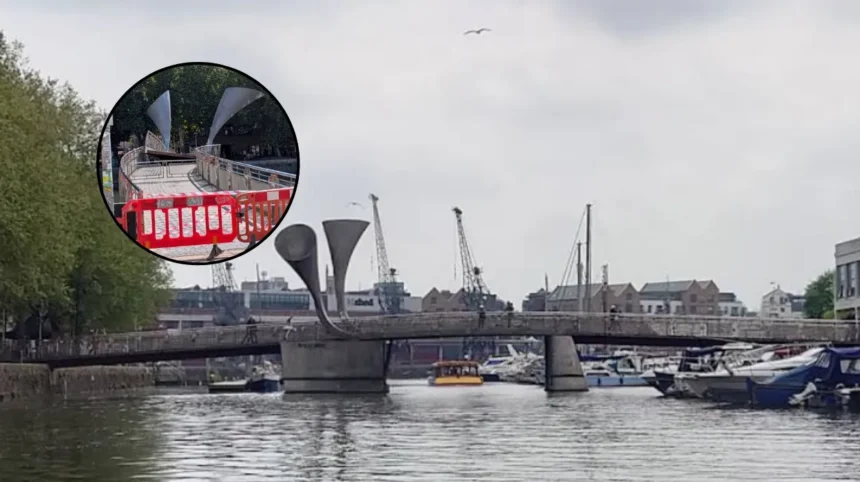
- The footbridge, which connects Narrow Quay and Canon’s Road, buckled and collapsed at an unusual angle at 11:00 BST on Thursday.
- The malfunction occurred as the mechanism descended after a routine lift operation designed to accommodate large vessels passing through the harbour.
- Authorities have cordoned off the immediate area to ensure public safety while structural engineers conduct a comprehensive evaluation.
- Pedro’s Bridge is widely recognised locally as a landmark feature adorned with traditional ‘love locks’ placed by residents and tourists.
Bristol (Bristol Express News) August 17, 2026 – Pedro’s Bridge, a key pedestrian crossing spanning Bristol Harbour, has been shut down with immediate effect following a severe mechanical failure and physical collapse during scheduled testing operations. The bridge, which provides a vital walking route between Narrow Quay and Canon’s Road, suffered critical structural damage at approximately 11:00 BST on Thursday morning. The incident took place during a routine test lift, a procedure conducted periodically to guarantee that the movable structure can open for tall ships navigating the waterway. Upon completing the lift sequence, the footbridge buckled unexpectedly during its descent, coming to rest at a stark and dangerous angle that prompted immediate safety interventions.
- Key Points:
- How Did the Structural Failure Occur During Routine Testing?
- What Safety Measures and Closures Are Currently in Place?
- What Is the Significance of Pedro’s Bridge to the Local Community?
- Background of Pedro’s Bridge and Bristol Harbour Infrastructure
- Prediction: How Will This Development Affect Local Residents and Visitors?
How Did the Structural Failure Occur During Routine Testing?
The malfunction developed during standard maintenance procedures intended to verify the health of the bridge’s mechanical lift system. Pedro’s Bridge is designed to open on occasion to facilitate the passage of large maritime traffic through the busy harbour corridor. According to municipal engineering staff present at the scene, the lifting phase proceeded without initial indication of distress. However, as the spans were lowered back into their lowered resting position, a major failure within the structural assembly caused the bridge frame to twist and settle unevenly. The resulting buckle left the deck misaligned and structurally compromised, forcing authorities to prevent all pedestrian access and halt maritime passage beneath the span until further notice.
What Safety Measures and Closures Are Currently in Place?
Safety teams and harbor officials acted rapidly to secure the site immediately following the 11:00 BST collapse. Cordon lines were established across both access approaches—at Narrow Quay and Canon’s Road—to prevent pedestrians from attempting to cross the damaged structure. In addition to land-based closures, harbour masters issued emergency navigation warnings to all watercraft operating within Bristol Harbour. Boats requiring a bridge lift are unable to transit through this specific section of the quay until the span can be safely stabilised, fully inspected, and repaired by specialist heavy-engineering contractors.
What Is the Significance of Pedro’s Bridge to the Local Community?
Pedro’s Bridge holds both practical and cultural value for the city of Bristol. Functionally, it serves as an important link for daily commuters, residents, and visitors navigating between key harbourfront cultural institutions, commercial businesses, and dining establishments. Beyond its role in pedestrian mobility, the footbridge has become famous locally as Bristol’s designated site for ‘love locks’, where couples attach engraved padlocks to the metal railings to symbolise their relationships. The sudden closure and visible damage to the span have drawn significant attention from passers-by and harbour users who rely on the crossing daily.
Background of Pedro’s Bridge and Bristol Harbour Infrastructure
The harbour infrastructure in Bristol relies heavily on a complex network of historic and modern swing bridges, bascule bridges, and footbridges designed to balance heavy foot traffic with active maritime navigation. Pedro’s Bridge was constructed to enhance pedestrian permeability across the Floating Harbour while retaining the essential capability to clear the channel for larger vessels, historic ships, and maintenance barges. Movable bridges of this type require stringent maintenance schedules due to the continuous exposure of their hydraulic, mechanical, and structural components to marine environments and load-bearing stresses. Routine test lifts are regularly scheduled by harbour authorities precisely to identify component wear before operational failures occur in public service.
Explore More Local Bristol News
Body Found in Search for Missing Bristol Student George Smyth, Romania 2026
New Chaiiwala Cafe Opening on Gloucester Road Bristol 2026
Prediction: How Will This Development Affect Local Residents and Visitors?
The prolonged closure of Pedro’s Bridge is expected to cause moderate disruption to pedestrian traffic, local harbour businesses, and maritime operators in the surrounding precinct.
- Pedestrian Commuters and Tourists: Daily walkers, joggers, and visitors moving between Narrow Quay and Canon’s Road will need to use alternative detours around the perimeter of the harbour basin. This will add extra travel time for foot traffic attempting to reach nearby harbourfront attractions, theatre venues, and food establishments.
- Local Harbour Businesses: Businesses situated directly along the footpaths on either end of the bridge may experience a temporary reduction in spontaneous footfall while the footbridge remains non-operational and cordoned off for heavy machinery access.
- Maritime Traffic: Vessel operators requiring tall-mast clearance through this segment of the harbour will face restricted movement until engineers can safely secure or raise the damaged span to clear the navigation channel.
- Community Cultural Assets: Local sentiment regarding the iconic ‘love locks’ will depend on the repair strategy chosen by engineers. If full structural replacement or major rail dismantling becomes necessary during the restoration work, authorities will need to manage public interest regarding the preservation or careful relocation of the attached locks.