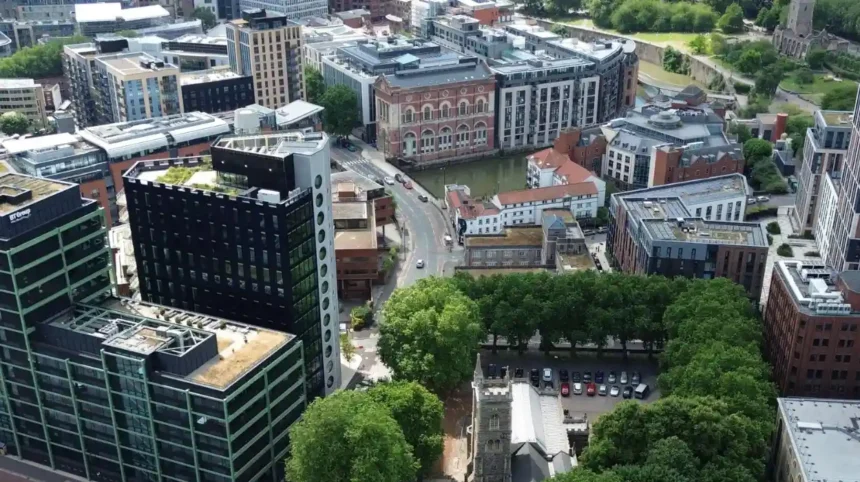
Bristol has one of the largest and most diverse employment economies in the South West of England. The city combines professional services, healthcare, education, technology, finance, engineering, retail, hospitality, public administration, construction and creative industries.
- What is the job market in Bristol like?
- How has Bristol’s job market developed?
- Which industries provide the most jobs in Bristol?
- What qualifications and skills are in demand in Bristol?
- How strong is employment in Bristol compared with the wider UK?
- What are salaries like in Bristol?
- How can people find jobs in Bristol?
- Which areas of Bristol have important employment opportunities?
- Which sectors are expected to shape Bristol’s future job market?
- What is the outlook for the Bristol job market?
The latest official labour-market data shows 263,500 Bristol residents were in employment between April 2025 and March 2026. The city had an estimated 352,000 total jobs in 2024, giving Bristol a jobs density of 1.01 jobs per working-age resident. This compares with 0.88 across the South West and 0.85 across Great Britain.
Bristol’s economy also has a high concentration of skilled employment. Professional occupations accounted for 39.5% of employment in the latest Annual Population Survey period, while managers, directors and senior officials accounted for 9.9%. Associate professional occupations represented a further 16.7%.
The city is therefore both a major employment centre and a significant regional source of skilled labour. Its labour market connects residents with employers across the wider West of England economy, including employment locations around Avonmouth, Filton, South Gloucestershire and surrounding areas.
What is the job market in Bristol like?
Bristol’s job market is a large, service-led employment economy covering professional services, health, education, technology, finance, retail, hospitality, public administration, construction, manufacturing and creative industries. In 2025–26, 263,500 residents were employed, while the city supported 352,000 jobs overall in Bristol.
The structure of employment makes Bristol different from a city dependent on one industry. Healthcare and social work, professional services, education, information technology, finance and administration all contribute substantial numbers of jobs.
Bristol also has an important industrial and logistics economy. Avonmouth provides industrial, distribution, manufacturing, energy and recycling employment close to the Port of Bristol. The city council identifies Avonmouth as a national distribution hub with access to transport infrastructure and employment space.
The city has 18,005 enterprises recorded in the 2025 UK Business Counts. Microbusinesses employing fewer than 10 people account for 15,590 enterprises, or 86.6% of the total. Small businesses employing between 10 and 49 people account for 1,955 enterprises. Medium businesses employing between 50 and 249 people account for 365 enterprises, while 90 large enterprises employ 250 or more people.
This business structure creates opportunities across different career stages. Large employers provide structured recruitment and graduate programmes. Smaller firms create opportunities in specialist services, entrepreneurship, technology, professional consultancy and creative work.
How has Bristol’s job market developed?
Bristol’s labour market developed from trade, manufacturing, engineering and financial services into a diversified economy centred on professional services, technology, health, education, media and culture. The city’s strategy builds on these strengths while targeting innovation, sustainability, skills and inclusive growth.
Bristol’s historical economy was strongly influenced by its port, maritime trade and manufacturing. Engineering became another important economic strength, particularly through the development of aviation and aerospace industries in the wider Bristol area.
Over time, the city’s economic base expanded beyond traditional industrial employment. Financial services, insurance, professional services, education, healthcare and technology became increasingly important.
The development of universities also strengthened Bristol’s role as a knowledge economy. The University of Bristol and UWE Bristol contribute graduates, research, innovation and specialist skills to employers across the city and wider region.
Bristol’s economic development strategy now focuses on three long-term ambitions: a fair economy, a green economy and a thriving economy. The strategy covers the period from 2025 to 2035 and places business growth, innovation, global connections, future skills and local wealth building among its delivery priorities.
The city’s economic transition is also visible in its sector profile. Traditional strengths such as advanced engineering remain important, while the council identifies high-tech industries, zero-carbon activity, professional services and creative and digital industries as major parts of the modern economy.
Which industries provide the most jobs in Bristol?
Health and social care, professional scientific and technical services, retail, education, information and communication, finance, hospitality, administration, public services and construction form parts of Bristol’s employment base. In 2024, health and social work had 48,000 jobs, while professional services had 45,000.
Human health and social work is Bristol’s largest employee-jobs sector. It accounted for 48,000 employee jobs in 2024, representing 15.5% of employee jobs. Examples include hospitals, nursing, social work, residential care, community care and other health-related services.
Professional, scientific and technical activities provided 45,000 employee jobs, or 14.5% of the city’s employee jobs. Examples include legal services, accountancy, consultancy, architecture, engineering, scientific research and specialist professional services.
Wholesale and retail trade provided 31,000 employee jobs. Examples include shops, supermarkets, vehicle sales and repair businesses, wholesalers and retail management.
Education accounted for 27,000 employee jobs. Examples include schools, colleges, universities, training organisations and education support services.
Information and communication accounted for 23,000 employee jobs. Examples include software development, telecommunications, publishing, digital services and technology businesses.
Administrative and support services also provided 23,000 employee jobs. Examples include business support, recruitment, facilities management, security, office administration and other outsourced services.
Accommodation and food services represented 22,000 employee jobs. Examples include hotels, restaurants, cafés, catering businesses and visitor-economy employers.
Financial and insurance activities provided 19,000 employee jobs. Examples include banking, insurance, financial advice, investment services and specialist financial operations.
Public administration and defence accounted for 17,000 employee jobs. Transport and storage provided 13,000, construction 11,000 and manufacturing 10,000.
The combination of these industries gives Bristol a broad employment base. A change in recruitment within one sector does not define the entire city labour market because employment is distributed across healthcare, professional services, technology, education, commerce, hospitality, government and industrial activity.
What qualifications and skills are in demand in Bristol?
Bristol has a highly qualified workforce and a concentration of professional occupations. In 2025, 60.4% of residents aged 16–64 held qualifications at RQF level 4 or above. Professional occupations represented 39.5% of employment, creating demand for specialist and technical skills.
RQF level 4 and above includes higher technical qualifications, higher education qualifications and degrees. Bristol had 191,600 residents aged 16–64 with qualifications at this level in 2025.
A further 246,000 residents had qualifications at RQF level 3 or above. Overall, 91.3% had qualifications at RQF level 2 or above, while 4.2% had no qualifications.
The high qualification profile supports employment in professional, managerial and technical occupations. Bristol had 104,100 people working in professional occupations during April 2025 to March 2026. Associate professional occupations accounted for another 44,100 people.
Examples of professional roles include engineers, accountants, lawyers, healthcare professionals, scientists, teachers, software specialists and business consultants.
Digital skills are increasingly important across sectors rather than only within technology companies. Employers in finance, healthcare, professional services, government, education and creative industries all use digital systems and data.
Bristol’s economic strategy identifies future skills as a major priority. The city intends to work with employers and skills providers to prepare local people for future employment and improve access to jobs in priority sectors.
The city’s high-tech economy also creates demand for specialist capabilities. Bristol’s economic strategy identifies cyber, technology, clean energy, media, culture and innovation as particular strengths.
Skills development therefore applies to both new entrants and experienced workers. Relevant pathways include university degrees, apprenticeships, vocational qualifications, professional certifications, technical training and employer-based development.
How strong is employment in Bristol compared with the wider UK?
Bristol’s employment performance is stronger than Great Britain on several headline measures. Between April 2025 and March 2026, 79.8% of working-age residents were employed and 83.8% were economically active. Model-based unemployment was 4.2%, compared with 4.5% across Great Britain overall.
Bristol’s employment rate was 79.8% for people aged 16–64 during April 2025 to March 2026. The equivalent South West rate was 79.0%, while the Great Britain rate was 75.5%.
The economic activity rate was 83.8%, compared with 81.8% in the South West and 79.1% across Great Britain.
Model-based unemployment was 4.2%. Bristol’s Annual Population Survey estimate was 4.7%, although the Office for National Statistics recommends model-based estimates where local survey samples are small.
Economic inactivity was 16.2% among Bristol residents aged 16–64. Students accounted for 18,000 economically inactive residents, while 11,200 were looking after family or home. A further 9,800 were classified as long-term sick.
The city’s employment picture therefore includes both people in work and people outside the labour force. Economic inactivity is an important measure because it identifies potential labour supply that is not captured by unemployment statistics.
Bristol’s local health and wellbeing analysis recorded 11,600 unemployed people and 14,900 economically inactive people who wanted a job in the twelve months ending December 2025. Together, this represented 26,500 people who were involuntarily workless.
Youth labour-market conditions are also significant. In March 2026, Bristol had 2,530 out-of-work benefit claimants aged 18 to 24, representing 3.4% of that age group. The local rate was below the national rate of 5.8%.
What are salaries like in Bristol?
Pay in Bristol is above the South West average and close to Great Britain levels. In 2025, median full-time weekly pay for residents was £780.50, while workplace pay was £837.70. Pay varies by occupation, qualification, experience, industry and working pattern.
The 2025 median gross weekly pay for full-time employees living in Bristol was £780.50. The equivalent South West figure was £734.00, while Great Britain’s figure was £766.60.
Workplace analysis provides another measure. Employees working in Bristol had median full-time weekly pay of £837.70 in 2025. The South West figure was £728.70 and the Great Britain figure was £766.60.
The difference between resident and workplace earnings is important. Resident earnings measure people who live in Bristol regardless of where they work. Workplace earnings measure employees whose workplace is located in Bristol.
Hourly pay also exceeded regional and national benchmarks. Median full-time hourly pay excluding overtime was £20.74 for Bristol residents and £21.98 for employees working in Bristol. Great Britain’s equivalent figure was £19.74.
Salary levels differ substantially across occupations. Professional, managerial, scientific, technology and financial roles generally require higher qualifications and specialist experience. Entry-level retail, hospitality and some service positions typically operate at different salary levels.
Full-time and part-time work also produce different earnings patterns. Bristol had approximately 216,000 full-time employee jobs and 93,000 part-time employee jobs in 2024.
Salary comparisons should therefore consider occupation, hours, location, experience and employment status rather than using one city-wide figure as a universal wage.
How can people find jobs in Bristol?
People searching for work in Bristol can use employers, recruitment agencies, professional networks, universities, training providers, the council and government employment services. Effective searches combine targeted applications with skills development, clear evidence of experience and monitoring of vacancies across industries.
The Bristol job search process begins with identifying suitable occupations and sectors. A candidate looking for software work should search technology and digital employers. A healthcare applicant should focus on hospitals, care organisations and health providers. A graduate should also examine graduate schemes and entry-level professional roles.
Bristol City Council operates its own jobs and careers service for council vacancies and provides email alerts for new positions. Separate opportunities exist for schools and education-related employment.
Universities are another important source of employment and skills development. The University of Bristol and UWE Bristol connect graduates with employers through careers services, professional networks, placements and industry engagement.
Recruitment agencies provide another route into employment. They are particularly relevant for temporary work, administrative positions, professional recruitment, specialist technical roles and sectors with high volumes of vacancies.
A strong application should connect qualifications and experience directly to the advertised requirements. A CV should identify relevant employment history, qualifications, technical skills and measurable achievements.
Skills development can improve access to occupations experiencing recruitment demand. Training can include digital skills, technical qualifications, professional certifications, apprenticeships and sector-specific education.
The local labour market also supports self-employment and entrepreneurship. Bristol’s 2025 business base contains thousands of microenterprises, demonstrating the importance of small businesses within the city’s employment structure.
Networking is particularly relevant in a professional economy. Industry events, university networks, professional associations, employer presentations and business communities can connect jobseekers with organisations before formal recruitment campaigns begin.
Which areas of Bristol have important employment opportunities?
Employment is distributed across Bristol’s city centre, business districts, industrial areas, healthcare sites, education campuses and regeneration locations. Avonmouth is important for industry and logistics, while central Bristol has strong professional, financial, technology, cultural, retail and hospitality employment.
Central Bristol contains a high concentration of offices, professional services, financial businesses, retail, hospitality, public services, cultural organisations and technology companies.
The city centre also remains an important regeneration area. Bristol’s economic strategy links employment growth with new commercial space, improved connectivity and regeneration.
Avonmouth provides a different employment profile. The area contains distribution, manufacturing, energy and recycling businesses and benefits from its position near the Port of Bristol.
The wider West of England labour market is also relevant to Bristol residents. The combined area had approximately 654,000 total jobs and a jobs density of 0.97 in 2024.
This wider economy includes employment around Bristol, South Gloucestershire and other neighbouring areas. Aerospace, advanced engineering and industrial employment are particularly important around the northern edge of the Bristol urban area.
Regeneration is another employment factor. The city council estimates that the local economy could gain between 31,000 and 53,000 additional jobs by 2043. Accommodating this growth would require approximately 164,000 square metres of office and research-and-development space and another 164,000 square metres of industrial and warehousing space.
Employment geography therefore changes as businesses expand, new developments are completed and transport infrastructure evolves.
Explore More Area Guide
Business Networking in Bristol: Complete Guide 2026
Bristol Startup Scene: Innovation and Growth 2026
Which sectors are expected to shape Bristol’s future job market?
Bristol’s job market is positioned for change through technology, artificial intelligence, clean energy, infrastructure, regeneration, health innovation and skills investment. The city’s 2025–2035 strategy targets a green and thriving economy, while planning evidence projects 31,000 to 53,000 jobs by 2043.
Technology is central to Bristol’s future employment profile. The city has established strengths in digital technology and cyber industries, with digital infrastructure supporting businesses, workers and residents.
Artificial intelligence is also changing the skills requirements of professional and technical occupations. AI tools increasingly affect software development, data analysis, marketing, finance, research, administration and creative production. Workers therefore require both occupation-specific expertise and the ability to use emerging digital systems.
Clean energy represents another strategic area. Bristol’s economic plans connect economic development with the transition to a low-carbon economy. Future employment includes energy infrastructure, building efficiency, renewable energy, transport electrification, engineering and environmental services.
The city’s net-zero programme also creates demand for construction and technical skills. Infrastructure investment can require engineers, electricians, planners, project managers, construction workers, energy specialists and environmental professionals.
Health innovation is supported by Bristol’s large health and social work employment base. The sector already accounts for 48,000 employee jobs, creating a substantial foundation for medical research, healthcare delivery, social care and health technology.
Creative and cultural industries remain part of Bristol’s economic identity. Media, film, television, design, music, arts and related professional services contribute to the city’s diversified economy.
Bristol’s international connections also support employment. The city’s economic strategy records citizens born in more than 187 countries and identifies international investment as an important economic opportunity. In 2022–23, 36 foreign direct investment projects were recorded in the Bristol and West of England LEP area, creating more than 1,400 jobs.
Future employment growth therefore depends on several connected factors: business investment, infrastructure, skills, innovation, housing, transport, access to employment space and the ability of residents to obtain relevant qualifications.
What is the outlook for the Bristol job market?
Bristol has a diversified labour market, high employment, strong professional representation and a large regional jobs base. Future growth is linked to technology, clean energy, health, professional services, regeneration and skills, with local planning evidence projecting substantial employment growth through 2043.
Bristol enters the next phase of economic development from a relatively strong labour-market position. The city has more jobs than its working-age population would require for a one-to-one local employment ratio, reflected in its 1.01 jobs-density figure for 2024.
The high concentration of professional employment is another structural advantage. At the same time, healthcare, education, retail, hospitality, administration, construction, transport and manufacturing provide employment across different qualification levels.
The city’s economic strategy for 2025–2035 establishes a long-term framework for supporting business growth, innovation, future skills, global investment, local wealth building and sustainable economic development.
Employment growth also requires suitable commercial space. Bristol’s planning evidence projects between 31,000 and 53,000 additional jobs by 2043. The city has identified requirements for new office, research and development, industrial and warehousing space to support this expansion.
The future Bristol job market will therefore depend on how effectively economic growth translates into accessible employment. Skills programmes, transport connections, affordable housing, business investment and employment space all influence whether residents can benefit from new jobs.
For jobseekers, the most relevant long-term approach is to develop transferable skills alongside occupation-specific expertise. Digital literacy, technical competence, communication, problem-solving and professional qualifications remain useful across multiple sectors.
For employers, Bristol’s large qualified workforce provides a substantial recruitment pool. For policymakers, the central challenge is ensuring that economic growth produces accessible and well-paid employment across the city.
Bristol’s labour market is therefore best understood as a diversified regional employment system rather than a single industry job market. Its established strengths in health, professional services, education, technology, finance, engineering, creative industries and commerce provide the foundation for future employment growth.
What is the job market like in Bristol?
Bristol has a diverse job market covering healthcare, professional services, technology, education, finance, engineering, retail, hospitality, construction and creative industries.