Key Points
- Major Route Overhaul: A total of 25 bus services travelling through Bristol city centre are being rerouted, marking the largest network overhaul in the central shopping district for years.
- Effective Date: The changes take effect on Sunday 30 August, with commuters returning from the August Bank Holiday on Tuesday experiencing the revised network for the first time.
- Permanent Closures: All existing bus stops on Union Street, The Horsefair, and Penn Street are closing permanently to traffic as part of Bristol City Council’s project to pedestrianise the heart of Broadmead.
- New Stopping Locations: Passengers will be directed to alternative and newly constructed bus stops located on Fairfax Street, Broad Weir, Lower Castle Street, Rupert Street, and Bond Street.
- Service Alterations: Key services, including the numbers 1, 2, 3, 4, 5, 6, 7, and 8, will follow revised routes through the city centre, with some overnight services such as the number 1 experiencing reductions.
- Long-Term Regeneration: The transport shake-up forms part of the wider Bristol on the Move City Centre project, designed to facilitate major residential, commercial, and leisure developments in Broadmead.
Bristol (Bristol Express News) August 28, 2026 – A major transport overhaul is set to transform travel across central Bristol, as Bristol City Council and local transport operators implement the largest reorganization of city centre bus services in years. Beginning on Sunday 30 August, a total of 25 bus routes through the primary shopping precinct of Broadmead will be diverted onto new corridors, removing public transport from key central thoroughfares. The operational shift will be fully tested on Tuesday 1 September, when regular commuters return to work following the August Bank Holiday weekend.
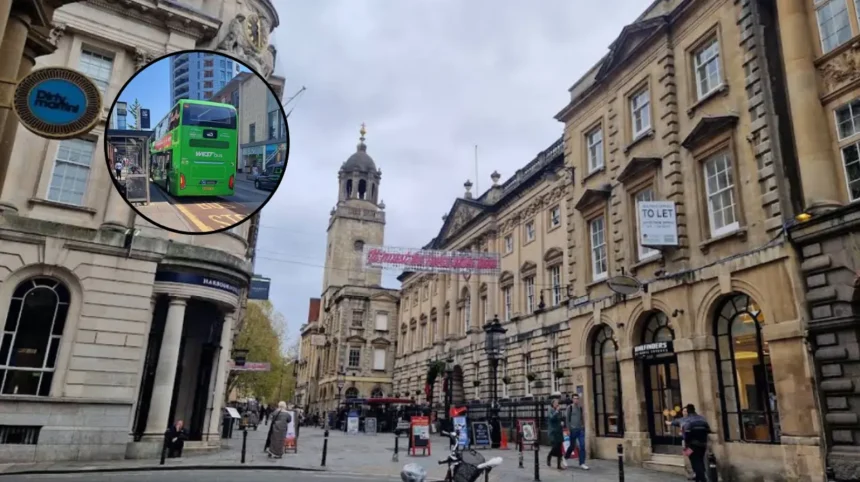
Under the scheme, all existing bus stops located along Union Street, The Horsefair, and Penn Street will cease operations. Union Street will undergo temporary closures during initial construction, whilst The Horsefair and Penn Street will be closed permanently to general vehicular traffic and public transport. Buses that previously traversed the core of Broadmead are being redirected to updated and newly created stopping infrastructure situated on surrounding streets, including Fairfax Street, Lower Castle Street, Broad Weir, Rupert Street, and Bond Street.
Which bus routes are changing in Bristol city centre?
As reported by Chief Reporter Tristan Cork of the Bristol Post, the network reorganisation impacts a broad array of key municipal routes connecting the city centre with outer suburbs and regional hubs.
Under the revised operational plan, services 1, 2, and 2a, which connect Cribbs Causeway with Broomhill, Stockwood, and Brentry, will operate on split loops through the city centre. Southbound services heading towards Broomhill and Stockwood will no longer serve stops B11 on The Horsefair or S10 on Broad Weir. Instead, they will run via The Centre, servicing stop B3 on Fairfax Street and stop B18 on Wine Street, before continuing along Victoria Street. Northbound journeys towards Cribbs Causeway and Brentry will bypass Union Street stop B12, travelling instead via Temple Way, Bond Street South, Bond Street, Rupert Street, and The Centre. Additionally, First Bus confirmed that the overnight number 1 service will be reduced, ceasing operations from Monday to Thursday nights due to low passenger usage, while retaining Friday and Saturday night runs.
Services 3 and 4, operating between Cribbs Causeway and Bristol City Centre, will terminate at Nelson Street after calling at the Hippodrome on inward journeys. Inbound passenger pick-ups for outward journeys will commence at stop B6 on Rupert Street before running through The Centre.
Service 5, which runs between Stoke Bishop and St Anne’s, will no longer call at stop B15 on The Horsefair or S9 on Penn Street. Inbound journeys towards St Anne’s will instead run via Nelson Street, passing beneath The Galleries via Fairfax Street, and stopping at a newly designated location on Lower Castle Street.
Services 6 and 7, connecting Kingswood with the city centre, will follow a similar diversion path for journeys leaving the city, utilizing Nelson Street, Fairfax Street, and Broad Weir to access new facilities on Lower Castle Street, whilst inward journeys remain unaffected.
Service 8, connecting Bristol Temple Meads with Clifton, will run through the city centre via Baldwin Street and Castle Park. From 8 September, coinciding with the opening of the new Temple Quarter university campus and eastern station entrance, the service will adopt a loop route around Temple Meads, calling at new stops along Temple Way and Avon Street via the Cattle Market Road tunnel.
Why is Bristol City Council rerouting public transport away from Broadmead?
As detailed by local authority releases and statements from key transport officials, the rerouting forms a foundational phase of the wider Bristol on the Move City Centre Development and Delivery Plan. The strategy aims to transform the primary commercial precinct from a transit corridor into a pedestrianised district designed to accommodate surrounding urban regeneration.
According to statements provided by Councillor Ed Plowden, Chair of Bristol City Council’s Transport and Connectivity Committee, the relocation of bus traffic is necessary to facilitate civil engineering works and create enhanced public spaces. Councillor Plowden stated:
“Moving buses away from some of Broadmead’s busiest shopping streets will allow us to create new public spaces, with planting, trees and seating areas, new public art and space for community events, while supporting wider plans for the city centre.”
Addressing accessibility concerns raised during public consultations, Councillor Plowden added:
“Having listened to concerns from disabled persons’ groups and Disabled people, we also want to reassure everyone that we are providing new disabled parking bays for Blue Badge holders and accessible taxi ranks and, much like our approach to replacing bus stops, we will not close any of these facilities before opening replacements.”
Head of Network for First Bus, George Burton, outlined the operational collaboration required to implement the new network layout. As reported by First Bus media relations, George Burton stated:
“We have worked closely with Bristol City Council and the Combined Authority to plan these routes and keep diversions as simple as possible. We will continue to support our local partners to help customers travel with confidence as the new routes settle in and people become familiar with the changes.”
Background of the particular development
The pedestrianisation of The Horsefair and Penn Street represents a long-planned structural change to central Bristol’s urban design, outlined within the Bristol City Centre Development and Delivery Plan (DDP). For several decades, Broadmead served as both a primary retail district and a central transfer node for the city’s bus operations. High volumes of bus traffic moving through narrow retail streets generated significant pedestrian congestion and safety concerns along The Horsefair and Union Street.
In recent years, Bristol City Council, in partnership with the West of England Mayoral Combined Authority, formulated plans to shift public transit to an outer perimeter loop. This strategy was designed to free up central public space to support major urban renewal projects, including the planned construction of thousands of new homes, commercial sites, and upgraded leisure environments across the central core.
To prepare the public for the operational transition, the council and transport partners launched the Broadmead Bus Changes information campaign in July 2026. The initiative deployed revised map displays, targeted digital notices, and deployed uniformed travel advisors to key stops along Union Street, The Horsefair, and Penn Street to distribute guidance and assist passengers ahead of the 30 August implementation date.
Explore More City Centre News
Non-Smoker Convicted in Mistaken Identity Cigarette Fine Case Bristol 2026
The Coconut Tree Expands to Broad Quay, Bristol City Centre 2026
Prediction: How this development will affect local commuters, shoppers, and local businesses
The implementation of the Broadmead bus diversions will directly impact daily transit patterns for tens of thousands of local commuters, high-street shoppers, and regional visitors, while fundamentally altering physical access to central commercial premises.
For daily commuters and public transport passengers, the initial operational phase is expected to cause increased walking distances and brief journey delays as passengers adapt to relocated stop positions on Fairfax Street, Lower Castle Street, and Bond Street. Passengers accustomed to alighting directly outside major retail hubs on Union Street and The Horsefair will now face longer foot journeys to access central retail destinations. In the longer term, the consolidation of bus routes onto higher-capacity perimeter roads such as Bond Street and Temple Way is intended to improve transit punctuality by removing buses from congested pedestrian zones.
For local retailers and commercial businesses within Broadmead, the structural changes present both short-term operational adjustments and potential long-term commercial opportunities. During the immediate construction and pedestrianisation phase, footfall along The Horsefair may experience temporary fluctuations as transit passengers no longer disembark directly in front of storefronts. However, the eventual transition to a fully pedestrianised boulevard with enhanced public realm features, outdoor seating, and green infrastructure is projected by town planners to increase dwell time and create a safer, more attractive environment for shoppers and future residents.