Key Points
- A new £23 million eastern entrance at Bristol Temple Meads station is officially set to open on Monday 7 September.
- The project provides direct access to the University of Bristol’s new Temple Quarter Enterprise Campus and improves connectivity for St Philip’s Marsh and eastern Bristol.
- The gateway is projected to serve approximately 2.5 million passengers annually by 2030, forming a fundamental part of plans to double the station’s capacity.
- Funded via a portion of a £94.7 million Government grant awarded to the West of England Mayoral Combined Authority (WECA), it is the first of three planned new entrances.
- Engineering required Network Rail to extend the station subway beneath platforms 13 and 15, involving complex structural excavation, drainage, and foundation works.
- Main building works were completed in October 2024 following the start of construction in late 2023, prior to the scheduled launch alongside the new university campus.
- Local transport will adjust from Tuesday 8 September, with the service 8 bus rerouted to serve a new stop on Cattle Market Road, ending its use of Station Approach.
- The development forms part of the broader Bristol Temple Quarter regeneration project, managed by Bristol Temple Quarter LLP alongside Network Rail, Bristol City Council, WECA, the University of Bristol, and Homes England.
Bristol (Bristol Express News) September 2, 2026 – Bristol Temple Meads’s new eastern entrance is officially set to open on Monday 7 September, marking a major milestone in the station’s ongoing transformation.
- Key Points
- When Will the New Gateway Open to Passengers?
- How Was the Scheme Funded and Delivered?
- Who Are the Strategic Partners Behind the Project?
- How Will Local Bus Routes and Access Be Affected?
- What Did Key Transport and Regional Leaders Say?
- Background of the Particular Development
- Prediction: How This Development Can Affect Rail Passengers, Students, and Local Businesses
When Will the New Gateway Open to Passengers?
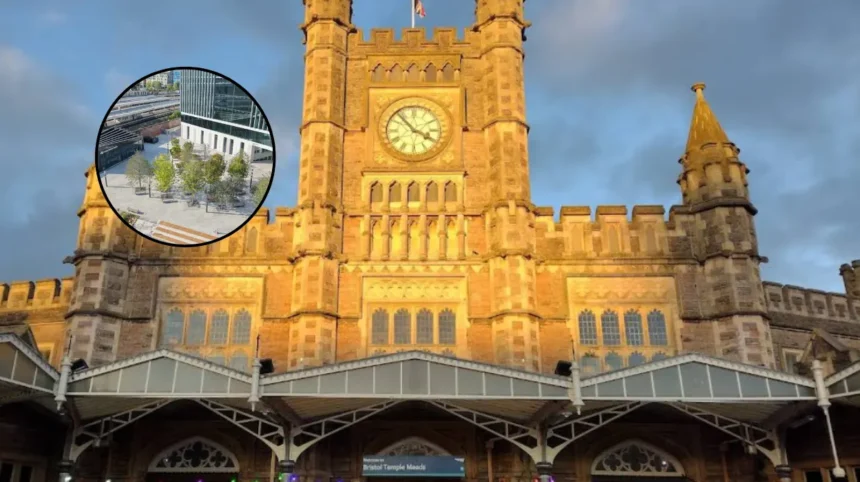
As reported by transport journalists covering the regional infrastructure, the brand-new £23 million eastern entrance will open to rail passengers on Monday 7 September. Delivered by Network Rail in close collaboration with the Bristol Temple Quarter partners, the gateway provides direct pedestrian access between Bristol Temple Meads and the University of Bristol’s new Temple Quarter Enterprise Campus. Beyond serving the university site, the multi-million-pound structure aims to significantly improve pedestrian and commuter links for businesses and residential communities in St Philip’s Marsh and across the eastern side of the city.
The new entrance is projected to handle roughly 2.5 million passengers each year by 2030. Rail planners confirm that the addition forms an essential part of a long-term strategic programme designed to double the overall passenger capacity at the West of England’s busiest railway hub.
How Was the Scheme Funded and Delivered?
As reported by regional infrastructure correspondents, the scheme represents the first of three new planned entrances for the historic railway station. The construction was financed through a portion of a £94.7 million Government funding grant originally secured by the West of England Mayoral Combined Authority (WECA).
Delivery of the project required substantial civil engineering operations led by Network Rail. To create the physical connection, engineering teams had to extend the existing station subway directly beneath platforms 13 and 15. The complex process required excavating through historical railway structures before workers could complete major foundation, drainage, and internal station improvement works. Physical groundwork first commenced in late 2023, with the primary structural building works finishing in October 2024 ahead of the formal operational opening alongside the University of Bristol’s Enterprise Campus development.
Who Are the Strategic Partners Behind the Project?
As reported by economic development reporters, the transformation of Bristol Temple Meads operates as a key physical anchor for the broader Bristol Temple Quarter regeneration programme. Positioned as one of the largest urban regeneration schemes in Europe, the overarching project targets the delivery of thousands of new homes, employment opportunities, and commercial developments across Bristol and the wider West of England area.
The delivery structure is governed through a joint collaboration between WECA and Bristol City Council, who established the dedicated delivery vehicle, Bristol Temple Quarter LLP, in 2024. The entity works alongside key strategic stakeholders including Network Rail, the University of Bristol, and Homes England to align transport infrastructure with regional development goals.
How Will Local Bus Routes and Access Be Affected?
As reported by local transit reporters, the opening of the rail entrance will trigger immediate adjustments to surrounding public transport networks. On Tuesday 8 September, the day following the rail entrance launch, the service 8 bus route—which connects Bristol Temple Meads to Clifton—will adjust its routing to serve the new eastern gateway directly.
The service will begin picking up and setting down passengers at a newly constructed bus stop located on Cattle Market Road, adjacent to the University of Bristol Temple Quarter campus. This operational shift will officially mark the end of the service 8 bus using the traditional Station Approach layout.
What Did Key Transport and Regional Leaders Say?
As reported by official transport statements released regarding the project, Marcus Jones, Network Rail’s Great Western route director, stated that:
“Bristol Temple Meads has been at the heart of the city since it opened in 1840, and this new entrance ensures it will play an even greater role in its future. By connecting the railway directly to the Temple Quarter Enterprise Campus and one of the UK’s most exciting innovation districts, we’re connecting new jobs, investment and economic growth to the rest of the West and beyond.”
Marcus Jones further stated that:
“This milestone reflects more than a decade of collaboration between partners with a shared ambition for Bristol Temple Quarter. Together, we’re transforming connectivity, unlocking development and creating a gateway that will support the region’s growth for decades to come.”
Background of the Particular Development
Bristol Temple Meads, designed by Isambard Kingdom Brunel and opened in 1840, has historically suffered from access limitations due to its geographical layout and surrounding water channels. For over a century, passenger access was largely constrained to the western side of the station via Station Approach. This layout created a disconnect between the rail network and the industrial areas of eastern Bristol, such as St Philip’s Marsh.
As industrial land in St Philip’s Marsh was earmarked for urban renewal, local councils and regional bodies identified rail connectivity as a primary bottleneck. Plans to open up the eastern side of the station gained traction over a decade ago as part of masterplanning for the Temple Quarter. The ambition accelerated significantly when the former Royal Mail sorting office site adjacent to the station was demolished to make way for the University of Bristol’s new Enterprise Campus. Funding secured by WECA in 2022 provided the capital required to commence structural subterranean engineering beneath active platforms, culminating in the completed eastern access point.
Prediction: How This Development Can Affect Rail Passengers, Students, and Local Businesses
The operational opening of the eastern entrance is set to alter daily transit patterns for several distinct user groups across the West of England:
- University Students and Academic Staff: Direct access from platform subways to the Temple Quarter Enterprise Campus eliminates lengthy walking detours around the perimeter of the station, reducing journey times significantly for daily commuters travelling from London, Bath, and the wider region.
- Rail Passengers and Commuters: By redirecting a estimated 2.5 million passengers annually through the eastern side by 2030, pedestrian congestion inside the main historic concourse and along Station Approach will lessen. Commuters accessing eastern districts will experience direct street-level connections.
- Local Businesses in St Philip’s Marsh and East Bristol: Improved footfall and direct transit links are anticipated to accelerate commercial investment in St Philip’s Marsh, transforming the area from light industrial use into an integrated commercial and innovation district.
- Bus Users and Local Drivers: The rerouting of the service 8 bus to Cattle Market Road will redistribute vehicular traffic away from the tight confines of Station Approach, altering drop-off zones and localized traffic flow around the perimeter of the station.