Key Points
- Proposed Injunction: The Bristol City Council is contemplating the use of a High Court injunction to stop any flag flying without authorisation on public lampposts and furniture, similar to what Oxfordshire County Council recently did.
- Game of Cat and Mouse: The city council officers complain that highways contractors hired by the council keep removing the flags, but activists put them back again.
- Safety Concerns and Warning: Liberal Democrat Councillor Stephen Williams pointed out the safety concerns related to the deaths that occurred earlier this year because of the erection of flags on public infrastructure. Also, people who ignore the injunction may find themselves in jail or fined, as well as their property seized.
- Regional Position: South Gloucestershire Council is adopting the same tough stance by making all unauthorised flags on highways infrastructure unauthorised and removing them immediately without warning.
- Further Actions: Additional information about the planned legal action will be made at the next meeting of the Bristol City Council public health and communities committee on October 15, after discussions with their Oxfordshire counterparts.
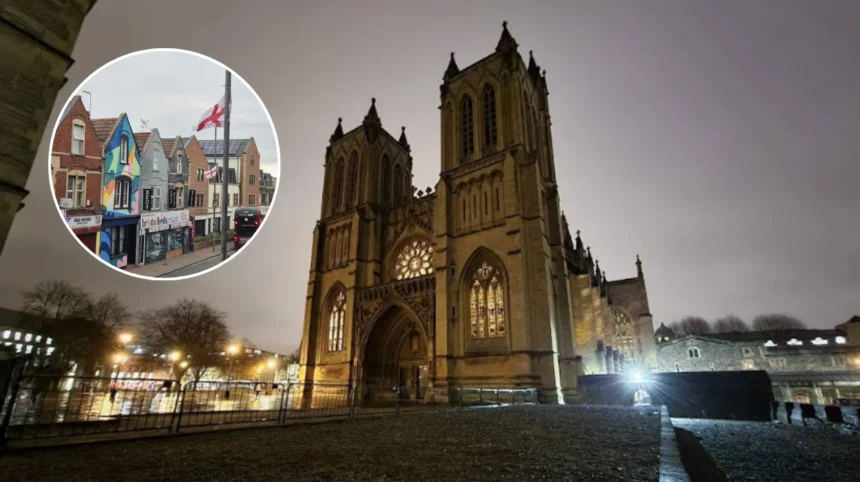
Bristol (Bristol Express News) September 15, 2026 — As reported by Adam Postans of Bristol Live, Bristol City Council could follow Oxfordshire’s lead by seeking a High Court injunction to stop the unauthorised flying of flags on public lampposts. City Hall leaders, who have previously maintained a relatively soft stance compared to other local authorities, have grown frustrated with a continuous cycle of removing flags, such as the St George’s Cross and Union Flags, only for activists to erect them again.
As detailed by Adam Postans of Bristol Live, the local authority is now examining the measures taken by Oxfordshire County Council, which secured a High Court injunction this summer to prohibit flags on public furniture, including railings and lampposts. Under that legal framework, any individual breaching the order faces potential imprisonment, financial penalties, or the seizure of their assets.
Addressing the Bristol City Council public health and communities committee, committee chair Councillor Stephen Williams stated that officials are systematically taking down flags at sensitive locations. As quoted by Adam Postans of Bristol Live, Councillor Stephen Williams stated that:
“We are taking down flags systematically at sensitive locations, such as outside schools, places of worship and other public buildings such as community centres.”
Councillor Stephen Williams further added, as reported by Adam Postans of Bristol Live, that:
“I’ve been saying repeatedly that I want to see the flags gradually come down. Unfortunately we’re in a situation where our highways contractors have taken down hundreds of flags, they pretty soon go up again, so we’re in a cat-and-mouse situation.”
According to Adam Postans of Bristol Live, Councillor Stephen Williams confirmed that a stronger approach has been agreed upon alongside council leader and Green Councillor Tony Dyer. As reported by Adam Postans of Bristol Live, Councillor Stephen Williams stated:
“The time has come – it has been decided by me and the leader – that we’re going to have to be more robust about the action we take. We are studying very carefully and we’re in close contact with political colleagues and officer colleagues in Oxfordshire who have taken a more robust approach, and we will have more to say about that at the next meeting.”
The next session of the committee is scheduled for October 15.
Meanwhile, neighbouring South Gloucestershire Council has already implemented a strict policy regarding flags tied to public infrastructure. As noted in reporting by Adam Postans of Bristol Live, South Gloucestershire Council described such displays as divisive, stating earlier this summer:
“We will treat all flags attached to highway infrastructure as unauthorised. These items will be removed within a reasonable timeframe and without prior notice.”
South Gloucestershire Council co-leaders Councillor Maggie Tyrell and Councillor Ian Boulton explained that while national flags can symbolise unity and pride during major celebrations, their placement in unauthorised contexts has caused concern. As documented by Adam Postans of Bristol Live, Councillor Maggie Tyrell and Councillor Ian Boulton stated:
“We recognise that national flags can bring vibrancy, pride and a sense of unity to our communities – especially during major events and periods of national celebration. The Union Flag and the St George’s Cross are symbols that belong to everyone. However, their placement in unauthorised locations and recent campaigns and behaviours linked to the unauthorised display of flags have caused genuine concern among many residents.”
Speaking on Friday, September 12, Councillor Stephen Williams emphasised that the issue extends beyond politics into public safety. As reported by Adam Postans of Bristol Live, Councillor Stephen Williams stated:
“Flags are a serious matter. There is divided opinion about the meaning of people putting up flags on council lampposts or railings. On the face of it there is nothing wrong whatsoever with people showing the Union Flag, the flag of St George or indeed the Welsh flag or the Scottish flag or any other flag. What is wrong is people unilaterally deciding that they’re going to erect those flags or other symbols or statements on public property, not their own property, and in particular on lampposts it is dangerous to do so. We know there was a tragic death as a result of that earlier this year. The policy is that people should not be doing this, they should not be erecting flags on public lampposts or public land.”
Explore more Local Bristol News:
Clifton Suspension Bridge Off-Peak Closure in Clifton 2026
Bristol Council Bans Fast Fashion and High Carbon Adverts in 2026
Background of the Particular Development
The debate surrounding the display of national flags on public infrastructure has intensified across various local authorities in England over recent months. Local councils have increasingly grappled with the tension between freedom of expression, community identity, and the practical management of public highways. Unauthorised attachments to lampposts, bridges, and traffic signs have historically created maintenance backlogs and safety concerns, as council contractors are regularly required to clear items that could pose risks to pedestrians, drivers, or utility workers.
In response to repetitive installations by activists and local groups, authorities like Oxfordshire County Council turned to the High Court to establish legal deterrents. By securing civil injunctions, councils aim to bypass slower administrative removal processes, attaching immediate legal consequences—such as contempt of court charges—to anyone caught affixing items to public property. This escalation reflects a growing regional shift toward tighter regulatory enforcement regarding public furniture and municipal assets.
How This Development Can Affect Residents and Local Activists
If Bristol City Council proceeds with seeking a High Court injunction, the legal landscape surrounding public spaces in Bristol will change significantly for local residents, community groups, and activists.
- For Local Activists and Protesters: The introduction of a High Court injunction would remove the relative leniency of traditional council removal policies. Activists attempting to hang flags on public lampposts or railings would no longer face merely the removal of their materials by highways contractors, but direct legal jeopardy, including potential fines, asset seizures, or imprisonment for contempt of court. This is likely to act as a powerful deterrent, sharply reducing the number of unauthorised displays in public view.
- For the General Public and Local Communities: Residents may notice a cleaner public realm around sensitive locations such as schools, places of worship, and community centres. However, the move could also polarise local opinion further. While residents concerned about unauthorised alterations to public property will likely welcome increased order and safety, others who view flag-flying as a legitimate form of public expression or patriotism may perceive the legal crackdown as heavy-handed, potentially fueling ongoing local debates regarding identity, free speech, and the management of municipal spaces.