Key Points
- Project Initiation: Work is due to start early next year for the official closure of Denmark Street in the city center of Bristol for any privately owned vehicles.
- Project Goals: The project plans are intended to create a safe, accessible, and visually appealing environment for theatre attendees, pedestrians, and local foodies.
- Historical Overview: A trial period which was conducted from March 2022 until September 2023 saw the restriction of vehicle movement on Denmark Street to increase local economic footfall.
- Infrastructure: The plan includes the construction of four public benches, eight planters on Frogmore Street, a dedicated loading bay on Denmark Street, and zebra crossing on Frogmore Street.
- Hippodrome Backing: Ben Phillips, theatre director of The Bristol Hippodrome, is fully backing the idea, emphasizing its usefulness to the visitors of Bristol Beacon, O2 Academy, and theatre itself.
Bristol (Bristol Express News) October 30, 2026 — A historic Bristol city centre street renowned for its vibrant theatre scene and popular eateries is set to undergo permanent pedestrian-focused improvements, with construction scheduled to kick off early next year.
What are the details of the upcoming traffic ban on Denmark Street?
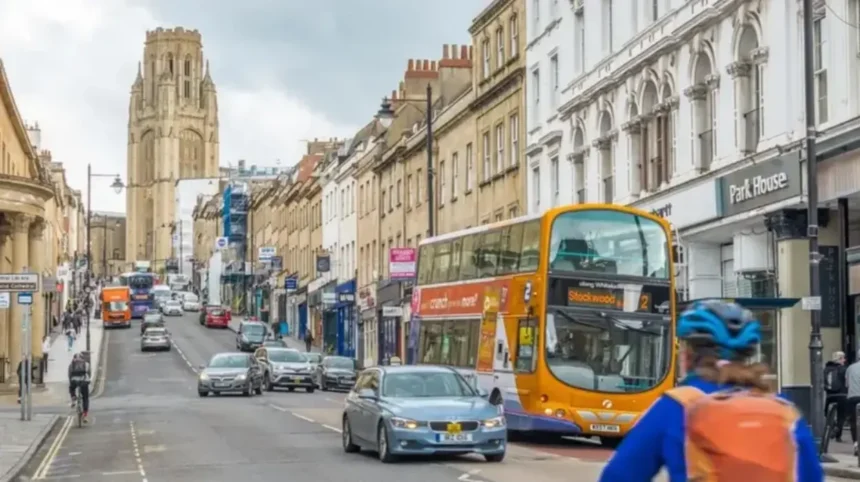
As reported by Ellie Kendall reporter of Bristol Live, work is set to commence early next year to close a Bristol city centre street to cars and “make it safer, accessible and more attractive”. The upcoming civil works focus primarily on Denmark Street, a historic thoroughfare famously home to various restaurants, including Cary Grant’s favourite local chip shop.
Detailing the background of the initiative, a council spokesperson stated that “a trial period between March 2022 and September 2023 saw Denmark Street closed to vehicle traffic to encourage more people to visit and spend time in the area”. Building upon the lessons learned during that pilot phase, local authorities are now pushing forward with structural layouts designed to enhance active travel.
The council spokesperson further stated:
“Together, we can make it easier and safer to walk, wheel, and cycle while boosting the region’s nightlife and culture too”.
What specific infrastructure and safety modifications are planned?
To support the transition away from general vehicular dominance, the regeneration project introduces several tangible layout enhancements across Denmark Street and adjacent Frogmore Street.
According to local planning disclosures highlighted by Ellie Kendall of Bristol Live, the scheme incorporates the deployment of four brand new public benches alongside eight structural planters positioned on Frogmore Street. Furthermore, a dedicated loading bay will be established on Denmark Street to guarantee that local commercial entities and restaurants can receive stock safely without obstructing pedestrian flow.
Pedestrian safety is also being directly reinforced through the installation of a new zebra crossing on Frogmore Street, situated directly outside the Trenchard Street car park. This specific location serves as a critical parking hub for patrons attending major live entertainment shows at the Bristol Beacon, the O2 Academy, and the historic Bristol Hippodrome theatre. Additionally, civil teams will apply double yellow lines to eliminate obstructive parking hazards right at the accessible entrance point of the Hippodrome itself.
How are local cultural institutions reacting to the development?
The adjustments have received strong backing from key stakeholders operating within the cultural heart of Bristol city centre, particularly those managing major entertainment venues.
Offering an official endorsement on behalf of the performance sector, Ben Phillips, theatre director at The Bristol Hippodrome, stated:
“We look forward to seeing these improvements that will benefit our audiences and make this important part of the city centre safer, more accessible and more attractive for everyone”.
Background of the particular development
The decision to restrict traffic on Denmark Street stems from a broader, multi-year municipal strategy adopted by Bristol City Council to re-engineer urban spaces in favour of non-motorised transport, improved air quality, and local commerce. Following successful experimental closures across strategic corridors—such as the permanent pedestrianisation of Bristol Bridge and parts of Baldwin Street initiated in previous years—local planners have progressively targeted secondary cultural arteries. The 2022–2023 trial on Denmark Street served as a testing ground to evaluate whether removing cars would successfully increase pedestrian dwell time, support hospitality venues, and create a cohesive cultural zone linking the Bristol Hippodrome with surrounding entertainment and dining infrastructure.
This infrastructure development is expected to significantly improve the evening arrival and departure experience for thousands of theatre-goers and hospitality patrons visiting the Bristol Hippodrome, O2 Academy, and Bristol Beacon. For the primary audience—consisting of pedestrians, culture enthusiasts, and local business owners—the reduction of vehicular traffic will lower local noise pollution, eliminate dangerous pavement crowding before and after major stage performances, and foster a safer environment for walking and wheeling. However, local delivery drivers and commercial operators will need to strictly adapt to the newly designated loading window schedules and infrastructure bay placements on Denmark Street to maintain supply chains without causing congestion on adjacent routes.