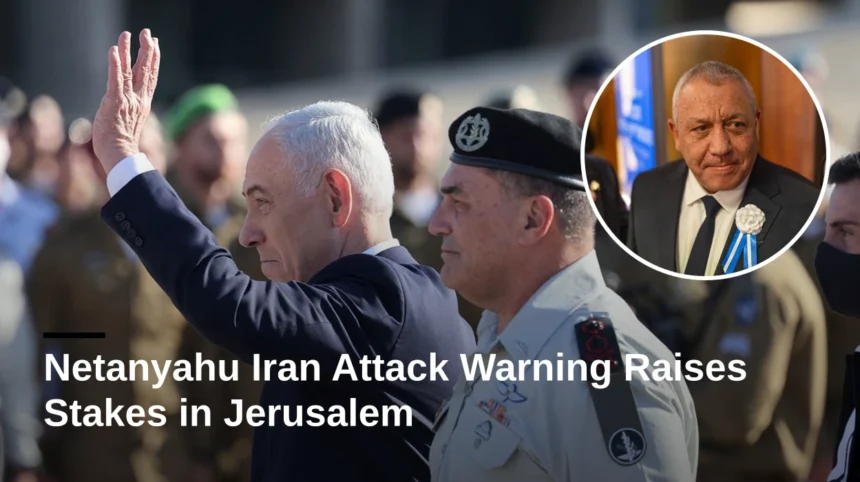
Key Points
- Israeli opposition leaders warn that Benjamin Netanyahu could seek renewed conflict with Iran to strengthen his political position.
- The Washington Post reported that Netanyahu pressed for strikes before Israel’s October 27 election, citing four people familiar with the matter.
- Israel Defense Forces Chief of Staff Lieutenant General Eyal Zamir reportedly opposed renewed hostilities because they could disrupt the election.
- Gadi Eisenkot received the mandate to form a government after winning recommendations from 67 lawmakers, compared with 46 for Netanyahu.
- Netanyahu remains caretaker prime minister during the transition, while rivals urge restraint.
Jerusalem (The Washington Post) November 17, 2026 – Israeli opposition leaders have warned that Prime Minister Benjamin Netanyahu could seek a renewed military confrontation with Iran to preserve his position after losing his parliamentary majority in the October 27 election. The allegations centre on reported efforts to advance new strikes before the vote, despite concerns within Israel’s military establishment that renewed hostilities could derail the election and intensify regional instability.
Why are Netanyahu’s rivals warning about a new Iran attack?
As reported by The Washington Post, four people familiar with the matter said Netanyahu had agitated for fresh strikes against Iran for several weeks before the election. The sources spoke anonymously because they were discussing sensitive security matters.
The report said Lieutenant General Eyal Zamir, chief of staff of the Israel Defense Forces, resisted a return to active hostilities. His concern was reportedly that military action could interfere with the scheduled vote.
Opposition leaders now fear Netanyahu could use a wartime crisis to improve his political prospects or delay the formation of a new government. The Washington Post reported that Gadi Eisenkot, Netanyahu’s principal challenger and a former military chief, has warned against operations that could provoke Tehran during the post-election transition.
What happened after Israel’s election?
Gadi Eisenkot received recommendations from 67 lawmakers in the 120-seat Knesset, while Netanyahu received 46, according to reporting cited in the available coverage. President Isaac Herzog subsequently tasked Eisenkot with trying to form the next government.
Netanyahu remains caretaker prime minister during the transition. Opposition figures are concerned that the transition period could provide an opportunity for escalation or obstruct coalition negotiations.
Netanyahu has denied allegations that he pursued military action for political purposes. Defence Minister Israel Katz said the outgoing government did not need opposition approval to conduct military operations, according to secondary reports summarising the dispute.
What is the background to Israel’s tensions with Iran?
Israel and Iran have remained adversaries over Iran’s nuclear programme, regional military activity and the threat of direct confrontation.
The Washington Post report placed the latest allegations in the period before Israel’s October 27 election, when Netanyahu was seeking to retain power.
The reported resistance from Eyal Zamir reflected concern that renewed hostilities could affect both national security and the electoral timetable.
After the election, Gadi Eisenkot’s mandate to form a government created a politically sensitive 42-day transition period.
Netanyahu has continued to call for action against what he describes as an Iranian threat, while his opponents have urged caution during the government-formation process.
How could the dispute affect Netanyahu’s political future?
If no new military operation is ordered, the allegations are likely to remain part of the political contest over Netanyahu’s record and intentions. A renewed confrontation with Iran could change public attention from coalition negotiations to national security, but it could also deepen opposition criticism and create further institutional tension.
For Netanyahu’s rivals, any escalation during the transition would raise questions about whether security decisions were influenced by political considerations. Eisenkot’s warnings indicate that preventing a crisis with Tehran remains central to the opposition’s effort to form a government.