Key Points
- The first section of Pero’s Bridge has been lifted from Bristol Harbour and placed on a barge.
- All three spans are due to be moved to Albion Dry Dock for detailed inspection and repairs.
- The recovery operation is expected to cost about £280,000 within an approved £1.51m refurbishment budget.
- Bristol City Council aims to restore and reopen the bridge by spring or summer 2027.
- No one was injured when the bridge collapsed on 31 October after earlier mechanical problems.
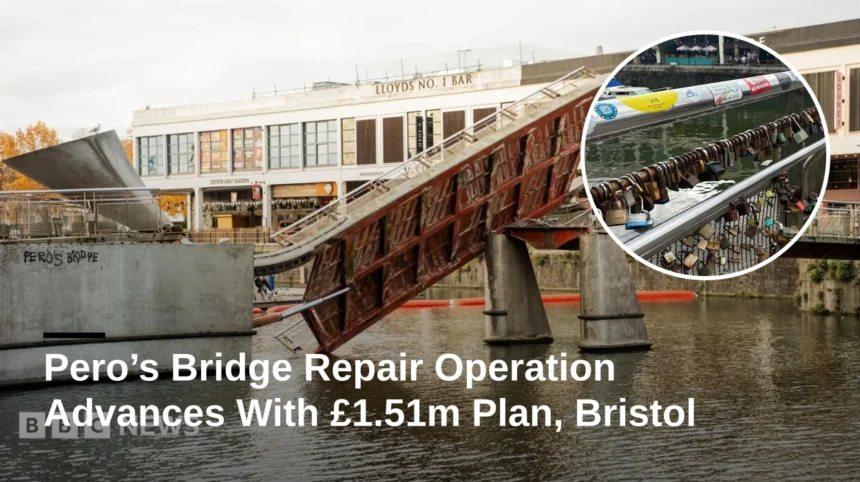
Bristol’s Pero’s Bridge is being removed from the harbour for inspection and repairs after its central section collapsed into the water, with the first span lifted onto a crane barge on Monday, November 23, 2026. Bristol City Council said the three spans will be transported to Albion Dry Dock, where engineers will assess the damage and determine the final repair programme. The recovery operation is expected to cost about £280,000 and is covered by the previously approved £1.51m refurbishment budget. The council hopes to reinstate the landmark by spring or summer 2027.
How is Bristol recovering Pero’s Bridge after its collapse?
As reported by BBC News, contractors positioned a crane barge, fitted lifting equipment to the central span, disconnected the hydraulic system and removed the damaged hydraulic ram before the lift. The 11-metre central section was secured on the barge and taken towards Albion Dry Dock.
Bristol City Council said work would continue to remove the Bordeaux Quay and Narrow Quay sides of the bridge. Moving all three spans to dry dock will allow engineers to carry out further assessments and establish the repairs, costs and timetable required.
BBC News reported that the council hopes the bridge will reopen by summer 2027. Other reports from ITV News West Country and Bristol Post said the target was spring 2027, with completion expected before summer.
Why did Pero’s Bridge collapse?
Pero’s Bridge was closed in August after a mechanical failure during a routine test lift. The central section later experienced another unexpected movement and toppled into Bristol Harbour on 31 October. No one was injured.
According to BBC News, earlier inspections identified corrosion, water damage and deterioration to bearings and the hydraulic lifting system. A one-tonne weight limit had been introduced before the collapse.
Councillor Andrew Brown, chair of Bristol’s harbour committee, said engineers could not yet be entirely certain of the precise cause. He said external vibrations, including wind gusts, heavy road traffic or loud music from nearby speakers, may have disturbed the structure’s balance.
What is the background to Pero’s Bridge?
Pero’s Bridge crosses Bristol’s Floating Harbour and opened in 1999. It was named after Pero Jones, an enslaved African who lived in Bristol.
The bridge has three spans, with a central section that can be raised to allow tall vessels to pass. The outer spans are fixed to the harbour walls.
A council report said routine test lifts were carried out every three months until 2016, when hundreds of locks attached to the railings made testing more difficult. The locks, estimated to weigh about three tonnes, were removed during maintenance work last summer.
In March, the harbour committee approved a refurbishment plan worth about £1.51m, including temporary removal of the structure for repairs.
What could the repairs mean for Bristol Harbour users?
Residents, visitors, harbour businesses and workers will continue to face restricted access across the Floating Harbour while the bridge remains closed. The dry-dock inspection should clarify whether the existing reopening timetable can be maintained or needs revision.
The wider harbour programme includes more than £3m for repairs to sluice gates and replacement of the harbour control system at Underfall Yard, £900,000 for underwater culverts, a planned £900,000 refurbishment of Cascade Steps and £465,000 for work on Prince Street Bridge.
For people who use Pero’s Bridge as a waterfront route, the next confirmed stage is the engineering assessment at Albion Dry Dock. A final repair schedule and cost estimate are expected after all three spans have been examined.