Bristol is one of England’s established cycling cities, with routes connecting the city centre, historic harbourside, green spaces, riverside paths and the surrounding countryside. The best cycling routes in Bristol range from traffic-free sections of the Bristol and Bath Railway Path to scenic rides through Ashton Court, along the River Avon and towards the Mendip Hills.
- What are the best cycling routes in Bristol?
- Bristol and Bath Railway Path
- Bristol Harbourside
- Festival Way
- Ashton Court cycling trails
- River Avon routes towards Pill
- Which cycling routes near Bristol are best for longer rides?
- Which Bristol cycling routes are suitable for beginners and families?
- Short rides along the Harbourside
- Family cycling on the Railway Path
- Planning a family ride on Festival Way
- Where can cyclists find off-road trails in Bristol?
- How can cyclists explore Bristol’s historic landmarks by bike?
- How long are Bristol’s main cycling routes?
- What should cyclists know about Bristol’s hills and terrain?
- How can cyclists plan a safe ride in Bristol?
- Check route maps and closures
- Prepare the bicycle
- Ride considerately on shared paths
- Prepare for weather and changing daylight
- When is the best time to go cycling in Bristol?
- How can visitors hire a bicycle in Bristol?
- How does cycling benefit Bristol’s residents and visitors?
- How should cyclists choose the best Bristol route for their needs?
Cycling in Bristol serves several purposes, including daily commuting, recreational exercise, family outings and longer-distance touring. The city’s cycling network combines dedicated paths, shared-use trails, quieter residential streets and on-road cycle lanes. Each route offers a different balance of distance, traffic exposure, gradient, scenery and access to facilities.
Choosing the right route depends on the cyclist’s experience, available time, bicycle type and preferred terrain. Beginners often benefit from flat, traffic-free paths, while experienced riders have access to longer countryside journeys and challenging climbs around the city’s outskirts.
What are the best cycling routes in Bristol?
The best cycling routes in Bristol include the Bristol and Bath Railway Path, Bristol Harbourside, the Festival Way, Ashton Court trails and riverside routes towards Pill. These routes provide options for commuters, recreational cyclists, families and experienced riders seeking longer journeys.
Bristol’s cycling routes connect urban destinations with parks, former railway corridors, waterways and rural landscapes. Some routes follow dedicated traffic-free paths, while others use public roads and shared pedestrian facilities.
The Bristol and Bath Railway Path is a leading option for longer traffic-free cycling. The Harbourside offers a shorter urban ride with access to historic landmarks and public spaces. Festival Way connects Bristol with the countryside towards Long Ashton, while Ashton Court provides woodland trails and off-road riding opportunities.
The best choice depends on the intended journey. A cyclist travelling with children benefits from a different route from a road cyclist training for endurance or a commuter travelling across the city.
Bristol and Bath Railway Path
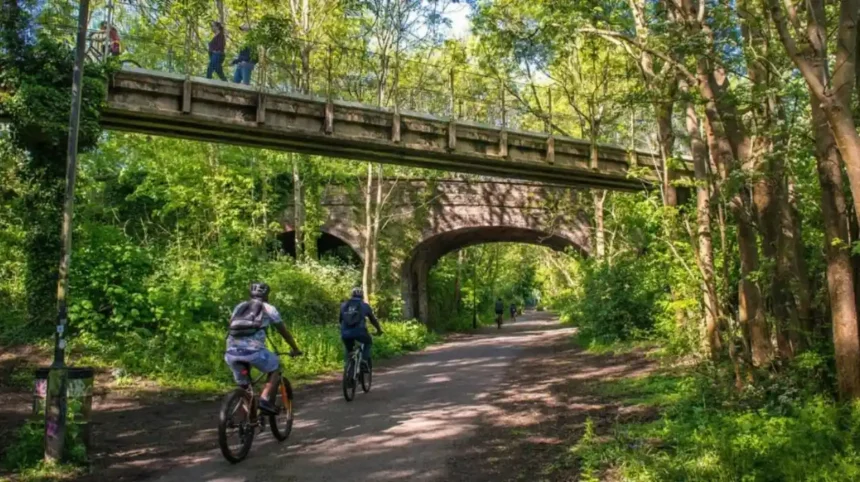
The Bristol and Bath Railway Path is a traffic-free walking and cycling route following a former railway line between Bristol and Bath. The route is approximately 13 miles (21 kilometres) long and passes through urban neighbourhoods, green corridors and countryside.
Its relatively gentle railway alignment makes it suitable for many recreational cyclists. The path passes through areas including Fishponds, Staple Hill and Mangotsfield, with access points that allow riders to complete shorter sections instead of the entire journey.
The route also provides a practical connection between two major South West England cities. Cyclists should check surface conditions, crossing points and access arrangements before travelling.
Bristol Harbourside
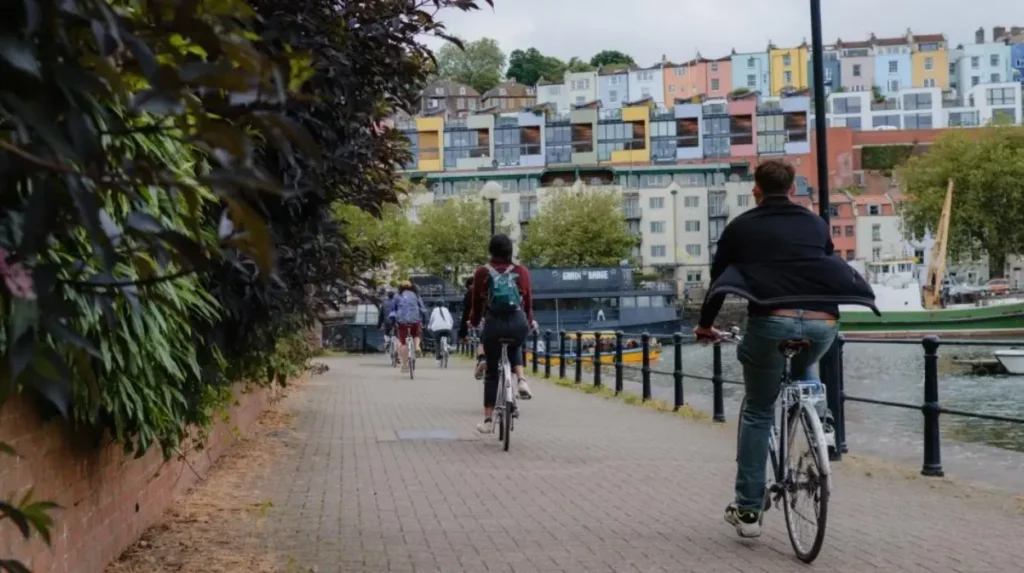
Bristol Harbourside offers a short urban cycling experience around the historic harbour and waterfront. The area connects central Bristol with cultural attractions, waterside paths, cafés and public spaces.
The route is suitable for leisure rides and short journeys, although pedestrians, visitors and busy public spaces require careful riding. Some sections involve shared paths, crossings or roads rather than uninterrupted cycle tracks.
Cyclists can connect the Harbourside with central Bristol and nearby green spaces. Riders should check local signage and avoid assuming that every waterfront section permits unrestricted cycling.
Festival Way
Festival Way is a cycling and walking route linking Bristol with Long Ashton and the surrounding countryside. It provides an alternative to busier roads for sections of journeys between the city and communities to the south-west.
The route combines dedicated paths with connections to the wider local transport network. Its countryside setting makes it useful for recreational rides and selected commuting journeys.
Cyclists should check the exact route before setting off because connections, junctions and road sections affect the total distance and riding conditions.
Ashton Court cycling trails
Ashton Court Estate is a large historic estate west of central Bristol, known for its woodland, parkland and outdoor recreation. Its cycling trails provide a different experience from the city’s flatter urban routes.
The estate suits riders seeking off-road cycling and varied terrain. Trail choice depends on ability, bicycle type and the conditions underfoot. Riders should follow estate signage and use trails appropriate to their experience.
River Avon routes towards Pill
Routes towards Pill follow the wider River Avon corridor west of Bristol and provide access to riverside landscapes and settlements beyond the urban centre. The experience combines water views, countryside sections and connections through the city’s western outskirts.
Route conditions vary, and not every riverside section forms a continuous traffic-free path. Riders should plan junctions and road connections carefully, especially when travelling with children or using a bicycle unsuitable for rough surfaces.
Which cycling routes near Bristol are best for longer rides?
Longer rides from Bristol include the Strawberry Line, National Cycle Network Route 33 and the Bristol and Bath Railway Path. These routes connect the city with North Somerset, countryside villages and neighbouring destinations, offering different combinations of traffic-free paths, road cycling and rural scenery.
Cyclists seeking a full-day journey have several options outside Bristol’s central neighbourhoods. Route selection depends on distance, elevation, traffic exposure and the availability of refreshment stops.
The Strawberry Line
The Strawberry Line is a walking and cycling route through North Somerset, following sections of former railway infrastructure. A popular section runs from Yatton towards Cheddar, passing rural landscapes, settlements and the historic market town of Axbridge.
The route is approximately 10 miles (16 kilometres) between Yatton and Cheddar, although the exact distance depends on the chosen access points and route connections. Its generally gentle profile makes it attractive to leisure cyclists and families planning a longer outing.
The Strawberry Line sits outside central Bristol, so riders need to plan their journey to the starting point. The route also provides opportunities to explore the wider Mendip landscape. Check the surface, access arrangements and route status before travelling.
National Cycle Network Route 33
National Cycle Network Route 33 connects Bristol with a longer network of routes through Somerset and towards the English Channel at Seaton. A National Cycle Network route is a signed cycling and walking corridor that can include traffic-free paths, shared routes and public roads.
The Bristol section follows the corridor through Ashton Court and towards Nailsea, overlapping with Festival Way. Riders travelling farther south and west encounter a wider range of terrain and road conditions.
The complete route is approximately 68 miles (110 kilometres), according to Walk Wheel Cycle Trust route information. This distance suits experienced cyclists planning a substantial ride rather than beginners seeking a short local circuit. Check the route map carefully because not every section is traffic-free.
Portishead, Pill and the Avon Gorge
The cycling corridor between Portishead, Pill and Bristol connects North Somerset with the city’s western waterfront. It combines waterside scenery, countryside views and approaches to the Avon Gorge, where the River Avon passes between steep wooded slopes.
This journey suits cyclists who want to travel between a coastal town and Bristol rather than complete a short city-centre circuit. The route also provides connections to the Harbourside and the wider National Cycle Network.
Riders should consult a current map before departure. The corridor includes different path types and road connections, so total distance, gradients and traffic exposure depend on the selected alignment. Avoid assuming the entire journey follows a continuous riverside track.
Which Bristol cycling routes are suitable for beginners and families?
Beginners and families benefit from routes with gentle gradients, predictable surfaces, convenient stopping points and limited motor traffic. The Bristol and Bath Railway Path and selected Harbourside sections provide useful starting points, while family rides on Festival Way require attention to road crossings.
Route difficulty depends on more than distance. Surface quality, junctions, pedestrian activity, gradients and access to toilets or refreshments all influence how comfortable a ride feels.
Short rides along the Harbourside
The Harbourside is suitable for a short introduction to cycling because riders can explore sections of the waterfront without committing to a long-distance journey. The area offers views of boats, historic buildings and cultural destinations around Bristol’s Floating Harbour.
Families should choose quieter periods and keep speeds low where pedestrians share the route. Busy waterfront spaces require particular care near crossings, bridges and visitor attractions.
A short out-and-back ride also makes it easy to finish when children become tired. Check local signs to identify shared paths and sections where cyclists need to dismount.
Family cycling on the Railway Path
The Bristol and Bath Railway Path is one of the strongest options for families who want a longer ride on a relatively flat route. Walk Wheel Cycle Trust describes the path as mainly traffic-free, with an asphalt surface along almost its entire length. Walk Wheel Cycle Trust+1
Families do not need to cycle the complete route. Starting at a convenient access point and returning along the same section allows riders to choose a manageable distance.
Parents should explain path etiquette before setting off. Children need to keep left where appropriate, give pedestrians sufficient space, avoid sudden turns and slow down around other users. The route is shared, so traffic-free does not mean free from hazards.
Planning a family ride on Festival Way
Festival Way offers access to Ashton Court and countryside beyond the city. However, the route is not entirely traffic-free. Walk Wheel Cycle Trust reports that approximately 67.8% of its mapped route is traffic-free and specifically highlights the B3128 crossing south of Ashton Court.
Families should review the route map before departure and prepare children for any on-road sections. Younger riders who are not confident around traffic are better suited to a carefully selected traffic-free section than the complete route.

Where can cyclists find off-road trails in Bristol?
Bristol offers off-road cycling at Ashton Court Estate, Leigh Woods and dedicated mountain-bike trail areas. These locations provide woodland tracks, purpose-built trails and varied terrain, allowing riders to develop handling skills while choosing routes that match their experience and equipment.
Off-road cycling differs from riding on paved urban paths. Trail surfaces include compacted earth, loose material, roots, stones and constructed features. These conditions affect traction, braking and the type of bicycle required.
Ashton Court Estate
Ashton Court Estate covers approximately 850 acres of woodland and grassland, according to Bristol City Council. The estate accommodates several outdoor activities, including cycling, walking and mountain biking. National Cycle Network Route 33 also passes through the estate. Bristol City Council+1
The Nova trail is a purpose-built mountain-bike loop of approximately four miles. It includes features such as berms, rollers and jumps, giving riders opportunities to practise cornering and bike control. The optional Supernova trail provides a more challenging half-mile extension. Ride Bristol
These trails suit riders looking for a structured off-road experience rather than a conventional road journey. Beginners should start with suitable sections and assess trail conditions before attempting technical features.
Leigh Woods
Leigh Woods is a woodland area across the River Avon from central Bristol. It provides access to natural landscapes and nearby off-road cycling opportunities, including links associated with Bristol’s wider mountain-bike network.
Riders should distinguish designated cycling trails from walking paths and environmentally sensitive areas. Not every woodland track is open to bicycles, and trail permissions can differ by location.
A suitable mountain bike or gravel bike depends on the specific route. Riders should check current trail guidance, surface conditions and access restrictions before entering the woodland.
What equipment is suitable for off-road cycling?
A mountain bike is generally suitable for technical woodland trails because its tyres, gearing and braking system support uneven terrain. A gravel bike suits many smoother unpaved paths, while a hybrid bicycle works well on paved routes and firm tracks.
Tyre choice affects grip and rolling resistance. Brakes need to work reliably on descents, and the bicycle should be checked for loose components before a ride.
Helmets, gloves, water and a basic repair kit are practical essentials. Riders attempting technical trails should also carry equipment appropriate for punctures and minor mechanical problems.
How can cyclists explore Bristol’s historic landmarks by bike?
Cycling connects Bristol’s historic harbour, Georgian streets, Clifton Suspension Bridge approaches and former railway corridors. A carefully planned urban route combines heritage attractions with waterfront views, although steep streets, pedestrian areas and busy junctions require cyclists to select suitable roads and follow local signs.
Bristol’s built environment reflects its development as a port, trading centre and industrial city. Cycling allows visitors to connect historic locations without relying entirely on motor transport.
Bristol’s Floating Harbour
The Floating Harbour is a historic harbour area created to maintain a stable water level for shipping. Today, its waterfront combines former maritime infrastructure, museums, public spaces and modern developments.
A ride around accessible sections of the harbour provides views of vessels, bridges and historic waterfront buildings. The route also connects with attractions such as M Shed, a museum documenting Bristol’s social and industrial history.
The waterfront is not a continuous, uninterrupted cycle track. Cyclists should plan connections between accessible paths, roads and shared public spaces.
Clifton and the Suspension Bridge
Clifton Suspension Bridge is one of Bristol’s best-known landmarks, spanning the Avon Gorge between Clifton and Leigh Woods. The surrounding area provides views of the gorge and access to nearby streets and green spaces.
Cyclists can incorporate the bridge into a wider sightseeing ride, but the approach involves gradients and road sections. Pedestrian activity around the bridge also affects riding conditions.
Check current access arrangements and bridge rules before travelling. A route that includes Clifton is less suitable for young beginners than a flat ride around the Harbourside or Railway Path.
Former railway infrastructure
Bristol’s former railway corridors demonstrate how transport infrastructure can be reused for active travel. The Bristol and Bath Railway Path is a prominent example: a railway line closed to passenger traffic in the late 1960s was subsequently converted into a walking and cycling route.
The conversion took place between 1979 and 1985, creating a long-distance path that supports commuting, leisure cycling and access to green corridors.
This approach links transport heritage with modern sustainable mobility. It also creates routes that avoid many direct interactions with motor traffic.
How long are Bristol’s main cycling routes?
Bristol’s main cycling routes range from short urban waterfront rides to journeys exceeding 60 miles. The Bristol and Bath Railway Path covers approximately 13 to 14 miles, Festival Way is about 10 miles, and National Cycle Network Route 33 extends much farther.
Distance figures depend on the exact route alignment, starting point and endpoint. Official route planners sometimes publish different measurements because routes include different access points or updated connections.
The following figures provide a practical guide to planning.
- Bristol and Bath Railway Path: approximately 13–14 miles (21–23 kilometres), depending on the mapped version and endpoints.
- Festival Way: approximately 9.7 miles (15.6 kilometres) on the Walk Wheel Cycle Trust route listing.
- The Strawberry Line: approximately 10 miles (16 kilometres) for the popular Yatton-to-Cheddar section.
- National Cycle Network Route 33: approximately 68 miles (110 kilometres) for the mapped route towards Seaton.
- Nova trail at Ashton Court: approximately four miles (6.4 kilometres) for the mountain-bike loop.
- Supernova trail at Ashton Court: approximately half a mile (0.8 kilometres) for the more challenging optional section.
These distances are planning references, not guarantees of current access or completion times. The route listings from Walk Wheel Cycle Trust, Visit Bristol and Ride Bristol provide the underlying route information.
How should cyclists estimate journey time?
Journey time depends on average speed, elevation, stops, path congestion and the cyclist’s experience. A flat, paved route generally supports more consistent progress than a technical trail or a ride with steep climbs.
For example, a cyclist averaging 10 miles per hour needs about one hour to cover 10 miles of continuous riding. Stops, crossings and busy shared paths increase the total journey time.
Use a route planner to check elevation and road exposure, then add time for refreshments, mechanical problems and sightseeing. A round trip also doubles the distance when the rider returns to the starting point.
What should cyclists know about Bristol’s hills and terrain?
Bristol combines flat waterfront paths and former railway corridors with steep residential streets and wooded hills. Cyclists should assess elevation, surface type and junctions before choosing a route because these factors affect physical effort, braking distance and overall journey time.
Bristol’s terrain varies significantly across the city. The Harbourside and Railway Path provide relatively level riding, while Clifton, parts of South Bristol and the outskirts introduce more demanding gradients.
Choosing a route by gradient
A flat route is useful for beginners, family groups and cyclists building endurance. A hilly route develops climbing ability but requires suitable gearing, controlled descents and more careful energy management.
Route maps with elevation profiles help riders identify sustained climbs before departure. Electric bicycles reduce the effort required on climbs, although riders still need to manage speed and braking.
Understanding path surfaces
Paved paths generally suit road bikes, hybrid bicycles and many touring bicycles. Gravel paths require tyres that provide sufficient grip, while muddy or rocky trails often demand wider tyres and stronger off-road handling skills.
Rain changes surface conditions. Wet leaves, mud, painted road markings and metal covers can become slippery, particularly during autumn and winter.
Check the route after heavy rain because flooding, standing water, debris or temporary closures affect accessibility. Walk Wheel Cycle Trust specifically warns that route conditions can change with weather and infrastructure works.
How can cyclists plan a safe ride in Bristol?
Safe cycling in Bristol starts with choosing a suitable route, checking current access conditions and preparing a roadworthy bicycle. Riders should use lights in low visibility, follow traffic signs, share paths responsibly and carry basic repair equipment for longer journeys.
A route’s safety depends on its design and the behaviour of everyone using it. Traffic-free sections reduce exposure to motor vehicles but still contain junctions, pedestrians and other cyclists.
Check route maps and closures
Better By Bike provides regional cycling information for Bristol, Bath, North Somerset and South Gloucestershire. Walk Wheel Cycle Trust publishes route descriptions and National Cycle Network maps, including information about surface types and on-road sections.
Review the route immediately before departure. Construction work, events, flooding and maintenance can change access or create diversions.
Prepare the bicycle
Before leaving, check tyre pressure, brakes, gears, chain condition and lights. Carry a pump, tyre levers, a spare tube or puncture-repair kit, and a suitable tool for minor adjustments.
The Highway Code sets out road-use requirements and guidance for cyclists in England. Bicycle lighting and reflectors are particularly important in darkness and poor visibility. Bristol City Council also advises cyclists visiting Ashton Court to ensure that their bicycle has reflectors and front and rear lights. Bristol City Council
Ride considerately on shared paths
Shared paths accommodate different users, including pedestrians, runners, wheelchair users and other cyclists. Riders should moderate their speed, provide space when overtaking and give an audible warning where appropriate.
Keep dogs and children in mind when passing groups. Slow down near bridges, blind corners and crowded access points. On roads, position the bicycle predictably and signal intentions clearly.
Prepare for weather and changing daylight
Bristol’s weather affects route comfort and surface conditions throughout the year. Rain increases stopping distances, while strong winds affect exposed sections and bridges.
Carry water, suitable clothing and a charged phone. Check daylight hours for longer journeys, especially when riding outside the city or returning from Bath or North Somerset.
When is the best time to go cycling in Bristol?
Spring and summer offer longer daylight hours for exploring Bristol’s cycle network, while autumn and winter provide year-round riding opportunities with greater attention to rain, mud and visibility. The best time depends on route conditions, daylight, crowd levels and the cyclist’s experience.
Spring is suitable for exploring green corridors as vegetation develops and daylight increases. Summer supports longer rides to Bath, Nailsea and North Somerset, although popular waterfront areas and recreational paths become busier during good weather.
Autumn brings changing foliage around Ashton Court and Leigh Woods. Wet leaves, mud and reduced daylight require additional care. Winter cycling remains practical on maintained paved paths, provided riders check for slippery surfaces, flooding and poor visibility.
Weekday mornings generally suit some commuting journeys, while quieter periods can improve the experience on busy recreational paths. Before setting off, check the weather forecast and current route information rather than relying on seasonal expectations alone.
How can visitors hire a bicycle in Bristol?
Visitors can explore Bristol using bicycle-hire services, guided cycling tours and mountain-bike rental providers. Central hire options suit Harbourside sightseeing, while specialist providers near Ashton Court supply bicycles for off-road trails. Availability, prices, deposits and opening hours require confirmation before booking.
Bristol has bicycle-hire options for visitors who arrive without their own equipment. Visit Bristol identifies Cycle the City as a central provider offering hire bicycles and guided tours, while Pedal Progression provides mountain-bike hire and coaching around Ashton Court.
Choose the bicycle according to the intended route. A hybrid bicycle suits many paved city paths, a touring bicycle supports longer journeys, and a mountain bike is better equipped for technical woodland trails.
Before collecting a bicycle, confirm the rental period, identification requirements, deposit, helmet availability and repair arrangements. Check the bicycle’s brakes, tyres, saddle height and lights before departure.
Visitors planning a ride between Bristol and Bath should also confirm whether the hire company permits longer-distance journeys and whether returning the bicycle at a different location is possible.
Explore More Area Guide
Best Running Routes in Bristol: Parks, Harbourside and Trails
Best Fishing Spots Near Bristol: Rivers, Lakes and Coastal Areas
How does cycling benefit Bristol’s residents and visitors?
Cycling supports everyday travel, physical activity, recreation and access to Bristol’s green spaces. Dedicated paths and former railway corridors connect neighbourhoods with employment areas and visitor attractions, giving residents and tourists alternatives to short car journeys and opportunities for regular outdoor exercise.
Everyday transport and local access
Cycling provides an alternative for some journeys to work, education, shops and leisure facilities. The usefulness of a route depends on whether it connects the actual starting point and destination without difficult gaps or unsuitable road sections.
Traffic-free paths can reduce exposure to motor traffic along particular sections. However, riders should assess the complete journey rather than assuming a route is traffic-free from end to end.
Physical activity and recreation
Recreational cycling combines cardiovascular activity with outdoor exploration. Short rides around the Harbourside offer an accessible starting point, while longer routes support endurance training and day trips.
Off-road trails also provide opportunities to develop balance, braking and bike-handling skills. Riders should increase distance and difficulty progressively, using equipment suitable for the terrain.
Access to green spaces
Routes through Ashton Court, Leigh Woods and the countryside beyond Bristol connect cycling with woodland, grassland and river landscapes. These corridors also support access to places outside the busiest central streets.
Responsible riding helps preserve the value of these spaces. Cyclists should respect wildlife, remain on permitted trails, avoid disturbing grazing animals and take litter home.
How should cyclists choose the best Bristol route for their needs?
The best Bristol cycling route is the one that matches the rider’s ability, available time, bicycle type and tolerance for traffic. Beginners benefit from flatter paths, families need manageable distances, and experienced riders can select longer countryside journeys or designated mountain-bike trails.
Use the following recommendations as a starting point:
- For beginners: choose a short, suitable section of the Bristol and Bath Railway Path.
- For families: select a manageable traffic-free section and plan convenient stopping points.
- For waterfront sightseeing: explore accessible sections of Bristol Harbourside.
- For countryside cycling: follow Festival Way towards Long Ashton and Nailsea.
- For mountain biking: use the designated Nova and Supernova trails at Ashton Court.
- For a long-distance challenge: plan the Bristol and Bath Railway Path or a suitable section of National Cycle Network Route 33.
- For exploring North Somerset: investigate the Strawberry Line and the cycling connections around Pill and Portishead.
Check official route maps before departure, especially when a journey includes public roads, shared paths or off-road sections. The route that appears shortest on a map is not always the most suitable for a particular bicycle or rider.
Bristol offers cycling routes for commuting, family outings, urban sightseeing, countryside exploration and mountain biking. The Bristol and Bath Railway Path stands out for its length and relatively flat, largely traffic-free alignment. Festival Way connects the city with Ashton Court and North Somerset, while the Strawberry Line provides another option for exploring the surrounding countryside.
Ashton Court and Leigh Woods serve riders looking for off-road experiences, while the Harbourside provides a convenient setting for shorter urban rides. Checking distances, gradients, surface conditions and current access information helps cyclists select routes that suit their plans.
For reliable planning, consult Bristol’s official cycling information, Better By Bike and Walk Wheel Cycle Trust before setting off.
What is the best cycling route in Bristol?
The Bristol and Bath Railway Path is one of the best cycling routes in Bristol, offering a largely traffic-free trail of approximately 13 miles between Bristol and Bath.