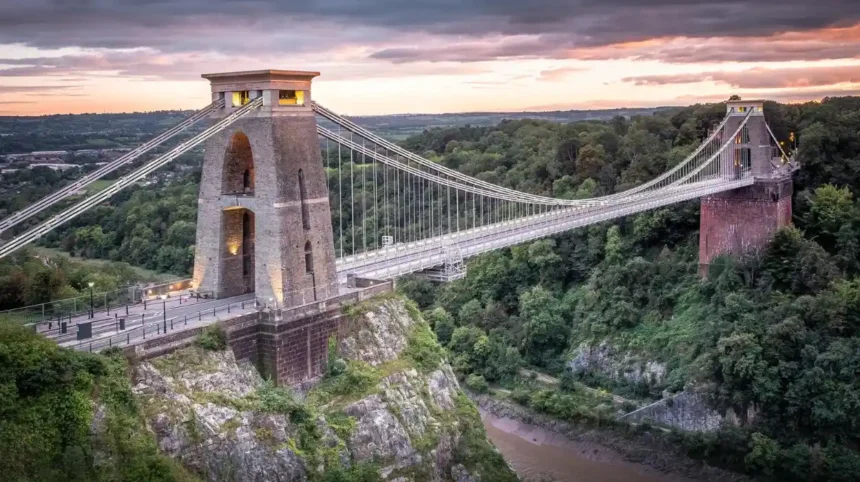
Clifton is a historic neighbourhood in Bristol, England, known for Georgian architecture, Clifton Village, Clifton Down, the Avon Gorge and the Grade I-listed Clifton Suspension Bridge. The area combines residential streets, independent shops, restaurants, cultural venues, green spaces and major heritage landmarks.
- What is Clifton in Bristol?
- How did Clifton develop historically?
- Why is Clifton known for Georgian architecture?
- What is Clifton Village known for?
- What is Clifton Suspension Bridge and why is it important?
- What can visitors see around Clifton Down?
- What is Clifton Observatory?
- What cultural attractions are located in Clifton?
- How close is Clifton to Bristol city centre?
- What is Clifton like for walking?
- What types of homes are found in Clifton?
- Why is Clifton important to Bristol’s identity?
- How does Clifton combine tourism, business and everyday life?
- What should visitors know before exploring Clifton?
- Why does Clifton remain relevant for Bristol’s future?
Its location west of Bristol city centre makes Clifton an important part of the city’s visitor economy and residential landscape. The neighbourhood extends around Clifton Triangle, Clifton Village and Clifton Down, with Hotwells and the Avon Gorge forming important nearby areas.
Visit Bristol describes Clifton as a neighbourhood characterised by Bath-stone terraces, garden squares, boutiques and access to the Clifton Suspension Bridge. The city centre is approximately a 15–20 minute walk away via Park Street.
What is Clifton in Bristol?
Clifton is a historic inner-west Bristol neighbourhood centred on Georgian architecture, Clifton Village, Clifton Down and the Avon Gorge. It combines residential streets with independent businesses, cultural attractions, public open space and direct access to the Clifton Suspension Bridge.
Clifton occupies elevated ground overlooking the Avon Gorge. Its position gives the neighbourhood a distinctive physical character. The gorge forms a major landscape feature between Clifton and Leigh Woods.
The area is particularly associated with Georgian and early Victorian development. Bristol has many examples of Georgian architecture, but Visit Bristol identifies Clifton as having one of the city’s strongest concentrations.
The neighbourhood also contains important public spaces. Clifton Down provides extensive open ground, while nearby Durdham Down adds another large area of accessible green space.
Clifton is not a single uniform environment. Different streets perform different functions. Clifton Triangle provides links towards Bristol city centre. Clifton Village contains shops, cafés, restaurants and heritage streets. Clifton Down provides open space and access to the gorge. The residential streets between these areas contain terraces, villas, crescents and historic buildings.
The area also has strong connections with education. The University of Bristol occupies several sites around the wider Clifton and Cotham area. This creates a significant student and academic presence alongside established residential communities.
How did Clifton develop historically?
Clifton developed from a rural and semi-rural area into a fashionable Bristol suburb mainly during the eighteenth and nineteenth centuries. Its growth accelerated through improved roads, Georgian development, public access to Clifton Down and the completion of the Clifton Suspension Bridge in 1864.
Clifton’s transformation is closely connected to Bristol’s economic growth. During the eighteenth century, Bristol expanded as a major port and commercial centre. Wealth generated by trade contributed to investment in residential development and fashionable suburban districts.
The area developed rapidly during the eighteenth and nineteenth centuries. Historic England records that Clifton was annexed to Bristol in 1836. Clifton Down retained its open character, avoiding enclosure legislation that affected many other areas.
The relationship between Clifton and Hotwells was also important. Bristol City Council’s Clifton Down history material records that Clifton expanded partly as Hotwells declined as a spa destination.
Clifton Down became protected as public open space through nineteenth-century developments. The Downs Bill of 1861 helped establish its long-term public status.
The construction of the Clifton Suspension Bridge created another major change. The bridge provided a permanent crossing over the Avon Gorge and strengthened Clifton’s physical relationship with Leigh Woods.
Construction began under Isambard Kingdom Brunel, although financial difficulties interrupted the project. The bridge was eventually completed after Brunel’s death by Sir John Hawkshaw and William Henry Barlow.
Historic England records that the bridge was completed between 1860 and 1864 and opened on 8 December 1864.
Why is Clifton known for Georgian architecture?
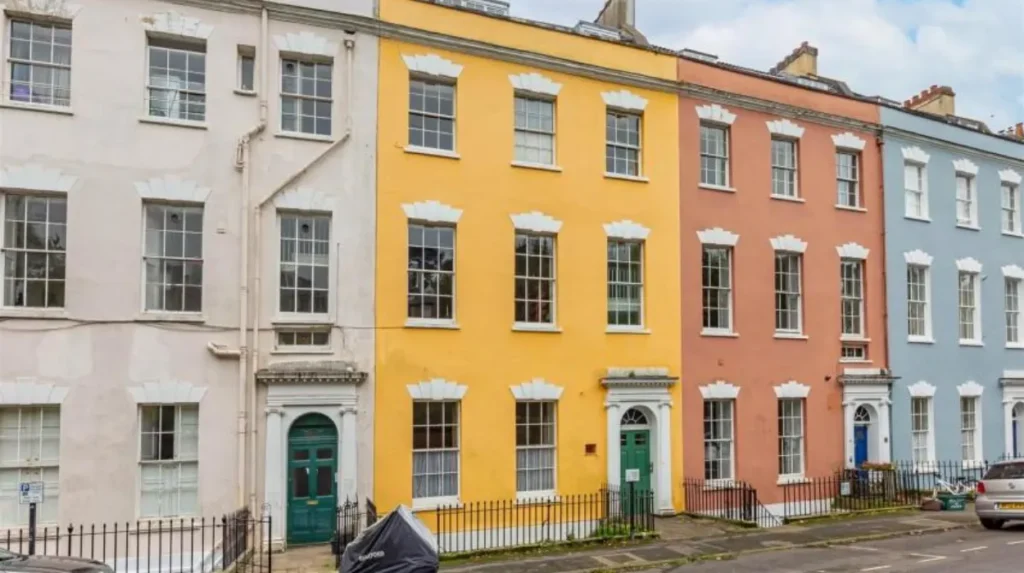
Clifton is known for Georgian architecture because eighteenth- and early nineteenth-century development produced extensive terraces, crescents, villas and formal streets using local Bath stone. Royal York Crescent, Caledonia Place and surrounding streets remain major examples of Clifton’s historic built environment.
Georgian architecture refers broadly to architectural styles associated with the reigns of the first four British King Georges, from 1714 to 1830. The style commonly uses balanced façades, repeated windows, classical proportions and carefully planned terraces.
Clifton contains numerous examples of this architectural tradition.
Royal York Crescent is one of the neighbourhood’s most recognisable residential features. Its long curved terrace creates a strong architectural relationship between buildings and open space.
Other streets around Clifton Village contain terraces and villas built during the period when Clifton developed as an affluent suburb.
Bath stone is another defining material. The pale limestone gives many Clifton buildings a consistent appearance. The material is also strongly associated with historic architecture across the wider Bristol and Bath region.
The architectural character remains significant for planning purposes. Bristol City Council has a Clifton and Hotwells Conservation Area Character Appraisal covering the historic environment. The Clifton and Hotwells Conservation Area was designated in 1972 and subsequently extended in 1977 and 1981.
Bristol currently has 33 conservation areas. The council explains that conservation areas protect places with special architectural or historic interest and can include historic street patterns, building materials, green spaces, trees and distinctive views.
This status affects development and alterations. Planning controls in conservation areas are generally stricter than in areas without conservation designation.
What is Clifton Village known for?
Clifton Village is the commercial and visitor-focused part of Clifton, with independent shops, cafés, restaurants, historic streets and the Victorian Clifton Arcade. It also provides access to Clifton Observatory, Royal York Crescent, the Suspension Bridge and viewpoints over the Avon Gorge.
Clifton Village is located around the southern and western parts of the neighbourhood. Its streets have a strong concentration of independent businesses.
The area is particularly associated with boutique shopping and food businesses. Visit Bristol describes Clifton Village as a hub containing boutiques and places to eat.
Clifton Arcade is another important local landmark. The Victorian arcade contains independent retail businesses and contributes to the area’s historic commercial character.
The village also provides a useful base for exploring nearby attractions. Visitors can walk towards Clifton Observatory, the Suspension Bridge and Clifton Down.
The commercial environment differs from Bristol city centre. Clifton Village has a more neighbourhood-focused arrangement, with smaller premises and independent businesses concentrated along historic streets.
This makes the village relevant to several types of visitors. Tourists use it as part of sightseeing routes. Residents use its shops and services. Students and workers use cafés and restaurants around the wider Clifton area.
What is Clifton Suspension Bridge and why is it important?
Clifton Suspension Bridge is a Grade I-listed suspension bridge across the Avon Gorge, designed by Isambard Kingdom Brunel and completed in 1864. Its 214-metre main span and approximately 75-metre height above high water make it Clifton’s defining engineering landmark.
The Clifton Suspension Bridge is one of Bristol’s most important heritage structures.
Historic England lists it at Grade I, recognising its exceptional architectural and historic interest. The bridge crosses the Avon Gorge between Clifton and Leigh Woods.
Brunel designed the bridge during the nineteenth century. Work began in 1831 but was interrupted by financial problems. Construction restarted in the 1830s and later stopped again.
The project was revived after Brunel’s death. Sir John Hawkshaw and William Henry Barlow completed the bridge in 1864. Historic England records a 214-metre span between the towers and a height of 74.7 metres above high water.
The bridge also has an important engineering history. Its structure uses wrought-iron chains, an iron deck and sandstone towers and abutments.
The bridge is part of the physical identity of Clifton. It connects the neighbourhood with Leigh Woods in North Somerset and provides one of Bristol’s most recognisable views over the Avon Gorge.
Pedestrians and cyclists can cross the bridge. Motor vehicles are subject to a toll. Visit Bristol identifies walking and cycling across the bridge as options for visitors, with the visitor centre at the Leigh Woods end.
What can visitors see around Clifton Down?
Clifton Down provides open green space, historic landscapes, viewpoints and access to the Avon Gorge. Key features include Clifton Observatory, the Giant’s Cave, historic earthworks and walking routes connecting the Downs with Clifton Village and the Suspension Bridge.
Clifton Down is one of the defining open spaces in the neighbourhood.
Historic England records that Clifton Down escaped enclosure legislation and became a public open space following the nineteenth-century Downs Bill.
The landscape contains evidence of earlier activity. Historic England identifies an ancient British camp on Clifton Down, reflecting the long history of human occupation in the area.
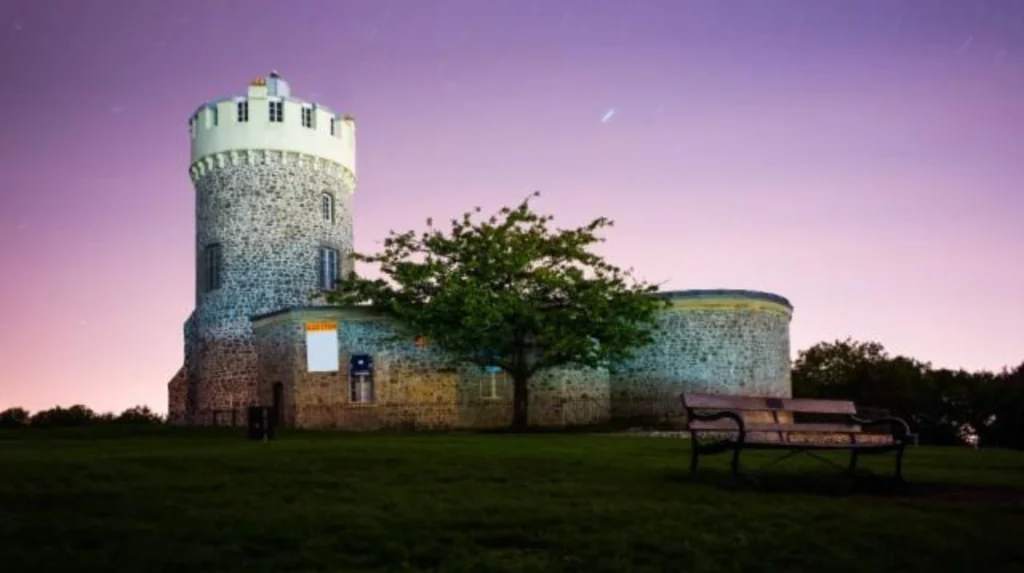
Clifton Observatory is another important feature. William West built an observatory on the Downs in 1828 and extended it in 1835. A tunnel approximately 200 metres long was excavated in 1836–1837 to connect the buildings with the Giant’s Cave.
The observatory became a nineteenth-century attraction because of its views across the Avon Gorge.
Today, the Downs provide space for walking, recreation and access to viewpoints. Their open character also creates an important contrast with Clifton’s dense Georgian streets.
For visitors, Clifton Down works as a link between the built heritage of Clifton Village and the natural landscape of the gorge.
What is Clifton Observatory?
Clifton Observatory is a historic building on Clifton Down associated with nineteenth-century viewing and tourism. It includes access to the Giant’s Cave and provides views across the Avon Gorge, making it an important heritage attraction within the Clifton landscape.
The observatory occupies a prominent position above the Avon Gorge.
William West established the original observatory in 1828. He extended it in 1835, followed by the excavation of the tunnel connecting it with the Giant’s Cave.
The Giant’s Cave is reached through the historic tunnel. Its location on the cliff face provides a direct connection between the built environment of Clifton and the geological landscape of the gorge.
The observatory also demonstrates how Clifton developed as a visitor destination before modern tourism. During the nineteenth century, viewpoints, walks and attractions on the Downs helped draw visitors to the area.
The site remains closely connected with Clifton’s visitor economy. Its elevated location makes it part of the wider sequence of viewpoints around the Suspension Bridge and Avon Gorge.
What cultural attractions are located in Clifton?
Clifton contains cultural attractions that reflect Bristol’s artistic, architectural and educational identity. Important examples include the Royal West of England Academy, Clifton Observatory, historic churches, listed buildings and the wider network of galleries, museums and cultural venues around central Bristol.
The Royal West of England Academy, commonly known as the RWA, is a major art institution on Queen’s Road.
Historic England lists the RWA as a Grade II* building. The building dates from 1857 and has an Italianate architectural design.
The academy contributes to Clifton’s role as an arts and education district. Its location near the University of Bristol and Bristol city centre places several cultural and academic institutions within walking distance.
Clifton also benefits from its proximity to other central Bristol cultural venues. Park Street, College Green, the Bristol Museum & Art Gallery area and the city centre are accessible from the neighbourhood.
This concentration of institutions gives Clifton a strong cultural dimension beyond its residential and tourism functions.
How close is Clifton to Bristol city centre?
Clifton is close to Bristol city centre, with Visit Bristol describing the journey from the centre as roughly a 15–20 minute walk via Park Street. Regular bus services also connect Clifton Village with central Bristol and surrounding neighbourhoods.
Clifton’s location is one of its most significant practical features.
Park Street provides a direct pedestrian route between central Bristol and Clifton. The route rises from the city centre towards the Clifton Triangle.
Visit Bristol states that Clifton is around a 15–20 minute walk from the centre via Park Street. Bus services also operate towards Clifton Village.
The exact journey time depends on the starting point, destination and travel conditions.
Walking is particularly useful for visitors because several major attractions sit along connected routes. A visitor can travel from central Bristol towards Clifton, continue through Clifton Village and reach the Suspension Bridge and Avon Gorge.
Public transport provides another option for residents and visitors. Travelwest and local bus operators provide journey-planning information for the Bristol area.
Clifton’s location therefore supports both short visits and longer stays without requiring a car for every journey.
What is Clifton like for walking?
Clifton is highly connected to walking routes because the neighbourhood combines compact streets, Clifton Village, Clifton Down, the Avon Gorge, Park Street and the Suspension Bridge. Walking provides direct access to heritage buildings, shops, viewpoints, green spaces and cultural venues.
Walking is an important way to experience Clifton.
The neighbourhood contains several destinations within relatively short distances. Clifton Village connects shops and restaurants with historic streets. Clifton Down provides access to open space. The Suspension Bridge connects directly with the gorge landscape.
The terrain is not completely flat. Clifton sits on elevated ground, and routes between the city centre and Clifton involve noticeable changes in elevation.
This topography is important when planning walking routes. Park Street rises towards the Clifton Triangle, while routes around the gorge include further slopes and steps.
Walking also provides access to architectural details that are less visible from a vehicle. Royal York Crescent, Georgian terraces, garden squares and smaller historic streets can be explored at pedestrian speed.
For visitors, a walking route can therefore combine heritage, architecture, green space and viewpoints within one part of Bristol.
What types of homes are found in Clifton?
Clifton contains a wide range of historic residential architecture, including Georgian terraces, crescents, villas and converted buildings. Residential streets sit alongside apartments, student accommodation and modern properties, creating a mixed housing environment around Clifton Village and the wider neighbourhood.
Housing is one of Clifton’s most visible characteristics.
Historic terraces form a substantial part of the neighbourhood’s architectural identity. Royal York Crescent is one of the best-known examples.
Other streets contain substantial villas and townhouses constructed during the eighteenth and nineteenth centuries. Many buildings use Bath stone and display classical architectural features.
Later changes introduced apartments and conversions into the existing building stock. Some large historic properties have been subdivided into flats.
Clifton’s proximity to the University of Bristol also influences housing demand and occupancy patterns in the wider area. Student housing exists alongside long-established residential properties.
The conservation area designation is relevant to the built environment. Bristol City Council states that development within conservation areas can require additional planning controls because the character and appearance of historic areas receive specific protection.
Why is Clifton important to Bristol’s identity?
Clifton is important to Bristol because it combines major engineering heritage, Georgian architecture, public green space, cultural institutions and the Avon Gorge. The Clifton Suspension Bridge provides an internationally recognised landmark, while Clifton’s streets represent Bristol’s historic suburban development.
Clifton represents several periods of Bristol’s history within one geographical area.
Its Georgian terraces demonstrate eighteenth- and early nineteenth-century urban expansion. Clifton Down preserves an important area of public open land. The Suspension Bridge represents nineteenth-century engineering. The Royal West of England Academy reflects Bristol’s continuing cultural development.
The area also demonstrates how geography shaped urban growth. The Avon Gorge created a major physical barrier while simultaneously becoming one of the defining landscapes associated with Bristol.
Clifton’s heritage is therefore not limited to individual buildings. Its significance comes from the relationship between streets, architecture, green spaces, the gorge and major landmarks.
The conservation framework recognises this wider character. Bristol City Council’s Clifton and Hotwells character appraisal examines the area’s architectural and historic qualities and provides a basis for managing future change.
How does Clifton combine tourism, business and everyday life?
Clifton functions as a mixed neighbourhood rather than a single-purpose tourist district. Residents, students, businesses and visitors use the same network of streets, shops, restaurants, green spaces, cultural venues and transport connections throughout the year.
Tourism is highly visible around Clifton Village, the Observatory and the Suspension Bridge.
However, everyday residential activity remains central to the neighbourhood. People live in the Georgian terraces, villas, apartments and converted historic buildings throughout Clifton.
Independent businesses serve both visitors and residents. Restaurants, cafés, shops and professional services operate alongside cultural and educational institutions.
The University of Bristol adds another layer of activity. Its nearby buildings and academic community contribute to regular pedestrian movement through Clifton and surrounding districts.
This mixed function is important when understanding the area. Clifton is simultaneously a heritage destination, residential neighbourhood, cultural district and gateway to the Avon Gorge.
Explore More Area Guide
Best Areas Near UWE Bristol: Frenchay, Fishponds & More
Best Areas Near the University of Bristol: Clifton, Redland & Cotham
What should visitors know before exploring Clifton?
Visitors should expect historic streets, steep sections, busy attraction areas, open green spaces and changing terrain. Planning around walking distances, weather, opening times, bridge conditions and public transport makes it easier to combine Clifton Village, Clifton Down, the Observatory and Suspension Bridge.
Clifton is straightforward to explore, but its physical geography affects how visitors move around.
Comfortable walking footwear is useful because routes include slopes and uneven surfaces. Weather also affects conditions around Clifton Down and the gorge.
Visitors should check current opening arrangements for individual attractions before travelling. The Suspension Bridge, Observatory and commercial businesses operate under their own arrangements.
The bridge is a functioning transport structure rather than simply a viewing platform. Visitors should follow pedestrian, cycling and traffic guidance when crossing.
Clifton Village is suitable for combining sightseeing with shopping and food. Clifton Down provides a different environment focused on open space and views.
The neighbourhood can also be combined with nearby Hotwells, Brandon Hill and central Bristol for a longer walking itinerary.
Why does Clifton remain relevant for Bristol’s future?
Clifton remains relevant because its heritage buildings, public spaces, cultural institutions, university connections and tourism economy continue to support Bristol’s wider urban structure. Future development must balance modern needs with conservation requirements and protection of the neighbourhood’s historic character.
Clifton’s future is closely connected with heritage management.
Bristol City Council uses conservation area character appraisals to understand historic significance and guide planning decisions. The council states that these appraisals help shape future development and planning policies.
This approach is important because Clifton contains buildings and landscapes with different levels of historic significance.
The Clifton Suspension Bridge has national heritage protection as a Grade I-listed structure. Other buildings, including the Royal West of England Academy and Clifton Observatory, have their own heritage designations.
At the same time, Clifton remains part of a growing modern city. Housing, education, transport, tourism, business activity and public-space management continue to influence the area.
The central challenge is therefore practical rather than simply historical. Clifton must accommodate contemporary urban life while maintaining the architectural, landscape and historic qualities that define the neighbourhood.
For visitors, residents and businesses, this makes Clifton one of Bristol’s most distinctive urban areas. Its identity comes from the combination of historic architecture, public green space, cultural institutions, the Avon Gorge and the Clifton Suspension Bridge.
What is Clifton famous for?
Clifton is famous for its Georgian architecture, Clifton Village, Clifton Suspension Bridge, Clifton Down, Avon Gorge and Clifton Observatory. The area is also known for independent shops, restaurants, cultural venues and its proximity to Bristol city centre.