Key Points
- A major £2.5 million public realm transformation scheme on Bristol’s historic King Street has officially reached completion after nearly two years of continuous work.
- Bristol City Council initiated the multi-stage infrastructure project in October 2024 to modernise the street’s physical environment.
- Key upgrades focus on improving accessibility for wheelchair users, enhancing safety for cyclists, and implementing new surface water drainage to prevent street flooding during heavy rainfall.
- King Street remains a vital central hub for Bristol’s evening economy, renowned for its historic cobblestones, traditional pubs, and cultural venues.
Bristol (Bristol Express News) August 20, 2026 – A multi-million-pound infrastructure project designed to revitalise one of Bristol’s most famous and heavily frequented thoroughfares has formally concluded following almost two years of physical construction. Bristol City Council commenced the £2.5 million engineering and resurfacing scheme on King Street in October 2024, focusing on long-overdue public realm upgrades aimed at resolving chronic surface flooding, removing physical barriers for disabled visitors, and establishing safer routes for active travel.
What Improvements Have Been Delivered on King Street?
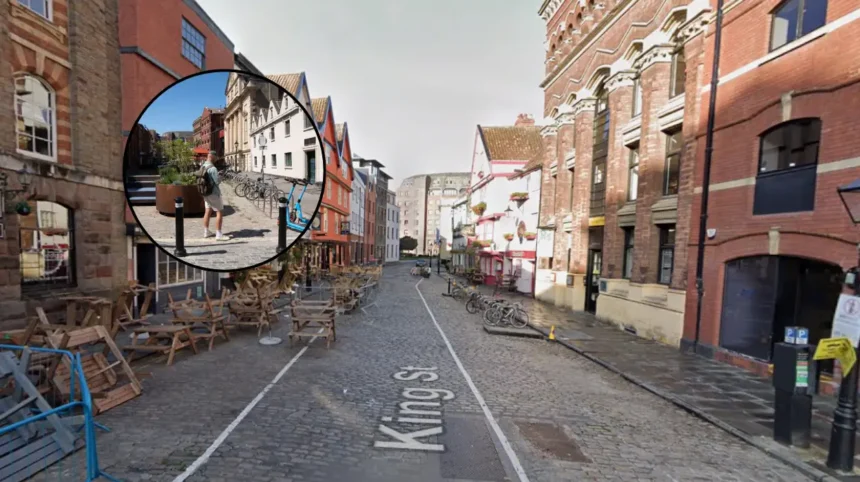
The scope of the £2.5 million initiative involved physical works targeting the cobblestone street and its surrounding arterial paths. Engineered upgrades were introduced to address longstanding physical accessibility challenges associated with historic cobbled surfaces. Smooth, level stone pathways have been incorporated alongside preserved cobbles to enable manual and motorised wheelchair users, as well as individuals with mobility assistance needs, to navigate the street safely.
Alongside accessibility measures, civil engineering contractors installed integrated surface water drainage systems beneath the roadway. The new infrastructure is designed to manage heavy surface runoff during intense rainfall events, mitigating water pooling outside commercial premises and historic buildings. The project also introduced designated travel routes and safer surface transitions for cyclists passing through the city centre nightlife district.
Why Were Engineering Works Required on the Street?
Prior to the commencement of works in October 2024, King Street faced persistent operational challenges due to its age and high levels of footfall. While the historic cobblestones defined the architectural character of the area, the uneven terrain posed significant hazards for mobility-impaired visitors, parents with pushchairs, and cyclists.
Furthermore, severe weather events frequently resulted in localized flooding along the thoroughfare. The absence of modern drainage capacity caused surface water to collect near low-lying pub entrances and pedestrian zones. Bristol City Council identified the need for targeted investment to modernise essential subterranean and surface infrastructure while retaining the heritage elements that designate King Street as a key central conservation zone.
What Is the Background of the King Street Development?
King Street dates back to the 17th century and serves as a core historical asset within Bristol’s city centre conservation boundary. Over decades, the street transitioned from a maritime trade corridor into the primary focal point of the city’s hospitality and nightlife sectors, housing historic public houses, timber-framed structures, and the Bristol Old Vic theatre.
Despite its commercial popularity, public realm investment in the immediate area remained limited for several years, leading to structural wear on the historic stone surfaces. Discussions regarding public realm upgrades were formally initiated by local transport and planning authorities to address accessibility compliance and climate resilience. Following public consultations and design planning, contractors were appointed, and groundworks officially commenced in October 2024. The implementation phase required staged road closures, temporary pedestrian diversions, and coordinated construction schedules to maintain safe access for local businesses throughout the two-year construction period.
Explore More Local Bristol News
Bristol Student Joins Gaza Aid Mission Aboard Flotilla Ship Bristol 2026
Body Found Believed to Be Missing Bristol Student George Smyth, Romania 2026
How Will This Development Affect Local Businesses, Residents, and Visitors?
The completion of the £2.5 million public realm scheme is expected to directly influence operational conditions for hospitality venues, local residents, and visitors across the city centre.
For local business operators and pub landlords, the installation of flood mitigation systems reduces the risk of property damage and operational disruptions caused by surface water ingress during heavy weather. Enhanced pedestrian surface stability and widened accessible pathways are anticipated to expand venue accessibility for disabled patrons, potentially increasing footfall during daytime and evening trading hours.
For cyclists and pedestrians, the dedicated surface adjustments provide a continuous, safer link through the city centre network, reducing the risk of accidents associated with uneven cobblestones. While the two-year construction phase required temporary adjustments to outdoor seating and delivery schedules, the finished infrastructure establishes a modernized public space designed to support high volume pedestrian traffic and long-term economic activity.