Key Points
- Closure Period: Peros Bridge in Bristol city center has been closed for over one month due to a failure that occurred during the test lift.
- Focusing on Hydraulic Lifting System: Investigation conducted by Bristol City Council is focused on the hydraulic lifting system of the bridge while the heat of the day has been ruled out as a reason of failure.
- Contractors’ Participation: The council’s officers are negotiating with contractors to take the bridge spans away for repair before November when they were originally scheduled.
- Financial Considerations: It was previously approved that £1.35 million had been spent in March on maintenance works that were scheduled for autumn but now more money will be spent due to this incident.
- Previous Straining on the Structure: There was previously straining of this landmark due to “love locks” hanging on its railings, which were taken away last year due to structural problems found by the inspector.
- Alternate Routes: People who usually travel using ferries near the Cascade Steps are now being diverted to the alternate location of landing at Prince Street Bridge beside the Arnolfini.
Bristol (Bristol Express News) September 16, 2026 — Council bosses have refused to state how long ongoing repairs will take for Pero’s Bridge, which has remained closed for more than a month after breaking down during a routine test lift.
- Key Points
- Why Has Pero’s Bridge Remained Closed and What Caused the Failure?
- What Do Council Officials and Harbour Authorities Say About the Repairs?
- What Are the Historical Pressures and Alternative Travel Arrangements?
- Background of the Particular Development
- How This Development Can Affect Local Pedestrians, Commuters, and Harbourside Businesses
As reported by Alex Seabrook of Bristol Live, municipal authorities informed councillors that due to the intricate nature of fixing movable bridges, it remains “too early to commit” to a definitive timescale for the completion of the city centre footbridge project.
Why Has Pero’s Bridge Remained Closed and What Caused the Failure?
The Harbourside landmark suffered a mechanical breakdown last month when a test lift left its middle section stuck at a skewed angle. According to reports, extreme heat on the day of the incident has been formally dismissed as a potential cause. Instead, technical investigations are closely examining the structure’s hydraulic lifting system.
Bristol City Council personnel are currently arranging for specialized contractors to extract the bridge spans to execute necessary repairs. While this extraction was originally mapped out for November, officials indicate it may take place ahead of schedule following updates presented to the harbour committee on Tuesday, September 15.
What Do Council Officials and Harbour Authorities Say About the Repairs?
Providing insights into the current stage of operations, harbourmaster David Lockwood stated, as reported by Alex Seabrook of Bristol Live: “We are still at an early stage. We’re only still in the commercial and legal discussion with the contracts for the removal of the spans. We certainly aim to keep on budget, that’s our job, and we aim to keep it on time. But once the project is under way, we’ll be able to give an update on both.”
Adding to these remarks, Patsy Mellor, director of management of place, noted in the coverage by Alex Seabrook of Bristol Live:
“It’s far too early to commit, because as we all know that once you open a bridge and get underneath it, sometimes you have more to deal with than you originally planned.”
Further context was provided by Liberal Democrat Councillor Andrew Brown, chair of the harbour committee, who addressed the intersection between emergency response and scheduled maintenance. As reported by Alex Seabrook of Bristol Live, Councillor Brown stated:
“Aside from dealing with the failure event, which is unfortunate, this is planned work. Although there might be unexpected things that we find when we take it off, to some extent it’s planned work rather than emergency work. So hopefully we’ll be able to do it in the original window.”
Furthermore, addressing the financial implications, Councillor Brown added via Bristol Live reporter Alex Seabrook:
“While we had already budgeted for a significant amount of investment in repairing and refurbishing the structure, there will be some additional costs associated with the fact that there has been that incident and we’ve got to deal with that. We’ll cross that bridge when we come to it.”
What Are the Historical Pressures and Alternative Travel Arrangements?
The complications follow a series of historic maintenance challenges for the structure, which opened in 1999 to connect Queen Square and Millennium Square across three spans—two fixed outer sections and a movable central section designed to accommodate tall vessels. In July last year, inspectors identified major structural concerns exacerbated by heavy padlocks, known as “love locks,” affixed by couples as symbols of commitment. The accumulated weight heavily strained the mechanism until authorities cleared the padlocks away, which had previously prompted a strict no-lift notice and restrictions preventing police horses from crossing.
In March, the harbour committee greenlit a £1.35 million planned refurbishment slated for the autumn. Following the recent breakdown, scaffolding and wooden hoarding have been erected around the site. Meanwhile, local pedestrian and commuter adjustments remain active: ferry passengers intending to board at the city centre stop near the Cascade Steps and the Watershed are being guided to an alternative ferry landing located by Prince Street Bridge, adjacent to the Arnolfini.
Explore more City Centre News:
Flaking Bristol City Centre Mural Repaint Set For Bristol 2026
Bristol City Centre Mural Scheduled For Repainting In 2027
Background of the Particular Development
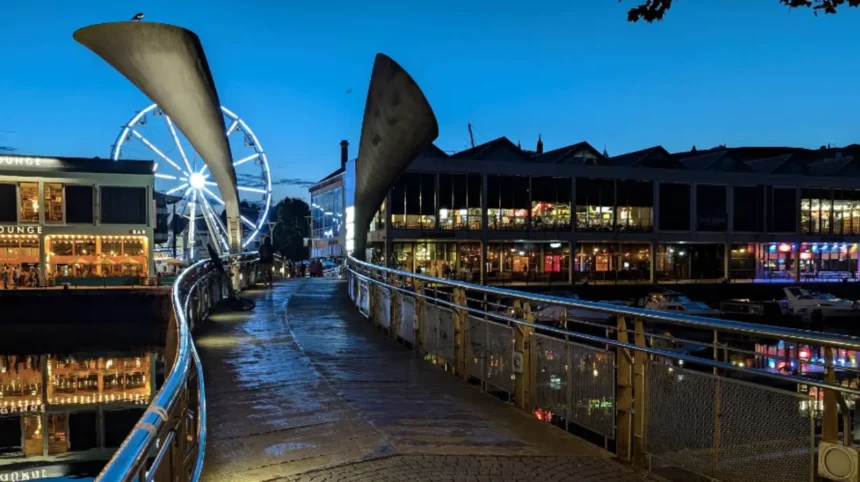
Pero’s Bridge is a notable pedestrian bascule bridge spanning St Augustine’s Reach in Bristol’s Harbourside, named in honour of Pero Jones, an enslaved African man who was brought to Bristol in the 18th century by the merchant John Pinney. Since its inauguration in 1999, the bridge has served as a vital pedestrian artery linking Queen Square to Millennium Square, facilitating both foot traffic and the passage of tall boats into the inner harbour via its central lifting span.
Over the decades, the bridge has required careful engineering oversight due to heavy public usage and environmental exposure. The recent developments stem from a combination of long-term structural fatigue—historically worsened by the accumulation of heavy love locks that strained its mechanical tolerances prior to their removal—and a routine test lift conducted in August 2026 that resulted in mechanical failure of the hydraulic lifting apparatus. Although the city council had already allocated £1.35 million in March 2026 for scheduled autumn maintenance, this unanticipated breakdown transformed routine restorative engineering into an urgent structural intervention requiring specialized contractor involvement and span removal.
How This Development Can Affect Local Pedestrians, Commuters, and Harbourside Businesses
The prolonged closure of Pero’s Bridge directly disrupts daily routines for thousands of pedestrians, cyclists, and commuters who rely on the footbridge as a direct shortcut between Queen Square, Millennium Square, and the wider Harbourside district. With wooden hoarding and scaffolding enclosing the site, foot traffic is forced onto alternative detours, adding minutes to local journeys and increasing congestion on nearby crossings. Furthermore, ferry passengers accustomed to using the Cascade Steps stop must navigate alternative arrangements near Prince Street Bridge, which can cause confusion for tourists and occasional visitors.
For local hospitality, retail, and tourism businesses operating around the Harbourside and Watershed areas, reduced footfall across this specific corridor could lead to a minor dip in casual walk-in trade while the crossing remains out of commission. Because council officials have declined to commit to a fixed reopening timeline—citing potential hidden complications once the spans are fully dismantled—local stakeholders face an extended period of uncertainty regarding when normal pedestrian flow and direct access across St Augustine’s Reach will be fully restored.