Key Points
- Bus Service Changes: Major revisions to the bus stops and route services in Bristol’s city center have recently come into effect this month and involve 25 bus services.
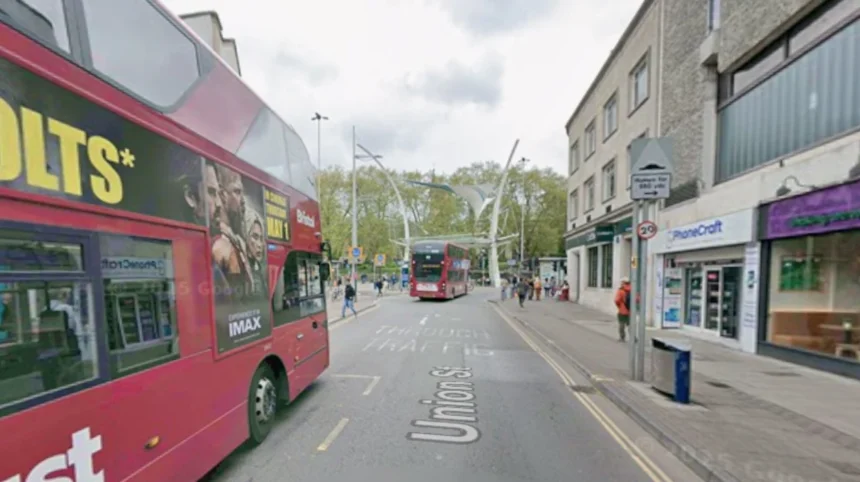
- Closed Access to Certain Streets: The streets Union Street, Horsefair, and Penn Street are closed to buses as part of a pedestrianization program.
- Opposition’s Description of Chaos: According to Chief Reporter Tristan Cork of the Bristol Post, the opposition group on Bristol City Council has referred to the situation faced by travelers as ‘bedlam’.
- Additional Staff Needed: The opposition group has asked for more informed ‘way finders’, citing the fact that current staff members are unfamiliar with the local transportation system.
- Rerouted Buses: North and westbound buses have taken new routes through Baldwin Street or Temple Way and Bond Street, whereas east and southeast bound buses head down Nelson Street under The Galleries and into Castle Park and Old Market.
Bristol (Bristol Express News) September 10, 2026 — Bus passengers travelling through the heart of Bristol are experiencing widespread frustration and what opposition councillors have termed ‘pandemonium’ following a major shake-up of local transport routes and bus stop locations.
The disruption stems from the recent closure of Union Street and the Horsefair to public transport services. Buses that previously navigated directly down Union Street and looped around Broadmead via the Horsefair to reach prominent stops near Primark and Cabot Circus have been permanently rerouted. Consequently, passengers attempting to navigate the city centre have encountered sudden logistical hurdles, prompting sharp political criticism at City Hall.
As reported by Chief Reporter Tristan Cork of the Bristol Post, the Labour group on Bristol City Council has stepped forward to condemn the rollout, characterising the scenes at key transit points as ‘bedlam’ and ‘mass confusion’ for everyday commuters.
What Are the Specific Diversions Affecting Passengers?
Under the newly implemented traffic management scheme, transit paths into, out of, and through the city centre have transformed significantly.
Westbound and northbound buses now bypass the closed shopping corridors by heading either down Baldwin Street towards The Centre, or by travelling around the outer perimeter of Cabot Circus along Temple Way and Bond Street. Meanwhile, services pushing through the city centre towards the east and south-east are being channelled along Nelson Street, travelling underneath The Galleries shopping complex toward Castle Park and Old Market.
These modifications form the initial phase of a broader municipal masterplan designed to fully pedestrianise the Horsefair, removing buses and all other motor vehicles entirely from that specific zone of the urban commercial district.
Why Are Opposition Councillors Demanding Better Staffing Support?
In response to mounting complaints from stranded or disoriented commuters, the Labour opposition at City Hall has formally called on the Green-led local authority to drastically ramp up on-the-ground support.
While acknowledgeable that some informational staff have been deployed, Labour councillors argued that these workers fall short of what is genuinely required. As noted in the critique, although these present members of staff are equipped with basic information sheets, they fundamentally lack a detailed, comprehensive knowledge of the wider regional transport network—an expertise vital for helping confused passengers untangle alternative connections.
Explore more City Centre News:
Non-Smoker Convicted in Mistaken Identity Cigarette Fine Case Bristol 2026
The Coconut Tree Expands to Broad Quay, Bristol City Centre 2026
Background of the Particular Development
The reconfiguration of the Broadmead transport network represents a critical component of the wider Bristol City Centre project and the forthcoming pedestrianisation of key retail zones. Municipal planners designed the scheme to prepare the urban core for thousands of anticipated new residential homes, retail establishments, and leisure spaces scheduled for construction across the district over the coming years.
By removing heavy bus traffic from shopping arteries like Union Street, the Horsefair, and Penn Street, the council aims to carve out substantial pedestrian-friendly environments featuring new green infrastructure, public art, and community spaces. However, the transition has laid bare the acute friction points inherent in balancing long-term urban regeneration with immediate, day-to-step public transit reliability.
How This Development Can Affect Bus Passengers and Commuters
For regular bus passengers, commuters, and shoppers relying on public transport in Bristol, this ongoing transition introduces a prolonged period of unpredictability and extended journey times. In the short term, travellers face a steep learning curve as they adapt to decentralized stops spread further across the city periphery, potentially discouraging spontaneous trips into the commercial centre and placing extra stress on interchange points.
If the local authority fails to address staffing deficiencies and streamline passenger guidance as demanded by opposition councillors, public dissatisfaction could harden, undermining confidence in the city’s broader transit strategy. Conversely, if effective wayfinding and clear communication are successfully integrated, passengers may eventually benefit from a quieter, less congested, and more modern urban core once construction and regeneration works fully mature.