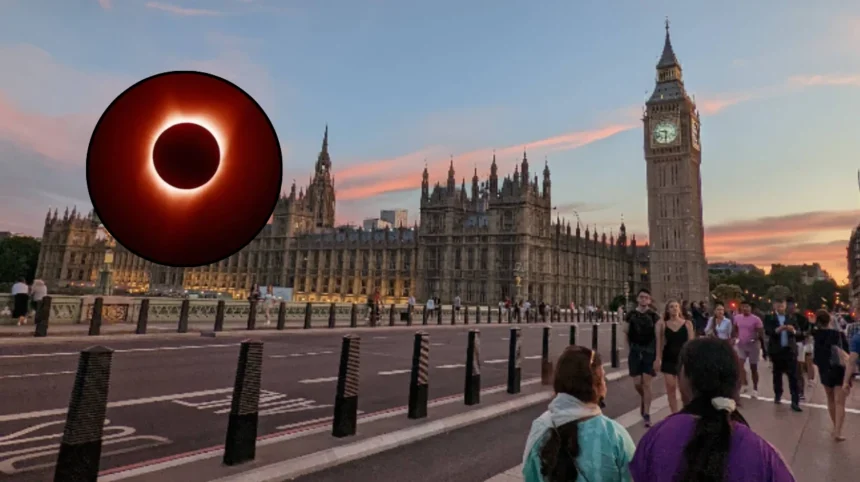
Key Points
- Major Astronomical Event: The UK is set to witness its most significant solar eclipse in 54 years on Wednesday, August 12, 2026.
- Peak Obscuration Regions: Devon, Cornwall, and westernmost Pembrokeshire will experience the maximum obscurity, with 94% to 96% of the sun hidden by the moon.
- Prime Spot: Plymouth is projected to see 94.66% coverage peaking at 7.16pm.
- Nationwide Timing: The eclipse will occur between 6.17pm and 8.06pm BST across Britain, with over 90% coverage for most of the country.
- Safety Warning: The Royal Greenwich Observatory has issued an explicit warning that regular sunglasses do not provide sufficient protection.
- Future Comparison: The next event with comparable solar obscuration in the UK will not occur until 2081, while a total solar eclipse will not happen over Britain until 2090.
London (Bristol Express News) August 8, 2026 – Where can skygazers across Britain secure the clearest views of the country’s most significant solar eclipse in over five decades? The Met Office has officially released its nationwide location guide ahead of Wednesday, August 12, detailing exact times and coverage percentages across England, Wales, Scotland, and Northern Ireland. Between 6.17pm and 8.06pm BST on August 12, the moon will block out more than 90% of the sun across the vast majority of Britain. This marks the highest level of solar obscuration visible from British skies since the historic total solar eclipse of August 11, 1999.
- Key Points
- Which UK Regions Will Experience the Highest Solar Obscuration?
- What Time Will the Solar Eclipse Peak in Major British Cities?
- How Can Skywatchers Safely View the Solar Eclipse?
- Where Is the Path of Total Solar Eclipse Located in Europe?
- What Is the Historical Background of Solar Eclipses in the UK?
- Prediction: How Will the August 12 Solar Eclipse Affect UK Skygazers, Transport, and Local Businesses?
As reported by Robert Rowlands of Wales Online, official data from the Met Office confirms that the far South West of England and western reaches of Wales will enjoy the highest degree of obscuration anywhere in the UK. Devon, Cornwall, and the westernmost edges of Pembrokeshire are projected to see between 94% and 96% of the sun concealed by the lunar disk. Among major coastal settlements, Plymouth has been highlighted as a top viewing spot, where 94.66% solar coverage will be reached precisely at 7.16pm BST.
Which UK Regions Will Experience the Highest Solar Obscuration?
As reported by Robert Rowlands of Wales Online and The Independent, Met Office mapping divides the UK into distinct obscuration zones based on proximity to the path of maximum alignment:
- 94% to 96% Coverage: Devon, Cornwall, and western Pembrokeshire.
- 92% to 94% Coverage: The remainder of Wales, Northern Ireland, sections of the West Midlands, the South West, and Scotland’s westernmost coastlines and Western Isles.
- 90% to 92% Coverage: Central and eastern England, southern Scotland, and the East Midlands.
- 88% to 90% Coverage: Easternmost coastal zones, including Norfolk, East Yorkshire, Aberdeenshire, and the Orkney and Shetland Islands.
As reported by Keiran Fleming of STV News, observers in western Scotland are positioned for substantial coverage, but local visibility could be tempered by microclimates.
Fleming noted that while western Scottish coastal areas will experience 92% to 94% coverage, cloud cover along the Atlantic margin may obscure views.
Conversely, eastern parts of Scotland, despite having slightly lower overall obscuration (88% to 90.7%), are currently forecast to benefit from clearer skies during the late afternoon and early evening window.
What Time Will the Solar Eclipse Peak in Major British Cities?
According to data compiled by the Met Office and reported by The Independent, the eclipse progression will move across the British Isles during the early evening hours of Wednesday, August 12.
The exact peak times and maximum obscuration figures for key urban centres across the nations include:
Skygazers planning to observe the phenomenon are advised that the partial eclipse will begin shortly after 6.17pm BST, reach its zenith around 7.03pm–7.16pm depending on geographical longitude, and conclude by 8.06pm BST as the sun sets low on the western horizon.
How Can Skywatchers Safely View the Solar Eclipse?
Safety experts and astronomers have issued clear guidance regarding proper visual protection during the event. As reported by The Independent, the Royal Greenwich Observatory warned the public that standard sunglasses—regardless of dark tint or ultraviolet ratings—do not offer safe protection against solar retinopathy or permanent eye damage.
According to statements given to the Press Association by Imo Bell, planetarium astronomer at the Royal Greenwich Observatory, observers must exercise caution while taking advantage of this rare celestial event:
“It’s not a total eclipse, but over 90% is really exciting. We’re not going to get one this good for a really long time,” stated Imo Bell of the Royal Greenwich Observatory.
As reported by The Independent, Bell advised members of the public seeking an optimal view to locate an elevated vantage point facing west with minimal obstruction from tall buildings or trees, given the sun’s low altitude during the 7.00pm hour.
Describing what observers can expect to see visually, Bell explained to the Press Association:
“We might notice the sky getting a little bit dark, so if you’re looking safely, it’ll look a bit like the moon is taking a bite out of the sun, you’ll see something that looks a bit like a crescent sun,” Bell noted.
For those without certified solar eclipse glasses or ISO-certified viewers, Bell highlighted a simple indirect viewing method using household kitchenware:
“And if all else fails, you can project the image of the eclipse using a household item like a colander which has lots of holes in – point the colander towards the Sun with your back facing it, and in the shadow of the colander you’ll be able to see the eclipse in the holes, which is really cool,” Bell stated.
Where Is the Path of Total Solar Eclipse Located in Europe?
While the British Isles will witness a deep partial solar eclipse, nearby mainland European locations will fall directly within the path of totality.
As reported by Robert Rowlands of Wales Online, the narrow corridor of 100% total solar obscuration on August 12 will cross parts of Iceland and northern Spain.
In Iceland, the capital city of Reykjavik will experience full totality. In continental Europe, northern and eastern Spain will see the moon completely cover the solar disk, with major Spanish cities such as A Coruña, Oviedo, Zaragoza, Bilbao, and Valencia lying directly in the path of totality.
Explore More UK News
UK Denies Direct Evacuation Aid to At-Risk Afghan Allies in London 2026
Food Fraud Costs UK Economy £2B Annually Portsmouth 2026
What Is the Historical Background of Solar Eclipses in the UK?
Solar eclipses occur when the moon passes directly between the Earth and the Sun, casting its shadow across the terrestrial surface. Total solar eclipses visible from the mainland United Kingdom are exceptionally rare events due to the dynamic geometry of lunar orbital inclination and Earth’s rotation.
The last total solar eclipse visible from British soil occurred on August 11, 1999, when the path of totality crossed Cornwall and parts of South Devon before continuing across the English Channel into continental Europe. The 1999
event attracted millions of visitors to the West Country, establishing a historical precedent for heightened public interest whenever significant solar coverage occurs in the region.
Since 1999, Britain has experienced several partial solar eclipses—notably in March 2015 (where obscuration ranged between 83% and 98% depending on latitude) and June 2021—but none have offered the combination of extensive national coverage (exceeding 90% across almost the entire landmass) seen in the August 12, 2026 event.
According to data confirmed by the Met Office and the Royal Greenwich Observatory, British skygazers will have to wait decades for comparable events:
- Next 90%+ Partial Eclipse in the UK: Scheduled for 2081.
- Next Total Solar Eclipse in the UK: Scheduled for September 23, 2090.
Prediction: How Will the August 12 Solar Eclipse Affect UK Skygazers, Transport, and Local Businesses?
The August 12, 2026 solar eclipse is anticipated to generate considerable public activity, localized economic influxes, and specific operational challenges across key regions of the United Kingdom:
With Devon, Cornwall, and western Pembrokeshire designated as top viewing zones for 94% to 96% coverage, coastal highways such as the A30, A38, and A40 are expected to see heavy traffic congestion leading into Wednesday afternoon.
Accommodation providers, coastal holiday parks, and hospitality venues in locations like Plymouth, St Ives, Penzance, and Tenby are likely to experience surge demand from day-trippers and amateur astronomers.
Because the peak of the eclipse coincides directly with the Wednesday evening rush hour (6.17pm to 8.06pm BST), transport authorities anticipate potential driver distraction along major motorway networks.
Sudden drops in ambient light levels during late afternoon commute hours could lead drivers to pull over abruptly on verges or dual carriageways, prompting safety warnings from national highways agencies.
In the days leading up to August 12, optometrists, science museum gift shops, and online retailers are expected to report a surge in demand for certified ISO 12312-2 solar viewing glasses. Public health agencies are anticipated to publish additional safety reminders warning against improvised filters or unverified lens coatings.
On a national infrastructure level, grid operators managing the UK power network will prepare for a brief, predictable drop in solar photovoltaic power production during the peak eclipse window between 6.30pm and 7.30pm BST, requiring temporary ramping of reserve energy supplies to maintain grid equilibrium.