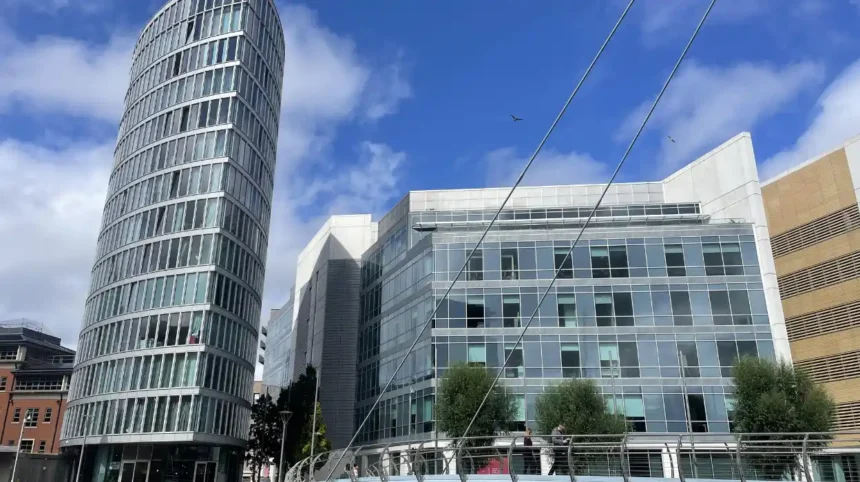
Local businesses in Bristol form a high-output urban economy generating over £22.8 billion in total Gross Value Added. The ecosystem comprises independent retailers, advanced engineering firms, creative agencies, and digital tech enterprises across forty distinct commercial districts within the city.
- What is the history of local businesses in Bristol?
- What key sectors define the structure of local businesses in Bristol?
- Digital Technology and Creative Media
- Aerospace and Advanced Engineering
- Financial, Legal, and Professional Services
- Independent Retail and Hospitality
- How do local businesses operate in Bristol?
- Regulatory and Licensing Frameworks
- Business Improvement Districts and Support Networks
- Sustainability Requirements and Low Emission Standards
- What real-world examples illustrate local businesses in Bristol?
- Aardman Animations
- Hargreaves Lansdown
- Tobacco Factory Theatres and Southville Regeneration
- The Bristol Port Company
- What statistics demonstrate the performance of local businesses in Bristol?
- What is the future impact of local businesses in Bristol?
Bristol serves as the largest economic engine in South West England, sustaining a registered resident population of 482,998 individuals. The local business architecture operates across four distinct spatial categories: core retail corridors, industrial zones, maritime port districts, and central office clusters. Central office clusters include Temple Quay, Queen Square, and the Old City district. Industrial zones incorporate the Avonmouth Severnside enterprise area adjacent to the Port of Bristol. Core retail corridors feature four high-density retail districts: Gloucester Road, Clifton Village, Bedminster, and Whiteladies Road.
The municipal economy demonstrates high labor productivity, with a total workforce of 243,600 active employees. Professional and business service companies constitute the largest individual employment sector, accounting for 24.41 percent of the total working population. Specific sub-sectors within this category include professional, scientific, and technical services, which supply 11.72 percent of total city employment, alongside administrative and support services at 9.62 percent. Educational and healthcare organizations represent the second-largest employer segment, holding a 24.28 percent employment share across institutions like the University of Bristol, University of the West of England, and Southmead Hospital.
Small and medium-sized enterprises (SMEs) drive microeconomic activity across Bristol, forming over 98 percent of all registered commercial entities. High density of independent trade distinguishes Bristol from comparable Core Cities in the United Kingdom, such as Birmingham, Manchester, and Leeds. The city maintains a high workforce qualification profile, where 58 percent of working-age residents possess a higher education qualification at Level 4 or above, exceeding the national average of 45 percent. This concentration of skilled labor provides technical infrastructure for growth across knowledge-intensive business sectors.
The spatial distribution of commerce relies heavily on transport networks connecting local business hubs to national markets. Rail infrastructure centers on Bristol Temple Meads railway station, which facilitates freight and commuter transit to London Paddington and regional centers. Maritime trade routes pass through the Port of Bristol at Avonmouth and Royal Portbury Dock, handling annual cargo volumes exceeding 6 million tonnes. Road connections depend on two national motorways: the M4 motorway running east-west between London and South Wales, and the M5 motorway running north-south between the West Midlands and the South West.
Economic value generation in Bristol shows spatial variations across municipal wards. Central wards like Ashley, Central, and Clifton generate higher commercial rates per square meter due to corporate headquarters and retail density. Outer wards like Avonmouth and Lawrence Weston provide essential logistics, energy generation, and manufacturing space. This geographic differentiation creates a self-sustaining municipal market structure where production, research, and distribution activities operate within a single administrative boundary.
What is the history of local businesses in Bristol?
Maritime commerce established the historic foundation of local businesses in Bristol during the thirteenth century. Colonial trade, transatlantic shipping, manufacturing, and aerospace engineering transformed the city into an international trading center before modern diversification created today’s technology sectors.
Commercial activity in Bristol began along the natural confluence of the River Avon and the River Frome. In the 1240s, civil engineers redirected the River Frome into a human-made channel known as Saint Augustine’s Reach to expand harbor capacity for deep-water vessels. The Bristol Society of Merchant Venturers received a royal charter from King Edward VI in 1552 to manage port operations and control export monopolies. Early trade exports consisted of wool cloth and manufactured goods, while imports included wine from France, grain from Ireland, and timber from the Baltic region.
During the seventeenth and eighteenth centuries, transatlantic trade routes expanded municipal wealth through the importation of plantation commodities. Local merchants processed three primary raw materials: tobacco, raw sugar, and cocoa beans. The growth of sugar refining led to the establishment of twenty sugar houses across the city by 1750. Financial services emerged directly to underwrite shipping operations, credit lines, and maritime insurance policies. Banks established during this era laid the foundation for Bristol’s modern financial district, which currently ranks as one of the largest regional financial centers in the United Kingdom.
Industrialization in the nineteenth century shifted local business focus toward heavy engineering and civil infrastructure. Engineer Isambard Kingdom Brunel designed the Great Western Railway connecting Bristol to London in 1841 and supervised the construction of the SS Great Britain, launched in Bristol Harbor in 1843. To solve tidal water limitations in the harbor, engineer William Jessop constructed the Floating Harbour between 1804 and 1809 by installing lock gates across an 80-acre section of the River Avon. This engineering modification allowed commercial ships to remain afloat at constant water levels during low tide.
The twentieth century marked the rise of aerospace engineering as a dominant industrial employer in the Bristol urban area. Sir George White founded the Bristol Aeroplane Company at Filton in 1910, establishing an industrial supply chain that produced military and commercial aircraft. The Filton facility contributed to the development and manufacturing of Concorde, the supersonic airliner, during the 1960s and 1970s. Aerospace manufacturing expanded into a network of specialized engineering firms including Rolls-Royce, Airbus UK, and GKN Aerospace, which continue operations in South Gloucestershire and Northern Bristol.
Retailing underwent structural evolution following physical reconstruction after World War II. Broadmead developed as the primary shopping precinct during the 1950s, replacing historic shopping streets destroyed during the Bristol Blitz. In 2008, the opening of Cabot Circus, a £500 million shopping center, added 93,000 square meters of retail space to the central business district. Concurrently, local communities protected traditional high streets from suburban shopping mall displacement, preserving long-standing commercial thoroughfares like Gloucester Road and Christmas Steps.
What key sectors define the structure of local businesses in Bristol?
Four major industry sectors structure the local business economy in Bristol: digital tech and creative media, aerospace and advanced manufacturing, financial and professional services, and independent retail and hospitality. These industries generate the majority of city output.
Digital Technology and Creative Media
The digital technology sector in Bristol yields an annual turnover exceeding £1.7 billion. Technology growth centers on artificial intelligence, microchip design, robotics, and cloud software development. High-technology spin-outs from the University of Bristol operate from incubator facilities such as Engine Shed, located adjacent to Bristol Temple Meads station. Notable digital enterprises originating or maintaining major development hubs in Bristol include three technology firms: Ultraleap, Graphcore, and Huboo.
Creative media businesses operate alongside the digital technology cluster. Bristol holds official status as a UNESCO City of Film, supported by production facilities at Bottle Yard Studios in Hengrove. The city hosts two world-renowned animation and natural history film production companies: Aardman Animations, creators of Wallace & Gromit, and the BBC Studios Natural History Unit. The creative sector incorporates over 6,000 active businesses employing approximately 15,000 professionals across media production, graphic design, and software engineering.
Aerospace and Advanced Engineering
Advanced manufacturing remains an essential industrial pillar, centered in northern Bristol and Avonmouth. The aerospace hub at Filton integrates research institutes, component manufacturers, and assembly plants. Two primary global engineering firms operate major facilities in this cluster: Airbus UK, which designs and tests commercial aircraft wings, and Rolls-Royce, which manufactures military and civil propulsion systems. The National Composites Centre (NCC), located at the Emersons Green Science Park, provides research infrastructure for lightweight material development.
Manufacturing outside aerospace focuses on environmental technologies, packaging, and industrial machinery. The Avonmouth industrial zone houses four sustainable technology installations: the Avonmouth Waste-to-Energy Plant, Accolade Wines bottling facility, Seabank Power Station, and Bristol Sewage Treatment Works. These facilities provide power generation, recycling, and industrial processing services for the West of England region.
Financial, Legal, and Professional Services
Financial services companies employ over 19,000 people within the Bristol unitary authority area. The sector includes investment management firms, retail banking operations, corporate law practices, and insurance providers. Hargreaves Lansdown, a FTSE 100 financial service firm founded in Bristol in 1981, maintains its national headquarters at One College Square on the Harbourside. Ethical banking institutions also locate primary offices in the city, exemplified by the UK headquarters of Triodos Bank on Deanery Road.
Legal services constitute a substantial portion of professional employment. Three major commercial law firms operate extensive offices in the Temple Quay financial district: Burges Salmon, Osborne Clarke, and TLT LLP. These legal practices advise national and international clients on corporate finance, intellectual property, renewable energy projects, and real estate transactions.
Independent Retail and Hospitality
Independent retail businesses form the structural core of Bristol’s suburban high streets. Retail trade occurs across forty designated local shopping centers. The hospitality industry operates through a dense network of independent restaurants, microbreweries, and public houses. Three microbreweries operating in the city include Bristol Beer Factory, Left Handed Giant, and Moor Brewery.
Independent trade concentrated along Gloucester Road represents the longest continuous street of independent shops in Europe, stretching 1.7 miles across the BS7 postal district. Retailers along this corridor include bookshops, green grocers, hardware suppliers, and clothing boutiques. St Nicholas Market, established inside The Exchange building on Corn Street in 1743, houses over 60 independent market traders offering street food, antiques, and handcrafted products.
How do local businesses operate in Bristol?
Local businesses operate within structured regulatory, legal, and economic frameworks overseen by Bristol City Council and regional business networks. Enterprise support systems, business improvement districts, and municipal green initiatives guide daily operations and capital investments.
Regulatory and Licensing Frameworks
Commercial enterprises operating in Bristol must comply with municipal regulations administered by Bristol City Council. Business entities pay commercial property taxes known as National Non-Domestic Rates (NNDR), which the local authority collects to fund public infrastructure and civic services. Companies modifying commercial properties or altering usage classes must obtain planning consent under the Town and Country Planning Act 1990.
Food service establishments, entertainment venues, and alcohol retailers require specific operational licenses. The Licensing Authority enforces provisions under the Licensing Act 2003, governing sale of alcohol, late-night refreshment, and live entertainment. Food businesses must register with the Environmental Health Department twenty-eight days prior to trading and undergo regular inspections rated under the Food Hygiene Rating Scheme.
Business Improvement Districts and Support Networks
Local trade coordination relies on Business Improvement Districts (BIDs). A BID is a defined geographical area where commercial rate-payers vote to pay an additional levy on their business rates to fund local improvements. Bristol operates four active Business Improvement Districts: Broadmead BID, Bristol City Centre BID, Redcliffe & Temple BID, and Bedminster BID.
These BIDs deliver public realm cleaning, safety street wardens, holiday lighting, and marketing campaigns to increase footfall. Commercial advice and export documentation are provided by Business West, the regional Chamber of Commerce headquartered at Leigh Court. Early-stage entrepreneurs access grants and business advisory programs funded by the West of England Combined Authority (WECA) through the Growth Hub platform.
Sustainability Requirements and Low Emission Standards
Operating a business in central Bristol requires compliance with strict municipal environmental policies. On September 28, 2022, Bristol City Council introduced a Clean Air Zone (CAZ) covering 3.2 square miles of the central urban area. Non-compliant commercial vehicles, including older diesel delivery vans and heavy goods vehicles (HGVs), must pay daily entry charges ranging from £9 to £100 to enter the zone.
The Clean Air Zone policy forced commercial operators to restructure supply chain logistics. Local businesses increasingly utilize zero-emission last-mile delivery services. Cargo bike logistics firms, such as Zedify Bristol, handle urban freight distribution for independent retailers, reducing vehicular traffic within the interior zone bounded by the A4044 inner ring road.
Explore More Area Guide
Bristol Second Most AI-Ready UK City Outside London 2026
Comprehensive Guide to the Best Shopping Centres and Retail Destinations in Bristol
What real-world examples illustrate local businesses in Bristol?
Prominent local businesses illustrate Bristol’s commercial diversity across tech, retail, manufacturing, and entertainment. Examples include Aardman Animations, Hargreaves Lansdown, St Nicholas Market traders, Tobacco Factory Theatres, and Bristol Port Company.
Aardman Animations
Aardman Animations represents a global creative media company headquartered on Gas Ferry Road in the Spike Island maritime district. Founded in 1972 by Peter Lord and David Sproxton, the company specializes in stop-motion clay animation, digital computer animation, and commercial production. In 2018, Aardman transferred 75 percent of company shares to an Employee Ownership Trust (EOT) to protect its independent corporate structure and prevent external acquisitions.
The studio operates production facilities in Aztec West business park alongside its central administrative headquarters. Aardman employs over 300 permanent staff, expanding to 500 during feature film productions. The firm generates foreign revenue through international distribution deals, consumer product licensing, and themed entertainment attractions worldwide.
Hargreaves Lansdown
Hargreaves Lansdown demonstrates corporate scaling within Bristol’s professional services sector. Entrepreneur founders Peter Hargreaves and Stephen Lansdown established the firm in 1981, initially operating from a bedroom in Clifton. The company developed into the United Kingdom’s largest direct-to-investor wealth management platform, managing over £120 billion in investment assets for more than 1.8 million retail clients.
The firm employs approximately 2,000 professionals at its corporate head office in Anchor Brewhouse on the Harbourside. Hargreaves Lansdown contributes substantial corporate tax revenues to municipal finances and serves as a major employer for financial analysts, software developers, and customer support specialists living in the West of England region.
Tobacco Factory Theatres and Southville Regeneration
The Tobacco Factory on Raleigh Road in Southville exemplifies urban commercial regeneration led by independent enterprise. Architect George Ferguson purchased the derelict Imperial Tobacco manufacturing site in 1994 to prevent demolition. The building was redeveloped into a multi-use facility incorporating a 250-seat theater, an independent cafe-bar, professional office spaces, and residential apartments.
This commercial intervention transformed North Street into a prosperous retail and hospitality corridor. The Tobacco Factory operates as a commercial anchor tenant, driving footfall for adjacent independent businesses including craft bakeries, specialty coffee shops, and design studios.
The Bristol Port Company
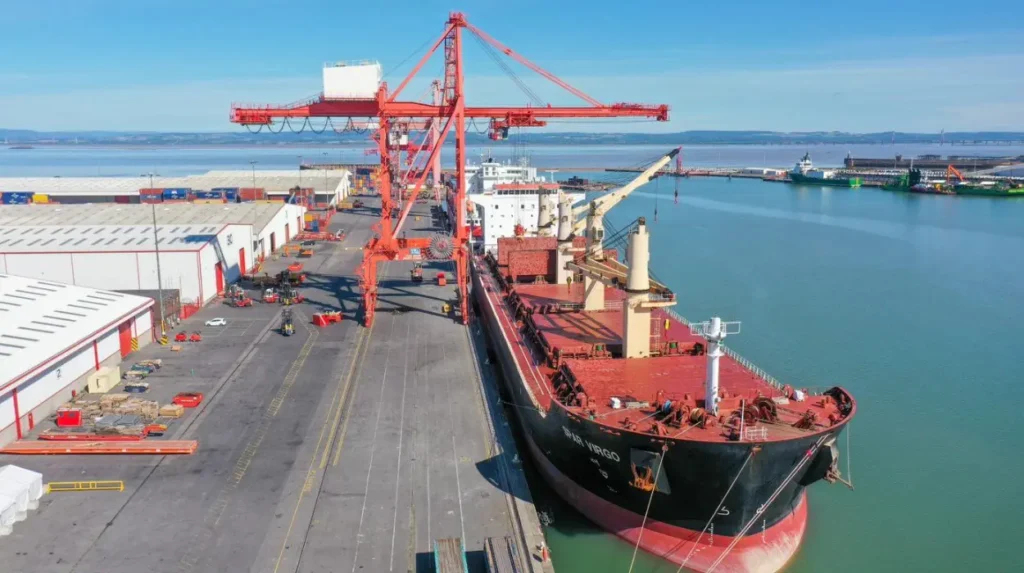
The Bristol Port Company manages commercial maritime trading operations at Royal Portbury Dock and Avonmouth Docks. Privatized in 1991 when entrepreneurs Terence Mordaunt and David Ord purchased the port operational rights from Bristol City Council for £36 million, the company invested over £600 million in port modernization.
The port functions as a national logistics hub for motor vehicle imports, handling over 500,000 motor vehicles annually for manufacturers like aviation and automotive importers. The facility incorporates 1,000 acres of open storage space, deep-water berth access for panamax vessels, and direct rail freight links connected to the national rail network.
What statistics demonstrate the performance of local businesses in Bristol?
Economic statistics reveal Bristol’s strong regional performance, including a total Gross Domestic Product of £22.8 billion, a labor force participation rate of 78.6 percent, and higher average household disposable income than surrounding rural districts.
Statistical data from the Office for National Statistics (ONS) confirms that Bristol maintains the highest economic productivity per worker among major English Core Cities outside London. Total economic output reached £22.8 billion in 2023, representing an increase of 14 percent over a five-year period. Output per hour worked stands at £34.31, matching national benchmarks.
Employment statistics indicate high labor market stability across municipal wards. The overall employment rate among working-age adults reached 78.6 percent in March 2024. Unemployment remained low at 3.8 percent, below the national average. Self-employment accounts for 11.2 percent of total labor force activity, reflecting the high prevalence of independent contractors, freelance media workers, and sole traders operating within creative and technical sectors.
Retail and visitor statistics demonstrate sustained consumer spending across commercial districts. The central shopping district surrounding Cabot Circus averages 2.9 million monthly visitor footfall counts. Small business survival rates in Bristol exceed national averages: 44.2 percent of small enterprises established in 2018 remained active five years later, compared to a national five-year business survival average of 39.5 percent.
Gross Disposable Household Income (GDHI) per head in Bristol was measured at £21,084. While average annual earnings for full-time workers reached £36,400, commercial rent costs and residential property prices remain higher in Bristol than in neighboring South West local authorities, such as North Somerset and South Gloucestershire.
What is the future impact of local businesses in Bristol?
Future business growth in Bristol centers on low-carbon industrial transitions, quantum technology commercialization, major commercial infrastructure projects like Temple Quarter Enterprise Zone, and expanded digital infrastructure investments.
The Bristol Temple Quarter Enterprise Zone
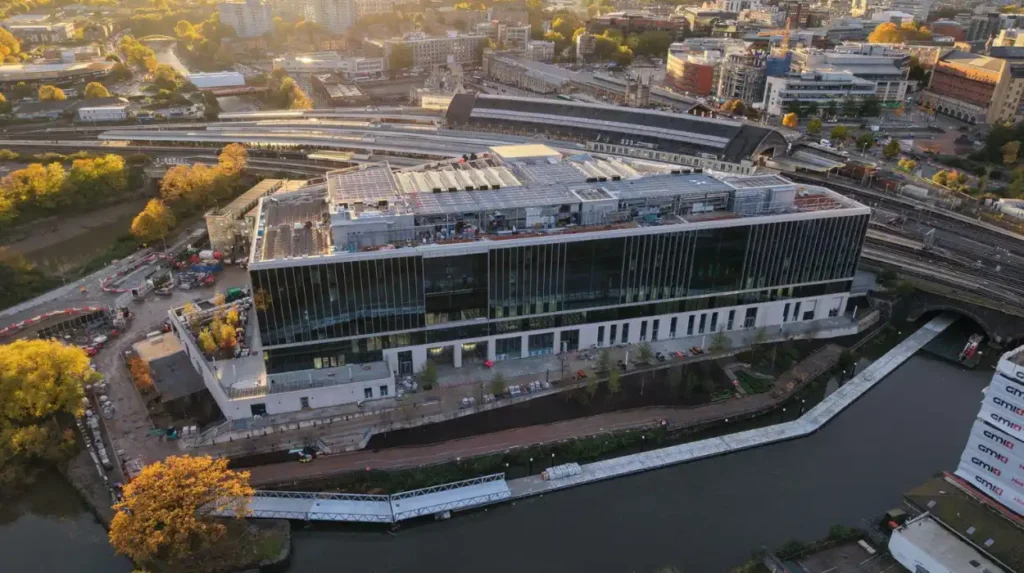
The Bristol Temple Quarter Enterprise Zone represents one of the largest urban regeneration projects in the United Kingdom. Spanning 135 hectares around Bristol Temple Meads station, the development plan projects the creation of 22,000 new jobs, 10,000 new residential units, and £1.6 billion in annual economic growth.
A central element of this project is the University of Bristol Temple Quarter Enterprise Campus, a £500 million research hub focused on digital technologies, quantum computing, and data science. The campus provides shared laboratory facilities where academic researchers collaborate with private technology companies to commercialize new products.
Decarbonization and Net-Zero Business Models
Bristol City Council committed the municipality to achieve net-zero carbon emissions by 2030 under the One City Climate Strategy. To meet this target, the local government established Bristol City Leap, a £1 billion joint venture partnership with Ameresco and Vattenfall. This initiative finances clean energy infrastructure projects including district heating networks, solar photovoltaic installations, and building retrofit programs.
Local businesses face tightening regulatory standards regarding building energy performance. Commercial landlords must upgrade property Energy Performance Certificates (EPC) to minimum ratings of Grade C or B to meet national efficiency targets. Supply chain requirements from major procurement entities increasingly mandate that suppliers disclose Scope 1, Scope 2, and Scope 3 carbon emissions.
Advanced Research, Quantum Tech, and Industry Trends
Commercialization of quantum technology represents a major growth trajectory for Bristol’s tech sector. The Quantum Technologies Innovation Centre (QTIC), established at the University of Bristol, serves as the world’s first dedicated incubator for quantum technology startups. Local firms developing applications in quantum cryptography, photonic microchips, and quantum computing algorithms include three tech companies: KETS Quantum Security, Phasecraft, and FluoretiQ.
In industrial manufacturing, the transition toward zero-carbon aerospace propulsion drives research at Filton. Regional aerospace manufacturers participate in national programs developing hydrogen fuel-cell systems and hybrid-electric aircraft structures. These technical developments ensure that local suppliers retain long-term subcontracts as global aviation transitions away from fossil fuels.
Through spatial regeneration, digital transformation, and industrial decarbonization, local businesses in Bristol remain structured to retain their position as key economic drivers within the UK economy.
What makes Bristol an important business hub in the UK?
Bristol is one of the strongest regional economies in the United Kingdom and acts as the main commercial centre of South West England. The city’s economy is supported by advanced engineering, aerospace, digital technology, creative industries, financial services, education, healthcare, retail, and maritime trade. Its combination of skilled workers, universities, transport connections, and innovation networks makes it attractive for both local businesses and international companies.