Key Points
- Extreme heat in summer causes dehydration, shrinking, and shifting of the earth’s soil, which put an enormous amount of physical pressure on underground water networks.
- The hard water pipes bend and crack due to movement in the soil, leading to bursts of pipes that were previously seen only during freezing winters.
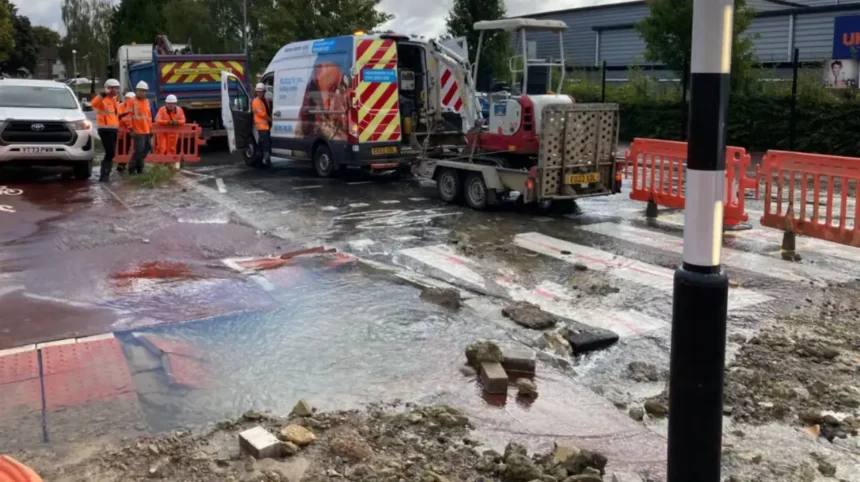
- The water main burst at Cheltenham on 18th of August caused a “raging river” flowing down the street, posing the risk of flooding houses.
- On 20th of August, there was a water main burst near Bristol which left nearly 1,500 houses without water supply for almost the entire day.
- Water companies have been working on repairing and replacing water pipes, but climate experts say that fast-changing extreme climate requires structural rejuvenation and sustainable resilience.
Gloucestershire (Bristol Express News) August 31, 2026 – Record scorching summer conditions across the West of England have triggered a wave of burst water mains, severely depleted supplies, and widespread hosepipe bans. The heatwave has exposed severe vulnerabilities in underground infrastructure, leading to major localized disruptions in both urban and suburban areas.
On 18 August, a major arterial road in Cheltenham was forced to close after a burst water main unleashed a “raging river” of water down the street, directly threatening to flood adjacent residential homes. Only two days later, on 20 August, another major main burst on the periphery of Bristol. This second failure cut off the water supply to nearly 1,500 homes, leaving residents without running water for the majority of the day.
Water companies operating across the region have stated that engineering teams are working continuously to repair active leaks and replace degrading pipe networks. However, as climate change leads to increasingly frequent extreme weather events, industry experts are calling for a fundamental overhaul of the network alongside a more resilient, sustainable approach to regional water management.
Why do heatwaves cause underground pipes to burst?
Underground pipe failures have traditionally been associated with winter freezes, when trapped water expands as it turns to ice. However, protracted heatwaves create an opposing mechanical pressure driven by the soil itself. During extended periods of high heat and low rainfall, deep soil layers lose moisture rapidly, causing the ground to dry out, contract, and shift position.
This ground movement exerts severe directional tension on underground utilities. Because traditional metal and aged water pipes are far more rigid than the surrounding earth, they are unable to absorb the movement, leading to structural buckling, fractures, and catastrophic main splits.
Richard Stanbrook, a director at Bristol Water, explained the shifting nature of network maintenance:
“It’s becoming a phenomenon that only used to happened in the winter but it’s now happening in the summer because the ground dries out and moves. That challenges our pipes because they are more rigid than the ground.”
Background of Underground Water Main Degradation
The infrastructure powering the West of England’s water supply relies heavily on assets laid down several decades—and in some urban centers, over a century—ago. Historically, subterranean networks were built using cast iron or rigid unplasticised materials designed to withstand vertical load pressure rather than lateral soil movement caused by severe drying cycles.
Over successive decades, these networks have suffered cumulative degradation from ground movement, chemical corrosion, and internal pressure changes. While winter freeze-thaw cycles have long been recognized as the primary threat to pipe integrity, the rapid emergence of high-temperature soil desiccation represents a relatively recent operational challenge for UK water undertakers. As summers grow drier and hotter, the frequency of ground shifts has escalated, accelerating structural failures in already aged pipework.
Explore More Local Bristol News
Bristol to Host World Natural Refrigerants Conference: Bristol 2028
Bristol Cabbie Banned After Taking Unlawful Undercover Cop Fare Bristol 2026
Future Outlook: How Will Pipe Network Vulnerability Impact Local Residents and Infrastructure?
The growing frequency of summer pipe bursts will directly impact local communities through increased service disruptions, economic costs, and potential structural property damage.
| Impacted Area | Key Vulnerability | Long-term Consequence for Residents |
| Household Water Access | Unplanned supply outages during peak summer demand | Temporary water loss, reduced pressure, and reliance on emergency bottle stations |
| Local Infrastructure | Road closures and surface flooding | Traffic diversions, damaged tarmac, and risk of surface flooding to adjacent properties |
| Economic & Utility Bills | High cost of reactive emergency repairs vs. systemic upgrades | Potential pressure on household utility tariffs to fund network modernization |
If summer heatwaves continue to intensify as projected, water undertakers will face growing pressure to shift from reactive leak repair to large-scale network replacement. Transitioning rigid legacy pipework to flexible, high-density materials capable of bending with ground movement will prove essential to securing supply reliability for households across the region.