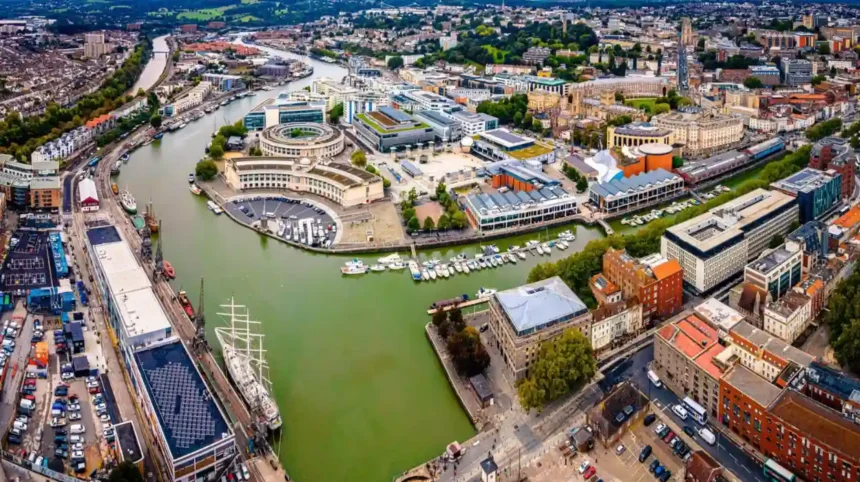
Bristol city centre is the historic, commercial and cultural heart of Bristol. It brings together major shopping districts, historic streets, museums, galleries, churches, markets, parks, restaurants, offices, transport connections and the redeveloped Harbourside.
- What is Bristol city centre?
- How did Bristol city centre develop?
- Which areas make up Bristol city centre?
- How can visitors travel around Bristol city centre?
- What are the main attractions in Bristol city centre?
- Where can visitors experience Bristol’s history?
- Where are the best shopping areas in Bristol city centre?
- What cultural experiences are available in Bristol city centre?
- What is the best way to explore Bristol city centre on foot?
- Why is Bristol city centre important to the city’s economy?
- How is Bristol city centre changing?
- What should visitors know before visiting Bristol city centre?
- Why does Bristol city centre remain important for visitors?
The centre is also one of the most important economic areas in South West England. Bristol is the largest city in the South West, with an estimated population of 495,300 in mid-2025. The wider city has experienced substantial population growth, with an estimated 43,500 additional residents between 2015 and 2025.
For visitors, Bristol city centre provides a compact base for exploring the city’s history, maritime heritage, architecture, shopping and cultural attractions. Many major destinations are connected by pedestrian routes, while Bristol Temple Meads railway station provides an important gateway to the central area.
What is Bristol city centre?
Bristol city centre is the central urban area of Bristol, combining shopping streets, historic quarters, Harbourside, cultural venues, parks, restaurants, offices and transport hubs. It connects major attractions within walking distance and forms the city’s principal visitor, commercial and cultural destination.
The term “Bristol city centre” describes the central area rather than a single neighbourhood. It includes several distinct districts with different historical and commercial identities.
Broadmead forms a major retail area. The Old City contains some of Bristol’s oldest surviving streets and buildings. Harbourside provides a waterside cultural and leisure district. College Green sits beside Bristol Cathedral, while Queen Square provides an important historic public space.
The central area also extends toward Redcliffe and Bristol Temple Quarter. These districts connect the historic core with Bristol Temple Meads railway station and major regeneration projects.
Bristol City Council’s city-centre strategy focuses on six broad themes: destination and identity, community and culture, movement and connections, homes and neighbourhoods, economy and innovation, and environmental sustainability.
This approach reflects the changing role of the centre. It functions as a visitor destination, employment area, residential location, transport interchange and cultural district.
How did Bristol city centre develop?
The history of Bristol city centre begins with Brycgstow, a settlement recorded from the ninth century, and developed through medieval trade, Georgian expansion, Victorian industry, wartime destruction and modern regeneration. Historic streets, churches, harbour structures and archaeological remains preserve these successive phases.
Bristol’s early settlement was associated with the name Brycgstow, meaning “place by the bridge”. Bristol City Council’s city-centre documentation identifies the ninth century as an important starting point for the city’s recorded urban history.
The medieval city developed around trade and transport. Its position near the River Avon helped Bristol become an important commercial port.
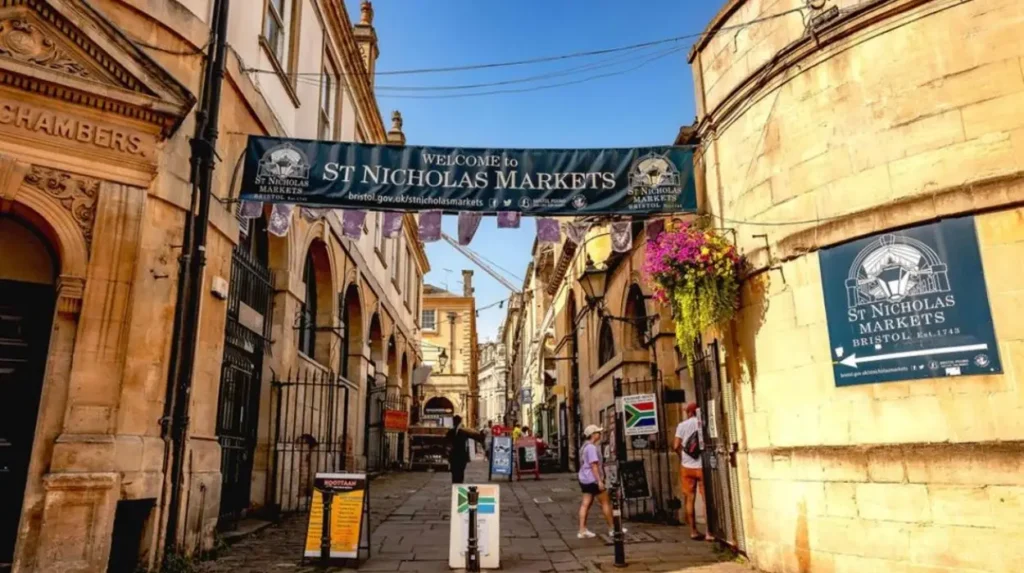
The Old City preserves elements of this historic development. Streets such as Wine Street and Corn Street formed important commercial routes. St Nicholas Market also reflects Bristol’s long-standing trading tradition.
During the Georgian period, Bristol expanded as a wealthy trading city. New buildings, streets and public spaces were developed beyond the medieval core.
The Victorian period brought another major transformation. Industrial activity, manufacturing, commerce and transport expanded. Broadmead and the Castle Park area became important commercial districts.
The twentieth century brought further changes. Wartime bombing damaged significant parts of central Bristol during the Bristol Blitz of 1940 and 1941. Post-war reconstruction altered sections of the historic urban landscape.
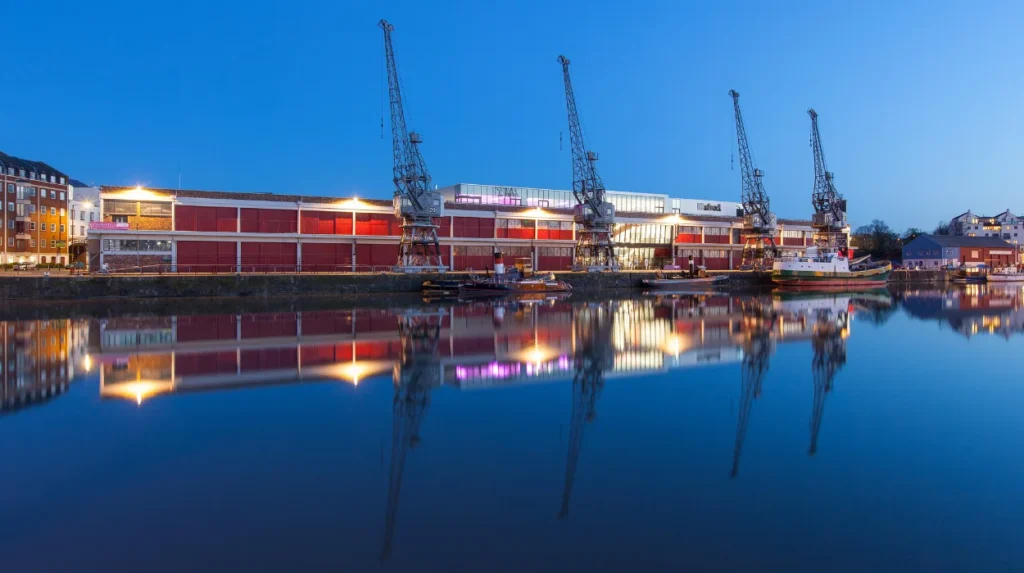
Later regeneration reshaped former industrial and dock areas. The Floating Harbour and Harbourside became central to Bristol’s visitor economy, with museums, cultural venues, restaurants and public spaces replacing many former industrial uses.
This layered history explains why Bristol city centre contains medieval streets, Georgian architecture, Victorian infrastructure, post-war development and modern regeneration within a relatively compact area.
Which areas make up Bristol city centre?
Bristol city centre includes several connected areas, including Broadmead, Old City, Harbourside, Queen Square, St Nicholas Market, College Green, Redcliffe and Temple Quarter. Each area has a distinct function, combining retail, heritage, culture, food, public space, employment and transport.
Broadmead
Broadmead is one of central Bristol’s principal shopping districts. It contains major retailers, food outlets and pedestrianised areas.
Nearby Cabot Circus provides a large modern retail and leisure complex. Bristol City Council describes Cabot Circus as part of a £500 million development, demonstrating the scale of investment in central retail infrastructure.
Old City
The Old City contains historic streets, traditional buildings and important commercial routes. It provides a direct connection between Bristol’s medieval heritage and its modern central economy.
Harbourside
Harbourside occupies the former dock area around Bristol’s Floating Harbour. It is now a major visitor district containing museums, cultural institutions, restaurants, public spaces and leisure facilities.
College Green
College Green sits beside Bristol Cathedral and provides an open public space close to the central shopping and Harbourside districts.
Queen Square
Queen Square is a historic Georgian public square. Its layout provides a significant example of Bristol’s eighteenth-century urban expansion.
Redcliffe
Redcliffe lies south-east of the central core and is strongly associated with historic churches, waterfront development and Bristol Temple Meads connections.
Temple Quarter
Temple Quarter surrounds Bristol Temple Meads and forms one of Bristol’s largest regeneration areas. Its development links transport, housing, education, employment and public realm improvements.
How can visitors travel around Bristol city centre?
Visitors can reach Bristol city centre by rail, bus, coach, bicycle, walking and road. Bristol Temple Meads provides the main national rail gateway, while central bus services connect surrounding districts. Walking and cycling routes link the principal shopping, cultural, harbour and employment areas.
Bristol Temple Meads is the city’s principal railway station and an important national transport gateway.
Visitors arriving by train can continue toward the Old City, Broadmead and Harbourside using local public transport or walking routes.
Buses serve central Bristol and connect the centre with surrounding neighbourhoods. Bus arrangements change as infrastructure and city-centre schemes develop, so visitors should check current travel information before travelling.
Walking is particularly practical for sightseeing. The central attractions are distributed across a relatively compact area. A visitor can combine Broadmead, the Old City, College Green and Harbourside without requiring a car for every journey.
Cycling also forms part of Bristol’s wider active-travel strategy. Bristol City Council’s city-centre regeneration programme identifies walking and active travel as important components of future central-city movement.
Driving into central Bristol requires additional planning because parking availability, traffic restrictions and road layouts vary by location. Visitors should check current council transport information before travelling by car.
What are the main attractions in Bristol city centre?
Key city-centre attractions include Bristol Cathedral, M Shed, the Harbourside, St Nicholas Market, Bristol Aquarium, We The Curious, Queen Square, Castle Park and the historic Old City. These places collectively cover religious heritage, maritime history, science, shopping, public space and urban culture.
Bristol Cathedral is one of the city’s most significant religious and architectural landmarks. It stands beside College Green in the centre.
M Shed focuses on Bristol’s social history. Its collections and displays explain how the city developed through communities, industry, transport and maritime activity.
The Harbourside connects several major visitor attractions. Visit Bristol identifies Millennium Square, Brunel’s SS Great Britain, We The Curious, Bristol Aquarium, Arnolfini, Spike Island, Watershed, Underfall Yard and M Shed among the area’s major attractions.
Brunel’s SS Great Britain represents Bristol’s engineering and maritime heritage. The ship was designed by Isambard Kingdom Brunel, one of Britain’s most influential nineteenth-century engineers.
Bristol Aquarium provides an indoor marine-life attraction in the Harbourside.
We The Curious focuses on science and discovery and forms part of the cultural concentration around Millennium Square.
St Nicholas Market provides a historic market environment. It is particularly relevant to visitors interested in independent traders, food and Bristol’s commercial heritage.
Castle Park provides green space close to Broadmead and the Old City. Its location makes it useful for combining shopping with outdoor space.
Where can visitors experience Bristol’s history?
Visitors can experience Bristol’s history through medieval streets, Georgian squares, historic churches, maritime buildings, museums and former dock infrastructure. Key examples include the Old City, Bristol Cathedral, Queen Square, M Shed, St Nicholas Market, Redcliffe and the Floating Harbour.
Bristol’s maritime history is central to understanding the city centre.
The Floating Harbour transformed Bristol’s waterfront and supported the city’s commercial development. The former docklands later became a major regeneration area.
M Shed occupies a former transit shed and documents Bristol’s social and industrial history. Visit Bristol describes it as a museum housed in a 1950s transit shed.
Bristol Cathedral represents another historical layer. Its architecture and religious history provide evidence of the city’s ecclesiastical development.
Queen Square demonstrates Georgian planning. The square was developed as part of Bristol’s expansion beyond its medieval core.
St Mary Redcliffe Church, located near the centre in Redcliffe, is another important heritage site. Visit Bristol identifies it as a Grade I example of English Gothic architecture.
The historic environment therefore operates as a connected network rather than a single attraction. Visitors can move between churches, markets, streets, squares and museums to understand different stages of Bristol’s development.
Where are the best shopping areas in Bristol city centre?
Bristol city centre provides shopping across Broadmead, Cabot Circus, independent streets and historic markets. Cabot Circus is a major retail and leisure development, while St Nicholas Market provides an older market setting. Independent businesses, cafés, restaurants and specialist shops add further commercial variety.
Broadmead is one of the principal destinations for conventional high-street shopping.
Cabot Circus expands the retail offer with shops, restaurants, leisure facilities and modern public spaces. The development forms an important part of Bristol’s central commercial economy.
St Nicholas Market provides a contrasting experience. Its historic environment supports independent traders and food businesses.
The Old City also contains independent businesses and hospitality venues. Areas around Corn Street and St Nicholas Market retain strong connections with Bristol’s historical trading functions.
Shopping in Bristol city centre therefore covers several formats. Visitors can access national retailers, department-store-style shopping, independent businesses, food markets and specialist outlets within the wider central area.
What cultural experiences are available in Bristol city centre?
Bristol city centre has strong cultural importance through museums, galleries, theatres, music venues, public art and street art. M Shed documents local social history, Bristol Museum explores art and natural history, and the Harbourside hosts major cultural institutions within a compact central area.
Bristol’s cultural identity extends beyond traditional museums.
M Shed provides a city-focused historical perspective. Bristol Museum & Art Gallery covers archaeology, natural history and art. Visit Bristol lists both institutions among the city’s principal museums and galleries.
The Harbourside adds contemporary cultural venues. Arnolfini provides a major centre for contemporary arts. Watershed combines cinema and cultural programming.
Bristol also has a strong street-art identity. The city is internationally associated with Banksy, the Bristol-born anonymous street artist. Visit Bristol identifies Banksy’s work as an important element of the city’s cultural identity.
Street art is particularly relevant around central neighbourhoods and surrounding districts. Visitors can incorporate public artworks into walking routes rather than limiting cultural sightseeing to formal institutions.
Music and performance also form part of the city’s cultural economy. Bristol’s central area contains venues supporting live music, theatre, comedy and evening entertainment.
What is the best way to explore Bristol city centre on foot?
Visitors can explore Bristol city centre efficiently on foot because major destinations cluster around Broadmead, the Old City, College Green and Harbourside. A practical route connects Temple Meads, St Nicholas Market, Broadmead, Bristol Cathedral, Harbourside and Queen Square.
A walking itinerary can begin at Bristol Temple Meads.
From the station, visitors can travel toward the Old City and St Nicholas Market. This introduces Bristol’s historic commercial core before continuing toward Broadmead.
The route can then move west toward College Green and Bristol Cathedral.
From College Green, visitors can continue toward the Harbourside. This section provides access to museums, restaurants, public spaces and waterfront attractions.
Queen Square provides an additional stop for visitors interested in Georgian planning and historic architecture.
Visitors with additional time can continue toward Clifton. Clifton is outside the immediate central core but remains accessible from central Bristol. Visit Bristol describes Clifton as approximately a 15–20 minute walk up Park Street from the centre, depending on the exact starting point and walking conditions.
Clifton also contains the Clifton Suspension Bridge, designed by Isambard Kingdom Brunel and completed in 1864.
The walking approach makes it possible to combine Bristol’s commercial, historic, cultural and architectural attractions within one sightseeing plan.
Why is Bristol city centre important to the city’s economy?
Bristol city centre supports tourism, retail, employment, education, culture and residential development. The wider city centre contains a substantial share of Bristol’s jobs, while millions of visitors contribute to local spending. Regeneration programmes focus on stronger connections, public spaces and housing.
Bristol city centre has an economic role that extends beyond tourism.
A previous Bristol City Council city-centre framework identified the wider city centre as containing approximately 45% of the city’s jobs, with around 120,000 jobs in the wider city-centre area at the time of that framework.
The city’s visitor economy is also significant. Bristol City Council states that the city receives more than nine million visitors each year.
Tourism supports accommodation, hospitality, attractions, transport, retail and cultural organisations.
The centre also supports higher education and professional employment. Bristol’s wider population includes a large student community. The council reported 68,800 students registered at the city’s two main universities during 2024/25.
This combination creates demand for housing, offices, public transport, shops, cultural facilities and leisure spaces.
How is Bristol city centre changing?
The future of Bristol city centre is shaped by regeneration programmes covering transport, housing, public realm, culture, employment and climate resilience. Temple Quarter is a major long-term project, while the city-centre plan focuses on movement, identity, community, culture and economic vitality.
City-centre regeneration is a long-term process rather than a single construction project.
Bristol City Council’s city-centre regeneration strategy identifies destination and identity, community and culture, movement and connections, homes and neighbourhoods, economy and innovation, and environmental sustainability as major planning themes.
Temple Quarter is one of the most significant projects.
The council describes Temple Quarter as a transformation of more than 130 hectares of brownfield land over 25 years. The programme includes ambitions for 10,000 new homes, thousands of new jobs and substantial economic investment.
The development includes Bristol Temple Meads, new homes, employment space, education facilities, public realm and improved walking and cycling connections.
The Bristol Local Plan documentation also sets out proposals for around 100,000 square metres of additional office and flexible workspace and at least 3,000 new homes within the Temple Quarter planning area up to 2040.
These projects are important for visitors because regeneration changes how people move through the centre. New pedestrian routes, public spaces, transport improvements and cultural facilities influence the visitor experience as well as residential and commercial activity.
Explore More Area Guide
Living in Bishopston: Complete Bristol Guide 2026
Living in Bedminster: Complete Bristol Guide 2026
What should visitors know before visiting Bristol city centre?
Visitors should plan around the concentration of attractions, check current transport arrangements, allow time for walking and combine historic districts with Harbourside, shopping areas and cultural venues. Checking opening information, travel conditions and event schedules before departure improves practical planning.
Bristol city centre works particularly well when attractions are grouped geographically.
A visitor interested in history can prioritise the Old City, Bristol Cathedral, Queen Square, St Nicholas Market and M Shed.
A visitor interested in shopping can focus on Broadmead, Cabot Circus and the surrounding independent retail streets.
A culture-focused itinerary can concentrate on the Harbourside, M Shed, Arnolfini, Watershed and nearby attractions.
Families can combine indoor attractions with public spaces such as Castle Park and the Harbourside.
Visitors should also account for Bristol’s hills. The city is not uniformly flat, particularly when travelling between the central area and Clifton.
Weather also affects walking conditions. Comfortable footwear is useful for longer city-centre itineraries.
Transport arrangements should be checked before travel because central bus routes and road layouts change as regeneration and transport projects progress. Bristol City Council currently highlights changes affecting bus routes through the city centre.
Why does Bristol city centre remain important for visitors?
Bristol city centre remains important because it combines historic architecture, maritime heritage, major museums, shopping, public spaces, restaurants, transport links and cultural venues in one connected urban area. Its continuing regeneration adds new housing, employment, public realm and visitor infrastructure.
The central area provides the clearest introduction to Bristol’s multiple identities.
Its medieval streets explain the origins of the trading city. Georgian squares demonstrate eighteenth-century expansion. Victorian infrastructure reflects industrial growth. The Floating Harbour represents Bristol’s maritime economy. Museums preserve social and industrial history.
Modern regeneration has changed former industrial spaces into cultural and leisure districts.
Bristol’s population growth and economic development also ensure that the centre remains an active urban environment rather than simply a historic visitor district. The city’s population reached an estimated 495,300 in mid-2025, according to Bristol City Council’s latest population information.
The result is a city centre where heritage, commerce, culture, transport, education and regeneration operate together.
For first-time visitors, the most efficient approach is to treat Bristol city centre as a collection of connected districts rather than a single attraction. Starting around Temple Meads or Broadmead, continuing through the Old City and College Green, and finishing around Harbourside provides a strong overview of Bristol’s history and present-day identity.
Bristol city centre is therefore both the historic core of the city and an evolving regional destination. Its combination of heritage assets, cultural institutions, shopping areas, waterfront spaces and long-term regeneration gives the centre continuing importance for tourists, residents, businesses and the wider South West economy.
What is Bristol city centre known for?
Bristol city centre is known for its historic streets, Harbourside, museums, shopping areas, Bristol Cathedral, St Nicholas Market, restaurants, cultural venues and maritime heritage. It combines medieval history, Georgian architecture, modern retail and major waterfront attractions.