Key Points
- The deteriorating ‘Our Common Ground’ city centre mural in Bristol will be repainted in spring or summer next year, but this time with more durable thermoplastic paint rather than regular paint.
- Painted in September last year on the site of what used to be a fountain on the Centre Promenade, the 700-sq-m mural quickly deteriorated and needed touch-up work within a month.
- A trial of a thermoplastic paint solution will take place in September or October this year, where it will remain throughout winter to evaluate its durability.
- The change to thermoplastic was announced by Andrew Brown, councillor for Liberal Democrats and chairman of the economy and skills policy committee, after a query by Carole Johnson, councillor for Labour.
- The Upfest organisation, that initially organised the event together with the artist Oshii, is not taking part in the project anymore.
- The initial cost of the installation was £61,000, funded by £31,000 from the council and £30,000 from the City Centre Business Improvement District given to the Bristol Legacy Foundation.
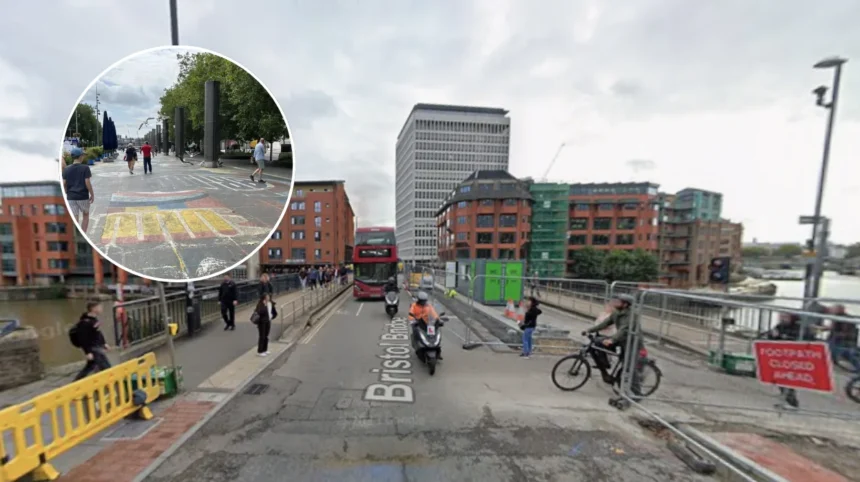
Bristol (Bristol Express News) September 14, 2026 –The flaking city centre mural is set to be repainted next spring or summer using a more durable material after a year-long debacle.
The artwork, titled ‘Our Common Ground’, was originally painted on the floor where the Centre Promenade fountains used to stand in September last year. However, it quickly began to flake away, forcing authorities to seek alternative solutions. As noted by Alex Seabrook of Bristol Live, Bristol City Council has decided to transition from paint to thermoplastics—a material typically utilised for road markings like white lane dividers and zebra crossings—which can endure for several years without intensive maintenance.
What Are the Phases of the Repair Project?
As detailed by Alex Seabrook of Bristol Live, the remediation process will take place in two distinct stages to ensure long-term viability:
- Phase One: This initial step involves thorough cleaning, surface treatment, and a small-scale trial. As outlined by Alex Seabrook of Bristol Live, this test phase will apply a thermoplastic solution instead of paint in September or October, leaving the surface exposed over the winter months to monitor its endurance against colder and wetter weather conditions.
- Phase Two: Providing the test proves successful, the second phase will involve the reinstatement of the full 700-square-metre artwork. According to Alex Seabrook of Bristol Live, this comprehensive restoration is scheduled for spring or summer next year, marking a delay a year later than previous estimates.
Who Prompted the Latest Council Update Regarding the Mural?
As reported by Alex Seabrook of Bristol Live, the recent update concerning the timeline emerged following an inquiry posed by Labour Councillor Carole Johnson during a member forum meeting. In response, Liberal Democrat Councillor Andrew Brown, who serves as the chair of the economy and skills policy committee, explained that thermoplastic would provide a significantly more reliable finish.
As stated by Councillor Andrew Brown, and documented by Alex Seabrook of Bristol Live:
“Research into alternative solutions has been conducted after the initial painted solution was unsuccessful. This has identified thermoplastics as a more durable and reliable treatment for this artwork.”
Explore more City Centre News:
Bristol City Centre Mural Scheduled For Repainting In 2027
Bristol City Centre Bus Route Changes Cause Pandemonium 2026
What Led to the Deterioration of the Original Artwork?
As outlined by Alex Seabrook of Bristol Live, the council originally commissioned Upfest alongside the artist Oshii to coordinate the painting of the mural as part of a wider regeneration scheme for the Centre Promenade following the removal of broken fountains. However, it is currently understood that Upfest is no longer involved in the project.
Just one month after its initial installation, the mural suffered substantial damage and required repainting. At the time, the council estimated that ongoing maintenance and repainting would incur costs between £3,000 and £5,000 annually, which fell outside the original budgetary scope. During a member forum meeting in December last year, repairs were initially slated for spring 2026, with Councillor Brown noting that the administration had inherited the project from its predecessors. Labour previously ran the council for eight years until local elections in 2024 brought the Greens to power with Liberal Democrat support.
Financial records show the original artwork cost £61,000 to produce. Of this total, the council contributed £31,000 covering installation, labour, production, and health and safety equipment. The remaining £30,000 was sourced from the City Centre Business Improvement District—funded via a local business levy—and distributed to the Bristol Legacy Foundation to cover artist fees, engagement activities, curation, and production. In July earlier this year, the charity expressed that they were “deeply saddened” by the deterioration and confirmed they are collaborating with the council on a lasting remedy.
Background of the Particular Development
The revitalization of the Centre Promenade began after the site’s historic fountains—installed in 2000—were officially deemed beyond repair in 2022. Due to limited water storage tank capacity and ageing underground mechanical systems, the fountains proved expensive and challenging to operate. Their removal opened up valuable public space, leading to a broader redesign of the area intended to expand street food market capacity, alter bike path surface colours for enhanced pedestrian safety, and replace mature trees.
The resulting ‘Our Common Ground’ mural was intended to celebrate African heritage, civic unity, and local identity. However, its swift physical deterioration drew widespread public criticism, prompting prominent local figures, including Green Deputy Leader Councillor Heather Mack, to admit public embarrassment and disappointment over the recurring maintenance setbacks.
The transition to industrial-grade thermoplastics for the ‘Our Common Ground’ mural carries significant implications for local stakeholders, including Bristol City Council, local businesses, taxpayers, and Bristolians who frequent the Centre Promenade. For Bristol City Council and local taxpayers, the successful implementation of thermoplastic markings could finally curtail the recurring financial drain of £3,000 to £5,000 per year previously projected for repainting standard paint layers.
If the upcoming winter test phase proves robust, it will restore public confidence in local governance and asset management, which faced scrutiny over the initial project’s short lifespan. For local businesses contributing to the City Centre Business Improvement District levy, a durable, well-maintained public artwork enhances the visual appeal of the main shopping and social hub, supporting footfall without repeated construction disruptions. Conversely, if the thermoplastic trial fails to withstand heavy foot traffic or severe winter weather, the council may face renewed political pressure, additional expenditure, and further reputational damage regarding public space stewardship.