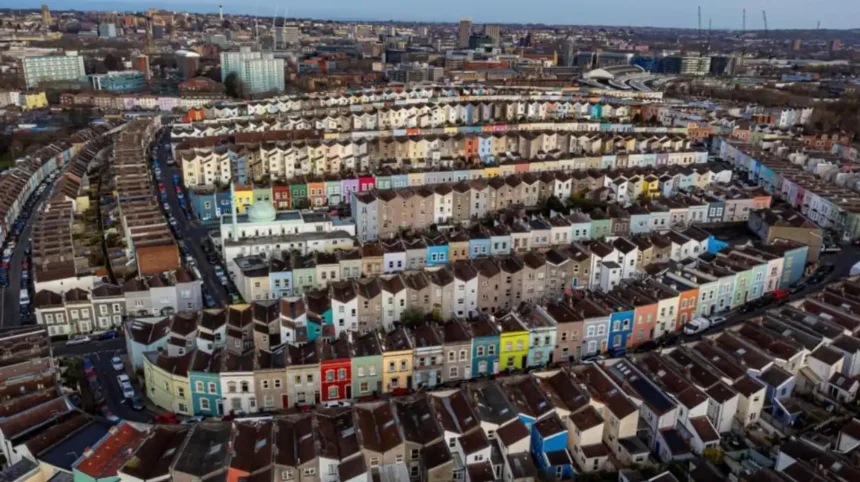
Bristol is one of the South West’s major cities and a significant housing market in England. The city combines historic neighbourhoods, inner-city apartments, Victorian terraces, suburban family housing and higher-value detached properties. House prices vary substantially by property type and location.
- What is the average house price in Bristol?
- How have Bristol house prices changed over time?
- How much do different types of homes cost in Bristol?
- Why are Bristol house prices higher than the South West average?
- How much do first-time buyers pay for homes in Bristol?
- How much do home movers pay in Bristol?
- How much do mortgage buyers pay for homes in Bristol?
- How much do cash buyers pay for Bristol homes?
- Which Bristol areas have the highest and lowest house prices?
- What factors affect house prices in Bristol?
- How does Bristol compare with the UK and South West housing markets?
- How do Bristol house prices affect affordability?
- What does the latest Bristol housing data mean for buyers?
- What is the future relevance of Bristol house price data?
The latest official UK House Price Index (UK HPI) data gives a reliable benchmark for understanding Bristol property values. In July 2026, the average house price in Bristol was £352,262, compared with £345,123 in July 2025. This represented annual growth of 2.1%.
The figures come from HM Land Registry and the Office for National Statistics (ONS). They measure completed property transactions rather than asking prices advertised by estate agents. The distinction is important when assessing the actual cost of buying a home in Bristol.
What is the average house price in Bristol?
The average house price in Bristol was £352,262 in July 2026, according to the UK House Price Index. This was 2.1% higher than £345,123 in July 2025, showing moderate annual growth in the city’s residential property market.
Bristol’s average house price represents the typical level of completed residential property transactions recorded in the City of Bristol local authority.
The July 2026 figure was provisional. UK HPI data for recent months is revised as additional transaction information becomes available. ONS advises using longer-term trends rather than interpreting a single monthly movement in isolation.
Bristol remained one of the higher-priced housing markets in the South West. The average property price across the South West was approximately £302,000 in July 2026, compared with Bristol’s £352,000 average. Bristol therefore stood substantially above the regional average.
The national comparison was also significant. The average UK property price was approximately £273,000 in July 2026, while the England average was approximately £293,000. Bristol therefore had a higher average property price than both England and the UK overall.
The average figure does not mean every Bristol home costs around £352,000. Property type, neighbourhood, floor area, tenure, condition, parking, garden space and proximity to employment centres all influence individual prices.
How have Bristol house prices changed over time?
Bristol house prices have experienced substantial long-term growth, although annual movements have varied. The official UK HPI provides a consistent historical series from 2005 onwards, allowing buyers to compare current prices with previous market conditions.
The UK House Price Index provides monthly local-authority data covering Bristol from January 2005. The index uses transaction information from HM Land Registry and applies a methodology designed to measure changes in residential property prices consistently over time.
Historical analysis matters because property prices move through different phases. Bristol experienced strong housing-market growth during much of the period after the global financial crisis, followed by periods of slower growth and market adjustment.
The pandemic period also produced significant changes in housing demand. Changes in working patterns, household preferences, mortgage conditions and the availability of homes affected property markets across England.
More recently, higher borrowing costs changed purchasing conditions. Mortgage affordability became a stronger consideration for buyers after interest rates increased substantially from their previous lows.
Bristol’s market subsequently moved into a period of slower annual price growth. The latest figures show that prices were still increasing annually in July 2026, but the 2.1% rise was more moderate than the rapid increases recorded during some earlier periods.
The ONS recommends examining longer periods when assessing local housing trends because local datasets contain fewer transactions than national datasets. Short-term movements therefore show greater volatility.
How much do different types of homes cost in Bristol?
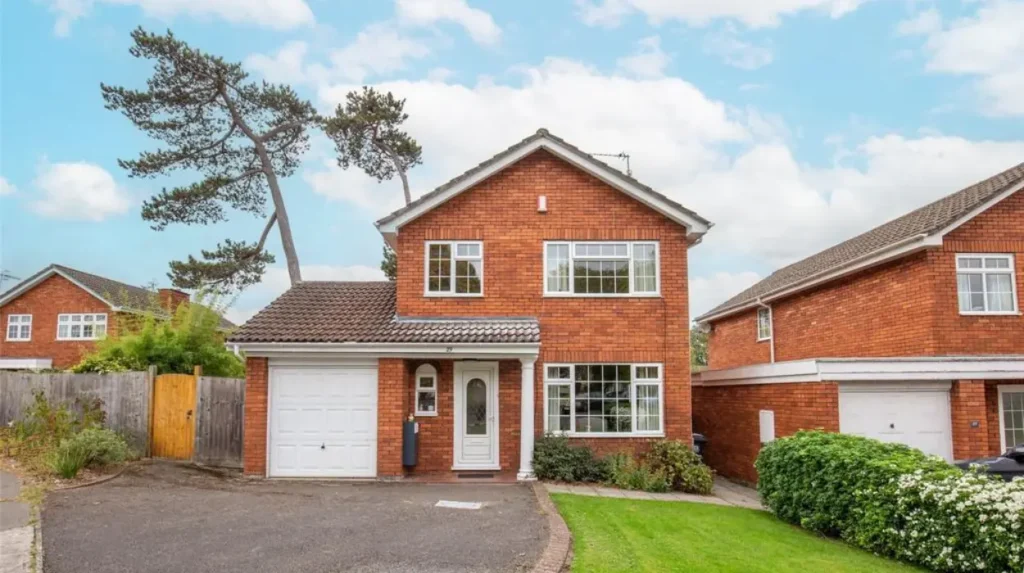
Property type creates a major price difference in Bristol. In July 2026, detached homes averaged £689,000, semi-detached homes £447,000, terraced homes £384,000, and flats and maisonettes £241,000.
Detached properties occupied the highest average price category. At £689,000, the average detached property cost substantially more than the overall Bristol average.
Detached homes generally provide greater internal floor space and often include gardens, driveways or additional private outdoor space. Their locations are concentrated more heavily in suburban parts of the city.
Semi-detached properties averaged £447,000. This category sits between detached and terraced housing in the Bristol market.
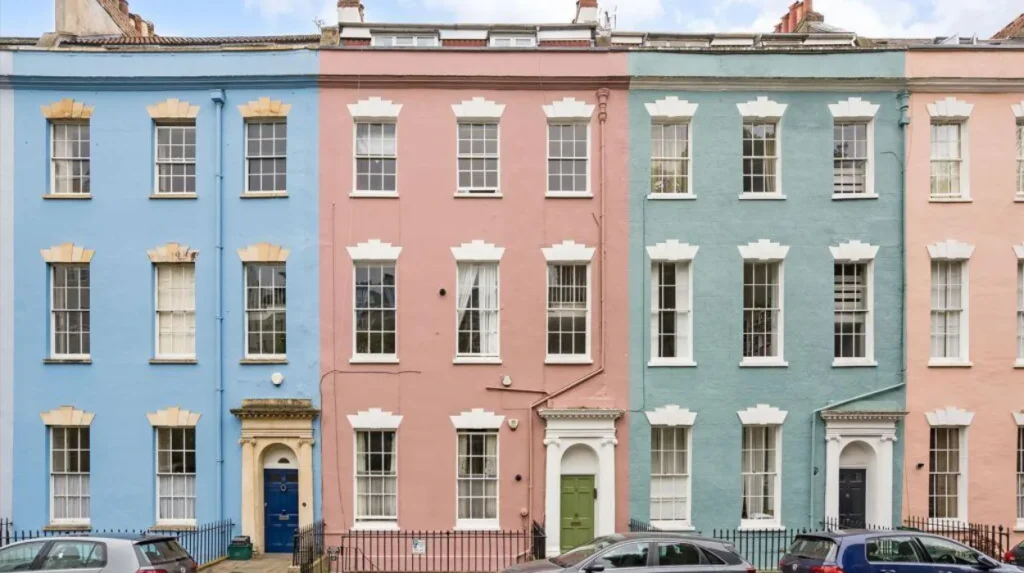
Terraced properties averaged £384,000. Bristol has a substantial stock of traditional terraced housing, particularly in established residential neighbourhoods close to central employment and transport areas.
Flats and maisonettes averaged £241,000. This was the lowest average property category in the July 2026 data.
The difference between flats and detached properties was therefore approximately £448,000.
These figures demonstrate why the citywide average should not be used as the expected price for a particular property. A buyer searching for a one-bedroom flat faces a very different market from a household searching for a detached family house.
Why are Bristol house prices higher than the South West average?
Bristol house prices exceed the South West average because the city has a large employment base, major universities, strong transport connections, established neighbourhoods and sustained housing demand across different household and employment groups.
Bristol is a major economic centre in South West England. It has established sectors including aerospace, advanced engineering, financial services, technology, creative industries, education and professional services.
The city also contains major higher-education institutions. The University of Bristol and University of the West of England Bristol (UWE Bristol) attract students, academic staff and professional workers.
Bristol’s transport position also supports housing demand. The city is connected to London, South Wales, the wider South West and national motorway networks. Bristol Temple Meads provides major rail connections.
Employment accessibility is particularly important in urban housing markets. Properties located close to employment centres and reliable public transport often attract demand from households that value shorter commuting distances.
Bristol also has a large and diverse housing stock. Historic terraces exist alongside modern apartment developments, suburban houses and larger properties.
The combination of employment, education, transport and housing demand helps explain why Bristol has maintained a higher average price than the wider South West region.
In July 2026, the South West average was approximately £302,000, compared with £352,262 in Bristol.
How much do first-time buyers pay for homes in Bristol?
The average Bristol first-time buyer paid £313,000 for a property in July 2026. This was 2.2% higher than the revised £307,000 average recorded for first-time buyers in July 2025.
First-time buyers form an important part of Bristol’s housing market. Their purchasing decisions are particularly sensitive to mortgage rates, deposits and household income.
The July 2026 first-time buyer average was approximately £39,000 below Bristol’s overall average price of £352,262.
This difference reflects the types of homes typically purchased by first-time buyers. Entry-level buyers frequently purchase flats, smaller terraced homes and properties in locations with lower average prices.
First-time buyers also face additional purchase costs. These include legal fees, surveys, mortgage-related costs and moving expenses.
The deposit requirement remains a major financial consideration. A 10% deposit on a £313,000 property would equal £31,300, before other purchasing expenses.
A buyer using a mortgage also needs to meet lender affordability requirements. Income, existing debts, deposit size, credit history, mortgage rate and loan term all influence the amount a lender is prepared to advance.
Bristol’s first-time buyer average also remains higher than the broader national market. The July 2026 Great Britain average for first-time buyers was approximately £336,000, although this comparison uses the ONS-defined Great Britain measure and should not be confused with the Bristol local figure.
How much do home movers pay in Bristol?
Home movers paid an average of £425,000 for a Bristol property in July 2026, compared with £416,000 one year earlier. This represents a higher price level than the average paid by first-time buyers.
Home movers are existing homeowners purchasing another property. Their transactions often involve larger homes, additional bedrooms or different neighbourhoods.
The July 2026 average of £425,000 was approximately £112,000 higher than the first-time buyer average of £313,000.
The difference reflects the characteristics of homes purchased by each group rather than a separate market price for identical properties.
A household moving from a flat to a family house, for example, enters a different segment of Bristol’s housing market.
Home movers also frequently use equity from an existing property as part of their purchase funding. This creates different financial conditions from first-time buyers who need to build a deposit without existing housing equity.
The ONS data therefore provides useful evidence that Bristol has different price levels depending on the buyer category.
How much do mortgage buyers pay for homes in Bristol?
The average Bristol home purchased with a mortgage cost £353,000 in July 2026. This was 2.2% above the revised £346,000 average recorded in July 2025, reflecting moderate annual price growth.
Mortgage-funded purchases represent a major part of the residential housing market.
The July 2026 mortgage-buyer average was close to Bristol’s overall average price. The difference between £353,000 and the overall £352,262 average was small.
Mortgage affordability depends on more than the property price. Borrowers also face interest payments, insurance, maintenance, council tax and other household costs.
Interest rates have a direct effect on monthly mortgage repayments. The same property price therefore produces different monthly costs under different mortgage-rate conditions.
The Bank of England’s monetary policy affects the wider borrowing environment through interest rates. Mortgage products also depend on lender pricing, loan-to-value ratios and individual borrower circumstances.
Buyers assessing Bristol house prices therefore need to consider both the purchase price and the financing cost.
How much do cash buyers pay for Bristol homes?
Cash buyers paid an average of £348,000 for Bristol properties in July 2026, compared with £342,000 in July 2025. The latest figure shows a 1.8% increase in the average cash-purchased property price.
Cash buyers purchase properties without financing the transaction through a mortgage.
The July 2026 average cash-buyer price was slightly below the overall Bristol average.
Cash transactions can involve different buyer groups, including existing homeowners, investors and households using accumulated savings or proceeds from another property.
The cash-buyer figure should not be interpreted as evidence that cash buyers receive a standard discount. UK HPI figures describe completed transactions rather than negotiated discounts as a separate category.
The difference between cash and mortgage prices also changes over time because the composition of properties purchased by each group changes.
Which Bristol areas have the highest and lowest house prices?
Bristol house prices differ substantially between neighbourhoods because local housing stock, property size, accessibility, amenities, land values and local demand vary. Citywide averages therefore provide context but cannot determine the value of an individual Bristol home.
Neighbourhood-level pricing is essential for understanding Bristol’s housing market.
Areas closer to central Bristol often contain substantial numbers of flats and terraced properties. These homes have different average values from suburban areas dominated by larger houses.
Neighbourhoods such as Clifton, Redland and Stoke Bishop contain significant concentrations of higher-value housing. Their property markets include period houses, larger family homes and well-established residential streets.
Other areas provide lower entry prices within the city. Neighbourhoods such as Easton, St George, Fishponds and parts of South Bristol contain different combinations of terraces, flats and family housing.
Property prices within the same neighbourhood also vary. A renovated Victorian terrace and a smaller flat do not share the same valuation characteristics.
Street-level factors also matter. Parking, garden size, building condition, floor area, energy efficiency, lease length for flats and proximity to transport all influence individual property values.
For this reason, an area average is best treated as a market indicator rather than a valuation for a specific home.
What factors affect house prices in Bristol?
Bristol house prices are influenced by property type, location, floor area, condition, transport access, local employment, mortgage affordability, housing supply and buyer demand. These factors interact to produce substantial price differences between individual properties.
Location is one of the most important factors. Access to employment centres, schools, public transport, shops and green space affects housing demand.
Property size also affects price. Larger homes generally command higher prices, although the relationship varies by location and property type.
Property condition influences buyer demand and renovation costs. Modernised properties often have different market positions from homes requiring substantial refurbishment.
Transport accessibility is important in Bristol because commuting affects household costs and daily travel time. Rail stations, bus routes and major roads influence the attractiveness of different locations.
Housing supply also affects prices. A constrained supply of suitable homes combined with strong demand places upward pressure on property values.
Mortgage affordability affects the purchasing power of households. Higher borrowing costs reduce the amount buyers can afford at a given monthly payment.
Economic conditions influence employment, wages, confidence and household formation. Bristol’s large employment base supports demand, while wider economic changes affect purchasing capacity.
How does Bristol compare with the UK and South West housing markets?
Bristol remained more expensive than both the South West and UK averages in July 2026. Bristol averaged £352,262, compared with approximately £302,000 across the South West and £273,000 across the UK.
The comparison demonstrates Bristol’s position within the national housing market.
The South West average was approximately £302,000 in July 2026. Bristol therefore stood around £50,000 above the regional figure.
The UK average was approximately £273,000. Bristol was therefore around £79,000 above the national figure.
The England average was approximately £293,000. Bristol remained above that level as well.
These comparisons establish Bristol as a relatively expensive housing market outside London.
The city also ranked among the higher-priced areas within the South West. ONS reported that Bristol had the fourth-highest average house price in the South West in July 2026.
How do Bristol house prices affect affordability?
Housing affordability in Bristol depends on the relationship between property prices, household income, deposits, mortgage rates and other housing costs. The £352,262 average price provides a market benchmark but does not represent affordability for every household.
Affordability is different from price.
A property priced at £352,000 has the same purchase price regardless of the buyer, but its affordability varies according to household income and financing arrangements.
Deposit size is another major factor. A 10% deposit on Bristol’s overall July 2026 average would equal approximately £35,226.
A 20% deposit would equal approximately £70,452.
Mortgage payments then depend on the loan amount, interest rate and mortgage term.
Affordability also includes ongoing costs. Homeowners need to account for council tax, utilities, insurance, maintenance and potential service charges.
Flats can have additional leasehold service charges. Larger properties can have higher maintenance and energy costs.
The ONS publishes housing affordability measures separately from the standard house price series because affordability calculations use different methodologies.
This distinction is important when comparing Bristol house prices with household earnings.
Explore More Area Guide
Average Rent in Bristol: 2026 Rental Prices and Costs
Cost of Living in Bristol: Rent, Bills and Expenses
What does the latest Bristol housing data mean for buyers?
The latest data shows a Bristol housing market with moderate annual price growth, a £352,262 citywide average, significant differences between property types and continued prices above the South West and UK averages.
Buyers should use the average price as a starting benchmark rather than a target purchase price.
First-time buyers can focus on the £313,000 average recorded for their buyer category. Home movers can use the £425,000 figure as a broader reference for the existing-owner market.
Property type creates an even larger distinction. The July 2026 averages ranged from £241,000 for flats and maisonettes to £689,000 for detached homes.
Location then creates further variation within each property category.
A practical Bristol house-price assessment therefore requires three levels of information: the citywide average, the neighbourhood average and comparable prices for similar properties.
Recent transaction data is more useful for valuation than asking prices because completed sales demonstrate what buyers actually paid.
What is the future relevance of Bristol house price data?
Bristol house price data remains important for buyers, homeowners, landlords, researchers and policymakers because it tracks changes in property values, housing affordability and market conditions. Regular UK HPI updates provide a consistent framework for monitoring these changes.
The housing market will continue to respond to economic and demographic conditions.
Mortgage rates will influence purchasing power. Household incomes will affect affordability. Housing construction will affect available supply. Population and employment changes will influence demand.
Bristol’s position as a major South West employment and education centre remains an important structural feature of its housing market.
Official data also provides a stronger basis for long-term analysis than individual estate-agent asking prices.
The UK HPI is a National Statistic, with data published by HM Land Registry and used by ONS in its local housing-price products. The index provides historical data and regular updates for local authorities, including the City of Bristol.
The latest July 2026 figures show that Bristol’s average house price was £352,262, up 2.1% annually.
For anyone researching Bristol property prices, the most reliable approach is to combine the citywide UK HPI figure with property-type data, neighbourhood-level information and current mortgage affordability.
What is the average house price in Bristol?
The average house price in Bristol was £352,262 in July 2026, according to the UK House Price Index. This was a 2.1% increase compared with July 2025, when the average was £345,123.