Key Points
- The National Weather Service forecast more than 5 inches of rain across parts of the Bay Area through Friday morning.
- Flooding affected roads, public transport and San Francisco’s Van Ness Muni station.
- More than 18,000 Pacific Gas and Electric Company customers lost power at the storm’s peak.
- High winds prompted a temporary ground stop at San Francisco International Airport, with delays averaging 186 minutes.
- BART, Muni, SamTrans, Golden Gate Ferry and Waymo reported service disruptions.
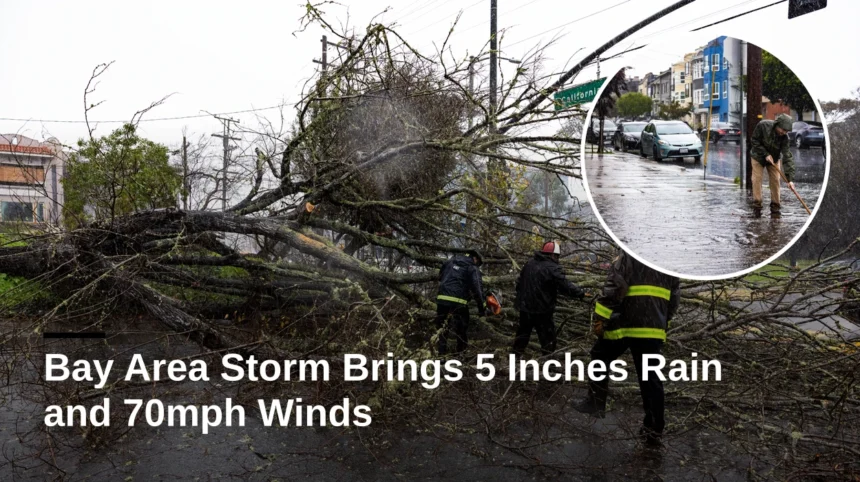
Bay Area (KQED) November 19, 2026 — A powerful storm brought heavy rain, flooding, high winds, transport disruption and power outages across the Bay Area, with the National Weather Service forecasting more than 5 inches of rain through Friday morning.[1] Flooding closed major road lanes, disrupted public transport and prompted emergency responses, while strong winds temporarily halted flights into San Francisco International Airport.[1]
As reported by KQED, the National Weather Service issued a flood advisory covering Contra Costa, San Francisco, San Mateo and Santa Clara counties. Meteorologist Roger Gass said urban areas, small streams and locations with poor drainage faced the greatest flooding risk, although the agency did not issue a flood watch because the ground was not saturated.[1]
How did flooding affect roads, transit and schools?
The California Highway Patrol reported major flooding on southbound Interstate 280 near Geneva Avenue in San Francisco. Flooding also nearly shut down Interstate 580 in the East Bay, where Caltrans closed lanes between Harbor Way and Canal Boulevard. Richmond officials advised residents to avoid several flooded streets.[1]
San Francisco firefighters rescued two people from a flooded roadway after a vehicle collision, according to the department. San Francisco’s Van Ness Muni station closed because of flooding, while BART, Muni, SamTrans and Golden Gate Ferry reported delays, reroutes or cancellations.[1]
San Francisco State University moved in-person classes to remote learning or cancelled them because of weather conditions. Waymo also suspended service in the area after vehicles stalled in flood zones, San Francisco Supervisor Bilal Mahmood said.[1]
What happened to flights and electricity?
San Francisco International Airport imposed a ground stop for departures to the airport because of high winds, according to the Federal Aviation Administration. The restriction was lifted by 11:45 a.m., but departures were still delayed by an average of 186 minutes at that time.[1]
The National Weather Service issued a high wind warning for the East Bay Hills and a wind advisory for inland valleys and coastal areas, with gusts potentially reaching 70 miles per hour in the hills.[1] The agency later reported that some coastal wind advisories had been cancelled while other Bay Area and Central Coast areas remained under wind advisories.[2]
More than 18,000 Pacific Gas and Electric Company customers lost electricity across the East Bay, South Bay and Peninsula. Spokesperson Tamar Sarkissian said crews had been directed to affected areas and that the company did not expect the following storm to be as powerful.[1]
“We are ready to head out and take care of any work that needs to take place,” Pacific Gas and Electric Company spokesperson Tamar Sarkissian said, according to KQED.[1]
What was the wider regional impact?
CBS News reported record rainfall in San Francisco, additional flooding and downed trees. The National Weather Service later issued flood warnings for Alameda and Contra Costa counties, covering rivers, creeks, streams and other flood-prone locations.[3]
East Bay Times reported that Ben Lomond in the Santa Cruz Mountains received 5.75 inches of rain and that San Francisco International Airport halted flights for about 90 minutes. The report also noted a closure of Highway 1 in Big Sur because of flash-flood risk near areas affected by recent wildfires.[6]
What does the storm mean for Bay Area residents?
Residents and commuters should expect continued disruption where roads, drainage systems and public transport remain affected. Travellers using San Francisco International Airport should check flight status before leaving, while drivers should avoid flooded roads and never approach downed power lines.
The National Weather Service expects isolated thunderstorms and further unsettled conditions, with another cold front potentially approaching over the weekend.[1] The storm’s effects are likely to be felt most by commuters, public transport users, air travellers, households affected by outages and people living near creeks, low-lying roads or areas recently damaged by wildfire.