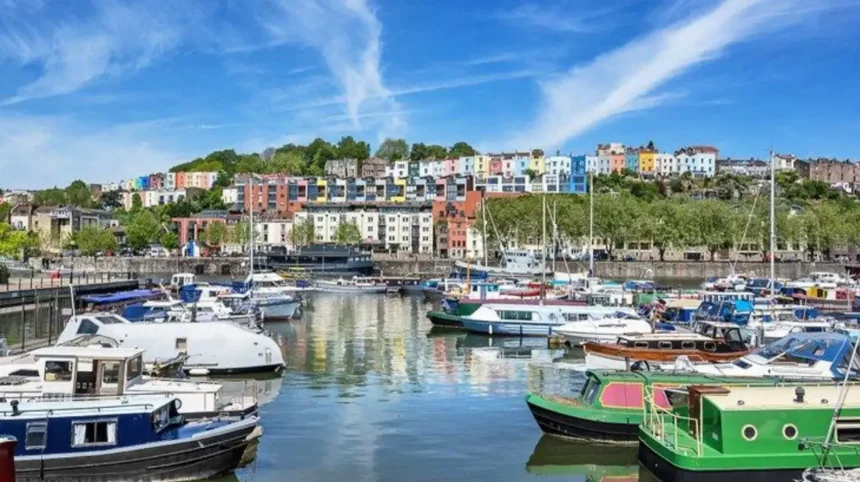
Bristol Harbourside is one of the city’s most important visitor districts. The waterfront combines maritime heritage, museums, contemporary art, science attractions, cinemas, restaurants, walking routes and water-based activities. Its attractions sit around the historic Floating Harbour, creating a compact area that suits day trips, family visits, cultural breaks and city-centre exploration.
- What is Bristol Harbourside and why is it important?
- How did Bristol Harbourside develop from a working dock into a visitor destination?
- What are the best museums to visit around Bristol Harbourside?
- What can families do around Bristol Harbourside?
- Where can visitors enjoy art and culture around Bristol Harbourside?
- What are the best places for a Harbourside walk?
- Where can visitors experience Bristol’s maritime engineering?
- What water-based activities are available around Bristol Harbourside?
- What historic landmarks are close to Bristol Harbourside?
- Where should visitors eat and relax around Bristol Harbourside?
- How accessible and practical is Bristol Harbourside for visitors?
- How should you plan a full day around Bristol Harbourside?
- Why does Bristol Harbourside remain important for Bristol tourism?
The modern Harbourside developed from Bristol’s historic docks. The area once supported international maritime trade and cargo handling. Today, former dock buildings, working maritime facilities and modern cultural venues form a mixed urban waterfront. Visit Bristol identifies attractions including M Shed, Brunel’s SS Great Britain, We The Curious, Bristol Aquarium, Arnolfini, Spike Island, Watershed and Underfall Yard across the wider Harbourside area.
What is Bristol Harbourside and why is it important?
Bristol Harbourside is a central waterfront district built around the historic Floating Harbour, combining maritime heritage, museums, arts venues, science attractions, restaurants, public spaces and water activities within an accessible city-centre destination.
The Harbourside sits within central Bristol and follows sections of the Floating Harbour. The waterfront connects several important visitor locations, including Millennium Square, Narrow Quay, Prince Street, Wapping Wharf and Cumberland Road.
Its importance comes from the relationship between Bristol’s commercial history and its present cultural economy. Historic docks supported shipping and cargo movements, while the regenerated waterfront now supports tourism, culture, leisure and hospitality.
The district is not a single attraction. It is a connected collection of destinations. Visitors can walk between museums, galleries, cafés, restaurants, public spaces and waterfront viewpoints without needing transport for every stop.
Visit Bristol describes the Harbourside as a former busy dock where sailors and merchants traded goods before its transformation into an area containing restaurants, bars, shops, hotels, sports and cultural attractions.
How did Bristol Harbourside develop from a working dock into a visitor destination?
Bristol Harbourside developed from an active commercial port after the Floating Harbour opened in 1809, with later dock decline followed by regeneration that introduced museums, cultural venues, public spaces, restaurants and leisure facilities.
The history of Bristol Harbourside is closely connected with the Floating Harbour. Bristol’s large tidal range created operational problems for ships using the River Avon. Bristol City Council records that tides fluctuated by about 9 metres, leaving vessels vulnerable to grounding at low tide.
In 1802, the Bristol Docks Company commissioned engineer William Jessop to design a system that maintained more consistent water levels. Jessop’s scheme included Cumberland Basin and locks connecting the harbour system with the River Avon.
The Floating Harbour officially opened on 1 May 1809. The River Avon was diverted through the New Cut, while the dock system provided a more controlled environment for shipping.
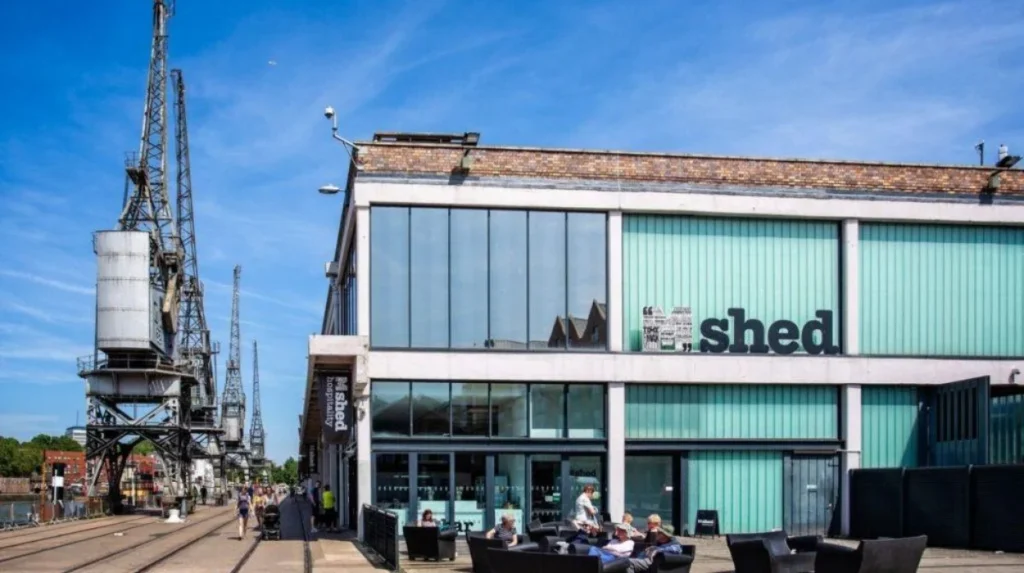
The waterfront later became an important industrial and commercial environment. M Shed’s research records that the Floating Harbour contained almost 40 cranes at its peak, demonstrating the scale of cargo operations during Bristol’s port era. Four large electric cranes outside M Shed date from the 1950s.
The decline of traditional dock operations eventually created opportunities for regeneration. Historic warehouses, dock infrastructure and waterfront spaces gained new cultural and leisure functions.
This history remains visible today. Visitors encounter working maritime infrastructure at Underfall Yard, historic ships at SS Great Britain, industrial objects at M Shed and former industrial buildings reused for contemporary art.
What are the best museums to visit around Bristol Harbourside?
The strongest museum choices around Bristol Harbourside include M Shed for Bristol history, the SS Great Britain for maritime engineering and We The Curious for interactive science, giving visitors three distinct educational experiences.
M Shed is one of the most important places for understanding Bristol itself. The museum focuses on the city’s people, history, industry, transport and changing identity.
The museum occupies a former transit shed beside the Floating Harbour. Its outdoor collection includes four large electric cargo cranes constructed in 1951. These cranes provide a direct physical connection with Bristol’s post-war dock industry.
Entry to M Shed is free, although donations are welcomed. The museum currently operates Tuesday to Sunday from 10am to 5pm, while certain exhibitions require advance booking.
For maritime engineering, Brunel’s SS Great Britain is a major Harbourside attraction. The ship was designed by Isambard Kingdom Brunel, the Victorian engineer responsible for major infrastructure and transport projects. SS Great Britain represents a significant stage in the development of iron shipbuilding and steam-powered ocean travel.
We The Curious provides a different experience. It is an educational science centre at Millennium Square with interactive exhibits and a planetarium. Its programme focuses on science, discovery and creative learning. The venue operates Tuesday to Sunday during term time and daily during Bristol school holidays, generally from 10am to 5pm.
These museums serve different visitor purposes. M Shed explains Bristol’s civic and social history. SS Great Britain focuses on maritime technology and engineering. We The Curious focuses on science and hands-on learning.
What can families do around Bristol Harbourside?
Families can combine interactive science at We The Curious, marine life at Bristol Aquarium, outdoor space at Millennium Square and maritime history at M Shed, creating a varied Harbourside itinerary without travelling between distant parts of Bristol.
We The Curious is particularly suited to families seeking interactive learning. Its exhibits encourage visitors to investigate scientific ideas through participation rather than passive observation. The venue also operates a planetarium with age restrictions for some 3D shows. Children under 12 require supervision throughout the building.
Bristol Aquarium provides another family-focused attraction. It is located on Anchor Road in the centre of the historic Harbourside. The aquarium presents marine and freshwater species and includes themed underwater environments.
The aquarium operates throughout the year apart from Christmas Day. Opening hours change seasonally, so visitors should check the current schedule before travelling. The attraction is step-free and provides ramps, accessible toilets and facilities suitable for wheelchairs and mobility scooters.
Millennium Square provides an outdoor area between major attractions. Its fountains and large screen make it a useful central meeting point within the Harbourside.
M Shed also works well for families because its displays connect Bristol’s history with recognisable city locations and objects. The free admission makes it particularly useful for visitors managing a family attraction budget.
A practical family route starts at Millennium Square, continues to We The Curious or Bristol Aquarium, moves along the waterfront towards M Shed and finishes with food near the water.
Where can visitors enjoy art and culture around Bristol Harbourside?
Visitors can experience contemporary visual art, performance, film and creative events at venues including Arnolfini, Spike Island and Watershed, making Bristol Harbourside an important cultural district as well as a historic waterfront.
Arnolfini is Bristol’s international centre for contemporary arts. It occupies Bush House on Narrow Quay, a Grade II listed building located between the Harbourside and Prince Street. Its programme includes visual art, performance, dance, film and music.
Arnolfini has been part of Bristol’s cultural landscape since 1961. Its programme has included internationally recognised artists such as Paula Rego, Grayson Perry, Rachel Whiteread, Richard Long and Sonia Boyce.
The building also contains a café bar, bookshop, theatre and exhibition spaces. Its theatre has 209 seats, while additional event spaces accommodate smaller gatherings.
Watershed provides a dedicated destination for cinema and digital culture. It operates from the Harbourside at Canons Road and combines cinema screens, events, a café and bar. Its cinema programme includes independent, international and specialist films alongside wider cultural events.
Spike Island is located further along the waterfront at Cumberland Road. It occupies an 80,000-square-foot former industrial building and operates as an international centre for contemporary art. The organisation supports more than 70 independent artists through studio spaces and presents exhibitions, events and creative programmes.
These venues demonstrate the cultural transformation of Bristol’s docklands. Industrial buildings now support contemporary artistic production, exhibition, education and public engagement.
What are the best places for a Harbourside walk?
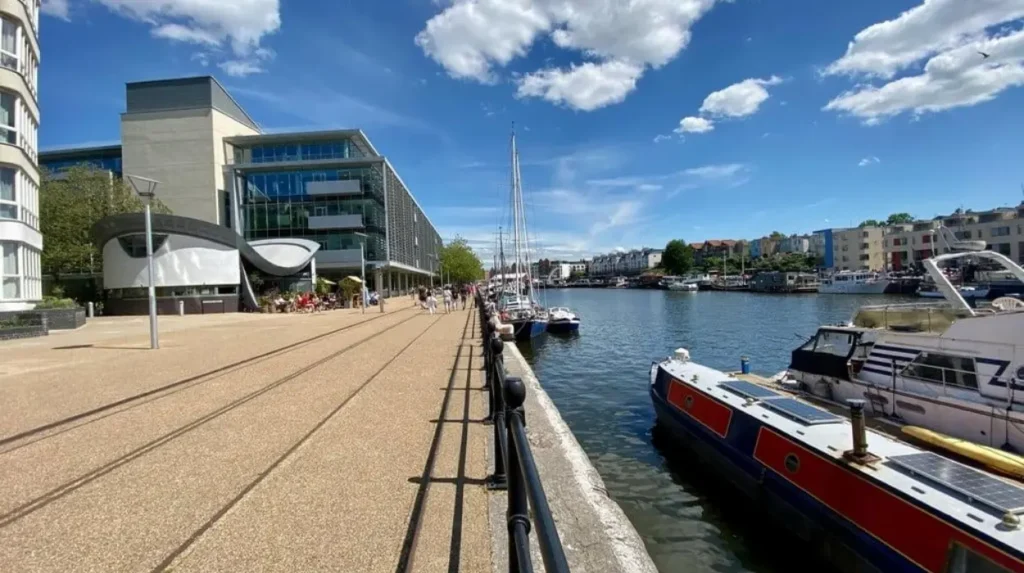
The best Harbourside walks follow the Floating Harbour between Millennium Square, Narrow Quay, Prince Street, M Shed, Wapping Wharf and Cumberland Road, combining waterfront views with museums, historic buildings, bridges, boats and public spaces.
Walking is one of the simplest ways to experience Bristol Harbourside because major attractions are concentrated around the water.
Start at Millennium Square and follow the waterfront towards Narrow Quay. This section provides views across the Floating Harbour and access to We The Curious, Bristol Aquarium, Watershed and nearby restaurants.
Continue towards Prince Street and Arnolfini. The route then leads towards M Shed and the historic dockside environment.
The waterfront becomes more maritime as the route approaches Wapping Wharf and Cumberland Road. Visitors can continue towards Underfall Yard for a deeper look at Bristol’s dock engineering.
The wider Harbourside also supports cycling and water-based recreation. Visit Bristol identifies activities including cycling, rowing, windsurfing and paddleboarding.
The walking route is useful for visitors who want to reduce transport costs. It also provides access to attractions that are difficult to appreciate from inside a building, including cranes, historic dock structures, bridges and boats.
Visitors should allow additional time around each attraction rather than treating the waterfront as a single short walk. A museum-focused route takes longer than a simple waterfront stroll.
Where can visitors experience Bristol’s maritime engineering?
Underfall Yard provides one of the clearest places to understand how Bristol maintained its Floating Harbour, with historic pumping equipment, a working boatyard, a patent slipway, interactive displays and engineering information about dock operations.
Underfall Yard is located on Cumberland Road and remains connected with Bristol’s maritime infrastructure. It combines heritage interpretation with a functioning boatyard.
The site has supported the Floating Harbour since the nineteenth century. Its patent slipway dates back to the 1850s, when boatbuilders William Ross, William Labdon Ross and Joseph Sage established a slipway for lifting vessels from the water.
The current slipway was ordered in 1890 by Docks Engineer John Ward Girdlestone. It represents the engineering infrastructure required to maintain vessels operating within the harbour.
The Underfall Yard Visitor Centre explains the technical systems behind Bristol’s dock operations. Displays include a giant interactive map and information about water levels, silt management and entrance locks.
The Pump Room contains three electric pumping engines. The 1907 pumps demonstrate how hydraulic systems powered equipment across the docks. Hydraulic power supplied cranes, swing bridges, lock gates, sluices and other dock functions.
This makes Underfall Yard particularly valuable for visitors interested in engineering, industrial history and maritime infrastructure.
What water-based activities are available around Bristol Harbourside?
Bristol Harbourside supports boat trips, paddleboarding, canoeing, rowing and other water activities on the Floating Harbour, giving visitors direct access to the historic waterway that shaped Bristol’s commercial and industrial development.
The Floating Harbour is not simply a scenic feature. It remains a working water environment with boats, locks, bridges and operational infrastructure.
Boat trips provide an alternative perspective on Bristol’s waterfront. Views from the water reveal historic buildings, maritime structures and sections of the harbour that are less visible from pedestrian routes.
Paddleboarding is another activity promoted around the Harbourside. Visitors can use organised sessions to explore the Floating Harbour while receiving appropriate instruction and equipment.
Canoeing and rowing provide additional options for active visitors. These activities connect recreation with the physical geography of Bristol’s dock system.
Visit Bristol specifically identifies boat trips, paddleboarding with SUP Bristol and canoeing as ways to explore the Floating Harbour from the water.
Water activities require attention to operator rules, weather conditions, equipment requirements and harbour regulations. Visitors should use established operators and follow their safety instructions.
The water also has an important historical function. The Floating Harbour was created to improve the reliability of commercial shipping by controlling water levels. Recreational use therefore takes place within an engineered maritime environment established more than two centuries ago.
What historic landmarks are close to Bristol Harbourside?
Historic landmarks near Bristol Harbourside include SS Great Britain, Bristol Cathedral, historic dock structures, Underfall Yard and preserved industrial buildings, providing access to Bristol’s maritime, religious, engineering and architectural heritage within central Bristol.
Bristol Cathedral stands close to the Harbourside around College Green. The cathedral has more than 900 years of history and has been a place of worship since 1140.
The Elder Lady Chapel dates from 1220 and represents an early surviving part of the cathedral complex. The Diocese of Bristol was established in 1542, when Bristol Cathedral became the cathedral church of the new diocese.
SS Great Britain provides the strongest maritime landmark connection. The ship represents nineteenth-century engineering and Bristol’s role in shipbuilding and global transport.
Underfall Yard provides a different type of historic experience. Instead of focusing on one famous object, it explains the engineering systems required to maintain the Floating Harbour.
The M Shed cranes also function as industrial landmarks. Their 1951 construction links the modern visitor district with the post-war period when the docks continued to handle cargo.
Together, these sites create a layered historical experience. Visitors can move from medieval religious architecture to Victorian engineering and twentieth-century industrial infrastructure within a relatively small central area.
Where should visitors eat and relax around Bristol Harbourside?
Visitors can find restaurants, cafés, bars and food venues throughout Bristol Harbourside, with concentrated choices around Millennium Square, Narrow Quay, Wapping Wharf and the waterfront buildings surrounding major cultural attractions.
Food and drink form a major part of the Harbourside visitor economy. The waterfront contains venues ranging from cafés and casual food outlets to restaurants and bars.
Watershed has a café and bar overlooking the Harbourside. Its food service includes vegetarian and vegan choices alongside a children’s menu.
Arnolfini also has a Harbourside Bar and café facilities. Its location on Narrow Quay makes it convenient for visitors combining art with food or drinks.
Wapping Wharf provides another significant food destination near the southern side of the central Harbourside. Its location connects the waterfront with independent food businesses and pedestrian routes.
Millennium Square works well as a meeting point because it sits beside several major attractions. Visitors can use it to structure a day around science, marine life, museums and waterfront dining.
The best approach is to match food stops with the walking route. This reduces unnecessary backtracking and keeps the day centred on the waterfront.
How accessible and practical is Bristol Harbourside for visitors?
Bristol Harbourside is highly practical for visitors because major attractions sit within walking distance, several venues provide accessibility facilities, and public transport connects the waterfront with Bristol city centre and Temple Meads.
Arnolfini is approximately a 10-minute walk from Bristol city centre and around 20 minutes from Bristol Temple Meads railway station, according to its visitor information. The venue provides accessible facilities and cycle parking.
Bristol Aquarium provides step-free access, ramps and accessible toilets. Its location at Anchor Road places it directly within the central Harbourside attraction zone.
Underfall Yard is approximately 1.5 miles from the city centre via the Harbourside Walk. Bristol Ferry services connect nearby points, while bus and Metrobus options serve the wider area.
Driving requires additional planning because Bristol operates a Clean Air Zone. The zone started on 28 November 2022. Bristol City Council states that non-compliant private cars and light goods vehicles are charged £9 per day, while heavy goods vehicles, buses and coaches face a £100 daily charge.
Motorcycles are not charged under Bristol’s Clean Air Zone, while compliant vehicles such as Euro 6 diesel vehicles and qualifying petrol vehicles are generally exempt from the daily charge. Visitors should check their vehicle before travelling.
The Harbourside is therefore well suited to walking-based itineraries. Visitors arriving by rail can reach the waterfront without relying on a car, while attractions are concentrated along connected pedestrian routes.
Explore More Area Guide
Pet-Friendly Accommodation in Bristol: Complete Guide 2026
Pet Services in Bristol: Complete Local Guide
How should you plan a full day around Bristol Harbourside?
A full Harbourside day works best by combining one major museum, one family or science attraction, a waterfront walk, a cultural venue, a food stop and an evening activity rather than attempting every attraction in one visit.
Start in the morning at M Shed if Bristol’s history is the priority. Its free admission provides an efficient introduction to the city and the dock area.
Continue towards Millennium Square for We The Curious or Bristol Aquarium. Families can select the venue that best matches their interests, while adults can prioritise the museum and maritime attractions.
Walk towards Narrow Quay and Arnolfini for contemporary art. The location provides a natural transition from maritime history to modern culture.
Continue along the waterfront towards Wapping Wharf for food. The route provides views across the Floating Harbour while connecting several different sections of the regeneration area.
Spend the afternoon at SS Great Britain or Underfall Yard. SS Great Britain provides a major ship-based experience, while Underfall Yard explains the engineering behind the harbour itself.
Finish with a film or cultural event at Watershed, particularly if the itinerary extends into the evening. Watershed operates seven days a week and combines cinema with a Harbourside café and bar.
Visitors with limited time should prioritise the waterfront walk, M Shed and one major paid attraction. Visitors with two days can divide museums, art, maritime heritage and water activities into separate itineraries.
Why does Bristol Harbourside remain important for Bristol tourism?
Bristol Harbourside remains important because it concentrates historic infrastructure, cultural institutions, family attractions, maritime heritage, public spaces, hospitality and active travel around one of Bristol’s defining geographic features.
The Harbourside demonstrates how a historic industrial waterfront can serve multiple modern functions without losing its connection with the past.
The Floating Harbour remains the defining physical feature. Its creation in 1809 changed Bristol’s port operations and established infrastructure that still shapes the city’s geography.
The current visitor economy operates around this historic framework. M Shed preserves Bristol’s social and industrial history. SS Great Britain represents engineering and maritime innovation. Underfall Yard explains dock maintenance. Arnolfini and Spike Island support contemporary art. Watershed provides cinema and digital culture. We The Curious delivers science education. Bristol Aquarium provides marine-focused family entertainment.
This combination creates a destination with different levels of visitor engagement. A traveller can simply walk beside the water, visit free cultural spaces, book a museum experience, participate in a water activity or spend an entire day exploring attractions.
The Harbourside also connects tourism with Bristol’s wider city-centre economy. Restaurants, cafés, hotels, cultural organisations and transport services benefit from the concentration of visitors.
Its future relevance rests on maintaining the relationship between heritage, public access, culture and sustainable urban travel. The continued reuse of historic dock infrastructure gives Bristol Harbourside a clear identity within the wider city.
For visitors, the main advantage is concentration. Major attractions sit close together, while the Floating Harbour provides a continuous route linking them. That makes Bristol Harbourside one of the most comprehensive areas for experiencing Bristol’s history, culture, science, maritime identity and waterfront environment in a single visit.
What is Bristol Harbourside famous for?
Bristol Harbourside is famous for its historic Floating Harbour, maritime heritage, museums, cultural venues, restaurants and waterfront attractions. Major places include SS Great Britain, M Shed, Bristol Aquarium, We The Curious, Arnolfini and Underfall Yard.