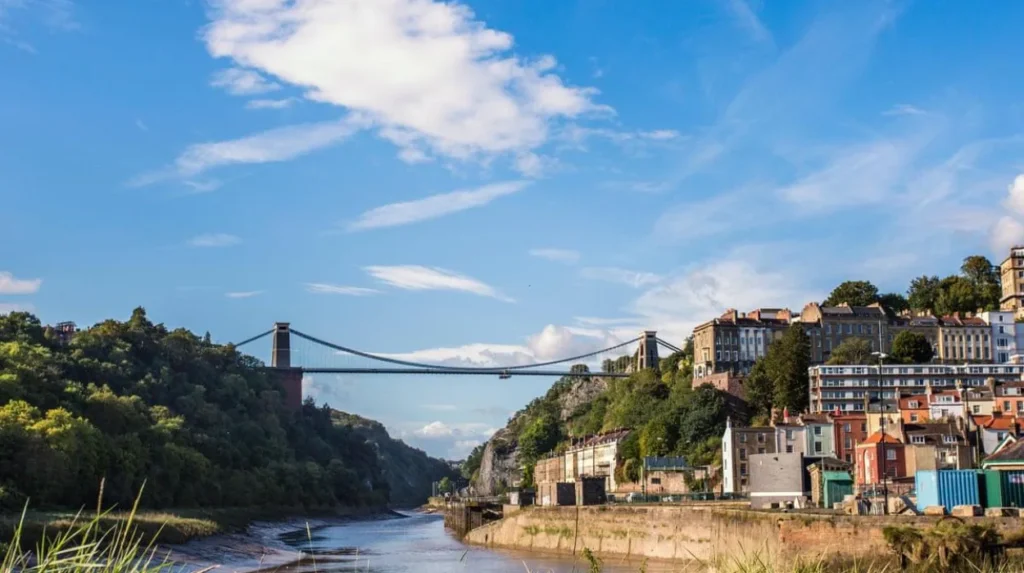
The Clifton Suspension Bridge is one of Bristol’s defining landmarks and one of the strongest viewpoints in the city. It crosses the Avon Gorge, linking Clifton in Bristol with Leigh Woods in North Somerset. Designed by Isambard Kingdom Brunel and completed in 1864, the bridge provides elevated views across the River Avon, the gorge, Bristol’s western skyline and surrounding countryside. Its 214-metre main span and position approximately 75.5 metres above high water create several distinct viewing perspectives.
- Why is Clifton Suspension Bridge one of Bristol’s best viewpoints?
- Where is the best view of Clifton Suspension Bridge?
- What can you see from the Clifton Suspension Bridge itself?
- Where can you get the best photograph of Clifton Suspension Bridge?
- What is the best view of Clifton Suspension Bridge from Leigh Woods?
- Can you see Clifton Suspension Bridge from The Downs and Sea Walls?
- What is the best time to see Clifton Suspension Bridge?
- How can you visit the best Clifton Suspension Bridge viewpoints in one route?
- What historical details make the Clifton Suspension Bridge views significant?
- How should visitors plan for the best Clifton Suspension Bridge views?
- What are the main Clifton Suspension Bridge viewpoints to remember?
The best views are not limited to the bridge deck. Observatory Hill, Clifton Observatory, The Downs, Sea Walls, Leigh Woods, the Leigh Woods abutment and selected viewpoints below the gorge each reveal different aspects of the structure and landscape. Visit Bristol identifies Observatory Hill as the best place to view the bridge, while the National Trust highlights viewpoints within Leigh Woods overlooking the bridge and city.
For visitors interested in photography, architecture, geography, walking or Bristol sightseeing, understanding these viewpoints makes it easier to plan an efficient visit.
Why is Clifton Suspension Bridge one of Bristol’s best viewpoints?
Clifton Suspension Bridge combines height, historic engineering and a dramatic limestone gorge, creating views across the River Avon, Bristol, Leigh Woods and the surrounding landscape. Its elevated deck also provides direct perspectives of the bridge towers, suspension chains and Avon Gorge.
The Clifton Suspension Bridge is more than a crossing. It is a major viewing location within Bristol’s landscape. The bridge deck sits 248 feet, or 75.5 metres, above high water. Its main span measures 702 feet, or 214 metres, between the centres of the two towers. The total structure extends 1,352 feet, or 414 metres, between its anchorages.
The bridge opened on 8 December 1864. It was constructed after a long and interrupted development process associated with Brunel’s design. Construction had previously been abandoned for financial reasons, and completion eventually occurred 21 years after work had stopped.
The location gives visitors several visual layers. The nearest layer consists of the bridge itself. The second includes the Avon Gorge and River Avon. The wider view extends towards Bristol, Leigh Woods and the countryside beyond.
The bridge also has two pedestrian footpaths. Visitors can walk across the structure and observe the gorge from both sides of the deck. A suggested one-way pedestrian system is in place, with visitors advised to follow bridge signage.
This combination makes the bridge particularly useful for visitors seeking several viewpoints during one walking route.
Where is the best view of Clifton Suspension Bridge?
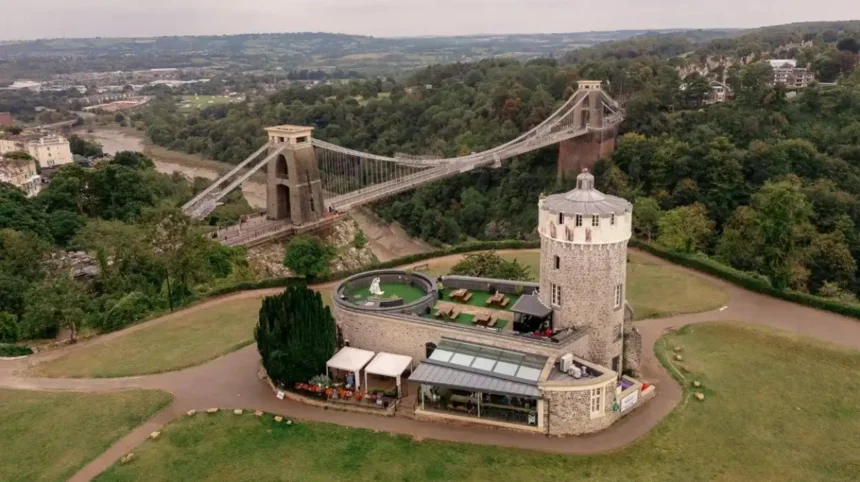
The strongest overall view of Clifton Suspension Bridge is from Observatory Hill on the Clifton side of the Avon Gorge. The elevated position provides a clear perspective of the bridge, its towers, suspension chains and surrounding gorge landscape.
Observatory Hill sits beside Clifton Observatory, above the Avon Gorge. Visit Bristol specifically identifies Observatory Hill as the best place to view the bridge and describes its viewpoints as suitable locations for photography.
The viewpoint is especially effective because the bridge is visible across the gorge rather than directly underneath it. This creates a broad composition containing the structure, limestone cliffs and river corridor.
The area also connects naturally with other Clifton attractions. Clifton Observatory occupies a prominent position on Clifton Down and provides views across the bridge and surrounding landscape. The building itself has a long history. It was originally constructed as a snuff mill in 1766 before William West converted it into an observatory.
The Observatory also contains a Camera Obscura, an optical device that projects an external scene onto an interior viewing surface. The attraction provides a distinctive perspective of Clifton Suspension Bridge and the Avon Gorge.
The hill therefore works as both an outdoor viewpoint and an access point for additional attractions.
Visitors should distinguish Observatory Hill from the bridge itself. The bridge provides an elevated view along and across the gorge, while Observatory Hill provides a more complete view of the entire structure.
What can you see from the Clifton Suspension Bridge itself?
From the bridge deck, visitors can see the Avon Gorge, River Avon, Leigh Woods, Bristol’s western landscape and the bridge’s structural details. Looking along the deck reveals the suspension chains, towers and roadway, while looking outward exposes the dramatic height above the river.
Walking across the bridge provides a direct understanding of its scale. The deck measures approximately 9.5 metres in overall width. The suspension chains and rods are constructed from wrought iron, while the towers are principally built from local Pennant stone.
The bridge offers different visual experiences depending on direction.
Looking towards Leigh Woods reveals the wooded landscape surrounding the southern side of the gorge. Looking back towards Clifton shows the urban environment and the terraces and buildings around the western edge of Bristol.
The river itself is another major feature. The Avon passes through the gorge below the bridge and continues towards Bristol’s harbour and the Severn Estuary.
The bridge’s height is particularly significant. The deck stands 75.5 metres above high water, creating a substantial vertical separation between the pedestrian path and the river.
The bridge also offers close views of its engineering components. Visitors can observe the chains, rods, towers, roadway and anchorages rather than seeing the structure only from a distance.
The Clifton Suspension Bridge Trust recommends an Over and Under the Clifton Suspension Bridge self-guided walk. The route begins on the Clifton side and continues across the bridge towards Leigh Woods, with specific points for observing the gorge, abutment and historic engineering features.
This makes crossing the bridge an important part of a complete viewpoint itinerary.
Where can you get the best photograph of Clifton Suspension Bridge?
The best photographic perspectives come from Observatory Hill, Clifton Observatory, Leigh Woods and viewpoints along the gorge. These locations show the bridge from different elevations and directions, allowing photographers to capture the full span, towers, chains, river and surrounding landscape.
Clifton Observatory provides a particularly strong elevated composition. Its rooftop terrace offers open-air views towards the bridge and Avon Gorge. Visit Bristol also identifies the Observatory as a location with significant views of the landmark.
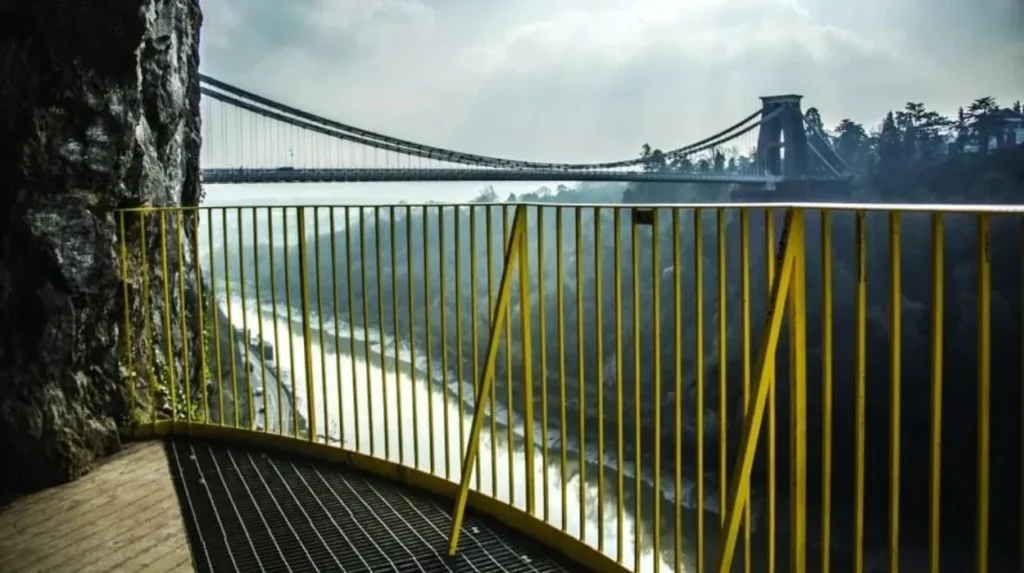
The Giant’s Cave viewing platform creates another distinctive angle. The cave is reached through a tunnel approximately 200 feet, or 60 metres, long. Visitors descend 130 steps, and the cave opens onto the cliff face approximately 76 metres above the River Avon.
From this position, the bridge appears from a lower and more unusual perspective. The viewing platform is specifically associated with views of the Avon Gorge and Clifton Suspension Bridge.
Leigh Woods provides the opposite visual relationship. Instead of photographing the bridge from Clifton, visitors see the structure from the North Somerset side of the gorge. The National Trust describes designated pathways leading to views of the suspension bridge and the city beyond.
The Sea Walls area on Clifton Down also provides important views along the gorge. Visit Bristol identifies Sea Walls as another lookout across the Avon Gorge.
For photography, these locations provide three principal perspectives: elevated views from Clifton, opposite-bank views from Leigh Woods and lower gorge perspectives near the Giant’s Cave.
What is the best view of Clifton Suspension Bridge from Leigh Woods?
Leigh Woods provides a strong opposite-side view of Clifton Suspension Bridge, with woodland framing the structure and the Avon Gorge below. Paths around the National Trust site lead to viewpoints showing the bridge, Bristol skyline and surrounding countryside from North Somerset.
Leigh Woods is a National Nature Reserve managed by the National Trust. It occupies woodland above the Avon Gorge and contains a mixture of broadleaf forest, grassland, veteran trees and historic features.
The woodland is particularly important for visitors who want a natural setting around the bridge. Paths pass through oak, small-leaved lime and ash woodland, while open areas provide views towards the bridge and city.
The National Trust’s Leigh Woods Woodland Wander is a circular walking route measuring one mile, or 1.6 kilometres. The route takes approximately 30 to 45 minutes and includes views from the edge of the Avon Gorge and Stokeleigh Camp hillfort.
Stokeleigh Camp is an Iron Age hillfort positioned above the gorge. Its location creates another elevated viewpoint towards the Avon Gorge and surrounding landscape.
Leigh Woods also has a significant connection with the history of the area. In 1909, George Alfred Wills donated 80 acres of Leigh Woods to the National Trust. A further 60 acres were transferred in 1936, including the last quarry then in operation.
The woodland therefore combines landscape value, archaeological heritage and bridge views.
Visitors crossing the bridge can continue into Leigh Woods after reaching the North Somerset side. The bridge’s Leigh Woods visitor centre and museum provide additional information about its engineering and history.
This creates a practical route for visitors who want to see the bridge from both sides during one visit.
Can you see Clifton Suspension Bridge from The Downs and Sea Walls?
The Downs and Sea Walls provide broad elevated views across the Avon Gorge, with the Clifton Suspension Bridge forming a major landmark within the landscape. These open spaces also provide longer views along the gorge and access to walking routes around Clifton Down.
The Downs consists of Clifton Down and Durdham Down, forming a large protected area of open parkland on the northern side of Clifton. The area is used by walkers, runners, cyclists and other visitors.
Sea Walls sits along the gorge edge and provides direct views towards the Avon Gorge. Its position differs from the enclosed perspectives found within woodland or around individual buildings.
The open character of The Downs also makes it useful for visitors who want a wider landscape view. The bridge appears as part of the larger gorge rather than as an isolated engineering structure.
The area has strong ecological relevance. The Avon Gorge supports peregrine falcons and rare plant species. Visit Bristol identifies the gorge as a habitat for nesting peregrine falcons and other wildlife.
The Clifton Suspension Bridge Trust also identifies a peregrine watchpoint and information board on Clifton Down. During suitable periods, visitors can observe the birds from designated areas while learning about the gorge environment.
The combination of open parkland and gorge-edge viewpoints makes The Downs a useful part of a longer Clifton walking route.
Visitors can combine The Downs, Sea Walls, Clifton Observatory and the bridge itself. These locations are close enough to create a continuous sightseeing itinerary without requiring a separate vehicle journey.
What is the best time to see Clifton Suspension Bridge?
The best viewing conditions depend on the desired scene. Daylight provides the clearest architectural detail, while late afternoon and sunset create changing light across the bridge, gorge and river. Weather conditions strongly affect visibility, contrast and the appearance of distant landscapes.
Daylight is the most practical period for visitors focused on architecture. The bridge’s towers, chains, roadway and stonework are easier to identify in direct or diffuse daylight.
Late afternoon provides changing illumination across the Avon Gorge. The position of the sun alters the appearance of the bridge and surrounding cliffs as the day progresses.
Visit Bristol specifically recommends summer evening visits for sunset views from the Clifton area. Its visitor guidance identifies the far tower of the bridge as a notable sunset viewpoint.
Cloud conditions also influence the visual quality of the wider landscape. Clear conditions expose more of the Bristol skyline and countryside, while mist and low cloud reduce long-distance visibility.
Wind is another consideration because the bridge is an exposed elevated structure. Visitors should follow safety instructions and remain within pedestrian areas.
Seasonal changes also affect Leigh Woods. The National Trust identifies bluebells and wood anemones in spring, shaded woodland during summer and red and golden foliage during autumn.
This creates different visual characteristics throughout the year. Spring emphasises woodland vegetation. Summer provides dense green foliage. Autumn adds changing leaf colour around the gorge.
The bridge itself remains accessible as a viewpoint throughout the year, subject to operational conditions and any temporary restrictions.
How can you visit the best Clifton Suspension Bridge viewpoints in one route?
A practical viewpoint route starts at Clifton Observatory, continues to Observatory Hill and The Downs, crosses Clifton Suspension Bridge, enters Leigh Woods and finishes with views from the opposite side. This route combines the principal elevated, bridge-level and woodland perspectives.
Begin at Clifton Observatory on Clifton Down. The Observatory provides access to the Camera Obscura, Giant’s Cave and rooftop terrace, subject to opening arrangements. Current published information lists seasonal opening hours for the Camera Obscura and Museum.
Continue to Observatory Hill. The hill provides one of the clearest elevated views of the bridge and gorge. The surrounding paths also provide opportunities to examine the bridge from different angles.
Walk towards the Clifton Suspension Bridge and cross the pedestrian route. The bridge has footpaths on either side and visitors should follow the recommended pedestrian system and signage.
As you cross, examine the structure from deck level. Look along the suspension chains, towards the towers and across the Avon Gorge. The bridge’s 214-metre main span becomes particularly apparent from the pedestrian path.
Continue towards Leigh Woods. From the Leigh Woods side, look back towards the bridge and Clifton. The National Trust paths provide additional viewpoints through woodland and along the gorge edge.
For visitors with more time, follow the Leigh Woods Woodland Wander. The one-mile circular route includes the gorge edge and Stokeleigh Camp hillfort.
Visitors can then return across the bridge or continue through Leigh Woods depending on their wider Bristol itinerary.
For public transport users, Visit Bristol states that the bridge is roughly a 40-minute walk from Bristol city centre, with steep hills. Bus route 8 provides an alternative connection from central Bristol and various city stops, including Temple Meads.
This route covers the major viewpoints without treating the bridge as a single viewing location.
What historical details make the Clifton Suspension Bridge views significant?
The views around Clifton Suspension Bridge are historically significant because they combine Brunel’s 19th-century engineering with the older Avon Gorge landscape, Leigh Woods and Clifton. The bridge opened in 1864 after a long construction history and remains a Grade I listed structure.
The bridge was designed by Isambard Kingdom Brunel, the British engineer associated with major Victorian infrastructure projects. The Clifton project developed from a proposal to create a crossing over the Avon Gorge.
The completed bridge opened on 8 December 1864. The opening transformed movement between Clifton and Leigh Woods and increased access to the area.
Its engineering remains central to the visual character of the gorge. The structure uses wrought-iron chains and suspension rods, while the towers are principally constructed from local Pennant stone.
The bridge is also protected as a Grade I listed structure, reflecting its architectural and historic importance. The Clifton Suspension Bridge Trust has cared for the 160-year-old structure and its heritage collection for more than 70 years.
The surrounding landscape has its own historical layers. Leigh Woods contains archaeological remains including Stokeleigh Camp, while the area also has a history of quarrying and land use.
Leigh Woods once supported significant celestine production. The National Trust records that between 1880 and 1920 Bristol was producing an estimated 90% of the world’s celestine, with material from Leigh Woods transported towards the Avon.
The landscape visible from the bridge therefore represents more than a modern city panorama. It contains evidence of engineering, industrial activity, woodland management, archaeology and urban development.
The preservation of these features also explains why the best views remain valuable for both tourism and heritage education.
Explore More Area Guide
Bristol Street Art Guide: Banksy, Murals & Locations 2026
Guide to Bristol City Centre: Attractions, History & Travel Bristol 2026
How should visitors plan for the best Clifton Suspension Bridge views?
Visitors should combine several viewpoints rather than relying on one location. Observatory Hill provides the strongest overall bridge perspective, the bridge deck provides close structural views, and Leigh Woods and Sea Walls provide wider landscape perspectives across the Avon Gorge.
A viewpoint-focused visit works best when locations are treated as connected parts of the same landscape.
The first priority is Observatory Hill, which provides the clearest overall view according to Visit Bristol.
The second priority is the bridge deck. Walking across the structure gives visitors direct views of the gorge, river, towers and suspension system. Pedestrian access is available across the bridge.
The third priority is Leigh Woods. The National Trust provides paths through the woodland, including a one-mile circular route with views of the bridge and Avon Gorge.
The fourth priority is Sea Walls and The Downs. These open viewpoints provide broader perspectives and form part of the wider Clifton landscape.
Visitors should also check attraction opening arrangements before planning visits to the Camera Obscura, Giant’s Cave and Observatory facilities. Published opening information changes seasonally.
The Clifton Suspension Bridge itself remains an important working transport structure rather than a static monument. Visitors should remain on designated pedestrian routes and observe all signs and operational instructions.
The most comprehensive experience therefore combines Observatory Hill, Clifton Suspension Bridge, Leigh Woods and The Downs. Each location presents a different relationship between the bridge and the Avon Gorge.
For tourists staying in central Bristol, the area also connects naturally with Clifton Village, Clifton Down and other western Bristol attractions. Visit Bristol describes Clifton as a major visitor area containing the bridge, Georgian architecture, Clifton Village and The Downs.
What are the main Clifton Suspension Bridge viewpoints to remember?
The principal viewpoints are Observatory Hill, Clifton Observatory, the Clifton Suspension Bridge deck, Giant’s Cave, Leigh Woods, Stokeleigh Camp and Sea Walls. Together, they provide elevated, bridge-level, woodland, gorge-level and wide landscape perspectives across Bristol’s Avon Gorge.
Each location serves a different viewing purpose.
Observatory Hill provides the strongest overall elevated composition of the bridge.
Clifton Observatory adds rooftop and Camera Obscura perspectives, alongside access to Giant’s Cave.
The bridge deck provides the closest direct view of the engineering structure and the gorge below.
Giant’s Cave provides a lower cliff-face perspective approximately 76 metres above the River Avon.
Leigh Woods frames the bridge with woodland and provides views towards Bristol from the opposite side of the gorge.
Stokeleigh Camp adds an archaeological and elevated perspective within Leigh Woods.
Sea Walls provides an open gorge-edge viewpoint on Clifton Down.
Together, these locations explain why Clifton Suspension Bridge remains one of Bristol’s most important visual landmarks. Its 214-metre span, 75.5-metre deck height, Victorian engineering and position above the Avon Gorge create a landscape with multiple distinct viewpoints.
For a first visit, the most efficient sequence is Clifton Observatory → Observatory Hill → Clifton Suspension Bridge → Leigh Woods → The Downs or Sea Walls. This route provides the broadest range of perspectives while also incorporating the historical and natural features surrounding the bridge.
Where is the best view of Clifton Suspension Bridge?
The best overall view of Clifton Suspension Bridge is from Observatory Hill beside Clifton Observatory. It provides an elevated perspective across the Avon Gorge, showing the bridge, towers, suspension chains and surrounding landscape.