
Bristol is a major employment, education and transport centre in South West England. Its commuting area extends beyond the city boundary into South Gloucestershire, North Somerset, Bath and North East Somerset, and neighbouring parts of Gloucestershire and Somerset. The city also attracts commuters travelling from further afield by rail, bus and road.
- Why is Bristol an important commuting centre?
- How do people commute from Bristol today?
- How important is cycling for commuting in Bristol?
- How effective is public transport for commuting from Bristol?
- Which Bristol railway stations are important for commuters?
- What are the main road commuting routes into Bristol?
- How does the Bristol Clean Air Zone affect commuters?
- How has commuting from Bristol changed since the COVID-19 pandemic?
- What makes Bristol suitable for walking to work?
- What are the main challenges of commuting from Bristol?
- How is Bristol improving its future commuting network?
- What is the best way to plan a commute from Bristol?
- What does the future of commuting from Bristol look like?
Commuting from Bristol includes travel by car, bus, train, bicycle, walking, motorcycle, e-bike and other forms of transport. The pattern has changed significantly since the COVID-19 pandemic because hybrid working has reduced the number of daily journeys for many employees.
The latest Bristol Travel to Work Survey provides a useful picture of current commuting behaviour. In the 2026 survey, 36% of respondents travelled by personal motor vehicle, including 31% driving alone, 4% car sharing and 1% travelling by motorbike or moped. Active travel accounted for 31%, with 17% walking and 14% cycling. Public transport accounted for 25%, including 17% by bus and 8% by train.
Why is Bristol an important commuting centre?
Bristol is an important commuting centre because it combines a large employment base with strong rail, bus, road and active-travel connections to surrounding communities and major destinations across South West England. Its central districts concentrate offices, education, healthcare, retail, technology and professional services.
Bristol functions as the economic core of a wider urban area. Major employment locations include Bristol city centre, Temple Quarter, Harbourside, Southmead, Filton and surrounding business districts.
The city also has major educational institutions, including the University of Bristol and the University of the West of England. Healthcare is another major employment sector, with large facilities such as Southmead Hospital generating regular commuter demand.
The Temple Quarter is particularly important to Bristol’s future transport network. Its location around Bristol Temple Meads places employment, education and transport infrastructure close together.
Commuting is not limited to people who live inside Bristol. Workers travel into the city from surrounding areas, while Bristol residents travel outward to places such as Filton, Bath, Weston-super-Mare and other employment centres.
Census 2021 data confirms the importance of commuting while also showing how dramatically working patterns changed during the pandemic. Bristol recorded 38.6% of employed residents mainly working at or from home in 2021, compared with 4.6% in 2011.
The Census data requires careful interpretation because the 2021 Census took place during COVID-19 restrictions. Current travel-to-work survey data therefore provides a more useful indication of post-pandemic commuting patterns.
How do people commute from Bristol today?
People commuting from Bristol use a combination of cars, buses, trains, bicycles, walking, motorcycles and e-travel. The latest Bristol Travel to Work Survey records 36% personal motor-vehicle travel, 31% active travel, 25% public transport and 3% e-travel among respondents.
The 2026 Bristol Travel to Work Survey shows a diversified commuting system. Personal motor vehicles remain significant, but they no longer represent the only dominant form of travel.
Driving alone accounted for 31% of respondents. Car sharing accounted for 4%, while motorbike and moped travel represented 1%.
Active travel is also a major part of Bristol commuting. Walking accounted for 17% and cycling for 14%. The combined 31% active-travel share demonstrates the importance of short-distance commuting within the city.
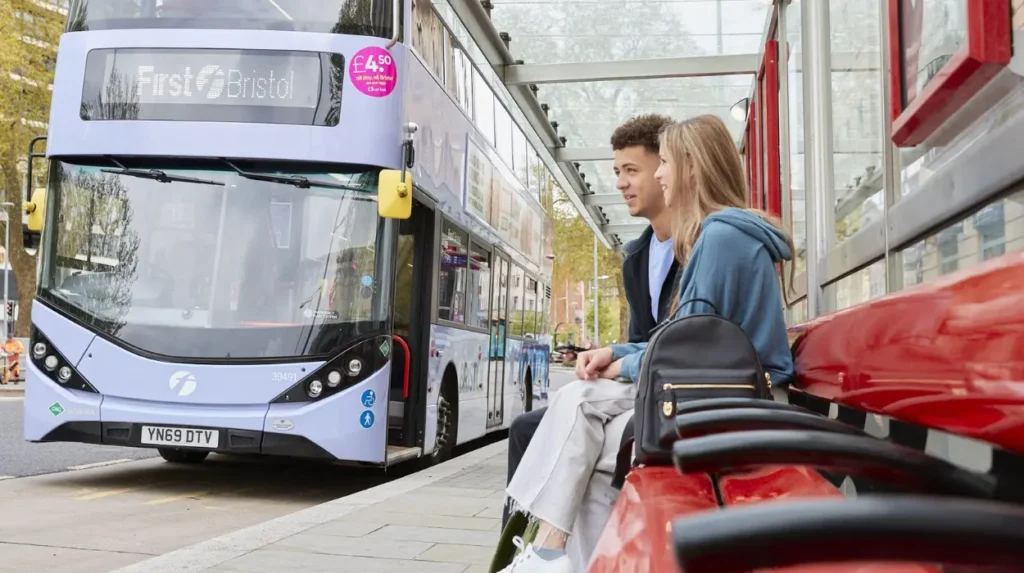
Public transport accounted for 25%. Bus travel represented 17%, while train travel represented 8%. This gives buses a larger role than rail for everyday commuting within the Bristol area.
E-travel accounted for 3%, predominantly involving e-bikes. This category has remained relatively consistent since 2022 according to the survey.
The average one-way commuting journey recorded by the 2026 survey was 39 minutes. The average journey distance was 10 miles, down from 11 miles in 2025.
These figures demonstrate that commuting from Bristol is geographically diverse. Some workers travel only a few kilometres, while others cross the city boundary and travel into Bristol from neighbouring authorities.
How important is cycling for commuting in Bristol?
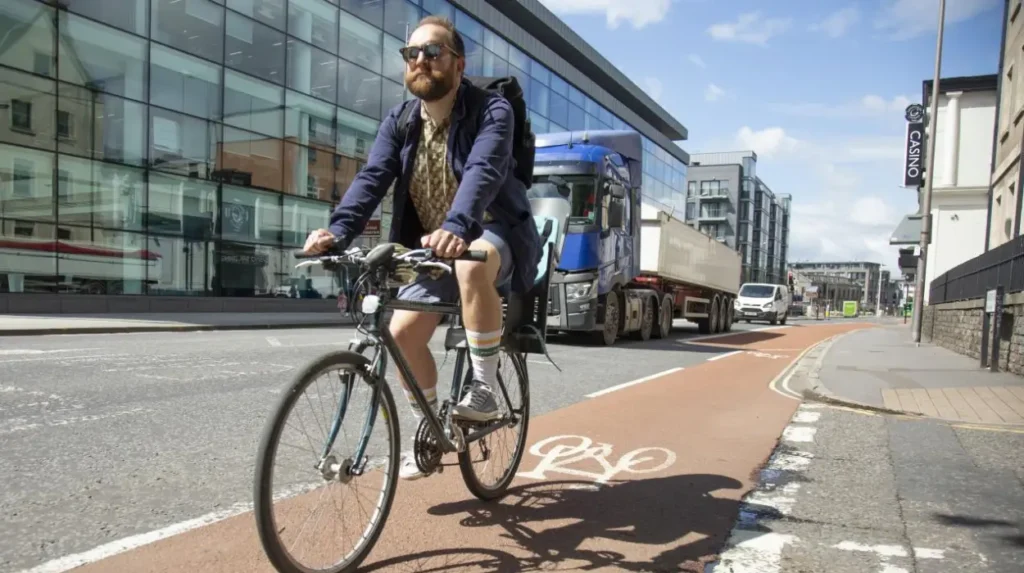
Cycling is one of Bristol’s most significant commuting modes. Census 2021 recorded 12,466 people cycling to work, representing 5.2% of employed residents, while the latest Travel to Work Survey records 14% cycling among participating organisations.
Bristol has a long-established cycling culture. Census 2021 recorded 12,466 people travelling to work by bicycle, representing 5.2% of employed residents. Bristol recorded the highest cycling percentage among the Core Cities in England and Wales in that census.
The 2026 Travel to Work Survey presents a different measurement because it surveys participating workplaces rather than the entire resident population. It recorded cycling at 14% and walking at 17%.
The difference between the datasets illustrates why commuting statistics need to be compared carefully. Census data measures residents using their usual method on a specific census date. Workplace travel surveys measure participating organisations and their employees.
Cycling is particularly relevant for short-distance commuting. Census 2021 found that 12.9% of employed Bristol residents travelled less than 2 kilometres to their workplace, while another 17.8% travelled between 2 and less than 5 kilometres.
These distances create a strong basis for walking and cycling. Bristol’s cycling network, cycle parking, e-bike use and active-travel programmes form part of the city’s broader transport strategy.
E-bikes also extend the practical commuting range for riders travelling longer distances or dealing with Bristol’s hills. The Travel to Work Survey recorded 3% of respondents using e-travel in 2026.
How effective is public transport for commuting from Bristol?
Public transport is a major commuting option in Bristol, with buses providing the largest share of public-transport journeys and trains connecting the city with surrounding towns and regional centres such as Bath, Cardiff, Gloucester, Weston-super-Mare and London.
Bristol’s public transport system combines bus and rail services. The 2026 Travel to Work Survey recorded 25% of respondents commuting by public transport, divided between 17% bus and 8% train.
Buses provide extensive coverage within Bristol and surrounding communities. They serve residential areas that do not have direct railway stations and provide access to employment districts, shopping areas, universities and hospitals.
Rail provides a different function. Bristol’s railway network connects the city with regional and national destinations. Bristol Temple Meads is the principal railway station and a major interchange for commuters.
Network Rail’s Great Western route extends from London Paddington to Penzance and passes through Bristol. The network includes the Great Western Main Line, which connects Bristol with London and South Wales.
Bristol Temple Meads also has services operated by Great Western Railway and CrossCountry. GWR provides connections involving London, Reading, Bristol, Plymouth, Penzance, Cardiff and Swansea, while CrossCountry provides longer-distance services across Britain.
Rail commuting has also expanded through new local infrastructure. Ashley Down railway station reopened on 28 September 2024 after almost 60 years without a local station. Network Rail states that the station provides a 12-minute train journey to Bristol Temple Meads.
The reopened station demonstrates the role of rail investment in reducing dependence on road travel and improving access to employment.
Which Bristol railway stations are important for commuters?
Bristol Temple Meads is the principal railway gateway for commuters, supported by local stations including Ashley Down, Clifton Down, Redland, Montpelier, Stapleton Road, Lawrence Hill and Bedminster. These stations connect residential communities with central Bristol and regional rail destinations.
Bristol Temple Meads has served the city since 31 August 1840. It was designed by Isambard Kingdom Brunel as the western terminus of the Great Western Railway’s main line from London to Bristol.
The station initially operated services between Bristol and Bath. Through services to London began the following year. As railway traffic increased, Temple Meads expanded repeatedly.
The station’s historical importance remains relevant to modern commuting because its location connects rail travel with Bristol’s central employment districts.
Local stations provide additional access points. Ashley Down reopened in 2024, strengthening rail connectivity in north Bristol. Network Rail describes the project as reconnecting the local community to the railway after nearly six decades.
Other stations across the Bristol area provide access to the local network, including Clifton Down, Redland, Montpelier, Stapleton Road, Lawrence Hill and Bedminster.
The rail network is also undergoing continuing investment. Network Rail is modernising infrastructure around Bristol and improving Temple Meads as part of a broader programme designed to support future passenger demand.
Temple Meads is also undergoing major redevelopment. Network Rail has created an eastern entrance and is developing additional entrances as part of the wider regeneration programme. The eastern entrance is designed to improve access from the eastern side of Bristol and connect directly with the University of Bristol Enterprise Campus.
What are the main road commuting routes into Bristol?
The main road approaches to Bristol include the M4, M5, A4, A38, A37, A4018, A420 and A36 corridors. These routes connect Bristol with South Gloucestershire, North Somerset, Bath, South Wales, Gloucestershire and surrounding communities.
Road commuting remains an important part of Bristol’s transport system. The 2026 Travel to Work Survey recorded 31% of respondents driving alone, 4% car sharing and 1% travelling by motorbike or moped.
The M4 provides a major east-west connection. It links Bristol with Bath, Swindon, Reading and London to the east and connects with the wider motorway network toward South Wales and the west.
The M5 provides the principal north-south motorway connection around Bristol. It links the city with South Gloucestershire, Gloucestershire, Somerset and destinations farther south and north.
The A4 serves important corridors between Bristol and Bath. The A38 connects Bristol with areas including Filton and the northern part of the metropolitan area, while the A4018 serves north-west Bristol.
The A37 provides an important southern approach, while the A420 connects Bristol with areas towards Chippenham and Swindon.
Road commuting patterns are strongly affected by employment concentration and peak-hour demand. Bristol’s compact central districts attract a large volume of traffic from surrounding residential areas.
The road network therefore operates alongside public transport and active travel rather than independently. Commuters frequently combine modes, such as driving to a railway station, taking a bus to a central interchange or cycling for the final part of a journey.
How does the Bristol Clean Air Zone affect commuters?
Bristol’s Clean Air Zone regulates certain vehicle journeys in the central area to improve air quality. Commuters using vehicles that do not meet the required emissions standards need to check applicable charges before travelling into the zone.
The Bristol Clean Air Zone, or CAZ, is an area-based vehicle emissions policy covering central parts of Bristol. Its purpose is to reduce harmful air pollution from road traffic.
The policy is particularly relevant to commuters who drive into central Bristol. Vehicle compliance determines whether a charge applies rather than the driver’s employment status alone.
Bristol City Council also provides support for eligible people travelling into the zone for work. Its Clean Air Zone business information states that people travelling to work in a non-compliant vehicle and meeting specified income conditions can qualify for financial support.
The council also promotes alternatives such as bus, train, e-scooter and car-club travel.
For commuters, the CAZ creates a direct connection between vehicle choice and commuting costs. Checking vehicle compliance before a regular journey is therefore an important part of planning a Bristol commute.
The policy also supports the wider transport objective of reducing emissions and encouraging cleaner forms of travel.
How has commuting from Bristol changed since the COVID-19 pandemic?
Commuting from Bristol has shifted toward hybrid working, shorter travel distances and greater use of flexible travel patterns. Census 2021 recorded 38.6% working mainly from home, while the 2026 workplace survey shows 62% working from home at least one day each week.
The pandemic significantly changed commuting behaviour in Bristol. Census 2021 recorded a sharp rise in home working from 4.6% in 2011 to 38.6% in 2021.
The census took place during a period of exceptional restrictions, so those figures do not represent normal long-term commuting conditions.
The 2026 Bristol Travel to Work Survey provides more recent evidence. It found that 62% of respondents worked from home at least one day each week, while 25% worked from home three or more days per week.
Only 3% of respondents reported working entirely from home. That figure remains substantially above the pre-COVID workplace survey levels.
Hybrid working also changes the frequency of commuting. Employees who work from home several days each week do not make the same number of weekly journeys as employees travelling to a workplace every weekday.
The 2026 survey recorded an average commuting frequency of 2.3 days per week among train commuters. Car-sharing and walking commuters travelled to work most frequently at 3.5 days per week.
This demonstrates an important shift from measuring commuting only by distance or transport mode. Frequency is now equally important because hybrid workers make fewer journeys while maintaining employment relationships with workplaces.
What makes Bristol suitable for walking to work?
Bristol is well suited to walking for shorter commutes because many residential neighbourhoods sit close to employment, education, retail and public-service destinations. Census 2021 recorded 26,730 people walking to work, representing 11.2% of employed residents.
Walking is particularly relevant to Bristol’s compact urban structure. Central neighbourhoods provide access to offices, universities, shops, healthcare facilities, restaurants and public services within relatively short distances.
Census 2021 recorded 26,730 people walking to work in Bristol. This represented 11.2% of employed residents and was the highest walking percentage among the English and Welsh Core Cities in that census.
The 2026 Travel to Work Survey recorded an even higher 17% walking share among participating organisations.
Walking also forms an important part of multimodal commuting. A commuter can walk from home to a bus stop, railway station or workplace after completing the longer section of the journey by public transport.
Bristol’s pedestrian environment therefore affects more than people who walk for the entire journey. It also affects access to transport interchanges.
The high proportion of short workplace journeys strengthens the role of walking as a practical commuting method. Census 2021 recorded 12.9% of workplace journeys at less than 2 kilometres and 17.8% between 2 and less than 5 kilometres.
What are the main challenges of commuting from Bristol?
The main commuting challenges in Bristol include road congestion, journey reliability, pressure on public transport, limited parking, air-quality regulation and differences in access between neighbourhoods. Hybrid working has changed demand but has not removed peak travel pressures.
Congestion remains a major consideration for people travelling by car. Bristol attracts commuters from a wide surrounding area, creating significant demand on the M4, M5, radial A-roads and city-centre streets.
Public transport presents a different set of challenges. Bus passengers depend on road conditions, while rail passengers depend on timetable capacity, infrastructure reliability and interchange arrangements.
Journey reliability is important because a 39-minute average one-way commute does not describe the full range of individual journeys. The 2026 Travel to Work Survey provides an average across participating respondents.
Parking is another factor. Limited central parking increases the attractiveness of public transport, cycling and walking while also affecting commuters who require a car because of their destination, working pattern or equipment.
The Clean Air Zone adds another consideration for drivers. Vehicle compliance needs to be checked when planning regular journeys into the central zone.
Accessibility also remains important. Bristol Temple Meads has step-free access to all platforms, while passenger assistance is available for people who need support at the station.
These factors mean that the best commuting option depends on the origin, destination, working schedule and required level of reliability.
How is Bristol improving its future commuting network?
Bristol’s future commuting network is being strengthened through rail investment, station redevelopment, new stations, active-travel infrastructure and wider transport planning. Projects around Temple Meads and the restored Portishead Line are designed to improve connectivity and support sustainable regional travel.
Rail investment is central to Bristol’s long-term transport development. Network Rail manages more than 2,000 miles of railway on the Great Western route and is continuing infrastructure renewal across the region.
Bristol Temple Meads is a major focus. The station redevelopment includes new entrances and improved connections with surrounding areas. Network Rail states that the eastern entrance is designed to support access from the east of Bristol and connect with the University of Bristol Enterprise Campus.
The reopening of Ashley Down station in September 2024 has already expanded local rail access.
The Portishead Line is another major regional project. Network Rail is restoring the railway between Bristol and Portishead. The planned reopening in 2028 is designed to reconnect more than 50,000 people to the railway, with an hourly direct service between Portishead and Bristol Temple Meads planned to take around 25 minutes. New stations are planned at Portishead and Pill.
These projects demonstrate how commuting infrastructure extends beyond Bristol’s administrative boundary. Bristol’s employment market depends on connections with surrounding communities, so regional rail development directly affects access to jobs.
Future commuting also depends on active travel and lower-emission transport. The current travel-to-work figures already show substantial participation in walking, cycling and e-travel.
Explore More Area Guide
Transport in Bristol: Buses, Rail and Travel Guide 2026
Business Networking in Bristol: Complete Guide 2026
What is the best way to plan a commute from Bristol?
The most effective way to plan a Bristol commute is to compare the complete journey rather than only the main transport mode. Consider door-to-door time, reliability, cost, parking, vehicle compliance, interchange requirements, walking distance and the number of days travelled each week.
A commuter should begin with the exact origin and workplace destination. The distance between the two locations determines whether walking or cycling is practical and whether a bus or railway station provides a useful connection.
The next factor is journey frequency. Someone travelling twice a week has different transport priorities from someone commuting five days each week.
For rail commuters, Bristol Temple Meads provides extensive regional and national connections. Local stations such as Ashley Down and other suburban stations provide additional access depending on the starting location.
For bus commuters, route coverage and interchange points are particularly important. A direct service generally reduces the number of transfer points and simplifies the journey.
Drivers should check whether their vehicle meets Bristol Clean Air Zone requirements before regularly travelling into central Bristol.
Cyclists and pedestrians should assess the complete route rather than relying only on the shortest distance. Junctions, hills, road conditions and secure cycle parking influence the practical commuting experience.
Hybrid workers should calculate the weekly rather than daily cost. A rail season ticket, parking arrangement or car ownership cost needs to be assessed against the actual number of commuting days.
The 2026 Travel to Work Survey shows that commuting frequency differs by transport mode. Train commuters averaged 2.3 days per week, while walking and car-sharing commuters averaged 3.5 days.
This makes flexible ticketing and multimodal travel increasingly relevant to Bristol commuters.
What does the future of commuting from Bristol look like?
The future of commuting from Bristol is centred on greater transport choice, expanded rail access, hybrid working, active travel and cleaner vehicles. Bristol’s employment growth and regional connections will continue to make reliable transport infrastructure essential to the city’s economy.
Bristol’s commuting system is moving toward a more varied model. The latest data shows that no single transport mode dominates every type of journey.
Cars remain important, accounting for 36% of respondents when driving alone, car sharing and motorbike or moped travel are combined. Active travel accounts for 31%, public transport for 25% and e-travel for 3%.
Hybrid working is another permanent factor in commuting patterns. With 62% of respondents in the 2026 survey working from home at least one day each week, employers and transport planners need to account for changing weekly travel demand.
Rail investment is also expanding access. Ashley Down station has already restored a local rail connection, while the Portishead Line project is scheduled to reconnect Portishead and Pill with Bristol’s railway network.
Temple Meads redevelopment will further strengthen Bristol’s central transport interchange. The station’s long history, beginning in 1840, reflects its continuing role as the city’s principal railway gateway.
The overall direction is clear. Bristol’s future commuting network will depend on integrating rail, buses, walking, cycling, e-travel and private vehicles rather than relying on one form of transport.
For commuters, this means that journey planning increasingly involves comparing time, cost, frequency, reliability, accessibility and environmental requirements. For Bristol as a city, transport connectivity remains a fundamental part of employment access, economic development and sustainable urban growth.
What is the most common way to commute from Bristol?
Driving alone is the largest individual commuting mode in the latest Bristol Travel to Work Survey, accounting for 31% of respondents. Bus travel accounts for 17%, walking 17%, cycling 14%, and train travel 8%.