The Herreshoff Marine Museum preserves the monumental legacy of the Herreshoff Manufacturing Company, an enterprise that advanced naval architecture and dominated international yacht racing between 1878 and 1945. The museum stands as a testament to industrial innovation and maritime craftsmanship.
- Which Core Exhibits Form the Foundation of the Museum Collection?
- How Did the Herreshoff Manufacturing Company Revolutionize Naval Architecture?
- What Role Does the America’s Cup Hall of Fame Play within the Institution?
- How Does the Museum Interface with the Modern Bristol Community and Industry?
- FAQs About Herreshoff Marine Museum
- What are the operating hours and admission fees for the Herreshoff Marine Museum?
- Where is the Herreshoff Marine Museum located and is parking available?
- Can visitors view the original design blueprints of Nathanael Herreshoff?
- What is the connection between the Herreshoff Museum and the America’s Cup?
- Does the museum offer private boat charters or access to the marina?
The institution occupies the original waterfront site where brothers John Brown Herreshoff and Nathanael Greene Herreshoff established their boatbuilding partnership in 1878 in Bristol, Rhode Island. John Brown Herreshoff, who lost his sight in youth, possessed exceptional business acumen and tactile engineering skills, while Nathanael Greene Herreshoff graduated from the Massachusetts Institute of Technology as a brilliant steam engineer and naval architect. Together, they transformed a local boatyard into a vertically integrated manufacturing facility that produced the fastest steam vessels, torpedo boats, and sailing yachts of the era.
The historical impact of the company centers heavily on its unparalleled success in the America’s Cup, the premier competition in international yachting. Between 1893 and 1934, the Herreshoff Manufacturing Company constructed eight consecutive successful defenders of the cup, a feat that remains unmatched in maritime history. The engineering breakthroughs developed on the shores of Narragansett Bay influenced naval defense and civilian pleasure craft worldwide.
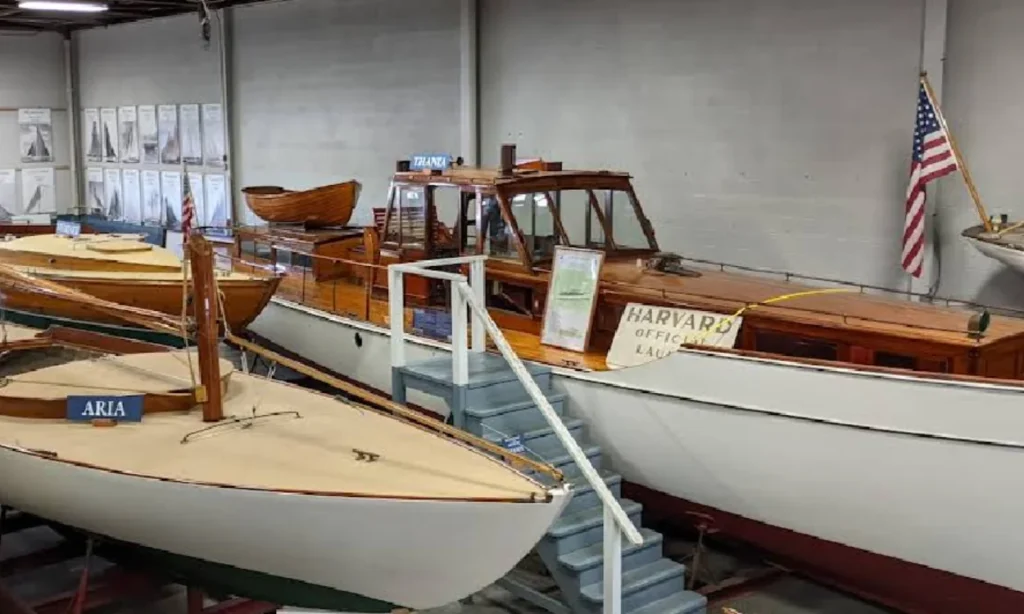
The museum itself was established in 1971 by A. Sidney DeWolf Herreshoff and Rebecca Chase Herreshoff to prevent the erasure of this industrial heritage after the factory closed its doors in 1945. The initial collection began as a modest floating exhibit after the yacht Thania was bequeathed to a non-existent museum entity, prompting the family to formalize the preservation effort. By 1978, the museum acquired a physical storehouse on Burnside Street, embarking on a multi-decade expansion that eventually reclaimed most of the original campus, including the manufacturing buildings, the family homestead, and the waterfront marina. Today, the site functions as a global pilgrimage point for historians, engineers, and sailors seeking to analyze the roots of modern yacht design.
Which Core Exhibits Form the Foundation of the Museum Collection?
The foundational exhibits of the museum feature over sixty historic vessels, hundreds of archival design models, and thousands of personal artifacts that document the evolution of American marine engineering. These collections illustrate the transition from traditional wood construction to advanced metallurgy.
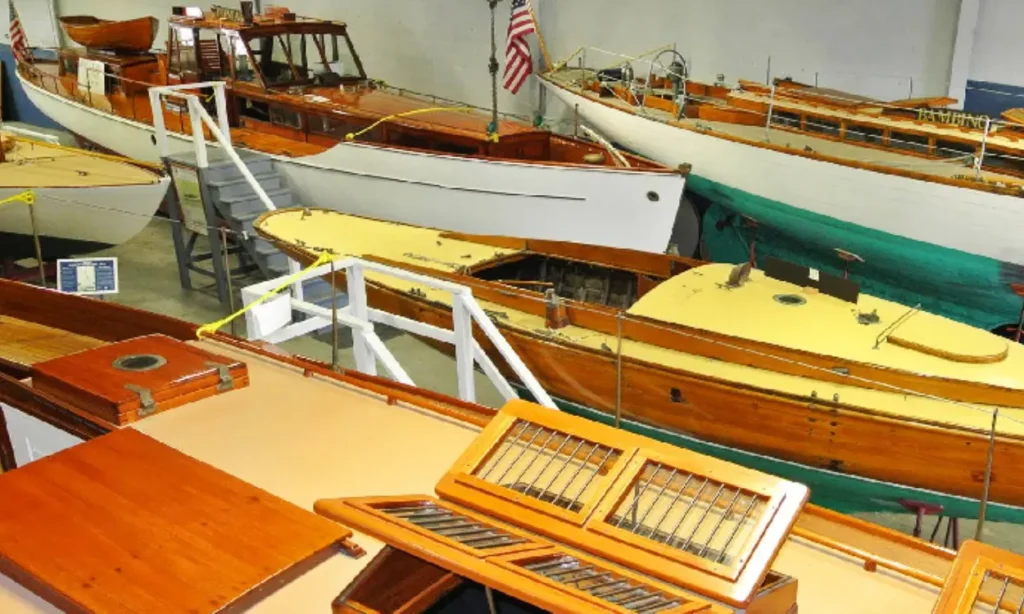
The center of the facility is the Hall of Boats, a vast exhibition space housing a diverse fleet of original, fully restored Herreshoff vessels. Visitors encounter watercraft spanning multiple eras, including the 1887 catamaran Clara, designed by Nathanael Greene Herreshoff, and the historic 1905 motor launch Thania. The collection showcases smaller, highly enduring production classes such as the Herreshoff 12 ½ and the Herreshoff S-Boat, alongside grand racing machines like Harold Vanderbilt’s Trivia and the 1992 International America’s Cup Class yacht Defiant. Walking through the hall provides an immediate look at structural engineering, allowing visitors to inspect the hull forms, framing techniques, and hardware choices that defined the Golden Age of Yachting.
Adjacent to the floating vessels is the Nathanael Greene Herreshoff Model Room, an architectural and historical archive containing approximately 500 original half-hull models. These models represent the actual design medium used by Captain Nat, who carved the shapes from wood blocks to calculate hydrodynamics before drafting formal blueprints. The room serves as a visual record of almost every design produced by the company, showing the incremental evolutionary steps toward modern keel configurations and overhangs.
The museum complex also incorporates the Rebecca Chase Herreshoff Library and Archives, which protects over 5,000 texts, 3,000 historic glass-plate negatives, and a vast repository of manufacturing logbooks. This research facility allows scholars to examine original construction contracts, correspondence with Gilded Age tycoons, and specific offset books containing the precise geometric measurements of historic hulls. The preservation of these primary sources ensures that the exact engineering methodologies of the 19th and 20th centuries remain accessible for modern replication and study.
How Did the Herreshoff Manufacturing Company Revolutionize Naval Architecture?
The Herreshoff Manufacturing Company revolutionized naval architecture by introducing systematic scientific engineering principles, standardized manufacturing processes, and breakthrough material innovations to an industry previously guided by traditional rule-of-thumb methods. The brothers introduced mathematical precision to the shipyard.
Nathanael Herreshoff applied his rigorous mechanical engineering training to optimize every component of a vessel, reducing weight while maximizing structural strength. The company pioneered the use of longitudinal framing systems, lightweight steel and bronze alloy plating, and hollow metal spars, which allowed yachts to carry larger sail plans without becoming top-heavy. The team introduced sail tracks and slides, structural bulb keels, and the modern fin-keel design, which separated the ballast from the steering mechanism to dramatically lower hydrodynamic drag. The introduction of these features completely altered the underwater profile of racing vessels.
The manufacturing process on the Bristol waterfront was highly vertically integrated, meaning the company manufactured its own engines, boilers, hardware, sails, and hulls under a single management system. This configuration enabled strict quality control and rapid prototyping, which was essential when executing complex military and civilian contracts. The company constructed the first torpedo boats for the United States Navy, utilizing high-speed steam technology that pushed hull velocities past previous theoretical limits.
The treatment of raw materials followed strict chemical and mechanical protocols designed by the founders. For example, when preparing oak for hull fabrication, the wood underwent a meticulous 48-hour conditioning process where it was seasoned in saltwater to eradicate marine boring organisms and subsequently injected with specialized lubricants to enhance pliability. This specific process prevented structural warping and ensured that the tight turns of a yacht hull could be molded without fracturing the timber fibers. The resulting durability allowed many Herreshoff vessels to remain operational for over a century, a testament to the industrial standards enforced inside the Bristol facility.
What Role Does the America’s Cup Hall of Fame Play within the Institution?
The America’s Cup Hall of Fame preserves the human history, competitive achievements, and technological milestones of the world’s oldest international sporting trophy by honoring outstanding contributors to the sport. The institution provides an international benchmark for yachting excellence.
Founded in 1992 under the leadership of Halsey Chase Herreshoff, a four-time America’s Cup defender and grandson of Captain Nat, the Hall of Fame recognizes individuals who have shaped the course of the regatta since its inception in 1851. The roster of inductees includes more than one hundred legends of the sport, spanning categories such as skipper, designer, shipwright, syndicate leader, and maritime chronicler. Notable inductees encompass historical figures like Harold Vanderbilt and modern innovators who have pushed the boundaries of hydrofoils and carbon fiber technology. The selection committee evaluates nominees based on international recognition, exceptional ability, integrity of character, and lasting contributions to yachting.
The physical hall displays a collection of historic yacht models, steering wheels, crew uniforms, structural fragments, and multimedia installations that tell the story of the dramatic duels on the water. Visitors can trace the history of the event from the original victory of the yacht America in Cowes, England, through the iconic defender series managed by the New York Yacht Club, to the modern multi-hull competitions. By anchoring the Hall of Fame at the Bristol campus, the museum connects the physical objects in its collection to the broader human narrative of global maritime competition.
How Does the Museum Interface with the Modern Bristol Community and Industry?
The museum interfaces with the modern community by operating active educational programs, hosting international regattas, and providing deep historical context to the maritime tourism industry of New England. The site bridges past industrial achievements with future workforce development.
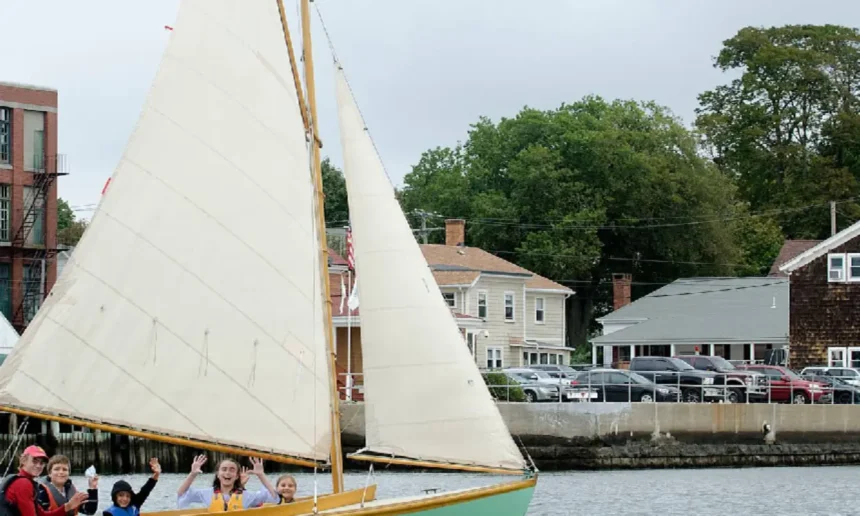
The institution runs an active sailing school and maritime skills program designed to train new generations of mariners in traditional seamanship and modern competitive sailing tactics. Utilizing the historic waterfront and classic boat designs, these programs foster a direct physical connection to Narragansett Bay, reinforcing the maritime identity of Rhode Island. The museum also coordinates academic symposia and lectures that draw naval architects, structural engineers, and historians from global institutions to debate design theory and preservation ethics. These gatherings maintain Bristol’s reputation as an active center of intellectual discourse within the marine trades.
The economic implications for the region are substantial, as the museum acts as a primary anchor for cultural heritage tourism in Bristol County. By drawing thousands of domestic and international visitors annually, the museum supports local hospitality businesses, including the nearby Beehive Cafe, which serves as a popular gathering point for visiting historians and sailors. The facility also hosts the annual Herreshoff Classic Yacht Regatta, an event that brings a historic fleet of wooden vessels back to the local waters, generating revenue for regional boatyards, sail lofts, and marine suppliers. This ongoing commercial and educational activity ensures that the legacy of industrial innovation established by the Herreshoff brothers remains an active driver of modern maritime culture.
Read More: Planning an extended coastal trip across historical maritime towns? View our complete structural strategy in the Weston-super-Mare Visitor Guide.
FAQs About Herreshoff Marine Museum
What are the operating hours and admission fees for the Herreshoff Marine Museum?
The museum is generally open to the public daily from 10:00 AM to 5:00 PM during its primary operational season, which runs from May through October. Admission rates vary by demographic, with structured discounts provided for senior citizens, military personnel, students, and young children, while museum members receive complimentary access. It is advisable to consult the official ticketing portal before arriving to confirm specific seasonal schedule adjustments.
Where is the Herreshoff Marine Museum located and is parking available?
The physical campus is situated at 1 Burnside Street in Bristol, Rhode Island, occupying a prominent waterfront location along the eastern shore of Narragansett Bay. The site offers dedicated on-site parking options for visitors, and additional street parking is accessible along the surrounding residential and commercial corridors. The location is easily accessible by automobile from both Providence and the historic yachting hub of Newport.
Can visitors view the original design blueprints of Nathanael Herreshoff?
The original paper blueprints, technical engineering indexes, and casting records are primarily housed within the Haffenreffer-Herreshoff Collection at the MIT Museum in Cambridge, Massachusetts. However, the Bristol facility maintains an extensive on-site archive, digitized offset records, and the complete collection of physical half-models within the Model Room. Researchers can gain access to these specialized archival materials by scheduling a formal research appointment with the institutional archivist.
What is the connection between the Herreshoff Museum and the America’s Cup?
The museum stands on the exact geographical site where the Herreshoff Manufacturing Company designed and constructed eight consecutive successful defenders of the America’s Cup between 1893 and 1934. Because of this historic dominance, the museum campus was selected to house the official America’s Cup Hall of Fame in 1992. The institution continues to manage the selection process and display artifacts honoring the legends of this historic race.
Does the museum offer private boat charters or access to the marina?
The facility operates a fully functional waterfront marina that provides seasonal moorings, dockage spaces, and transient slip rentals for visiting yachtsmen traveling through Narragansett Bay. Additionally, the museum utilizes its historic fleet to host exclusive classic boat regattas and corporate events, though standard admission tickets do not include private sailing charters. Boat owners seeking dockage must submit a formal reservation request through the waterfront management office.