Key Points:
- Errors in Percentages in Official Report: The yearly report assessing the Bristol’s CAZ had tables showing the wrong percentages in that the percentages did not add up to 100 percent but rather 84 percent in one table and 128 percent in the other.
- Increase in Pollution: The concentration of nitrogen dioxide in the Clean Air Zone increased slightly in the previous year according to the experts from the Bristol City Council as a reflection of the national trend.
- Penalties Not Paid and Write-offs: There were millions of pounds worth of PCNs write-offs since about a quarter of them was written off while just 43 percent were paid.
- Debts That Could Not Be Recovered and Repeat Offenders: In the previous financial year, there was a write-off of 27.8 million pounds worth of CAZ fines. About 45,000 fines are being pursued from only 11,000 repeat offenders.
- Question of Fairness: The Lib Dem Cllr Tim Kent brought up concerns about fairness in that those drivers that did not comply and avoid fines are getting away with their offenses while those complying are following the regulations.
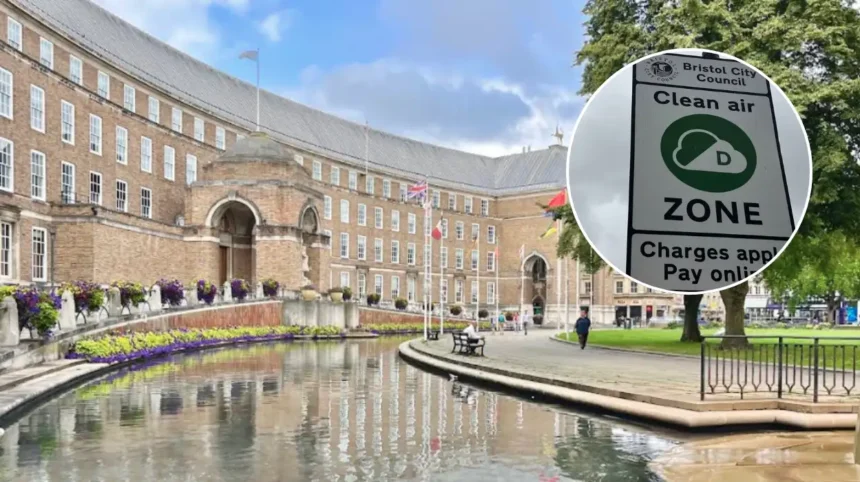
Bristol (Bristol Express News) September 30, 2026 — As reported by Alex Seabrook, Local Democracy Reporter of Bristol Live, an annual report evaluating Bristol’s Clean Air Zone (CAZ) was marred with errors as “bizarre” percentages were given which do not add up to 100. The report highlighted two major problems last year, with pollution in the city centre increasing and many drivers not paying CAZ fines.
Last year saw a small increase in levels of nitrogen dioxide within the Clean Air Zone, which experts at Bristol City Council have blamed on particular weather conditions, given a similar national picture. Additionally, millions of pounds of fines for not paying the charge were written off.
How Did Data Errors Obscure the Extent of the Penalty Charge Problem?
Understanding the extent of the problem with penalty charge notices was made difficult due to erroneous tables about how many were paid, cancelled, or written off. As detailed by Alex Seabrook of Bristol Live, on one table, the percentages from 2024 added up to 84, and on a separate table, percentages added up to 128.
The fines for people not paying the charge are a critical way to hit the aims of the Clean Air Zone, which is why understanding the latest figures is so important. An update on the Clean Air Zone was given to councillors on the environment policy committee.
As reported by Alex Seabrook of Bristol Live, Liberal Democrat Councillor Tim Kent stated that: “We’ve got a PCN table with percentages going down it. But they add up to about 125 per cent, give or take a couple of per cent, not 100 per cent, which seems a bit bizarre.”
What Are the Financial and Enforcement Realities of the Clean Air Zone Fines?
Drivers of non-compliant vehicles who enter the zone without paying the fee are hit with a penalty charge notice of 129 pounds. This is halved for people who pay within a fortnight, but increased for those who don’t pay and then receive a charge certificate. If someone doesn’t pay, the council asks the DVLA to find out who owns the vehicle and where they live, so a fine can be sent.
However, last year the council wrote off 79,483 fines, where the DVLA was unable to provide who owned the vehicles, and where bailiffs couldn’t find the owner or recover the debt. About a quarter of fines were written off, with only 43 percent actually paid.
Regardless of the confusion, councillors raised questions about how fairly the Clean Air Zone is working. Less than five per cent of vehicles driving inside the zone are liable to pay a charge or fine, and then many of these drivers don’t actually end up paying anything at all anyway.
As reported by Alex Seabrook of Bristol Live, Councillor Tim Kent added that:
“There’s an issue here of fairness. If someone does drive a non-compliant vehicle into the CAZ, and doesn’t pay their nine quid, then they don’t have to pay anything. Because in fact about half the PCNs aren’t being paid. Some people appear to be rigging the system. I’m surprised it’s so many that we can’t track down.”
Over the last financial year, 27.8 million pounds of CAZ fines were written off, according to a separate report. Many of the debts belong to repeat offenders. Enforcement agents are currently chasing around 45,000 fines, which were racked up by around only 11,000 drivers.
Explore more Local Bristol News:
Bristol City Council Approves Emergency Pero’s Bridge Repairs: City Centre 2026
Bristol Energy Liquidation Ends With £39.3m Bristol Council Taxpayer Bill 2026
Background of the Particular Development
The implementation of Clean Air Zones (CAZs) across various urban centres in the United Kingdom forms part of a nationwide strategy to tackle illegal levels of nitrogen dioxide and improve public health. Bristol City Council introduced its Clean Air Zone to deter high-polluting vehicles from entering the city centre by charging non-compliant older cars, taxis, and commercial vehicles. Alongside the daily fee, penalty charge notices (PCNs) were established as a vital enforcement mechanism to ensure compliance. However, ongoing administrative challenges, difficulties in tracing vehicle owners through the DVLA, and substantial volumes of uncollected debt have consistently complicated local authority efforts to balance environmental objectives with efficient financial management.
How This Development Can Affect Drivers, Taxpayers, and Local Governance
These data errors and enforcement shortfalls are likely to trigger heightened scrutiny from local government watchdogs and taxpayers regarding administrative competence at Bristol City Council. For everyday drivers and compliant motorists, the revelation that millions of pounds in fines are written off—often driven by repeat offenders evading detection—creates a perception of systemic unfairness and undermines public trust in traffic enforcement policies. If enforcement agencies face continued difficulties in tracking down uncollected debts and verifying data reporting, the council may face increased pressure to overhaul its penalty tracking systems, tighten enforcement against persistent evaders, or re-evaluate the financial models underpinning the Clean Air Zone to ensure equitable outcomes for the wider public.