Key Points
- According to a report published in BBC news by Matty Edwards and Hannah Miller, there is a record level of 2,000 families in Bristol living in temporary accommodations, which is costing Bristol city council about £20 million per year.
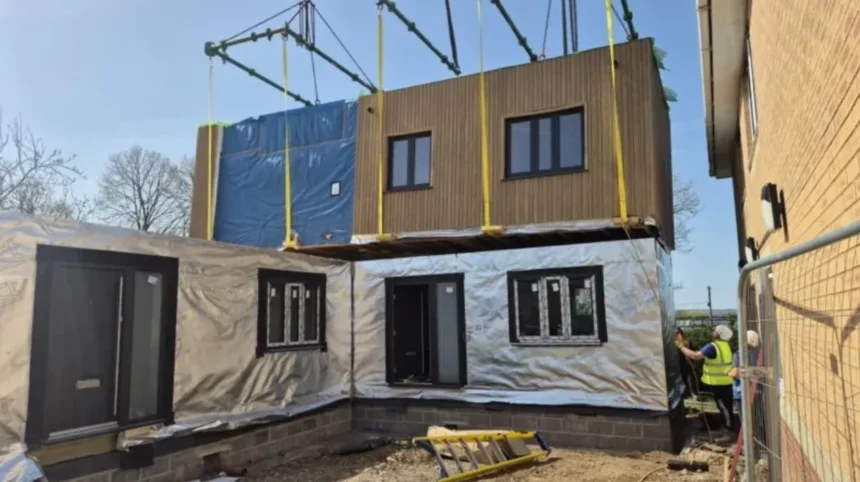
- A recent project launched in Hengrove, south Bristol has provided five two-bedroom modular homes that have been manufactured in factories by the housing association called Places For People (PFP).
- “Marie,” who is the name given to a mother in Bristol who has spent seven months shifting hotels and even travelling to Bath, has cried out saying that it is “a new beginning for my kids.”
- Managing Director of PFP Paul Smith mentioned that “the modular design is much cheaper by around £25,000 per annum per family than hotel rooms,” adding that the homes will be usable for at least 60 years.
- Barry Parsons, Bristol City Council’s housing leader, remarked that the council’s creative method has brought down the number of homeless families housed in hotels or bed-and-breakfast from about 150 families two years ago to just one or two now.
- The heads of PFP and the council agree that “slow planning process and land access are the major obstacles for scaling of this initiative on the national scale, where there are 165,000 children living in poor-quality temporary housing.”
Bristol (Bristol Express News) September 10, 2026 — A mother known by the pseudonym Marie is among a record 2,000 Bristol families currently living in temporary accommodation, an issue that costs the local authority roughly £20m annually. After enduring three years of housing instability—including sharing a single bed with her 11-year-old son in a one-bedroom flat and spending seven gruelling months shuffled from hotel to hotel as far away as Bath—Marie is preparing to move into a newly developed modular housing scheme in Hengrove, south Bristol.
As reported by Matty Edwards and Hannah Miller of BBC News, Marie expressed the emotional toll of her previous living conditions:
“It massively changed all of our lives, our mental health, everything.”
She added regarding her constant relocation:
“The last seven weeks we were in the hotel, we were being moved every Monday, so I had to take the day off work and my son the day off school. We never knew where we were going, we’d pack up all our stuff and wait for an email from the council.”
Looking toward her relocation, Marie stated to Matty Edwards and Hannah Miller of BBC News: “I had tears in my eyes because it’s a new start for my children. It might not be where we need to be at but it’s my final stepping stone to my forever home.” She further noted:
“It will give us routine, structure for my kids. My son can have a school friend round if he wants… It’s going to change all of our lives massively.”
While acknowledging she remains one of 18,000 people on the social housing waiting list, she described her upcoming temporary dwelling as “like a palace” and remarked:
“This place where I’m going, if there was a lot more of that available to people like me, if they put money into things like that instead of forking out for hotels, people’s lives would be different too.”
Could modular homes cut housing costs for local authorities?
The newly established site in Hengrove supplies just five new homes situated on council-owned land. However, as reported by Matty Edwards and Hannah Miller of BBC News, housing association Places For People (PFP) estimates that the model could be scaled up significantly because it operates at roughly £25,000 a year less per family than utilizing traditional hotel rooms.
As reported by Matty Edwards and Hannah Miller of BBC News, PFP managing director Paul Smith explained: “This is an amazing win-win because it provides people with much better quality of life and actually saves the council quite a significant amount of money, because temporary accommodation is incredibly expensive.” Smith noted that although these modular structures are manufactured in factories in approximately half the time of standard builds, they are engineered to last for a minimum of 60 years and incorporate dedicated support services.
Reflecting on the wider application of the scheme, Smith told Matty Edwards and Hannah Miller of BBC News: “My only concern is that we’re not doing more of this and PFP would like to do a lot more.” He added: “We’ve got a few schemes across Bristol that we’ve done in partnership with the council and we hope we can do more here in Bristol and across the country.” According to Smith, the principal obstacles standing in the way of expansion are protracted planning processes and difficulties securing access to land. Praising Bristol City Council as a “fantastic partner”, Smith also highlighted the broader national picture, stating: “There are 165,000 children in poor quality temporary accommodation at the moment and that shouldn’t be seen as acceptable. We believe that we have part of the solution to that.”
What steps are local councils taking to combat the temporary accommodation crisis?
Throughout 2024, Bristol City Council initiated a strategy to curb the soaring expenditures linked to temporary accommodation while rescuing families from substandard environments. As reported by Matty Edwards and Hannah Miller of BBC News, this ongoing municipal programme has already secured £13.7m in savings across the preceding two financial years, with an anticipated additional £4m saving expected within the current financial cycle. A cornerstone of this strategy involves a pilot scheme designed to deploy 50 modular units across small, underutilised plots of council-owned land.
As reported by Matty Edwards and Hannah Miller of BBC News, Barry Parsons, Bristol City Council’s housing chief, declared that he is “really proud” of the progress made, noting that only one or two homeless families are currently placed in hotels or bed and breakfasts at any given time—a dramatic drop from approximately 150 families two years prior. Parsons emphasised that the council’s proactive measures ensure that despite record numbers entering temporary housing, the authority is “providing people with better quality of accommodation at lower cost.”
Furthermore, Parsons told Matty Edwards and Hannah Miller of BBC News:
“We’re using a wide range of innovative approaches to address this crisis and one of the things we’re using is modern methods of construction, including modular homes. It’s really exciting because this is quite new – this is an example of the council really innovating.”
He cautioned, however, that
“modular is not the be all and end all, it’s part of the story for us,”
explaining that the broader initiative encompasses housing people with comprehensive support networks through various channels, including modular developments, new builds, and open-market property acquisitions.
Explore more Local Bristol News:
Bristol Veterinary Surgeon Grows Giant Vegetables Like Sport, Bristol 2026
Bristol Council Plans New Harbourside Safety Barriers 2026
Background of the Development
The integration of modular housing into local authority strategies stems from an acute, long-term national shortage of social housing coupled with a sharp post-pandemic rise in homelessness and private rental evictions across the United Kingdom. Traditional emergency placements, such as commercial hotels and bed-and-breakfasts, have historically served as a costly stopgap measure for local councils legally obligated to house destitute families.
However, reliance on these commercial spaces drained municipal budgets into the billions nationwide while subjecting vulnerable children to cramped, unstable environments devoid of routine. In response, forward-thinking local authorities like Bristol City Council began experimenting with modern methods of construction (MMC)—utilising factory-built modular units on small, irregular pockets of publicly owned land that are typically deemed unviable for standard commercial developments—to simultaneously reduce expenditures and humanise temporary living standards.
Impact on Homeless Families
As modular housing initiatives scale up through partnerships between housing associations like Places For People and local councils, homeless families facing prolonged stays in temporary accommodation stand to experience profound improvements in daily stability, mental health, and educational continuity. By replacing transient, unpredictable hotel stays—which frequently force parents and children to change locations weekly—with semi-permanent modular pod homes equipped with proper support services, children can maintain consistent school attendance and local social ties.
Financially, the substantial cost savings recouped by local authorities redirect vital public funds away from commercial hotel chains and back into building permanent social housing infrastructure. For the thousands of families currently languishing on local authority waiting lists, the normalisation of modular developments serves as a viable, humane bridge that mitigates trauma while they await permanent resettlement.