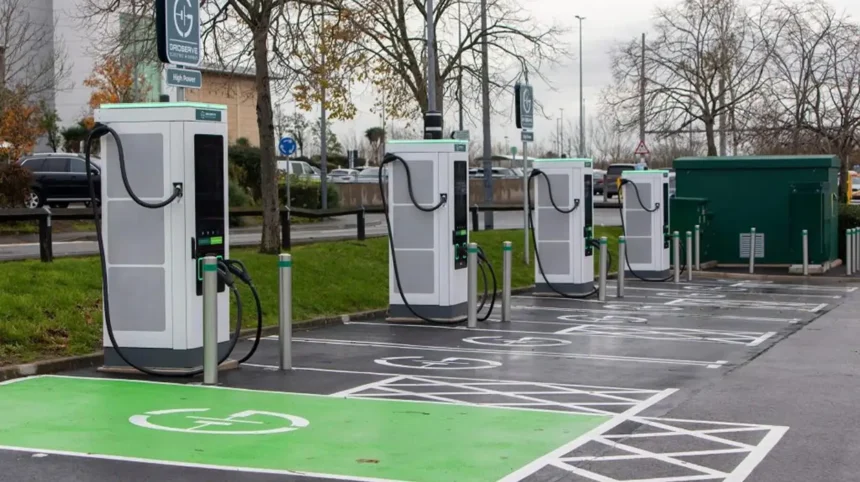
Bristol has developed a growing public electric vehicle charging network covering city-centre car parks, residential streets, Park and Ride sites, shopping areas and major travel routes. The network includes council-backed Revive chargepoints, privately operated chargers and lamppost charging points.
- What are electric vehicle charging points in Bristol?
- How has Bristol’s EV charging network developed?
- What types of EV charging points are available in Bristol?
- Where can you find EV charging points in Bristol?
- How do you use EV charging points in Bristol?
- How much does EV charging cost in Bristol?
- Can Bristol residents charge an EV at home without a driveway?
- What EV charging grants are available in Bristol?
- How reliable are public EV charging points in Bristol?
- What is Bristol City Council’s plan for future EV charging?
- Why are EV charging points important for Bristol?
- How should drivers plan an EV journey around Bristol?
Bristol City Council’s Electric Vehicle Infrastructure Strategy 2026–2036 sets out a long-term framework for expanding charging infrastructure, improving reliability and ensuring residents without off-street parking have practical access to charging. The strategy prioritises a consistent user experience, commercially sustainable infrastructure and future demand.
The latest Bristol strategy states that approximately 50 rapid chargepoints rated at 50kW or above and around 150 standard chargepoints rated up to 22kW were available for public charging in Bristol in April 2025. Around 75% of the existing network was privately owned and operated.
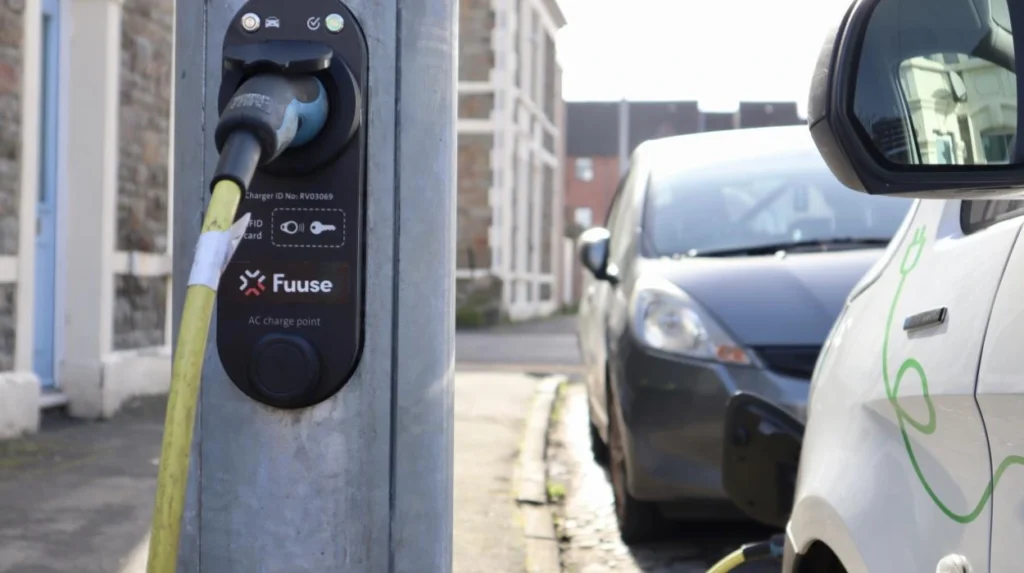
Bristol also has 150 public lamppost charging points installed at the base of upgraded lampposts. These chargers provide an important option for residents who rely on street parking.
The wider UK network is expanding rapidly. Department for Transport statistics recorded 119,080 public EV chargers across the UK on 1 April 2026, including 27,372 chargers rated rapid or above at 50kW or more. The official statistics use data supplied by chargepoint operators and collated through Zapmap.
For Bristol residents, visitors and businesses, understanding charger types, locations, payment systems, charging speeds and installation options is essential for planning electric vehicle journeys.
What are electric vehicle charging points in Bristol?
Electric vehicle charging points in Bristol are publicly or privately accessible electrical systems that supply energy to electric vehicles. They include standard, fast and rapid chargers located at homes, workplaces, car parks, streets and travel destinations.
An electric vehicle charging point, also called a chargepoint, connects an electric vehicle to an electricity supply. The vehicle’s battery stores the electricity for propulsion.
Charging infrastructure is different from a petrol station because charging takes place across a wider range of locations. A driver can charge at home, at work, in a public car park, on a residential street or during a longer journey.
Public chargepoints are operated by chargepoint operators. These companies manage hardware, payment systems, software, maintenance and customer support. Bristol’s public network therefore includes infrastructure operated by the council and infrastructure owned by private companies.
The Bristol Electric Vehicle Infrastructure Strategy identifies a mixed network. Around 75% of the city’s public charging network was privately owned and operated when the strategy assessed the April 2025 position.
The Revive charging network provides a council-supported regional network across Bristol, South Gloucestershire, Bath and North East Somerset, and North Somerset. Bristol City Council describes Revive as one of the principal charging networks serving the area.
Charging points are important because electric vehicles depend on reliable access to electricity. A dense network reduces dependence on a single charging location and supports drivers who do not have private driveways.
How has Bristol’s EV charging network developed?
Bristol’s EV charging network developed from regional public charging initiatives into a mixed public-private system. The city expanded charging through council projects, regional programmes, residential infrastructure, private operators and newer lamppost charging installations.
Bristol’s charging infrastructure forms part of a wider regional transition towards electric transport.
One significant programme was Go Ultra Low West, a £7 million initiative involving Bristol, South Gloucestershire, North Somerset and Bath and North East Somerset. The programme supported electric vehicle adoption and installed more than 120 new chargepoint connections, helping expand the regional public network.
The regional Revive network subsequently replaced the former Source West network. It was established by the West of England local authorities to provide public charging infrastructure across the region.
Bristol’s current strategy provides the next stage of development. The Bristol Electric Vehicle Infrastructure Strategy 2026–2036 establishes objectives for consistent charging experiences, commercially sustainable infrastructure, future demand and improved access for households without off-street parking.
The strategy also records the changing structure of Bristol’s charging network. In April 2025, the city had approximately 50 rapid chargepoints and 150 standard public chargepoints, while Revive operated 32 fast and 13 rapid chargepoints in Bristol.
The growth of lamppost charging represents another stage of development. Bristol City Council currently states that 150 EV lamppost chargepoints are available across Bristol. These units are installed at the base of upgraded lampposts and are available for public use.
This development reflects the changing needs of urban EV drivers. A city with flats, terraced housing and streets without private driveways needs charging infrastructure beyond private garages and driveways.
What types of EV charging points are available in Bristol?
Bristol’s charging network includes standard chargers up to 22kW, rapid chargers from 50kW and higher-powered public charging infrastructure. Examples include lamppost chargers, car-park chargers, workplace units, residential chargers and rapid motorway-style facilities.
Charging speed is measured in kilowatts (kW). A higher power rating generally allows an electric vehicle to receive energy faster, although the actual charging rate also depends on the vehicle, battery condition and charger compatibility.
Standard charging is suited to longer parking periods. Examples include residential chargers, workplace chargers and public car-park units where a vehicle remains parked for several hours.
Fast charging occupies the middle ground between standard and rapid charging. Bristol’s Revive network includes fast charging infrastructure. The city’s strategy records 32 Revive fast chargepoints in Bristol based on the 2024 network data used in the strategy.
Rapid charging starts at 50kW within the Bristol strategy and UK public charging regulations. These chargers are designed for shorter stops and are particularly useful for longer journeys, taxis, commercial vehicles and drivers who need to replenish a substantial amount of battery energy quickly.
Bristol’s strategy identified approximately 50 public rapid chargepoints rated at 50kW or above in April 2025.
Lamppost charging uses existing street infrastructure to provide residential charging. Bristol currently has 150 such public charging points. The council directs users to the Fuuse app for locations, prices and operating instructions.
The correct charger depends on the vehicle and journey. A driver leaving a vehicle overnight requires a different charging pattern from a taxi driver completing repeated urban journeys.
Where can you find EV charging points in Bristol?
Public EV charging points are concentrated across Bristol’s city centre, Temple Meads area, council car parks, Park and Ride facilities, residential streets, shopping destinations and major routes. Examples include College Street, Trenchard Street, Temple Gate, West End and selected Park and Ride sites.
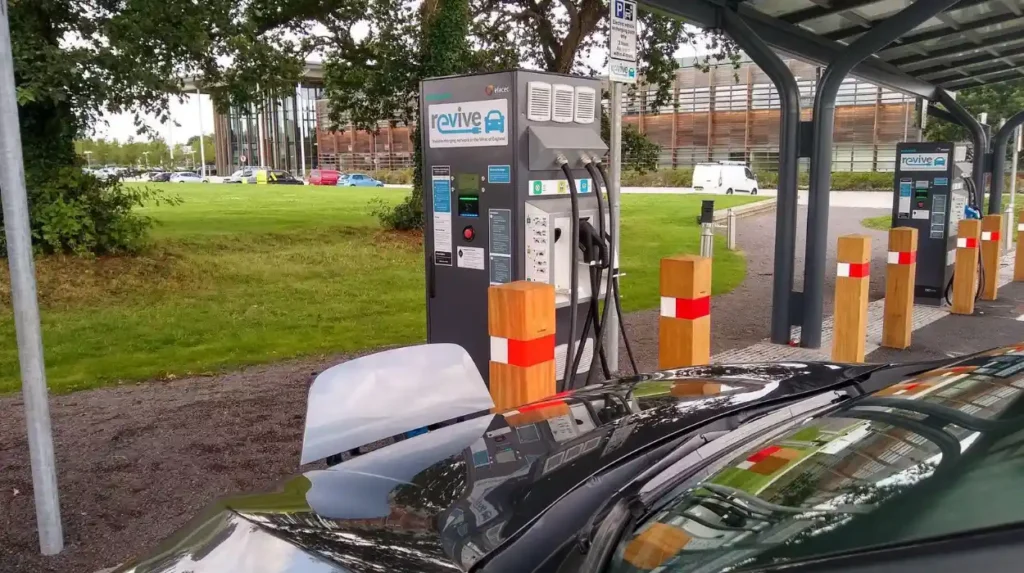
Bristol City Council provides public charging through the Revive network in locations including car parks, parks, shopping centres and well-used routes. Revive operates across Bristol and neighbouring West of England local authorities.
Several Bristol City Council car parks have dedicated EV charging bays.
College Street, BS1 5UU has four charging bays in the covered section.
The Grove, BS1 4RB has two charging bays near 44 The Grove.
Trenchard Street, BS1 5AN has eight charging bays on level 1.
Temple Gate, BS1 6PL has four charging bays on the ground floor.
West End, BS8 1EH has six charging bays on level 2B.
Parking charges continue to apply when using charging points in Bristol City Council car parks. Drivers therefore need to account for both charging costs and parking charges when planning a stop.
Bristol’s Park and Ride network also provides charging facilities.
Brislington Park and Ride, on the A4 Bath Road, has four charging bays in section C16.
Portway Park and Ride, on the A4 Portway, has four charging bays.
Long Ashton Park and Ride has four charging bays near the waiting-room area.
These locations provide a useful option for drivers combining car travel with public transport into Bristol.
The city-centre and Temple Meads areas have a high concentration of publicly accessible charging infrastructure. Bristol’s 2026–2036 strategy specifically identifies these areas as locations with a high proportion of existing public chargepoints.
For the most current locations, availability and charger status, drivers should use live charging-network information rather than relying on a static list. The Bristol strategy directs residents to Zapmap for the latest information about EV chargepoints in Bristol and across the UK.
How do you use EV charging points in Bristol?
Using a public EV charger involves locating a compatible unit, checking its availability and price, connecting the vehicle, starting the charging session and completing payment. Examples of access methods include contactless bank cards, operator apps and roaming services.
The exact process depends on the chargepoint operator.
Before travelling, drivers should check the connector type, charging power, availability, operating status and price. Vehicle compatibility is essential because different electric vehicles use different charging connections and charging capabilities.
At a public charger, the driver parks within the marked charging bay and connects the vehicle using the appropriate cable. Some chargers provide a cable, while others require the driver to use the vehicle’s own charging cable.
Payment methods vary between networks. Public charging regulations have introduced important standardisation requirements.
The Public Charge Point Regulations 2023 require the maximum charging price to be displayed clearly in pence per kilowatt-hour. The advertised price must not increase after charging begins.
Contactless payment is also required for new public chargepoints rated at 8kW or above deployed after 24 November 2024 and for existing public chargepoints rated at 50kW or above. Contactless payment must be available without requiring a pre-existing contract with the operator.
Bristol’s lamppost charging system uses the Fuuse app. The council states that the app provides charger locations, prices and instructions for using the lamppost units.
Revive charging requires users to create a Revive account. Bristol City Council provides access information through its electric vehicle charging service.
Drivers should also check parking restrictions. A charging bay can be subject to parking rules, time limits or other local restrictions. Charging does not automatically remove a separate parking requirement.
How much does EV charging cost in Bristol?
EV charging costs in Bristol depend on the chargepoint operator, charging speed, electricity tariff, parking charges and payment method. Public charging prices are displayed in pence per kilowatt-hour, while home charging costs depend on the household electricity tariff and charging pattern.
There is no single Bristol-wide price for public EV charging.
Chargepoint operators set their own tariffs within the regulatory framework. The Public Charge Point Regulations 2023 require public operators to display the maximum charging-session price clearly in pence per kilowatt-hour.
The total cost of a charging stop depends on the amount of electricity transferred. A vehicle that receives 30kWh uses less electricity than one that receives 60kWh.
Charging speed also affects the economics of a journey. Rapid charging provides faster energy delivery but public rapid charging tariffs are often structured differently from slower charging. Drivers should therefore compare the displayed price before starting a session.
Parking charges represent another potential cost. Bristol City Council explicitly states that parking charges continue to apply in council car parks when drivers use EV charging points.
Home charging is priced through the household electricity tariff. A driver with a domestic charger pays for electricity according to the relevant electricity contract rather than a public chargepoint tariff.
The difference between home and public charging is important for long-term EV ownership. Drivers with reliable private charging access can schedule charging around their household electricity arrangements. Drivers without off-street parking depend more heavily on public infrastructure.
Bristol’s strategy therefore places particular emphasis on residents without access to off-street parking. The city intends to ensure the future charging network prioritises these users while remaining commercially sustainable.
Can Bristol residents charge an EV at home without a driveway?
Bristol residents without driveways cannot run an ordinary charging cable across the public pavement. Bristol City Council is conducting a cross-pavement charging trial that uses approved solutions to connect private electricity supplies with vehicles parked on the street.
Cable safety is a significant issue in streets with limited off-street parking.
Bristol City Council states that residents cannot trail a charging cable across a pavement. A cable across a footway creates a trip hazard and an accessibility problem, particularly for disabled and vulnerable pedestrians.
Residents also cannot independently install charging equipment on public pavements or streets. Bristol City Council states that only the council can install equipment on the pavement or street.
The council is addressing this issue through a cross-pavement gully charging trial. The system provides a controlled route for a charging cable between a home chargepoint and a vehicle parked on the street.
The trial targets Bristol households without off-street parking that want to charge an EV using their domestic electricity supply.
The published timetable states that expressions of interest opened in March 2026. Installation of cross-pavement solutions is scheduled in batches from August 2026 to June 2027, followed by monitoring and evaluation, with a final report scheduled for August 2027.
This approach is important for Bristol because residential streets contain many homes without private driveways. A safe cross-pavement solution provides a route towards domestic charging without creating uncontrolled obstacles across footways.
National grant support also covers eligible households with on-street parking. From 1 April 2026, the relevant grant provides up to £500 towards an eligible chargepoint installation involving a cross-pavement solution.
What EV charging grants are available in Bristol?
Eligible Bristol residents, landlords and workplaces can access national EV chargepoint grants. From 1 April 2026, several schemes provide support of up to £500 per socket, subject to eligibility, installation requirements and scheme deadlines.
The Office for Zero Emission Vehicles, known as OZEV, administers UK government support for EV charging infrastructure.
The grant framework changed on 1 April 2026. The updated schemes run until 31 March 2027, subject to the published eligibility conditions and government decisions.
Renters and flat owners can access an EV chargepoint grant worth up to £500. Eligible applicants must have private off-street parking for the standard renters and flat owners scheme.
A separate grant supports households with on-street parking where an approved cross-pavement solution is installed. The maximum grant is also £500.
Residential landlords can receive up to £500 per socket, covering 75% of eligible purchase and installation costs. The landlord scheme supports up to 200 sockets per year across eligible properties.
Workplaces can also access the Workplace Charging Scheme. From 1 April 2026, the maximum support increased to £500 per socket, with businesses and eligible organisations able to apply for up to 40 sockets across their sites.
The application process requires an approved installer and eligible equipment. Applicants must follow the scheme’s rules before installation. For renters and flat owners, written permission from a landlord, freeholder or property manager is part of the application documentation where applicable.
Applicants should check current OZEV eligibility before arranging installation. Grant rules, eligible equipment and funding periods are government-controlled and subject to published updates.
How reliable are public EV charging points in Bristol?
Public EV charging reliability is governed by national standards as well as operator maintenance. Rapid public chargers rated at 50kW or above are subject to a 99% reliability requirement, while Bristol’s strategy prioritises consistent and dependable service.
Reliability is a central issue for public EV infrastructure.
The Public Charge Point Regulations 2023 require rapid chargepoints to achieve 99% reliability, measured across an operator’s rapid charging network over a calendar year. Operators must publish reliability information and provide annual reliability reporting.
The regulations also require a free, staffed 24-hour helpline at public chargepoints. The helpline must provide real-time assistance for issues within the operator’s control.
Open data is another requirement. Chargepoint operators must use the Open Charge Point Interface (OCPI) and make relevant reference and availability data publicly accessible in machine-readable form.
These requirements improve transparency for drivers and help charging platforms display current infrastructure information.
Bristol’s strategy also identifies reliability and user experience as key objectives. The city’s 2026–2036 plan aims to create a consistent, reliable and fair charging experience while ensuring infrastructure remains suitable over the long term.
Drivers should still check live charger status before travelling to a specific unit. Public infrastructure is distributed across different operators, and individual units can be temporarily unavailable because of maintenance, faults, communications problems or electricity supply issues.
For Bristol City Council car-park charging problems, the council directs users to Revive support channels.
What is Bristol City Council’s plan for future EV charging?
Bristol’s 2026–2036 EV Infrastructure Strategy focuses on expanding charging capacity, improving reliability, supporting residents without off-street parking and attracting sustainable private investment. The strategy also supports future-proof infrastructure, open data, smart charging and passive electrical provision.
The Bristol Electric Vehicle Infrastructure Strategy 2026–2036 provides the city’s principal long-term framework for EV charging infrastructure.
Its objectives include creating a consistent, reliable and fair user experience, developing a commercially sustainable network, future-proofing infrastructure and prioritising residents who lack off-street parking.
The strategy recognises that Bristol cannot rely on a single ownership model. The city is considering commercial arrangements ranging from council-owned and operated infrastructure to concession and lease models.
Planning policy is also relevant. Bristol’s strategy states that the current Local Plan requires one in five parking spaces in the city to be equipped with active EV charging. This applies to on-street and off-street parking.
Future roadworks and redevelopment also provide opportunities to install passive electrical infrastructure. Passive provision allows electrical capacity and connections to be prepared before chargepoints are physically installed.
The strategy identifies smart charging as another important component. Smart charging manages when and how vehicles draw electricity, supporting efficient use of the electricity network.
Data interoperability also matters. Open Charge Point Interface requirements allow charging information to move between systems and services. This supports navigation tools, roaming services and live availability information.
Bristol is also using its own fleet transition to develop charging infrastructure. The council’s 2026–2028 Climate Emergency Action Plan records EV charging activity associated with council fleet depots and public Revive infrastructure.
The long-term direction is therefore broader than simply adding more charging sockets. Bristol’s approach links charging capacity with planning, transport, electricity infrastructure, accessibility, commercial investment and urban development.
Explore More Area Guide
Bristol Airport Guide: Flights, Transport & Travel Tips
Best Areas Near Transport Links in Bristol 2026
Why are EV charging points important for Bristol?
EV charging points support Bristol’s transition to electric transport by providing energy access for residents, visitors, businesses and fleets. Their importance is strongest for households without driveways, commercial drivers, visitors and motorists making longer journeys.
Bristol’s transport system contains a mixture of residential streets, employment districts, shopping areas, university activity, tourism destinations and regional transport corridors.
Electric vehicles require dependable charging access across these environments.
Home charging remains an important part of EV ownership, but not every Bristol household has a driveway or private parking space. Dense urban housing creates a direct need for public and residential street charging.
Public infrastructure also supports visitors arriving from outside Bristol. A driver travelling into the city needs charging options that match the length and purpose of the visit.
Businesses have separate requirements. Company cars, delivery vehicles, taxis, vans and other fleets need predictable charging schedules. Workplace charging can reduce reliance on public infrastructure for vehicles that remain parked at business premises.
The charging network also supports the wider decarbonisation of transport. Bristol’s Climate Emergency Action Plan links vehicle electrification with broader city decarbonisation activity.
National growth demonstrates the scale of the transition. The Department for Transport recorded 119,080 public EV chargers across the UK on 1 April 2026, including 27,372 rapid chargers rated at 50kW or above.
Bristol’s own infrastructure strategy provides a local response to this national expansion. Its 2036 planning horizon recognises that charging demand will continue to influence streets, car parks, new development and electricity infrastructure.
For residents, the practical significance is simple: access to reliable charging determines how easily an electric vehicle fits into daily travel.
How should drivers plan an EV journey around Bristol?
Drivers should check charger location, connector compatibility, charging speed, live availability, price, parking restrictions and payment requirements before travelling. Bristol’s council and regional networks provide local information, while live charging platforms provide current network status.
Journey planning starts with the vehicle.
Drivers should know the vehicle’s maximum AC and DC charging rates and compatible connectors. Installing or selecting a charger with a higher power rating does not force the vehicle to accept that maximum power.
The next consideration is location. A charger near the driver’s destination is often more practical than travelling specifically to a distant charging site.
Parking conditions also matter. Bristol council car parks combine charging with normal parking rules, so the driver needs to account for both.
Price information should be checked before charging. Public charging regulations require transparent pence-per-kilowatt-hour pricing, providing a standard basis for comparing charging costs.
Live availability is equally important. The Bristol strategy recommends Zapmap as a source for current EV charging information in Bristol and throughout the UK.
Drivers using Revive should create an account and follow the network’s payment and operating instructions.
Lamppost charger users should use the Fuuse app to identify locations, prices and operating instructions.
For longer journeys, drivers should identify alternative charging locations rather than relying on a single charger. This approach is particularly relevant when travelling at busy times or when a journey depends on a rapid charger.
For residents considering home charging, the most important questions are parking rights, electrical capacity, installation eligibility, grant availability and safe cable management.
Bristol’s expanding infrastructure gives EV drivers a growing range of options. The most reliable approach is to combine home, workplace and public charging where each option fits the journey.
The future of EV charging in Bristol
Bristol’s charging infrastructure is moving from early network development towards a more integrated citywide system. The 2026–2036 Electric Vehicle Infrastructure Strategy provides the framework for this transition.
The strategy prioritises charging access for residents without off-street parking, reliable public infrastructure, commercially sustainable investment and future-proof installations.
The cross-pavement charging trial represents an important practical test for residential streets. Its results will inform Bristol’s longer-term policy for households that cannot charge vehicles on private driveways.
The combination of public rapid chargers, standard chargers, lamppost infrastructure, workplace charging and home charging grants creates a broader charging ecosystem.
For motorists, the key consideration is not simply the number of charging points. Location, reliability, speed, price, accessibility and payment options determine whether infrastructure is useful.
Bristol’s charging strategy therefore treats EV infrastructure as part of the city’s wider transport and energy system. As electric vehicle adoption increases, charging points will remain an important element of Bristol’s streets, car parks, residential areas and commercial transport network.
Where can I find electric vehicle charging points in Bristol?
Bristol has EV charging points across city-centre car parks, residential streets, Park and Ride sites, shopping areas and major routes. Examples include College Street, Trenchard Street, Temple Gate, West End, Brislington Park and Ride, Portway Park and Ride and Long Ashton Park and Ride.