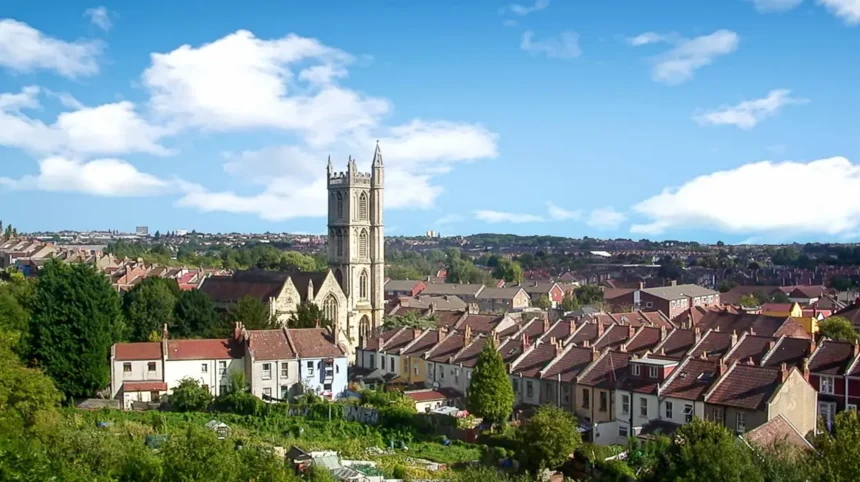
St Werburghs is an inner-city Bristol neighbourhood north-east of the city centre, known for its historic church, community-led projects, city farm, allotments, Narroways Millennium Green and distinctive residential streets. The area combines industrial heritage, Victorian development, green spaces and strong community infrastructure.
- What is St Werburghs in Bristol?
- How did St Werburghs develop historically?
- What is St Werburgh’s Church used for today?
- What green spaces can people visit in St Werburghs?
- What is St Werburghs City Farm?
- What is Narroways Millennium Green known for?
- How is St Werburghs connected to Bristol’s community life?
- What is the housing and built environment like in St Werburghs?
- How accessible is St Werburghs from central Bristol?
- What can visitors do in St Werburghs?
- Why is St Werburghs significant within Bristol today?
What is St Werburghs in Bristol?
St Werburghs is an inner-city residential neighbourhood in north-east Bristol, centred around Mina Road and surrounded by areas including Ashley, Easton, St Pauls, Montpelier and Horfield. Its identity combines historic buildings, community facilities, urban agriculture and accessible green space.
St Werburghs sits immediately north-east of central Bristol. The neighbourhood is associated particularly with Mina Road, St Werburghs Park, Watercress Road, Boiling Wells Lane, Narroways and the slopes around Ashley Vale.
The area forms part of Bristol’s inner urban landscape rather than a separate town or village. Its location places residents and visitors close to central Bristol while retaining a strong neighbourhood identity.
The surrounding urban geography is distinctive. Railway infrastructure, the M32 corridor, allotment land and steep green slopes help define the physical boundaries of the neighbourhood.
St Werburghs is also closely connected with Ashley, the wider ward area used by Bristol City Council. Bristol’s local information system provides neighbourhood data covering facilities, schools, parking, conservation areas, allotments and other local services.
The neighbourhood’s identity is strongly connected with community organisations. St Werburghs Community Centre is listed by Bristol City Council as a community facility serving the Ashley ward.
For visitors, St Werburghs provides a different experience from Bristol’s central shopping and harbourside districts. Its attractions are distributed across streets, green spaces, community sites and historic buildings.
How did St Werburghs develop historically?
St Werburghs developed from areas historically known as Ashley Vale and Baptist Mills before taking its modern name in the late nineteenth century. The relocation of St Werburgh’s Church from Corn Street to Mina Road in 1879 established the name associated with the neighbourhood.
The history of St Werburghs extends beyond its present neighbourhood name. Before 1879, different parts of the area were associated with Ashley Vale and Baptist Mills. The relocation of St Werburgh’s Church to Mina Road gave the district its current identity.
The original St Werburgh’s Church stood on Corn Street in central Bristol. The church had medieval origins and was rebuilt during the eighteenth century.
Urban development eventually created pressure around the original church site. The building occupied space in a busy central street, while changes to Bristol’s road network increased the importance of movement through the area.
The church was dismantled after its final service in August 1877. Parts of the building, including its historic tower, were incorporated into the new building at Mina Road. The new church was completed in 1879.
This relocation created a direct historical connection between central Bristol and the developing district around Baptist Mills.
The wider landscape also has an industrial history. Research from the University of the West of England’s Regional History Centre records the Glass Mill at Ashley Vale, which operated from the sixteenth century until the nineteenth century. The mill was associated with watercourses around Mina Road and the Boiling Well Brook.
Water has remained an important part of the area’s history. The local landscape included springs, brooks and water infrastructure connected with Bristol’s historical water supply.
The River Frome and associated watercourses also contributed to historical flooding in the wider area. Historic accounts record significant flooding during the nineteenth century.
What is St Werburgh’s Church used for today?
St Werburgh’s Church is a Grade II listed former Church of England building on Mina Road. The church ceased religious use in 1988 and was subsequently adapted for indoor climbing, giving the historic building a new recreational function.*
The building on Mina Road is one of the most recognisable landmarks in St Werburghs.
Its Grade II* listing reflects its architectural and historic importance. The church incorporates historic fabric from the earlier Corn Street building, particularly the medieval tower.
The church stopped functioning as a place of worship in 1988 after being declared redundant. It subsequently entered secular use as an indoor climbing centre.
This adaptive reuse demonstrates how historic buildings can retain a practical function after their original purpose ends.
The church also provides a useful reference point for exploring the neighbourhood. Mina Road connects the building with residential streets, community facilities, green spaces and routes towards central Bristol.
For heritage-focused visitors, the church is significant because its history covers multiple phases of Bristol’s development. The building links medieval religious history, eighteenth-century urban reconstruction, nineteenth-century suburban expansion and twentieth-century adaptive reuse.
What green spaces can people visit in St Werburghs?
St Werburghs contains several important green spaces, including Narroways Millennium Green, community allotments, St Werburghs City Farm and smaller parks and open areas. These sites provide wildlife habitat, walking routes, community growing space and outdoor recreation.
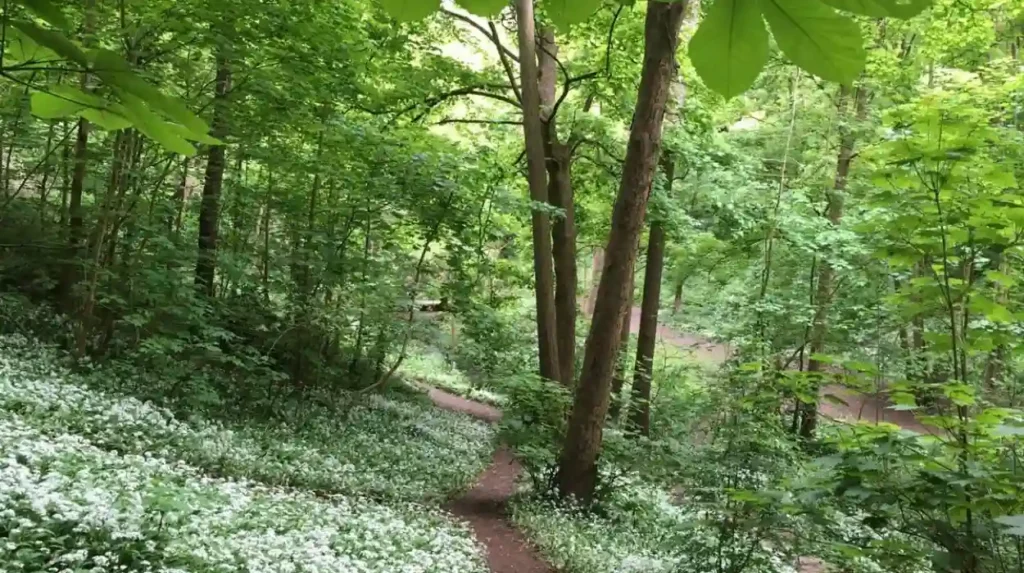
Narroways Millennium Green is one of the area’s most important open spaces. Bristol City Council describes it as a grassy and wooded ridge divided by railway cuttings, with views across Bristol.
The site includes scrub, hedgerows, wildflower meadow, woodland and a community orchard. These habitats create a mixture of open and wooded environments within the inner city.
Narroways has several pedestrian entrances. Access points are located on Mina Road, Ashley Hill and Boiling Wells Lane. The site is open at all times and admission is free.
The site’s history also demonstrates the importance of local environmental action. Bristol City Council purchased the land in 1997 after a fundraising campaign to protect it from development. Narroways became a Millennium Green in 2000 and was leased to the Narroways Millennium Green Trust for 999 years.
Narroways is also designated as a Local Nature Reserve and Site of Nature Conservation Interest.
The terrain is uneven. Steep slopes and unsurfaced paths limit wheelchair and buggy accessibility in some sections. Visitors therefore need to consider the physical character of the site when planning a walk.
St Werburghs also contains allotment landscapes that contribute significantly to the neighbourhood’s visual character. Ashley Vale Allotments is listed by Bristol City Council with 169 plots.
These growing spaces form part of the broader network of allotments and community food-growing projects across Bristol.
What is St Werburghs City Farm?
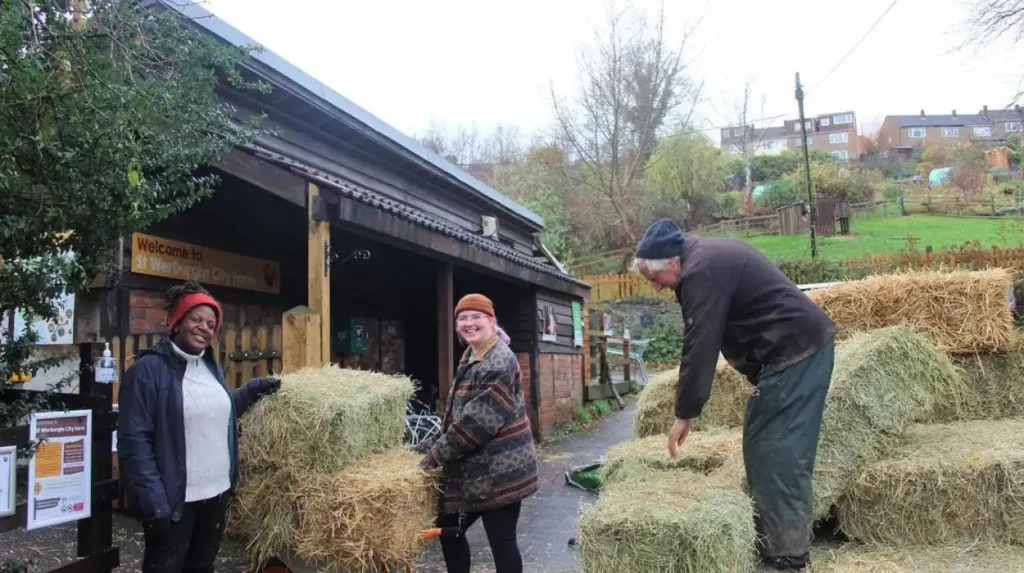
St Werburghs City Farm is a community organisation connecting people with land, food, animals and nature. Its site includes a smallholding, community garden, conservation area and community allotments, creating a substantial urban agriculture resource in Bristol.
St Werburghs City Farm is one of the neighbourhood’s best-known community institutions.
The organisation describes its site as an urban green space supporting connections between land, animals and people. Its current facilities include a two-acre smallholding, one-acre community garden, 2.5-acre Boiling Wells conservation site and 13 acres of community allotments.
These different land uses provide a broad range of community and environmental functions.
The smallholding provides an urban farming setting. The community garden supports growing and educational activity. Boiling Wells provides a conservation function, while the allotments provide growing space for local residents.
The organisation has operated as a formal company since 1987, according to Companies House records.
The city farm is also integrated into Bristol’s wider allotment and community-growing network. Bristol City Council identifies St Werburghs City Farm among organisations connected with allotment and growing activity.
The farm therefore represents more than a visitor attraction. It forms part of the area’s social infrastructure and contributes to urban food growing, environmental education and community participation.
What is Narroways Millennium Green known for?
Narroways Millennium Green is known for its wildlife habitats, railway-cutting landscape, community orchard, walking routes and elevated views across Bristol. It is a Local Nature Reserve and Site of Nature Conservation Interest managed with support from the Narroways Millennium Green Trust.
The landscape is unusual for an inner-city neighbourhood because it combines railway infrastructure with semi-natural habitats.
The ridge includes woodland, scrub, hedgerows and meadow. These environments support biodiversity within a densely developed part of Bristol.
The community orchard adds another form of local land use. Orchards provide food-growing opportunities while also contributing habitat and seasonal landscape variation.
The site’s community management structure is also significant. Volunteers associated with the Narroways Millennium Green Trust organise regular workdays and support the site’s ongoing management.
Narroways therefore combines environmental protection with public recreation.
Its elevated position also gives visitors views over Bristol. The combination of terrain, vegetation and railway infrastructure creates a distinctive landscape within the city.
How is St Werburghs connected to Bristol’s community life?
St Werburghs has a strong network of community organisations, growing projects and shared facilities. Community infrastructure includes St Werburghs Community Centre, St Werburghs City Farm, allotment groups and volunteer-led environmental projects such as Narroways Millennium Green.
Community activity is a defining structural feature of St Werburghs.
St Werburghs Community Centre provides a local base for activities and community services. Bristol City Council lists the centre within its local area committee information for the Ashley ward.
The neighbourhood also has a long association with community-led environmental activity.
Narroways was protected from development through a local fundraising campaign before becoming a Millennium Green. Its continuing management involves volunteer participation.
St Werburghs City Farm provides another major community institution. Its combination of farming, conservation, gardening and educational activity creates connections between residents and the physical landscape.
Allotments provide a further layer of community participation. Bristol City Council’s allotment network includes Ashley Vale and Ashley Vale Association sites, alongside many other growing sites across the city.
The concentration of community infrastructure helps explain why St Werburghs has a distinct neighbourhood identity despite its proximity to central Bristol.
What is the housing and built environment like in St Werburghs?
St Werburghs has a mixed inner-city residential environment containing traditional housing, streets around Mina Road, homes close to allotments and newer community-led development. Its built environment reflects nineteenth-century expansion alongside later residential and environmental projects.
The residential landscape varies across the neighbourhood.
Traditional housing reflects the area’s nineteenth-century urban expansion. Streets around Mina Road and nearby roads contain established residential buildings alongside later additions.
The neighbourhood’s topography also affects its built environment. Narroways and the surrounding slopes create differences in elevation across relatively short distances.
The relationship between housing and green space is another defining feature. Allotment slopes, Narroways and community growing land occupy significant parts of the local landscape.
St Werburghs has also been associated with community-led housing initiatives. The neighbourhood’s history includes environmental campaigns and self-build housing activity connected with the wider Ashley Vale area.
The result is a built environment that combines established urban housing with community-oriented land uses.
Property information is highly street-specific. Bristol City Council’s local information tools provide address-level information covering matters such as school catchments, resident parking schemes, solar potential and nearby facilities.
Anyone considering moving to St Werburghs should therefore assess individual streets rather than treating the whole neighbourhood as a uniform housing market.
How accessible is St Werburghs from central Bristol?
St Werburghs is positioned close to central Bristol and has pedestrian, cycling and road connections into the inner city. Mina Road, Ashley Hill and nearby routes connect the neighbourhood with surrounding districts, while the M32 provides a major regional road connection.
The neighbourhood’s location makes it practical for journeys towards central Bristol.
Mina Road is one of the area’s principal local streets. Ashley Hill provides another important connection towards the north and north-east.
The M32 forms a major transport corridor near St Werburghs. It connects Bristol’s central area with the wider motorway network and northern parts of the city.
Walking routes also form an important part of local movement. Narroways has entrances from Mina Road, Ashley Hill and Boiling Wells Lane, linking the natural landscape with surrounding streets.
Public transport arrangements should be checked against current timetables because routes and service patterns change. Bristol City Council’s local information resources provide current local transport and infrastructure information.
For visitors, the neighbourhood works particularly well as part of an inner-Bristol walking itinerary combining St Werburgh’s Church, Mina Road, the city farm and Narroways.
Ezplore More Area Guide
Montpelier Bristol Area Guide: History, Architecture and Local Life
Hotwells Bristol Area Guide: History, Attractions and Local Life
What can visitors do in St Werburghs?
Visitors can explore historic St Werburgh’s Church, walk through Narroways Millennium Green, visit St Werburghs City Farm, view community allotment landscapes and explore Mina Road. These attractions provide heritage, nature, community and urban landscape experiences within one neighbourhood.
A visit can begin around Mina Road and St Werburgh’s Church.
The former church provides the area’s principal historic landmark. Its Grade II* status and unusual relocation history make it important within Bristol’s architectural heritage.
Narroways provides the main natural landscape experience. Visitors can follow its paths, observe vegetation and wildlife habitats and access viewpoints across Bristol.
St Werburghs City Farm provides an urban agriculture experience. Its smallholding, garden and conservation areas illustrate how food production and environmental activity operate within a city neighbourhood.
The allotments provide another visual element. Ashley Vale’s 169 plots demonstrate the scale of community food-growing land in the area.
The neighbourhood is therefore suited to visitors interested in local history, urban nature, community initiatives and Bristol’s residential landscapes.
Why is St Werburghs significant within Bristol today?
St Werburghs remains significant because it combines historic architecture, community infrastructure, urban agriculture, wildlife habitat and inner-city housing. Its protected green spaces and established community organisations provide long-term environmental and social value within a densely developed part of Bristol.
The neighbourhood illustrates several important aspects of modern Bristol.
Its historic church demonstrates how heritage buildings can acquire new uses. Its city farm demonstrates the role of urban agriculture. Narroways demonstrates community-supported conservation. Its allotments demonstrate the continuing importance of local food-growing land.
These functions operate within a relatively compact inner-city environment.
Narroways has formal environmental designations, while its management structure includes community volunteers.
St Werburghs City Farm manages multiple forms of community land, including its smallholding, community garden, conservation site and allotments.
The area’s future relevance is therefore closely connected with maintaining the balance between housing, transport, heritage, biodiversity and community facilities.
Bristol’s planning and local information systems provide tools for tracking changes to neighbourhood infrastructure, conservation areas, facilities and land uses.
For residents, this makes St Werburghs an established inner-city neighbourhood with a strong local infrastructure. For visitors, it provides a compact route through Bristol’s architectural, environmental and community history.
What is St Werburghs in Bristol?
St Werburghs is an inner-city neighbourhood in north-east Bristol. It is known for Mina Road, St Werburgh’s Church, St Werburghs City Farm, Narroways Millennium Green, allotments, community projects and historic residential streets.