Key Points
- Second Structural Failure: Pero’s Bridge in central Bristol underwent its second structural failure close to 23:00 GMT during Halloween night when the middle part collapsed into the harbour.
- Theory of Vibration: According to the Harbour Committee Chairman and Liberal Democrat councillor Andrew Brown, engineers suspect that vibrations caused by loud music speakers, busy roads or wind gusts could have disrupted the delicate balance.
- History of Corrosion: According to information obtained via a Freedom of Information request, Bristol City Council received notification of the bridge’s structural damage due to corrosion during a July 2025 inspection followed by more inspections in December 2025.
- £1.54 million Repair Project: The Harbour Committee approved a £1.54 million repair project in March to dismantle the bridge in order to fix it, with work planned to commence in November.
- Load Weight from “Love-Locks”: Councillor Andrew Brown explained that the years of attachment of padlocks to the bridge resulted in three extra tonnes of load weight.
- Specialist Recovery Operations: A specialist crane is being utilised from Cornwall along with four rubber fenders that have a diameter of three metres.
- Temporary Bridge Not Built: The council decided not to install any temporary bridge because of the huge cost and chances of blocking ferry services through the harbour.
- Expected Reopening Time: Restoration work on the bridge will be completed by the summer of 2027.
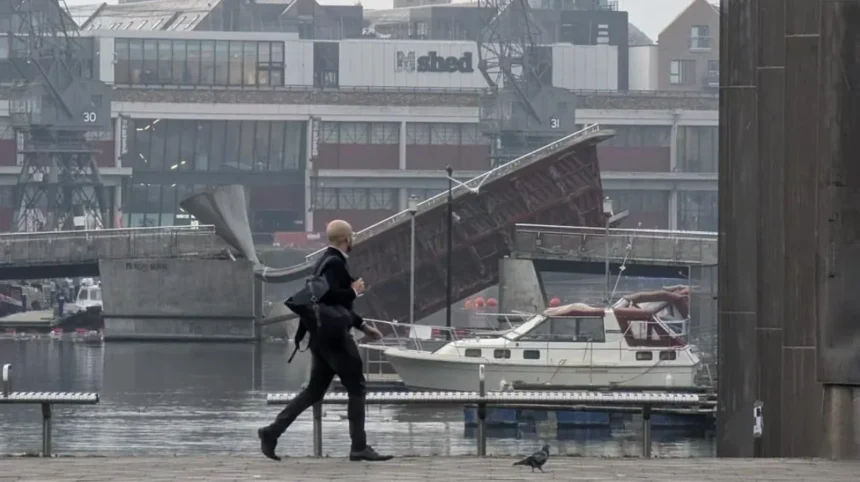
Bristol (Bristol Express News) November 6, 2026 — Pero’s Bridge, an iconic lifting footbridge in central Bristol, has suffered a severe structural collapse into the harbour after previously suffering mechanical failure. Engineers are investigating whether external vibrations, including sound waves from nearby venue speakers, triggered the fall. A major £1.54 million recovery operation is underway, with full reinstatement projected for summer 2027.
- Key Points
- What Caused the Middle Section of Pero’s Bridge to Fall into the Water?
- How Are Engineers Planning to Recover and Repair the Collapsed Footbridge?
- What Role Did Structural Corrosion and “Love-Locks” Play in the Infrastructure Failure?
- How Have Local Political Leaders Reacted to the Infrastructure Crisis?
- Background of the Development
- Prediction: How This Development Can Affect the Local Community, Businesses, and Harbour Operators
What Caused the Middle Section of Pero’s Bridge to Fall into the Water?
As reported by Hannah Miller, Politics Reporter for BBC News in Bristol, the central section of Pero’s Bridge detached and collapsed into the harbour below at approximately 23:00 GMT on Halloween evening. The lifting footbridge, situated in a bustling section of central Bristol surrounded by bars, restaurants, and cultural venues, had already been left partially suspended following an earlier mechanical breakdown during the summer.
According to statements provided by Liberal Democrat councillor Andrew Brown, Chair of Bristol City Council’s Harbour Committee, structural engineers suspect that external physical factors disturbed the precarious balance of the compromised structure. As reported by Hannah Miller of the BBC, Councillor Andrew Brown stated that “external vibrations disturbing the balance of the structure” could have originated from a combination of sources, including strong gusts of wind, nearby heavy road traffic, or loud music played through audio speakers situated along the shore.
The incident occurred just days before scheduled engineering interventions were due to commence on site. In early October, monitoring devices detected renewed structural movement within the mechanism, prompting maintenance teams to install temporary supports. Although these emergency measures successfully sustained the structure during the severe weather conditions of Storm Austen, they failed to prevent the sudden detachment of the central span on Halloween night. Councillor Andrew Brown conceded that authority officials “cannot be entirely sure of the exact cause of the latest movement” until thorough forensic engineering examinations can take place in dry dock conditions.
How Are Engineers Planning to Recover and Repair the Collapsed Footbridge?
As detailed by Hannah Miller of the BBC, municipal authorities have initiated a multi-stage salvage operation to extract the damaged bridge components from the waterway without disrupting navigation channels. A high-capacity specialist crane is being transported from Cornwall to Bristol to execute the lifting procedure. Marine engineering teams plan to move the structure to a nearby dry dock facility within two weeks for detailed inspection and structural refitting.
To prepare the bridge for safe extraction, technicians are deploying four substantial floating rubber fenders, each measuring 3 metres (10 feet) in diameter. These marine fenders will provide buoyancy, cushion the metallic framework against the harbour walls, and stabilise the submerged structure during lifting operations.
Bristol City Council confirmed that the precise final cost of repairing and restoring Pero’s Bridge cannot be determined until the structure has been fully safely secured in dry dock and subjected to non-destructive testing. As reported by Hannah Miller of the BBC, municipal leaders rejected proposals to construct a temporary footbridge across the inlet while main repairs are carried out. Council spokespersons explained that installing a temporary crossing would impose “significant cost” upon the local authority while creating unacceptable navigational restrictions for commercial harbour ferries and leisure craft.
Explore More Local Bristol News
Bristol Pub Shut Out: Zero Local Hostelries Named in UK’s Top 100 List 2026
ITV Confirms Return of Hit Crime Drama Gone Filming in Bristol 2026
What Role Did Structural Corrosion and “Love-Locks” Play in the Infrastructure Failure?
As reported by Hannah Miller of the BBC, official documents released under a Freedom of Information request demonstrate that Bristol City Council was formally notified of “severe corrosion” affecting critical load-bearing elements of Pero’s Bridge following a routine engineering assessment in the summer of 2025. This finding prompted further comprehensive structural assessments in December 2025, which ultimately informed the Harbour Committee’s decision in March to authorise a comprehensive £1.54 million restoration plan.
Beyond environmental weathering and systemic corrosion, long-term deadweight accumulation contributed significantly to the failure. As reported by Hannah Miller of the BBC, Councillor Andrew Brown stated that previous municipal administrations had disregarded repeated warnings regarding the physical impact of “love-locks”—padlocks attached to the bridge’s wire mesh and railings by members of the public.
Councillor Andrew Brown noted that these accumulated metal locks added an estimated three tonnes of uncalculated dead load to the lifting span. Councillor Brown stated that the present administration had “inherited a situation where the bridge could not be raised, restricting harbour operations,” to the extent that municipal authorities were forced to instruct local police units not to ride horses across the deck due to weight constraints.
How Have Local Political Leaders Reacted to the Infrastructure Crisis?
As reported by Hannah Miller of BBC News, the collapse of Pero’s Bridge has reignited political debate regarding municipal infrastructure management and historical funding priorities within Bristol City Council.
Representatives of the Labour Party, who held executive control of Bristol City Council until 2024, demanded full public transparency regarding the management of the bridge. As reported by Hannah Miller of the BBC, Labour councillor Tim Rippington stated:
“The public should have the opportunity to question decision-makers about the state of the bridge, the plans and timescales for its repair, and how the council can ensure this will not happen to other bridges.”
Responding to opposition criticism, Liberal Democrat councillor Andrew Brown maintained that the failure of Pero’s Bridge was the direct consequence of “decades of underinvestment” in the city’s historic harbour infrastructure by prior leadership. As reported by Hannah Miller of the BBC, Councillor Brown affirmed that the current administration remains “committed to continuing annual investment in harbour improvements,” while cautioning the public that “addressing this legacy of underinvestment will take time.”
Background of the Development
Pero’s Bridge, opened in 1999, is a prominent pedestrian bascule bridge spanning St Augustine’s Reach in Bristol Harbour. Designed by artist Eilis O’Connell in collaboration with Ove Arup & Partners, the structure is distinguished by its twin sculpted horn-shaped counterweights, which earned it the local moniker “the Horned Bridge”. The bridge was named in honour of Pero Jones, an enslaved African man brought to Bristol in 1783 by merchant John Pinney, serving as a permanent memorial to Bristol’s historical connections to the transatlantic slave trade.
Functionally, the bridge features a central double-leaf swing mechanism designed to lift, allowing tall-masted vessels and passenger ferries access to the inner harbour. Over its two decades of operational service, the bridge became a key pedestrian artery linking the Centre with the regenerated waterfront leisure district of Canon’s Marsh.
However, the maritime environment posed ongoing maintenance challenges. Constant exposure to brackish water accelerated the oxidation of steel fittings, while the operational mechanical gear suffered wear from repeated daily lifts. In recent years, public adoption of the site for attaching decorative “love-locks” severely altered the structural mass calculations designed by the original engineers. The combination of deferred structural maintenance, environmental corrosion, added static loads, and mechanical wear culminated in the initial failure during summer 2025, setting the stage for the structural collapse in October.
Prediction: How This Development Can Affect the Local Community, Businesses, and Harbour Operators
The prolonged closure of Pero’s Bridge until summer 2027 will directly impact several key stakeholder groups across Bristol:
1. Local Business Owners and Hospitality Venues
The waterfront district surrounding St Augustine’s Reach relies heavily on spontaneous pedestrian footfall connecting the city centre to Canon’s Marsh. The absence of this crossing point for nearly two years is expected to disrupt established pedestrian corridors. Hospitality venues, restaurants, and bars along the harbour apron are likely to experience reduced patronage, particularly during peak weekend trading and summer tourism periods, as visitors are forced to detour around the head of the reach.
2. Pedestrians, Commuters, and Mobility-Impaired Citizens
Daily foot traffic, including urban commuters and tourists, will face prolonged disruptions. The nearest alternative crossings—Prince Street Bridge to the south and the city centre thoroughfares to the north—add between 10 to 15 minutes of walking time to trips across the harbour. This detour poses particular challenges for individuals with reduced mobility, wheelchair users, and families with pushchairs, as alternative paths feature varying gradients and congested pavements.
3. Harbour Marine Operators and Ferry Services
While the temporary removal of the bridge span into dry dock will clear vertical navigation space for tall-masted vessels in the medium term, the immediate recovery operation presents operational hurdles. The deployment of 3-metre floating fenders and the positioning of heavy marine crane barges from Cornwall will require localized navigational restrictions. Ferry operators will need to adjust timetables and dock access around St Augustine’s Reach during active recovery operations.
4. Municipal Taxpayers and Public Infrastructure Oversight
From a financial perspective, the project carries risks of budgetary expansion. If dry-dock inspections reveal hidden structural micro-fractures or extensive sub-surface frame degradation caused by the fall, the total restoration cost could exceed the initial £1.54 million allocation. This would place further strain on Bristol City Council’s capital works budget, potentially leading to the deferral of other municipal maintenance projects across the city’s transport network.