Circular walks near Bristol offer opportunities to explore woodland, riverside paths, historic estates, nature reserves and countryside villages without returning along the same route. From Leigh Woods and Ashton Court to Chew Valley and Bath Skyline, the surrounding region provides walking routes for different fitness levels, interests and available time.
- What makes circular walks near Bristol popular?
- Which circular walks are best within easy reach of Bristol?
- 1. Leigh Woods circular walk
- 2. Ashton Court Estate circular walks
- 3. Blaise Castle Estate circular walks
- 4. Troopers Hill and Conham Valley
- 5. Snuff Mills and Oldbury Court Estate
- Which countryside circular walks near Bristol are worth exploring?
- 6. Tyntesfield woodland circular walk
- 7. Bath Skyline circular walk
- 8. Chew Valley circular walks
- 9. Dyrham Park countryside walks
- What is the Bristol Ring and how does its circular route work?
- How do circular walks near Bristol differ by difficulty and distance?
- Which circular walks suit beginners?
- Which routes suit experienced walkers?
- What should walkers consider when comparing route difficulty?
- When is the best time to enjoy circular walks near Bristol?
- What wildlife and natural features can walkers discover near Bristol?
- Woodland wildlife
- Riverside wildlife
- Grassland and butterfly habitats
- Why are nature reserves important?
- How can visitors plan a safe circular walk near Bristol?
- Check the route before departure
- Wear appropriate footwear
- Carry essential equipment
- Follow countryside access guidance
- Which circular walks near Bristol are suitable for families?
- How can walkers reach circular walking routes from Bristol?
- How do circular walks near Bristol support local tourism and environmental awareness?
- Supporting local communities
- Encouraging environmental responsibility
- Why will circular walking remain important?
- Where should you start exploring circular walks near Bristol?
Bristol is particularly well positioned for circular walking because the city sits close to the River Avon, the Mendip Hills, the Cotswolds and the North Somerset countryside. These landscapes provide varied walking environments, including wooded valleys, limestone landscapes, open farmland, historic parkland and waterside trails.
A circular walk follows a loop that starts and finishes at the same location. This format makes route planning straightforward and gives walkers an opportunity to experience different scenery along the outward and return sections. Walkers can choose short recreational routes, moderate countryside circuits or longer hiking challenges depending on distance, terrain and weather conditions.
Visit Bristol highlights the region’s extensive walking network, including the Bristol Ring, Leigh Woods, Ashton Court Estate, Troopers Hill and countryside routes around the city. These locations make circular walking accessible to residents and visitors throughout the year.
What makes circular walks near Bristol popular?
Circular walks near Bristol are popular because they combine accessible starting points, varied landscapes and routes that return to their original locations. Walkers experience woodland, rivers, historic estates and countryside without repeating the entire outward journey.
Bristol has an extensive network of public footpaths, recreational trails and green spaces. Its surrounding countryside also provides access to villages, nature reserves and elevated viewpoints.
The city’s geographical position creates several distinct walking environments. The River Avon connects urban and rural landscapes, while the Avon Gorge provides steep wooded slopes and geological features. To the south and west, North Somerset offers farmland and coastal landscapes. To the east, the countryside around Bath and South Gloucestershire provides wooded valleys and rolling hills.
Circular routes also suit different walking purposes. Families often choose shorter parkland circuits, while experienced walkers prefer longer routes with uneven ground and elevation changes.
What is a circular walking route?
A circular walking route is a path that returns to its original starting point after following a loop. Unlike a linear walk, which requires walkers to retrace their steps or arrange transport, a circular route normally finishes where it begins.
The route can follow public footpaths, woodland tracks, country lanes, estate paths and designated recreational trails. Some circuits use clearly marked paths, while others require navigation using a map or GPS.
Why does Bristol offer varied walking landscapes?
Bristol’s surrounding geography includes river valleys, limestone formations, woodland, agricultural land and historic estates. These landscapes create opportunities for different walking experiences within a relatively short journey from the city centre.
The Avon Gorge is an important geological and ecological feature. Its limestone cliffs support specialised plant communities, while Leigh Woods provides broadleaf woodland above the river.
The wider region also includes the Mendip Hills National Landscape and the Cotswolds National Landscape. Both areas offer countryside routes with distinctive geology, wildlife and historic settlements.
Which circular walks are best within easy reach of Bristol?
Leigh Woods, Ashton Court Estate, Blaise Castle Estate, Troopers Hill and Snuff Mills provide accessible circular walking opportunities around Bristol. These locations combine woodland, historic features, open parkland and riverside scenery across different distances and difficulty levels.
Walkers do not need to travel far from Bristol to find a circular route. Several green spaces around the city contain established paths and recreational walking networks.
1. Leigh Woods circular walk
Leigh Woods is one of the most recognisable woodland walking destinations near Bristol. It lies across the River Avon from Clifton and provides views towards the Clifton Suspension Bridge.
The National Trust describes its woodland wander as a one-mile (1.6-kilometre) circular route. The walk takes approximately 30–45 minutes and passes veteran trees, grassland and Stokeleigh Camp hillfort.
The route begins at the North Road entrance. Its terrain includes surfaced paths, grass, uneven rocky sections and occasional muddy areas.
Stokeleigh Camp is an important historic feature within the woodland. It is an Iron Age hillfort positioned above the Avon Gorge, providing evidence of ancient settlement and defensive activity.
Leigh Woods also supports rare Bristol whitebeam trees, alongside oak, ash and small-leaved lime. Spring brings woodland flowers, including bluebells and wood anemones.
The National Trust welcomes dogs, although walkers should follow local livestock guidance and keep dogs under control.
2. Ashton Court Estate circular walks
Ashton Court Estate is a large historic parkland area west of Bristol city centre. Its landscape includes open grassland, woodland, mature trees and historic estate features.
The estate is suitable for walkers seeking longer recreational circuits and open countryside scenery. Its network of paths connects different sections of the grounds, allowing visitors to create walks of varying lengths.
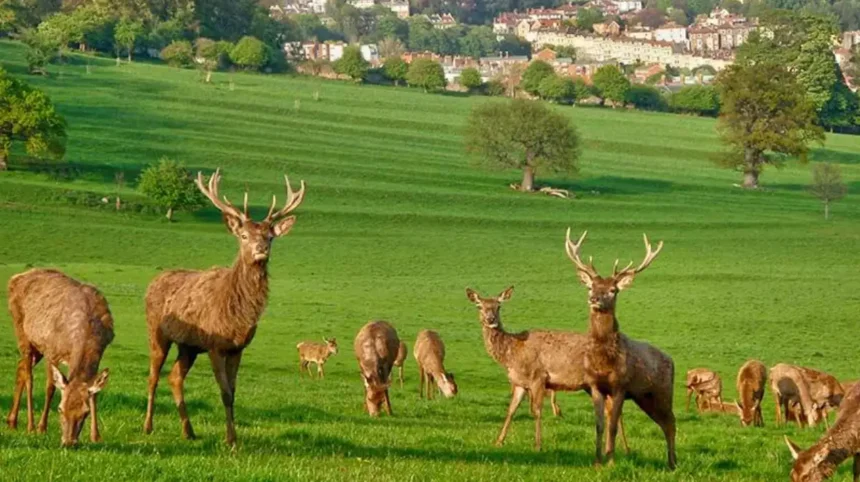
Deer are an important feature of the estate. The parkland provides opportunities to observe wildlife while following established paths.
Walkers can explore the grounds on foot and combine woodland sections with open views across the estate. The surrounding landscape also provides views towards the city and nearby countryside.
Route choice depends on the paths open on the day. Visitors should check estate information and follow local signs rather than assume that every path forms part of a single waymarked circular route.
3. Blaise Castle Estate circular walks
Blaise Castle Estate is a historic green space in north-west Bristol. It combines landscaped parkland, woodland, historic buildings and elevated viewpoints.
The estate includes Blaise Castle, a small hilltop folly built in the late eighteenth century. A folly is a decorative building constructed primarily for visual or recreational purposes rather than practical occupation.
The surrounding landscape contains woodland paths, open grassland and historic estate features. Walkers can explore different sections of the grounds and create a circular outing around the castle area.
The estate is particularly useful for visitors who want a combination of heritage and outdoor recreation without travelling far from Bristol’s residential districts.
The terrain varies between relatively accessible park paths and steeper woodland sections. Walkers should account for slopes and muddy conditions when choosing a route.
4. Troopers Hill and Conham Valley
Troopers Hill is a nature reserve in east Bristol known for its elevated position, industrial heritage and views across the city.
Its landscape includes grassland, heathland and woodland. The site also contains evidence of Bristol’s industrial past, including features associated with former clay and industrial workings.
A walk connecting Troopers Hill with Conham River Park provides an opportunity to experience both elevated viewpoints and the River Avon valley.
The route includes changes in elevation, so walkers should expect some uphill and downhill sections. Public footpaths and local paths connect the surrounding green spaces, but route conditions and access should be checked before departure.
5. Snuff Mills and Oldbury Court Estate
Snuff Mills is a riverside walking destination along the River Frome in north-east Bristol.
The location contains woodland, riverbanks, historic mill features and footbridges. Its connection with Oldbury Court Estate creates opportunities for longer walks through the surrounding green spaces.
The River Frome provides the main geographical feature of the area. Walkers encounter flowing water, wooded banks and changing river landscapes.
The combination of riverside and estate paths makes this area suitable for recreational walking and wildlife observation. Some sections become muddy after rainfall, particularly near the river.
Visit Bristol includes Snuff Mills, Troopers Hill, Ashton Court and Leigh Woods among the city’s walking destinations.
Which countryside circular walks near Bristol are worth exploring?
The countryside surrounding Bristol contains several established circular walking routes, including Tyntesfield woodland, Bath Skyline and Chew Valley circuits. These destinations offer historic estates, farmland, wooded valleys and elevated viewpoints for walkers seeking longer outdoor experiences.
The countryside outside Bristol provides a wider range of walking environments than the city’s urban parks. Routes around North Somerset, Bath and South Gloucestershire introduce walkers to traditional villages, historic estates and rural landscapes.
6. Tyntesfield woodland circular walk
Tyntesfield is a Victorian Gothic Revival estate near Wraxall, south-west of Bristol. The estate contains historic architecture, landscaped gardens, woodland and agricultural land.
The National Trust provides a 2.4-mile (3.84-kilometre) woodland circular walk beginning at Home Farm. The published walking time is approximately 1 hour 30 minutes to 2 hours.
The route passes through different sections of the estate, including woodland, the kitchen garden, rose garden, Holly Walk and Home Farm.
The walk is classified as easy, although its terrain includes steps, unsurfaced woodland paths, gravel and steep gradients. Visitors should wear suitable footwear.
Tyntesfield also provides shorter walking options. Its Sidelands circular walk covers approximately one mile (1.6 kilometres) and takes around 30–45 minutes. This route passes through woodland and fields, including Truckle Wood, where bluebells appear during spring.
The estate offers a useful combination of nature, historic architecture and landscaped grounds for visitors planning a countryside walk.
7. Bath Skyline circular walk
Bath Skyline provides one of the best-known countryside walking experiences within reach of Bristol.
The National Trust’s full Bath Skyline route covers six miles (9.6 kilometres) and takes approximately 3 hours 30 minutes to 4 hours. It is classified as moderate.
The route passes through woodland, farmland, wildflower meadows and secluded valleys. Elevated sections provide views across Bath, a UNESCO World Heritage Site recognised for its architectural and historical importance.
The walk begins at Bathwick Hill near Cleveland Walk, although walkers can join the circular route at several points.
A shorter alternative is the three-mile (4.8-kilometre) Walk to the View route, which starts at Bath Abbey and takes approximately 90 minutes. This route combines the historic city centre with countryside paths and views over Bath.
The Bath Skyline also contains archaeological features, including evidence of prehistoric activity and Roman occupation. Little Solsbury Hill, an Iron Age hillfort, provides another important historic feature in the wider landscape.
The route includes hills, uneven surfaces, steps and sections of farmland. Walkers should follow the National Trust’s recommended clockwise directions on the full circuit.
8. Chew Valley circular walks
Chew Valley is a rural area south of Bristol, known for its villages, agricultural landscape and reservoir scenery.
The area around Chew Magna provides opportunities for village-based circular walks. Routes connect historic streets, countryside footpaths, farmland and sections of the River Chew valley.
Chew Magna has historic buildings, including a fifteenth-century church and an old bridge. These features provide points of interest along countryside walks.
Walkers can also explore the wider landscape around Chew Valley Lake. The reservoir is an important location for birdwatching and nature observation.
The Chew Valley is particularly suitable for people interested in combining rural walking with wildlife observation. The landscape changes throughout the year, with spring vegetation, summer farmland, autumn colours and winter bird activity.
Route lengths vary according to the selected village, public footpaths and connecting lanes. Walkers should use a current Ordnance Survey map or verified route guide to identify a complete loop rather than assume that every lakeside or valley path forms a continuous circular trail.
9. Dyrham Park countryside walks
Dyrham Park is a historic National Trust estate located north-east of Bath and within reach of Bristol.
The estate contains approximately 270 acres of parkland, historic buildings, gardens and countryside landscapes.
Its walking environment includes open grassland, mature trees and views across the surrounding countryside. The historic parkland also provides opportunities to observe deer and other wildlife.
Dyrham Park suits walkers interested in historic landscapes and outdoor recreation. Its paths provide opportunities for shorter estate visits and longer explorations of the parkland.
Visitors should check the National Trust’s current access information before travelling because individual walking routes and estate facilities depend on operational arrangements.
What is the Bristol Ring and how does its circular route work?
The Bristol Ring is a 33-mile circular walking route around Bristol, divided into six sections. It connects urban green spaces, nature reserves, historic estates and riverside landscapes, with public transport access providing flexibility for completing individual sections.
The Bristol Ring is a major circular walking route designed to connect different parts of the city through existing green spaces and walking paths.
According to Visit Bristol, the route covers approximately 33 miles and is divided into six sections. Each section is accessible by public transport, making the route suitable for walkers who prefer shorter outings instead of completing the entire circuit in one day.
Which places does the Bristol Ring connect?
The route includes several recognised Bristol landmarks and natural spaces.
These include:
- Troopers Hill Nature Reserve: An elevated nature reserve in east Bristol with city views.
- Clifton Suspension Bridge: A historic bridge spanning the Avon Gorge.
- Nightingale Valley: A wooded valley within Leigh Woods.
- Ashton Court Estate: A historic parkland landscape west of the city.
- Stoke Park Estate: An open historic landscape with distinctive parkland features.
- Snuff Mills: A riverside destination along the River Frome.
These locations demonstrate how the Bristol Ring connects different types of urban and natural environments.
Can walkers complete the Bristol Ring in sections?
Yes. The six-section structure allows walkers to complete the route over several visits.
This approach is useful for people with limited free time, families and visitors who prefer shorter walking distances. Public transport connections also reduce the need to arrange separate return transport.
Walkers should consult the Go Jauntly route information recommended by Visit Bristol for the section maps and navigation details.
The Bristol Ring also provides a practical way to discover less familiar neighbourhoods and green spaces beyond the main tourist attractions.
How do circular walks near Bristol differ by difficulty and distance?
Circular walks near Bristol range from short, easy woodland circuits to moderate countryside routes and longer walking challenges. Distance, elevation, ground conditions, accessibility and navigation requirements determine the suitability of each route.
Choosing a walking route requires more than comparing distances. A short route with steep gradients can demand more effort than a longer route across level parkland.
The National Trust provides useful difficulty descriptions for its established routes. These classifications help walkers understand the physical demands and terrain before setting out.
Which circular walks suit beginners?
Beginners generally benefit from short routes with clearly marked paths, manageable gradients and convenient access.
Leigh Woods offers a one-mile circular woodland wander. Tyntesfield’s shorter Sidelands route also covers approximately one mile.
The three-mile Walk to the View at Bath Skyline provides another option, although it includes an ascent at Bathwick Hill.
Beginners should select routes according to their fitness and experience rather than distance alone.
Which routes suit experienced walkers?
Experienced walkers can explore longer routes with greater elevation changes and more varied terrain.
The six-mile Bath Skyline circuit provides a moderate challenge, while the 33-mile Bristol Ring offers a longer walking objective that can be completed in sections.
Countryside routes around Chew Valley and the wider Mendip Hills also provide opportunities for longer walks.
Experienced walkers should still check route conditions, access restrictions and navigation information before departure.
What should walkers consider when comparing route difficulty?
Four factors are particularly important.
First, elevation determines the amount of climbing and descending. Second, terrain influences stability and walking speed. Third, route markings affect navigation requirements. Fourth, weather conditions influence safety and ground quality.
For example, a woodland path becomes slippery after heavy rainfall, while an exposed hillside requires greater preparation during windy conditions.
Distance estimates should therefore be considered alongside terrain and expected walking time.
When is the best time to enjoy circular walks near Bristol?
Spring and autumn provide particularly attractive conditions for circular walks near Bristol, with woodland flowers, fresh vegetation and seasonal colours. Summer offers longer daylight hours, while winter walking requires greater attention to muddy paths, visibility and weather conditions.
Bristol’s surrounding countryside changes throughout the year. Each season creates different opportunities for exploring woodland, riverside paths, historic estates and open landscapes.
Spring walking
Spring is a suitable season for woodland exploration. Bluebells and wood anemones appear in woodland areas, including Leigh Woods and Tyntesfield.
The longer daylight hours also make it easier to plan countryside walks. Walkers should remain on established paths to protect woodland flowers and sensitive habitats.
Summer walking
Summer provides extended daylight and generally better opportunities for exploring longer countryside circuits.
Open routes around Chew Valley and Bath Skyline provide views across the surrounding landscape. Walkers should carry drinking water, use sun protection and avoid prolonged exposure during hot weather.
Autumn walking
Autumn brings changing foliage to Bristol’s woodland landscapes. Leigh Woods, Tyntesfield and Snuff Mills provide opportunities to experience seasonal colours.
Wet leaves and muddy ground increase the risk of slipping. Appropriate footwear becomes particularly important.
Winter walking
Winter provides quieter walking conditions in many countryside locations. However, shorter daylight hours require earlier starts and careful route planning.
Walkers should check weather forecasts, daylight times and path conditions before visiting exposed countryside locations.
What wildlife and natural features can walkers discover near Bristol?
Circular walks near Bristol pass through habitats supporting woodland birds, wildflowers, butterflies, mammals and aquatic wildlife. Leigh Woods, Chew Valley, Snuff Mills and Troopers Hill provide opportunities to observe different species within the region’s varied natural environments.
The Bristol region contains a mixture of woodland, grassland, wetlands, river corridors and farmland. These habitats support different forms of wildlife and create opportunities for nature observation during recreational walks.
Woodland wildlife
Leigh Woods and Tyntesfield contain broadleaf woodland with mature trees and seasonal vegetation.
Walkers can look for woodland birds, insects and small mammals. Deadwood and older trees also provide habitats for fungi and invertebrates.
Riverside wildlife
Snuff Mills and the River Avon valley provide habitats associated with freshwater environments.
Birdwatchers can look for water-associated species, including ducks, herons and other river birds. Wildlife sightings depend on the season, water conditions and disturbance levels.
Grassland and butterfly habitats
Troopers Hill contains grassland and heathland habitats. These environments support flowering plants and insects, including butterflies.
Walkers should avoid disturbing wildlife and should never remove plants, insects or other natural materials from protected habitats.
Why are nature reserves important?
Nature reserves protect habitats and support biodiversity. Biodiversity refers to the variety of living organisms within an ecosystem.
Bristol’s green spaces contribute to local ecological networks by connecting woodland, grassland and river environments.
The city’s countryside walking network therefore supports both outdoor recreation and opportunities for environmental education.
How can visitors plan a safe circular walk near Bristol?
Planning a circular walk near Bristol involves checking route length, terrain, access, weather, transport and daylight. Walkers should use reliable maps, carry essential supplies, follow public footpath signs and prepare for changing countryside conditions.
Good preparation makes walking more manageable and reduces the risk of navigation problems.
Check the route before departure
Walkers should identify the starting point, total distance, estimated duration and route direction.
Official National Trust route guides provide useful information about established estate walks. Ordnance Survey maps also help identify public footpaths, bridleways and connecting routes.
For longer journeys, GPS navigation provides additional support. However, walkers should not depend entirely on mobile phone coverage.
Wear appropriate footwear
Footwear should match the walking surface.
Walking boots provide additional ankle support on uneven terrain. Comfortable walking shoes are suitable for many shorter parkland and surfaced routes.
Waterproof footwear is useful during wet weather, particularly around woodland and riverside paths.
Carry essential equipment
A practical walking kit includes:
- Drinking water and snacks.
- A fully charged mobile phone.
- An offline route map.
- Weather-appropriate clothing.
- Basic first-aid supplies.
- A torch for unexpected delays.
Longer countryside walks also require suitable food, additional water and preparation for changing weather.
Follow countryside access guidance
Walkers should respect private property, livestock and wildlife habitats.
England’s Countryside Code provides guidance on responsible outdoor recreation. Its principles include respecting people, protecting the natural environment and leaving places as they are found.
Walkers should close gates, avoid disturbing farm animals, take litter home and keep dogs under control.
Public rights of way should also remain accessible. Visitors must follow official diversions where temporary closures or restrictions apply.
Which circular walks near Bristol are suitable for families?
Families can choose shorter circular walks at Leigh Woods, Tyntesfield and Bath Skyline, depending on children’s ages and walking ability. These destinations provide woodland paths, open spaces, nature features and opportunities to combine exercise with outdoor learning.
Family walking requires attention to distance, terrain, facilities and safety.
Leigh Woods provides a relatively short one-mile woodland circuit. Its natural play area offers an additional activity for children.
Tyntesfield’s shorter walking routes provide opportunities to explore woodland, gardens and estate features. However, steps, uneven paths and gradients affect accessibility.
Bath Skyline’s two-mile Family Discovery Trail around Claverton Down provides another option. The National Trust describes it as an accessible circular route through woodland paths and wildflower meadows.
Families should check current access information before travelling, particularly when using pushchairs or mobility equipment.
Children can also learn about local history and nature during walks. Identifying trees, observing birds and recognising historic landscape features turn a recreational outing into an educational experience.
How can walkers reach circular walking routes from Bristol?
Circular walking routes near Bristol are accessible through a combination of buses, trains, cycling connections and private transport. Leigh Woods, Bath Skyline and Tyntesfield have published travel information that helps visitors plan journeys without relying exclusively on cars.
Transport access is an important part of walking route selection. A suitable starting point should be easy to reach and should provide a practical return journey.
Public transport
Leigh Woods has bus connections from Bristol towards Portishead, with services stopping near North Road.
Bath Skyline can be reached from Bath city centre using local bus services. Bath Spa railway station also provides rail connections for visitors travelling from Bristol.
Tyntesfield has bus connections through services operating between Bristol, Clevedon and surrounding areas. The National Trust identifies the X6/X7 services as options for reaching the main entrance.
Bus and train timetables change, so visitors should confirm current services before departure.
Travelling by car
Driving provides flexibility for reaching countryside destinations outside Bristol.
However, parking arrangements differ between locations. Some estates operate managed car parks, while countryside walking areas have limited parking.
Visitors should check parking charges, opening arrangements and any access restrictions before travelling.
Walking and cycling connections
Some Bristol walking routes connect with established cycling and walking networks.
The Bristol Ring is particularly useful because its six sections have public transport access. Leigh Woods also connects with the wider River Avon walking environment.
These connections support car-free recreational travel and make it easier to explore multiple areas of Bristol.
Explore More Area Guide
Long Walks in Bristol: Best Trails and Scenic Walking Routes
Short Walks in Bristol: Best Scenic Routes, Parks and Trails
How do circular walks near Bristol support local tourism and environmental awareness?
Circular walks near Bristol support outdoor recreation, local tourism, environmental education and appreciation of regional heritage. They connect visitors with historic estates, countryside communities, nature reserves and landscapes that contribute to the region’s cultural and environmental identity.
Walking tourism provides opportunities to discover places beyond Bristol’s main visitor attractions.
Historic destinations such as Blaise Castle Estate and Tyntesfield introduce visitors to architectural and landscape heritage. Leigh Woods provides opportunities to understand local geology and woodland conservation.
The Bristol Ring also connects different neighbourhoods and green spaces, encouraging exploration beyond the city centre.
Supporting local communities
Countryside walks can bring visitors to surrounding villages and rural destinations.
Walkers visiting Chew Magna, Wraxall and the countryside around Bath can combine outdoor recreation with visits to local facilities.
This activity supports local visitor economies while encouraging appreciation of rural landscapes.
Encouraging environmental responsibility
Walking provides a low-impact way to explore many natural environments.
Responsible walking practices help protect wildlife habitats and maintain public access. Staying on designated paths reduces unnecessary disturbance to vegetation and sensitive ground.
Nature reserves also provide opportunities to learn about conservation, biodiversity and the importance of maintaining connected green spaces.
Why will circular walking remain important?
Access to outdoor recreation remains an important part of urban and regional planning.
Bristol’s combination of public parks, woodland, riverside paths and surrounding countryside provides a strong foundation for recreational walking.
Well-maintained paths and accessible transport connections will continue to support walking tourism and local outdoor activity.
Where should you start exploring circular walks near Bristol?
Circular walks near Bristol offer opportunities to explore historic landscapes, woodland, rivers, nature reserves and countryside villages. From the one-mile woodland wander at Leigh Woods to the six-mile Bath Skyline circuit, the region provides routes for different fitness levels and interests.
The Bristol Ring offers a longer challenge through six connected sections, while Tyntesfield, Ashton Court and Chew Valley provide alternative countryside experiences.
Walkers should select routes according to distance, terrain, accessibility and available transport. Checking official route information before departure helps ensure a safer and more enjoyable experience.
Exploring these walking destinations also provides a practical way to appreciate Bristol’s natural environment, local heritage and surrounding countryside.
What are the best circular walks near Bristol?
Some of the best circular walks near Bristol include Leigh Woods, Ashton Court Estate, Blaise Castle Estate, Troopers Hill, Snuff Mills, Tyntesfield and Bath Skyline. These destinations offer woodland trails, riverside paths, historic landscapes and countryside views.