Bristol has one of the strongest property markets in the South West. The city combines historic architecture, green space, employment centres, universities, cultural attractions and transport connections. These factors create substantial differences between neighbourhoods.
- What are the most expensive areas in Bristol?
- Why is Clifton one of Bristol’s most expensive areas?
- Why is Sneyd Park among Bristol’s most expensive residential areas?
- Why is Stoke Bishop an expensive part of Bristol?
- Why are Redland and Cotham expensive areas in Bristol?
- Is Westbury-on-Trym one of the most expensive parts of Bristol?
- Why is Henleaze considered a high-value Bristol neighbourhood?
- Which Bristol streets have the highest property prices?
- What makes property expensive in Bristol’s prime neighbourhoods?
- How much more expensive are Bristol’s prime areas than the city average?
- How does Bristol’s expensive property market compare with the wider South West?
- What should buyers consider when looking at expensive areas in Bristol?
- How is the future relevance of Bristol’s expensive areas changing?
- What are the key facts about Bristol’s most expensive areas?
The most expensive areas in Bristol are concentrated mainly in the north-west and west of the city. Clifton, Sneyd Park, Stoke Bishop, Redland, Cotham, Westbury-on-Trym and Henleaze contain many of Bristol’s highest-value homes. Several streets in these districts record sales above £1 million, while individual properties reach substantially higher prices.
The latest official data provides an important citywide benchmark. The Office for National Statistics (ONS), using UK House Price Index data from HM Land Registry, recorded an average Bristol house price of £352,000 in July 2026, compared with £345,000 in July 2025. Detached properties averaged £689,000, semi-detached properties £447,000, terraced properties £384,000, and flats or maisonettes £241,000.
Prime Bristol neighbourhoods sit significantly above this citywide average. Their property markets are shaped by historic housing, larger plots, access to parks and the Downs, views, architectural character, limited development land and proximity to established amenities.
What are the most expensive areas in Bristol?
The most expensive Bristol areas include Clifton, Sneyd Park, Stoke Bishop, Redland, Cotham, Westbury-on-Trym and Henleaze. These neighbourhoods contain large period houses, detached properties, substantial gardens, prestigious streets and homes close to major green spaces.
The exact order changes according to the measurement used. Average prices, median prices, individual transactions and postcode-level figures produce different results.
BS9, covering areas including Stoke Bishop, Sneyd Park, Henleaze and Westbury-on-Trym, stands out in recent postcode-level data. A 2026 analysis based on HM Land Registry transactions placed BS9 at a median sold price of approximately £611,000, ahead of BS6 at £475,000 and BS8 at £420,000 in its selected comparison.
Street-level figures show an even higher concentration of expensive property. Recent analysis using HM Land Registry Price Paid Data identified Old Sneed Park, Hurle Crescent, Old Sneed Road, Canynge Square, Downs Park West and Downs Park East among Bristol’s highest-value streets.
This distinction matters because neighbourhood averages include flats and smaller properties. A street containing predominantly detached houses produces a much higher typical transaction value.
Bristol’s expensive property market therefore has several layers. A postcode can be expensive because it contains a large concentration of valuable homes. A neighbourhood can contain both ordinary flats and multimillion-pound houses. Individual streets can sit far above their wider district average.
Why is Clifton one of Bristol’s most expensive areas?
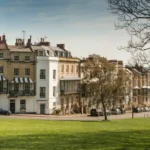
Clifton commands high property values because it combines Georgian and Victorian architecture, proximity to the Downs, the Avon Gorge, established amenities and central Bristol access. Its historic housing stock and restricted development character create a distinctive prime residential market.
Clifton is one of Bristol’s best-known residential districts. It occupies elevated ground beside the Avon Gorge and includes streets containing Georgian, Regency and Victorian buildings.
The area’s history contributes directly to its architectural character. Bristol City Council’s Clifton and Hotwells conservation appraisal records an Iron Age hillfort at Clifton Down and Roman-period activity in the wider area. The Clifton and Hotwells Conservation Area was designated in 1972, with later extensions in 1977 and 1981.
The Clifton Suspension Bridge is another major landmark. Designed by Isambard Kingdom Brunel and completed in 1864, the bridge crosses the Avon Gorge between Clifton and Leigh Woods. Bristol’s museum service records that construction began in 1831, experienced financial and political interruptions, and ultimately resulted in the bridge opening in 1864.
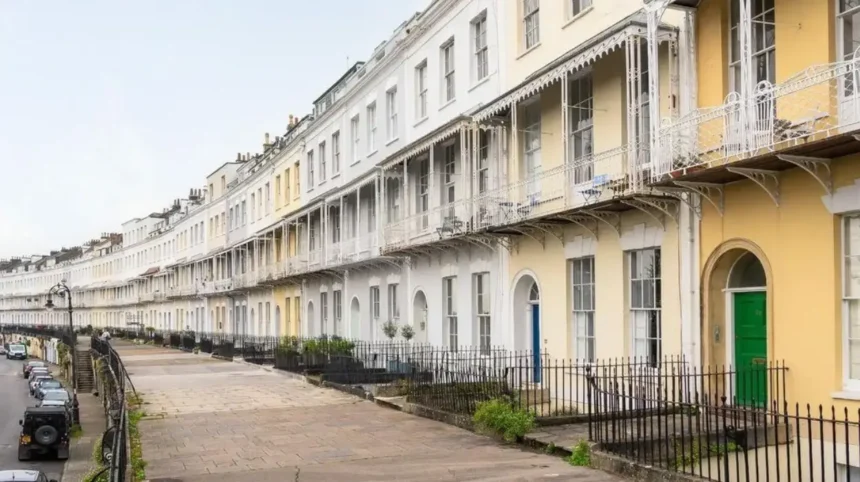
Clifton’s housing stock includes large period terraces, villas, converted houses and apartments. Streets around the Clifton Village area, Royal York Crescent, Sion Hill, Clifton Park and the surrounding slopes contain some of Bristol’s most recognisable residential architecture.
The area also benefits from proximity to The Downs, a major open-space area covering Clifton Down and Durdham Down. Bristol City Council provides walking, cycling, horse-riding and recreational facilities across the Downs.
Recent transaction research illustrates the price level. Hurle Crescent in BS8 recorded a five-year median sold price of approximately £1.4 million, while Canynge Square recorded approximately £1.185 million in the same analysis. These figures describe recorded transactions rather than asking prices.
Why is Sneyd Park among Bristol’s most expensive residential areas?
Sneyd Park is expensive because it combines large detached houses, substantial plots, mature landscaping, green surroundings and proximity to the Avon Gorge and Downs. Its conservation-area character limits the availability of comparable low-density development.
Sneyd Park sits in north-west Bristol between the Downs, Stoke Bishop and the Avon Gorge. The neighbourhood has a lower-density residential character than many inner-city districts.
Bristol City Council identifies Sneyd Park as a verdant residential suburb. Its conservation-area documentation records large detached houses constructed during the second half of the nineteenth century, when the Sneed Park estate was divided into substantial residential plots.
That historic pattern remains important to the area’s property market. Large plots are difficult to reproduce in established urban neighbourhoods. Existing properties therefore compete within a market where land availability is constrained.
Recent sold-price data illustrates the difference between property types. Rightmove’s recorded transaction information shows an overall average of approximately £630,061 for Sneyd Park over the last year, while detached properties averaged approximately £1.69 million.
Individual streets reach considerably higher levels. Mariners Drive has featured among Bristol’s most expensive addresses, with recent transaction analysis recording a median around £1.59 million over its selected 2023–2026 period.
Sneyd Park also benefits from its relationship with the Avon landscape. Bristol’s conservation documentation highlights long-distance views across the Avon and surrounding landscape as important components of the area’s character.
Why is Stoke Bishop an expensive part of Bristol?
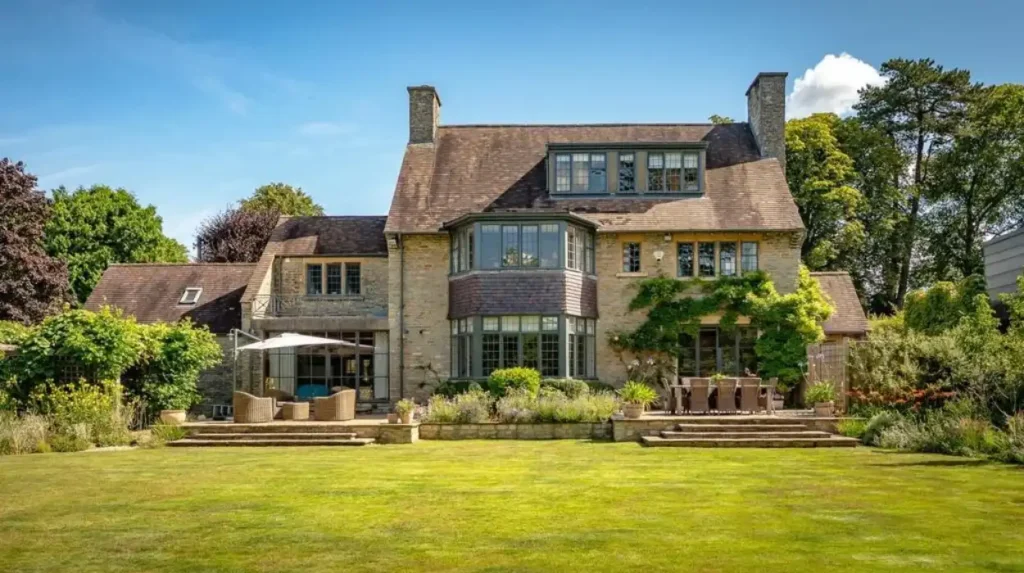
Stoke Bishop has high property values because it contains substantial detached and semi-detached houses, mature residential streets, green surroundings and large gardens. Its location near the Downs, Bristol’s northern suburbs and major educational institutions supports a strong higher-value housing market.
Stoke Bishop is located north-west of central Bristol and sits close to Sneyd Park, Westbury-on-Trym and the Downs.
Its housing stock differs from the denser Georgian and Victorian terraces of Clifton. The neighbourhood contains many larger detached and semi-detached properties, including homes built during the twentieth century.
Recent transaction information provides a useful illustration. Rightmove recorded an overall average sold price of approximately £713,758 in Stoke Bishop over the last year. Detached homes averaged approximately £1.137 million, while semi-detached properties averaged about £766,730.
Individual transactions also demonstrate the area’s upper market. Recent recorded sales include properties on Parrys Lane at £940,000, Druid Stoke Avenue at £850,000 and other substantial family homes at similar or higher levels.
Stoke Bishop’s relationship with open space is an important structural feature. The Downs provides extensive recreational land nearby, while the surrounding north-western neighbourhoods retain relatively low-density residential development.
The area’s housing profile also affects the average. A district with a greater share of detached houses produces a higher overall price than an area dominated by flats.
Why are Redland and Cotham expensive areas in Bristol?
Redland and Cotham command high prices because they combine historic housing, conservation areas, green spaces, established amenities and close access to central Bristol. Their period terraces, villas and converted properties create a high-value market with limited opportunities for large-scale redevelopment.
Redland and Cotham form an established residential area immediately north of central Bristol. They sit close to Clifton, Bishopston, the University of Bristol and major commercial streets.
The area has a strong architectural identity. Bristol City Council designated the Cotham and Redland Conservation Area in 1981. Its character appraisal records the development of public gardens, historic estates, Victorian buildings and transport infrastructure.
Redland Green and Cotham Gardens provide important local green spaces. Cotham Gardens was created on land donated to Bristol in the nineteenth century, while Redland’s residential development expanded through the Victorian period.
The property market includes large Victorian terraces, villas, period conversions and modern apartments. Some homes occupy substantial plots, while others have been converted into multiple flats.
Recent postcode-level data places BS6, which includes Redland and Cotham, at around £475,000 median sold price in one 2026 analysis.
Street-level figures can be substantially higher. Elgin Park recorded a five-year median around £1.39 million in recent HM Land Registry-based analysis, while Downs Park West and Downs Park East recorded medians above £1.1 million.
The combination of period architecture and central location gives Redland and Cotham a different price structure from outer Bristol. Many homes are within walking distance of restaurants, shops, schools, university facilities, parks and employment areas.
Is Westbury-on-Trym one of the most expensive parts of Bristol?
Westbury-on-Trym is one of Bristol’s higher-value residential locations because it combines village-style historic development, larger houses, green spaces and strong connections to north-west Bristol. Its housing stock includes substantial family properties alongside smaller homes and flats.
Westbury-on-Trym lies in north-west Bristol between Henleaze, Westbury Park, Stoke Bishop and Henbury.
The district has a historic village centre and a different urban form from central Bristol. Its housing includes period properties, twentieth-century family houses, detached homes and smaller residential developments.
The wider BS9 postcode district is particularly significant in Bristol’s high-value housing market. Recent data placed BS9 at approximately £611,000 median sold price, making it substantially higher than Bristol’s citywide average of £352,000 in July 2026.
Westbury-on-Trym’s position near the Trym Valley and surrounding green areas adds to its residential character. The wider north-west area also provides access to major roads connecting Bristol with South Gloucestershire and the motorway network.
The neighbourhood demonstrates why postcode-level data needs careful interpretation. BS9 covers several distinct communities. Its median does not represent the value of every property in Westbury-on-Trym.
Detached houses typically produce a much higher transaction value than flats. Therefore, a neighbourhood with a substantial detached-home market records a higher average than an area dominated by apartments.
Why is Henleaze considered a high-value Bristol neighbourhood?
Henleaze is a high-value Bristol neighbourhood because it contains substantial family houses, established residential streets, green spaces and convenient access to Westbury-on-Trym, Redland, the Downs and central Bristol. Its housing market sits within the expensive BS9 postcode district.
Henleaze occupies an established residential position in north Bristol. It borders Westbury-on-Trym, Westbury Park, Redland and Horfield.
The housing stock includes substantial semi-detached and detached houses, terraces and apartments. Many streets have mature gardens and relatively spacious plots.
Henleaze Avenue provides a useful example of the upper end of the local market. Recent HM Land Registry-based street analysis recorded a median sold price of approximately £1.075 million on the street over the selected five-year period.
The wider BS9 market is also important. BS9’s approximately £611,000 median in recent postcode analysis sits well above Bristol’s £352,000 citywide average recorded by ONS for July 2026.
Henleaze benefits from established local services and access to open spaces. Its position also provides connections towards the Downs and north-west Bristol.
The area’s high prices are therefore linked to property type, location and land availability rather than one single factor.
Which Bristol streets have the highest property prices?
Bristol’s highest-value streets include addresses in Sneyd Park, Clifton, Redland, the Downs and Stoke Bishop. Recent HM Land Registry-based analyses identify several streets with median recorded sale prices above £1 million across multi-year periods.
Street-level analysis provides a more detailed view than broad neighbourhood averages.
A recent analysis using HM Land Registry Price Paid Data identified Cadbury Camp Lane, Old Sneed Park, Hurle Crescent, Elgin Park and Berkshire Road among Bristol’s highest-priced streets over a five-year period.
The reported five-year median figures included approximately:
- Cadbury Camp Lane: £2.215 million
- Old Sneed Park: £1.76 million
- Hurle Crescent: £1.4 million
- Elgin Park: £1.3915 million
- Berkshire Road: £1.235 million
- Old Sneed Road: £1.225 million
- Canynge Square: £1.185 million
- Downs Park West: £1.1675 million
- Downs Park East: £1.13 million
- Burwalls Road: £1.12875 million
These figures represent medians from recorded sales, not valuations of every property on the street. The methodology also requires a minimum number of recorded transactions, which reduces the influence of one unusually expensive sale.
Another analysis covering February 2023 to January 2026 identified Mariners Drive in Sneyd Park at approximately £1.59 million median, demonstrating the concentration of high-value sales in BS9.
The exact ranking changes as new transactions enter the Land Registry database. Recent sales therefore provide a snapshot rather than a permanent league table.
What makes property expensive in Bristol’s prime neighbourhoods?
High Bristol property prices result from a combination of location, housing type, plot size, architectural character, green-space access, views, transport connections and restricted land supply. These factors operate together across Clifton, Sneyd Park, Stoke Bishop, Redland, Cotham and BS9.
Location is one of the strongest structural factors. Homes close to the city centre, major employment areas, universities and established amenities have strong locational advantages.
Housing type is another major factor. ONS data shows the large difference between Bristol’s average property categories. In July 2026, detached homes averaged £689,000, compared with £241,000 for flats and maisonettes.
Plot size also affects value. Large detached houses on substantial gardens are concentrated in neighbourhoods such as Sneyd Park and Stoke Bishop.
Historic architecture creates another layer. Clifton, Redland and Cotham contain extensive historic housing protected through conservation planning frameworks. Bristol City Council maintains character appraisals for Clifton and Hotwells, Cotham and Redland, Sneyd Park and other designated areas.
Green space is also significant. The Downs provides a major open landscape between Clifton and north-west Bristol. Access to parks and open areas forms part of the character of several expensive neighbourhoods.
Views contribute to the area’s physical appeal. Bristol’s topography produces views across the Avon Gorge, Downs and surrounding landscape. Council conservation documents identify these views as important components of local character.
Limited supply reinforces these characteristics. Established neighbourhoods with conservation controls and already-developed plots cannot easily reproduce large numbers of detached period properties.
How much more expensive are Bristol’s prime areas than the city average?
Bristol’s prime neighbourhoods can sit hundreds of thousands of pounds above the citywide average, while individual streets frequently exceed £1 million. The difference becomes especially large for detached properties in Clifton, Sneyd Park, Stoke Bishop and parts of BS9.
The official Bristol benchmark is £352,000 in July 2026, according to ONS and HM Land Registry data. The figure was 2.1% higher than July 2025.
The comparison with BS9 is significant. Recent transaction analysis placed the postcode’s median at about £611,000, approximately £259,000 above Bristol’s July 2026 average.
Detached property creates an even larger difference. Bristol’s citywide detached average was £689,000 in July 2026. Stoke Bishop detached sales averaged approximately £1.137 million over the latest period reported by Rightmove, while Sneyd Park detached sales averaged approximately £1.692 million.
These comparisons show why the phrase “most expensive area” needs a defined measurement.
A postcode median measures the typical transaction across an area. A neighbourhood average measures a different mix of property. A street median measures only properties sold on that street. A detached-property average measures a specific housing type.
These figures should not be treated as interchangeable.
How does Bristol’s expensive property market compare with the wider South West?
Bristol remains a high-value housing market within the South West. Its July 2026 average of £352,000 exceeded the South West average of about £302,000, placing Bristol among the region’s more expensive local housing markets.
The ONS recorded an average South West house price of approximately £302,000 in July 2026, compared with £352,000 in Bristol. Bristol therefore stood about £50,000 above the regional average.
Bristol’s position reflects its economic and demographic structure. The city is a major South West employment centre with established sectors including aerospace, engineering, technology, professional services, media, education and creative industries.
The city also has two major universities and a large student population. Employment and education centres contribute to housing demand across different parts of the city.
Prime neighbourhoods operate at a different level from the citywide market. Clifton and BS9 contain properties that sell for several times the Bristol average.
The regional comparison therefore provides context rather than a direct valuation measure. Bristol’s average includes all property types and neighbourhoods, while the expensive districts represent a much narrower part of the market.
What should buyers consider when looking at expensive areas in Bristol?
Buyers examining Bristol’s expensive neighbourhoods should compare recent sold prices, property type, floor area, tenure, condition, conservation restrictions, energy performance, transport access and ongoing ownership costs rather than relying on asking prices or postcode averages.
Asking prices do not establish market value. Completed transactions provide stronger evidence of what buyers actually paid.
HM Land Registry data forms the foundation of the UK House Price Index and records completed residential transactions. Recent figures are provisional and subject to revision, so longer-term comparisons provide more stable evidence.
Property condition also matters. Two Victorian houses on the same street can have very different values because of extensions, refurbishment, floor area, gardens, parking and structural condition.
Energy performance deserves attention. Older period homes frequently require greater maintenance and energy-efficiency work than modern properties. Conservation restrictions can also affect changes to historic buildings.
Ownership costs extend beyond the purchase price. Buyers need to consider mortgage costs, stamp duty, insurance, maintenance, service charges for flats and ongoing renovation expenses.
The surrounding environment matters as well. Homes beside busy roads, commercial areas or steep streets can have different market characteristics from otherwise similar properties.
For apartments, lease length and service charges require particular attention. A high purchase price does not automatically indicate low ongoing costs.
Explore More Area Guide
Best Affordable Areas in Bristol: Cheapest Places to Live
Best Areas for First-Time Buyers in Bristol
How is the future relevance of Bristol’s expensive areas changing?
Bristol’s prime neighbourhoods remain structurally important because historic housing, limited land, established amenities and access to green space cannot be easily reproduced. Future price changes will depend on wider economic conditions, mortgage costs, housing supply and buyer demand.
The fundamental characteristics of Clifton, Sneyd Park, Stoke Bishop, Redland, Cotham and BS9 are long established.
Conservation areas protect elements of historic character. Bristol City Council maintains designated character appraisals for several of these neighbourhoods, including Clifton and Hotwells, Cotham and Redland and Sneyd Park.
The supply of large historic homes remains constrained by existing urban form. Large plots cannot easily be created in established neighbourhoods without major redevelopment.
At the same time, the broader market continues to change. Bristol’s average house price reached £352,000 in July 2026, while rents reached £1,883 per month in August 2026. The ONS recorded annual house-price growth of 2.1% and annual rental growth of 5.9% over the respective periods.
These citywide figures do not predict individual neighbourhood performance. Prime markets respond to property-specific factors and wider economic conditions.
For anyone researching Bristol’s most expensive areas, the most useful approach is therefore to combine official citywide statistics with recent transaction evidence at postcode, neighbourhood and street level.
What are the key facts about Bristol’s most expensive areas?
Bristol’s expensive property market is concentrated in Clifton, Sneyd Park, Stoke Bishop, Redland, Cotham, Henleaze and Westbury-on-Trym. BS9 records particularly high values, while several individual streets in BS8, BS9 and BS6 exceed £1 million median sale prices.
The evidence shows a clear concentration in Bristol’s established north-west and central-west residential districts.
ONS recorded Bristol’s average house price at £352,000 in July 2026. Detached properties averaged £689,000, showing the substantial price premium associated with larger homes.
Recent postcode-level analysis placed BS9 at approximately £611,000, followed by BS6 at £475,000 and BS8 at £420,000.
Street-level HM Land Registry analysis identified multiple addresses with five-year median prices above £1 million, including Old Sneed Park, Hurle Crescent, Elgin Park, Berkshire Road, Canynge Square and Downs Park West.
The main reasons for these high values are consistent. They include larger homes, substantial plots, historic architecture, green-space access, established amenities, attractive views and restricted development opportunities.
Bristol’s most expensive areas therefore form a distinct part of the city’s housing market. Clifton represents the historic urban prime market, Sneyd Park and Stoke Bishop contain larger low-density homes, while Redland and Cotham combine period housing with strong central access. Henleaze and Westbury-on-Trym extend the high-value market across north-west Bristol.
What is the most expensive area in Bristol?
Clifton is one of Bristol’s best-known high-value residential areas. It features Georgian and Victorian homes, large terraces, villas and apartments. Sneyd Park, Stoke Bishop and parts of BS9 also contain some of Bristol’s highest-value properties.