
Bristol is one of the largest urban centres in South West England. The city has a diverse rental market covering city-centre apartments, Victorian terraces, family houses, student accommodation, shared houses and suburban properties.
- Why is renting in Bristol important for the local housing market?
- How much does it cost to rent in Bristol?
- Which Bristol areas are popular for renters?
- What types of rental property are available in Bristol?
- How does the renting process work in Bristol?
- What tenancy rules apply when renting in Bristol?
- How much deposit can a Bristol landlord charge?
- What rental costs should Bristol tenants budget for?
- What safety standards must rented homes in Bristol meet?
- What Energy Performance Certificate rules apply to Bristol rentals?
- What are Bristol’s HMO and property licensing rules?
- What rights do Bristol tenants have under the 2026 rental reforms?
- How should tenants choose a Bristol rental property?
- How can renters protect themselves from rental problems?
- What is the future of renting in Bristol?
- What should renters remember before signing a Bristol tenancy?
The rental market serves several groups. These include university students, young professionals, families, domestic workers, international residents and people relocating for employment.
The cost of renting depends on property size, location, condition, transport access and property type. Official Office for National Statistics data provides a consistent benchmark for Bristol rents. In June 2026, the average private rent was £1,883 per month, compared with £1,237 across the South West and £1,388 across the UK. Bristol therefore remained above both regional and national averages.
Why is renting in Bristol important for the local housing market?
Renting is a major part of Bristol’s housing system because more than 120,000 people live in privately rented homes. The sector supports students, workers, families and relocating residents while creating substantial demand for homes across the city.
Bristol City Council identifies private renting as a significant part of the city’s housing system. More than a quarter of Bristol residents rent their homes from private landlords, according to council information published during development of its Private Rented Sector Strategy.
The sector includes properties owned by individual landlords, property companies and institutional investors. Letting agents also manage a substantial proportion of rented housing.
Rental demand is connected to Bristol’s employment base, universities, transport infrastructure and population. Areas close to employment centres and major educational institutions have strong rental demand.
The city also contains a substantial student population. The University of Bristol and University of the West of England, Bristol contribute to demand for student houses, flats and rooms.
Bristol’s private rented sector therefore operates as a broad housing market rather than a single type of accommodation. A tenant searching for a one-bedroom flat has different requirements from a family seeking a three-bedroom house or students looking for a shared HMO.
The city’s rental market also changes with wider housing costs. When buying a property becomes less accessible, some households remain renters for longer. Rental supply, mortgage costs, construction and household formation also influence market conditions.

How much does it cost to rent in Bristol?
The average private rent in Bristol was £1,883 per month in June 2026. Average rents were £1,225 for one bedroom, £1,544 for two bedrooms, £1,757 for three bedrooms and £2,549 for four or more bedrooms.
Official ONS figures provide the clearest city-wide benchmark.
In June 2026, average Bristol rents were:
- One-bedroom properties: £1,225 per month.
- Two-bedroom properties: £1,544 per month.
- Three-bedroom properties: £1,757 per month.
- Four-or-more-bedroom properties: £2,549 per month.
These figures demonstrate the effect of property size on rental costs. A larger home generally commands a higher monthly rent because it provides additional bedrooms and living space.
Property type also affects the average. ONS recorded average Bristol rents of £1,508 for flats and maisonettes, £2,009 for terraced properties, £2,089 for semi-detached properties and £2,104 for detached properties in June 2026.
Rental inflation has also remained significant. Bristol’s average private rent increased from £1,753 in June 2025 to £1,883 in June 2026. This represented a 7.4% annual increase. The increase was higher than the 4.7% annual rise recorded across the South West.
Rental figures should be treated as city-wide averages rather than guaranteed asking rents. Individual properties differ because advertised prices reflect their location, condition, furnishing, energy performance and facilities.
Which Bristol areas are popular for renters?
Bristol contains distinct rental markets across central, inner-city and suburban neighbourhoods. Areas such as Clifton, Redland, Southville, Bedminster, Bishopston, Horfield, Easton, Fishponds and central Bristol offer different combinations of housing, transport, amenities and rental demand.
Clifton is known for its historic architecture, terraces, independent businesses and proximity to the University of Bristol. Rental housing includes converted period properties, flats and larger Victorian homes.
Redland borders Clifton and has a substantial supply of period houses and flats. Its location provides access to central Bristol and university facilities.
Bishopston and nearby areas contain Victorian and Edwardian terraces. Shared houses are particularly relevant to the local student and young professional rental market.
Horfield sits north of the city centre. It provides access to Gloucester Road, Southmead and wider north Bristol. Housing includes terraces, flats and shared properties.
Bedminster and Southville provide rental accommodation south of the River Avon. Their location offers access to central Bristol, local shopping areas and transport routes.
Easton has a varied housing stock and strong connections to central Bristol. The area contains Victorian terraces, converted properties and flats.
Fishponds provides a mixture of houses and flats east of central Bristol. It has links to UWE Bristol’s Frenchay campus and wider east Bristol.
Central Bristol contains modern apartment developments alongside converted historic buildings. Central properties suit tenants who prioritise proximity to employment, entertainment, restaurants, shopping and transport.
Rental prices differ between these areas. Tenants should compare individual properties rather than assuming that every home within a neighbourhood has the same rental value.
What types of rental property are available in Bristol?
Bristol’s rental market includes flats, terraces, semi-detached houses, detached houses, shared houses and rooms. Examples include one-bedroom city-centre flats, Victorian terraces in inner Bristol, family houses in suburban districts and licensed HMOs for shared living.
Flats and maisonettes form a significant part of the Bristol rental supply. ONS recorded an average rent of £1,508 for these property types in June 2026.
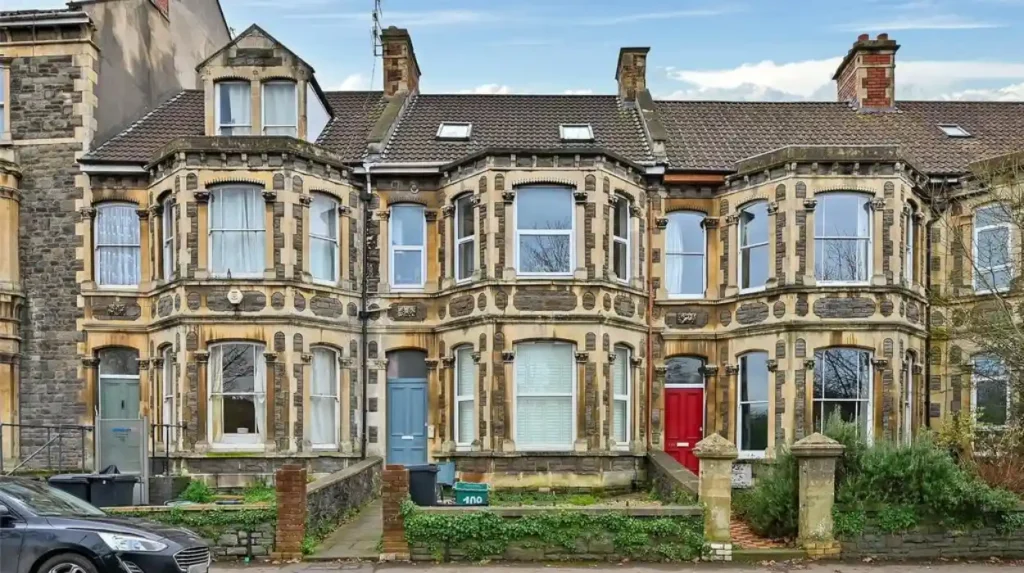
Terraced homes are common in inner Bristol. Many were constructed during the Victorian and Edwardian periods. They often provide two or three bedrooms and are frequently used by families, professionals and shared households.
Semi-detached and detached properties are more common in suburban areas. They generally provide more internal space and private outdoor areas.
Houses in Multiple Occupation, known as HMOs, provide shared accommodation where multiple tenants live in the same property and share facilities. Bristol defines an HMO as a property where at least three tenants form more than one household and share facilities such as kitchens or bathrooms.
Mandatory HMO licensing applies when five or more people from two or more separate households occupy the property and share facilities. Bristol also operates additional licensing arrangements affecting some smaller HMOs and selective licensing in specified areas.
Rooms in shared houses can reduce individual housing costs because tenants share communal facilities. The total household rent, however, still depends on property size, location and demand.
How does the renting process work in Bristol?
Renting normally involves searching for a property, viewing it, submitting an application, completing required checks, agreeing tenancy terms, paying permitted upfront costs and receiving the required information before occupation. Right to Rent checks apply to new private tenants in England.
The process begins with identifying suitable properties. Tenants compare monthly rent, location, property condition, energy performance, furnishings, bills and transport access.
A viewing allows the tenant to inspect the actual property. Important checks include heating, hot water, windows, ventilation, damp, mould, electrical fittings, locks, appliances and communal areas.
The next stage involves applying for the property. A letting agent or landlord can request information needed for affordability and identity checks.
Right to Rent rules apply in England. Landlords must check all new tenants aged 18 or over before a new tenancy begins, regardless of whether the person is named on the tenancy agreement.
Tenants with limited permission to remain in the UK are subject to specific timing requirements for Right to Rent checks. The Home Office provides the relevant procedures.
From 1 May 2026, the Renters’ Rights Act changed private renting in England. The reforms introduced assured periodic tenancies for most private rented arrangements and ended Section 21 no-fault evictions.
The legal framework therefore differs from the traditional fixed-term assured shorthold tenancy system used before the reforms.
What tenancy rules apply when renting in Bristol?
Since 1 May 2026, most private rented homes in England use assured periodic tenancies rather than traditional fixed-term assured shorthold tenancies. Tenants receive stronger protection against no-fault eviction, while landlords must use legally recognised grounds and procedures to regain possession.
An assured periodic tenancy continues from period to period without a fixed end date. The period is generally weekly or monthly according to the rental arrangement.
The Renters’ Rights Act introduced major changes from 1 May 2026. Section 21 no-fault eviction is no longer available for private landlords. Landlords instead need a valid legal ground for possession.
Tenants can also end an assured periodic tenancy by giving the required notice. Government guidance states that tenants can end these arrangements with two months’ notice under the new system.
The reforms also changed rent increases. Rent increases must follow the statutory process and cannot be imposed through informal changes to the agreed rent.
Tenants should read all written tenancy information carefully. It should identify the rent, payment arrangements, property address, landlord information and other relevant conditions.
Tenants should retain copies of agreements, correspondence, receipts, inspection records and notices. These documents provide evidence if a dispute occurs.
How much deposit can a Bristol landlord charge?
For most relevant private tenancies in England, the maximum tenancy deposit is five weeks’ rent when annual rent is below £50,000 and six weeks’ rent when annual rent is £50,000 or more. Deposits must receive statutory protection where the rules apply.
Deposit limits prevent landlords from demanding unlimited security payments.
For annual rent below £50,000, the maximum deposit is five weeks’ rent. For annual rent of £50,000 or more, the maximum is six weeks’ rent.
A holding deposit can also be requested before a tenancy is agreed. The maximum holding deposit is one week’s rent.
Under applicable tenancy deposit protection rules, landlords must protect qualifying deposits using a government-approved scheme.
The recognised schemes include the Deposit Protection Service, MyDeposits and the Tenancy Deposit Scheme.
Landlords must generally protect the deposit within 30 days of receiving it. At the end of the tenancy, the deposit is returned subject to legitimate deductions for issues such as unpaid rent or tenant-caused damage.
Tenants should photograph the property when moving in. A dated inventory and photographs provide evidence about the property’s condition.
What rental costs should Bristol tenants budget for?
A Bristol rental budget should include rent, deposit, council tax, utilities, broadband, insurance, transport and household expenses. The exact total depends on property size, council tax band, energy use, tenancy arrangements and whether bills are included in the advertised rent.
Monthly rent is the largest recurring cost for most tenants.
Council Tax is another significant household expense. The amount depends on the property’s valuation band and the applicable Bristol City Council charge.
Utility costs include electricity, gas where applicable and water. Broadband and television services can create additional monthly expenses.
Some rental properties include selected bills. Others require tenants to arrange and pay for each service independently. The tenancy agreement should state which costs are included.
Shared houses often divide certain household expenses between tenants. A clear agreement between housemates helps prevent disputes about bills.
Tenants should also budget for moving costs, furniture, cleaning, transport and insurance where applicable.
The most useful affordability calculation therefore uses the full monthly housing cost rather than rent alone.
What safety standards must rented homes in Bristol meet?
Private landlords must keep rental homes safe and free from serious hazards. Requirements cover gas safety, electrical installations, smoke alarms, carbon monoxide alarms, fire safety and essential repairs. Tenants should check safety information before moving into a property.
Gas appliances and flues supplied by landlords must receive annual safety checks from a Gas Safe registered engineer. Tenants must receive the relevant gas safety record before moving in or within the required period after the check.
Electrical installations must also be safe. Landlords must arrange inspection and testing by a qualified person at least every five years under the applicable electrical safety regulations.
Smoke alarms are required on each storey used as living accommodation. Carbon monoxide alarms are required in rooms containing solid-fuel appliances such as wood-burning stoves or coal fires.
Landlords are responsible for major repairs involving the structure, exterior, heating, hot water, plumbing, gas installations and electrical wiring.
Tenants should report repair problems promptly. Serious hazards can be reported to Bristol City Council’s housing services.
What Energy Performance Certificate rules apply to Bristol rentals?
Most privately rented homes in Bristol that require an Energy Performance Certificate must meet the minimum energy efficiency standard of EPC band E unless a valid exemption applies. Tenants should check the property’s EPC before agreeing to rent it.
An Energy Performance Certificate, or EPC, measures the energy efficiency of a property and gives it a rating from A to G.
The Minimum Energy Efficiency Standards prevent landlords from letting covered properties with an EPC rating below E unless an applicable exemption is registered.
Energy efficiency affects household running costs. A property with better insulation and efficient heating can require less energy to maintain comfortable indoor temperatures.
Tenants should examine the EPC rather than relying only on the property’s appearance. The certificate identifies the current rating and recommended energy improvements.
Energy performance is particularly relevant in Bristol because heating costs form an important part of household expenditure.
What are Bristol’s HMO and property licensing rules?
Bristol requires mandatory HMO licensing for qualifying properties with five or more occupants from two or more households sharing facilities. Additional licensing and selective licensing also apply in specified circumstances and locations across the city.
A House in Multiple Occupation is a shared rental property occupied by multiple households.
Bristol’s mandatory HMO licensing threshold covers properties occupied by five or more people from two or more households who share facilities such as kitchens, bathrooms or toilets.
The city also uses additional licensing for certain smaller HMOs. Selective licensing applies to specified private rented properties in designated areas.
Bristol City Council states that some smaller HMOs in the central Bristol area and Horfield ward require licensing. Selective and additional licensing also apply to specified properties in Bedminster and Brislington West.
Tenants considering a shared property should check whether the accommodation requires a licence and whether the property is listed on the council’s licensing register.
Licensing provides a mechanism for enforcing standards relating to management, safety and welfare.
What rights do Bristol tenants have under the 2026 rental reforms?
Bristol tenants have legal rights covering safe housing, privacy, deposit protection, fair rental processes, repairs and protection from unlawful eviction. From 1 May 2026, new rules also strengthened protection against rental discrimination and no-fault eviction.
Tenants have the right to live in a property that is safe and in good repair.
They also have rights concerning deposit protection, landlord identification, privacy and protection from unfair eviction and unfair rent.
Landlords normally need to provide at least 24 hours’ notice before entering a rented property for inspection or repairs, except in emergencies.
The Renters’ Rights Act also introduced restrictions on rental discrimination. From 1 May 2026, landlords cannot refuse a property solely because an applicant receives benefits or has children.
The reforms also address rental bidding. Advertised rents must state a specific amount, preventing landlords and agents from inviting prospective tenants to offer higher rents than advertised.
Pet rules also changed. Tenants can request permission to keep a pet, and landlords must consider the request and provide a reason for refusal.
These reforms create a more structured rental process for tenants and landlords.
How should tenants choose a Bristol rental property?
Tenants should compare total monthly costs, location, transport, property condition, energy performance, tenancy terms, deposit requirements and landlord or agent information before agreeing to rent. A suitable Bristol rental property must meet both financial and practical household requirements.
Location should be assessed against daily travel requirements. A property near a workplace or university can reduce commuting time and transport expenditure.
Transport connections are particularly relevant in Bristol because road congestion affects journey times across the urban area. Bus routes, railway stations and cycling infrastructure should be considered alongside distance.
Property condition requires an inspection during the viewing. Tenants should check for damp, mould, condensation, damaged windows, heating problems and poor ventilation.
Energy efficiency should be assessed through the EPC.
The tenant should also establish whether the property is furnished or unfurnished. Furnished properties can reduce initial furniture costs but can affect rental prices.
The tenancy agreement should clearly establish the rent and other financial obligations.
For shared accommodation, tenants should establish how bills, cleaning, communal spaces and household responsibilities are managed.
How can renters protect themselves from rental problems?
Renters can reduce disputes by verifying the landlord or agent, inspecting the property, keeping written records, checking licensing where relevant, confirming deposit protection and retaining copies of all tenancy documents, payments, inventories and repair correspondence.
Tenants should not rely solely on verbal promises. Important agreements should be recorded in writing.
Before paying money, tenants should establish who owns or manages the property and confirm the terms of the proposed tenancy.
Payment records should be retained. Bank statements, receipts and written confirmation provide evidence of financial transactions.
An inventory should record the condition of walls, floors, appliances, windows, fixtures and furniture.
Photographs should be dated and stored securely.
Repair requests should be made in writing. The message should describe the problem and its location.
If serious housing hazards remain unresolved, tenants can contact Bristol City Council’s housing services. Government guidance also confirms that local authorities can act where serious hazards affect health or create a nuisance.
Explore More Area Guide
Property Prices in Bristol: House Price Guide 2026
Best Areas Near Transport Links in Bristol 2026
What is the future of renting in Bristol?
Bristol’s rental market will remain an important part of the city’s housing system as the council develops its Private Rented Sector Strategy and implements stronger national tenant protections introduced in 2026. Housing affordability, quality, supply and enforcement remain central policy priorities.
Bristol City Council developed a Private Rented Sector Strategy for 2026 to 2029. The draft strategy consultation ran from 29 June to 10 August 2026 and focused on improving the private rented sector.
The council’s housing policies also focus on preventing homelessness and improving access to affordable, needs-based accommodation. Its Homelessness and Rough Sleeping Strategy covers the period from 2025 to 2030.
Nationally, the Renters’ Rights Act represents a major structural change in private renting. The reforms introduced from 1 May 2026 affect tenancy structures, possession procedures, rent increases, rental bidding, pets and discrimination.
For Bristol renters, the practical implications are clear. Tenants need to understand their legal rights, compare the complete cost of accommodation and verify property standards before entering an agreement.
The city’s rental market combines high demand with a wide range of property types. Official ONS data provides a useful benchmark, while individual rental listings determine the actual price of specific homes.
What should renters remember before signing a Bristol tenancy?
Renters should confirm the rent, deposit, tenancy type, landlord information, property condition, EPC, safety certificates, bills, licensing status and legal rights before signing. Careful checks create a clear record and reduce avoidable disputes during the tenancy.
Bristol has a large and diverse private rented sector. More than 120,000 residents live in privately rented homes, and the city-wide average rent reached £1,883 per month in June 2026.
Rental costs differ substantially according to bedroom count and property type. A one-bedroom property averaged £1,225 per month in June 2026, while four-or-more-bedroom properties averaged £2,549.
The legal environment also changed substantially on 1 May 2026. Most private rented tenancies now operate under the new assured periodic tenancy framework, and Section 21 no-fault eviction has ended.
A successful Bristol rental search therefore requires more than finding a property within a preferred price range. Tenants should assess affordability, location, condition, energy efficiency, legal compliance and tenancy terms together.
Using official ONS rental data, Bristol City Council housing information and GOV.UK tenancy guidance provides a reliable foundation for making informed rental decisions.
How much does it cost to rent in Bristol in 2026?
The average private rent in Bristol was £1,883 per month in June 2026. Average rents were £1,225 for one-bedroom properties, £1,544 for two bedrooms, £1,757 for three bedrooms and £2,549 for four or more bedrooms.