Parking in Bristol is a structured system covering on-street bays, council-operated car parks, private car parks, Residents’ Parking Schemes, the Central Parking Zone, Park and Ride facilities, disabled parking, motorcycle parking, and vehicle-related restrictions. Bristol City Council manages all on-street and most off-street public parking in the city centre, while private operators manage additional facilities across the wider urban area.
- What types of parking are available in Bristol?
- How does parking work in Bristol’s Central Parking Zone?
- How do Bristol Residents’ Parking Schemes work?
- Where can visitors park in Bristol city centre?
- How much does parking cost in Bristol?
- How does Bristol’s Clean Air Zone affect parking?
- What are the parking rules for disabled drivers and motorcycles in Bristol?
- How are parking restrictions and Penalty Charge Notices enforced in Bristol?
- How is Bristol’s parking system changing for the future?
- What is the best way to plan parking in Bristol?
The city’s parking policy is closely connected to transport management. Bristol aims to reduce unnecessary private-car use in the city centre, improve transport choices, manage congestion, support economic activity, and make better use of limited street space. The Bristol Transport Strategy, adopted in July 2019, identifies efficient parking management as part of the city’s wider transport system.
Parking conditions differ significantly between central Bristol, residential neighbourhoods, shopping districts, employment areas and transport interchanges. A driver therefore needs to identify the parking zone, read the local signs, check operating hours and understand whether a permit or payment is required.
As of August 2026, Bristol’s Central Parking Zone on-street charges have recently changed. From 10 August 2026, the current Central Parking Zone pay-and-display rates are £4.50 per hour in the one-hour zone from 8am to 6pm and £3.50 from 6pm to 10pm. The two-hour and four-hour zones charge £3.50 per hour from 8am to 6pm and £2.50 per hour from 6pm to 10pm. These zones are free between 10pm and 8am.
What types of parking are available in Bristol?
Bristol provides several parking categories, including on-street pay-and-display bays, council car parks, private car parks, Residents’ Parking Schemes, Park and Ride sites, disabled bays, motorcycle spaces, and specialist vehicle parking facilities across the city.
The main distinction is between on-street parking and off-street parking. On-street parking uses marked bays located on public roads. Off-street parking uses dedicated car parks operated by Bristol City Council, private companies, businesses, hospitals, retail locations or other organisations.
Central Bristol has a Controlled Parking Zone, commonly abbreviated to CPZ. A Controlled Parking Zone is an area where parking restrictions apply across streets and are indicated by signs and road markings. Bristol City Council states that every street within the central CPZ has some form of parking restriction at particular times.
On-street facilities include pay-and-display bays with different maximum stays. Depending on the location, drivers can find one-hour, two-hour and four-hour parking zones. The applicable duration and charge are displayed on signs and parking machines.
Bristol also has Residents’ Parking Schemes, or RPS areas. These schemes control parking in residential streets where demand for kerbside space requires formal management. Examples include Clifton East, Clifton Village, Kingsdown, Redland, Cotham, Southville, Bedminster East and Easton and St Phillips.
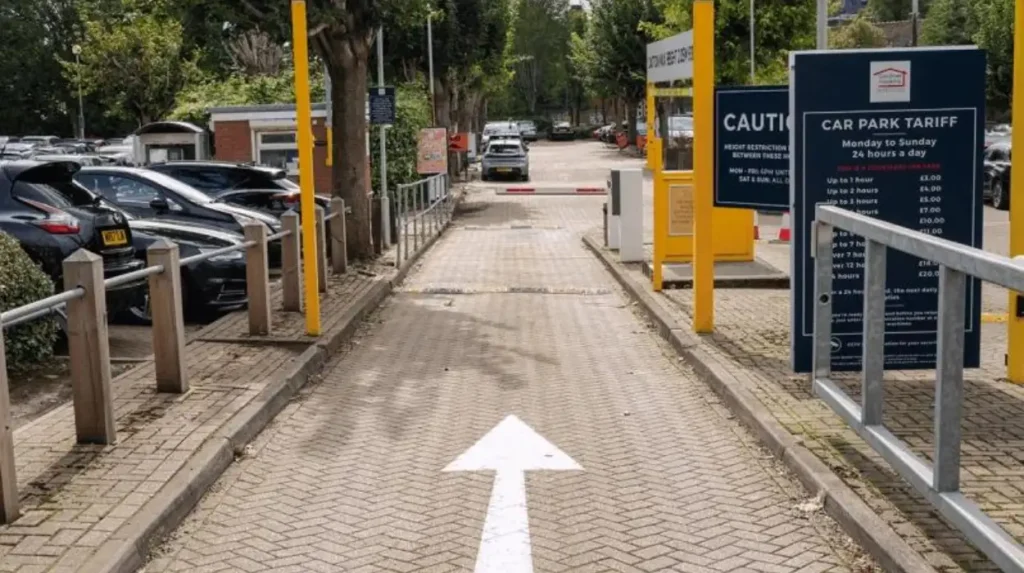
Off-street council parking includes locations such as Trenchard Street, Queen Square, Portwall Lane, Temple Gate, College Street, Frog Lane, Wapping Wharf and Redcliffe Parade. Bristol City Council publishes information about prices, opening times and maximum stays for its car parks.
Park and Ride provides another model. Drivers leave their vehicles outside the central area and continue into Bristol by bus. Bristol City Council operates three Park and Ride sites at Brislington, Long Ashton and Portway. Parking at these sites is free, although the connecting bus service requires a fare.
This range of parking facilities means that the best parking option depends on journey purpose, destination, duration, vehicle type and whether the driver needs direct access to central Bristol.
How does parking work in Bristol’s Central Parking Zone?
Bristol’s Central Parking Zone controls on-street parking throughout central Bristol using pay-and-display bays, yellow lines, loading restrictions and signed operating periods, with charges and maximum stays determined by each individual parking location.
The Central Parking Zone is the most tightly controlled parking environment in Bristol. It covers central streets where parking demand, traffic movement and limited kerbside capacity require formal restrictions.
Pay-and-display parking is divided into different maximum-stay zones. Current one-hour zones charge £4.50 per hour between 8am and 6pm and £3.50 per hour between 6pm and 10pm. Current two-hour and four-hour zones charge £3.50 per hour between 8am and 6pm and £2.50 per hour between 6pm and 10pm. Parking is free between 10pm and 8am in these current Central Parking Zone pay-and-display arrangements.
Maximum stay rules remain important even when a driver has paid. Payment does not automatically create unlimited parking rights. A two-hour bay, for example, cannot be treated as an all-day space simply because payment has been made.
Yellow lines form another part of the system. Double yellow lines prohibit parking at any time, subject to specific legal exemptions. Single yellow lines restrict parking during stated times, with the applicable restrictions shown by signs. Kerb markings also identify loading restrictions.
The Central Parking Zone also includes different types of street space. These include pay-and-display bays, loading areas, disabled parking spaces, motorcycle parking and other regulated kerbside areas.
Drivers should therefore check the complete combination of road markings, signs, bay markings and payment instructions before leaving a vehicle. The location itself does not determine whether parking is lawful. The restriction applying at that specific bay determines the legal position.
The council’s current parking information also provides guidance on using RingGo for applicable parking payments. Drivers should follow the payment method specified at the parking location rather than assuming that every bay uses the same system.
How do Bristol Residents’ Parking Schemes work?
Residents’ Parking Schemes control parking in residential areas by reserving selected spaces for permit holders, visitors, pay-and-display users, disabled motorists and shared-use parking according to local operating hours and signed restrictions.
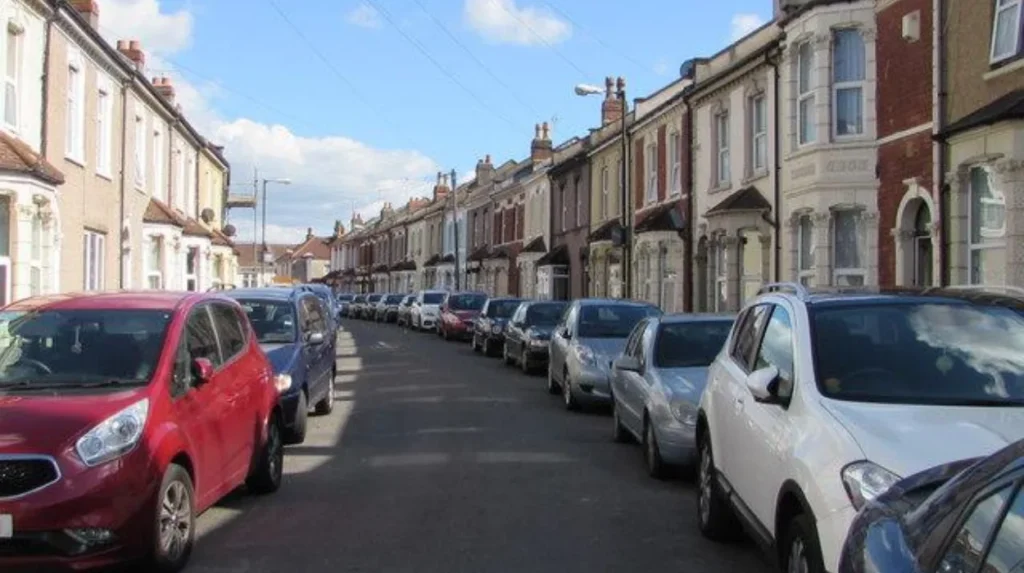
Residents’ Parking Schemes exist because residential streets often experience competition for limited parking space. The scheme establishes rules for who can park, where they can park and when restrictions operate.
Bristol’s RPS areas use several types of parking place. These include permit–holder bays, Permit Parking Areas, shared–use bays, pay–and–display bays, disabled bays, car–club bays and loading areas. Each type has its own purpose and restriction.
Residents generally require a valid digital parking permit to park in permit-controlled spaces during the scheme’s operating hours. Visitor permits are also available to eligible residents. Bristol’s resident permits are digital, so drivers do not normally need to display a physical permit inside the vehicle.
Permit costs depend on the parking area and vehicle characteristics. Outside the Central Parking Zone, the first annual residents’ permit currently costs £129 for vehicles in CO2 bands A to K and £193 for vehicles in bands L to M. A second permit costs £233 annually and a third permit costs £581 annually. Central Parking Zone residents’ permits currently cost £250 annually.
Visitor parking is also structured by area. A visitor permit normally applies to one vehicle for one day during the relevant scheme’s operating hours. Bristol provides different free and chargeable visitor allocations depending on the RPS area. For example, Bedminster East provides 50 free and 50 chargeable visitor permits, while Bower Ashton provides 70 free and 70 chargeable permits.
Most Bristol Residents’ Parking Schemes do not operate on Sundays or public holidays. Bower Ashton, Edward Road and Chatsworth Road are exceptions, operating throughout the week except Christmas Day. Local signs remain the controlling source because operating periods differ between schemes.
New housing is also affected by parking policy. Bristol restricts residents’ and visitors’ parking permits for many car-free and low-car developments. The relevant dates are 13 October 2005 for the Central Parking Zone and 1 August 2018 for RPS areas.
These policies connect parking with planning. New developments in controlled areas are not automatically entitled to the same parking rights as established residential properties.
Where can visitors park in Bristol city centre?
Visitors can use council car parks, private car parks, signed on-street bays and Park and Ride facilities, with the most suitable option depending on destination, parking duration, vehicle restrictions, operating hours, and whether central access is essential.
Bristol city centre contains numerous council-operated off-street parking facilities. The council’s published list includes Bristol First Hotel, Brunswick Square, College Street, Frog Lane, The Grove, Lower Guinea Street, Mardyke Wharf, Maritime Heritage Centre, Portwall Lane, Queen Square, Redcliffe Parade, Temple Gate, Trenchard Street, Wapping Wharf and West End.
These facilities serve different parts of the central area. Trenchard Street provides access towards the west of the commercial centre. Queen Square serves the eastern side of the central area. Temple Gate sits close to Bristol Temple Meads and the city’s major transport connections. Wapping Wharf serves the Harbourside and surrounding waterfront district.
The choice between on-street and off-street parking depends heavily on duration. Short visits can suit appropriately signed on-street bays where the maximum stay matches the visit. Longer visits generally require a car park that permits the required duration.
Park and Ride is a separate option for visitors who do not need to drive directly into the central area. Bristol has Park and Ride sites at Brislington, Long Ashton and Portway. Parking at these sites is free, while users pay the applicable bus fare.
Park and Ride also supports Bristol’s wider transport strategy. The Bristol Transport Strategy identifies multi-modal hubs as a mechanism for allowing people to park outside the centre and continue their journey using other transport modes.
Visitors should also distinguish council car parks from private car parks. Private operators can apply their own tariffs, maximum stays, payment systems and contractual terms. A driver should therefore check the operator’s signs before leaving the vehicle.
Parking information is particularly important around attractions, shopping districts, offices, hotels and major events. A central destination does not automatically provide a dedicated parking facility, and a nearby street does not automatically permit unrestricted parking.
How much does parking cost in Bristol?
Parking costs in Bristol vary by location and parking type, with current central on-street rates ranging from £2.50 to £4.50 per hour during charging periods, while resident permits and off-street facilities follow separate pricing structures.
Bristol does not have one citywide parking tariff. Charges depend on the parking zone, type of space, operating period, maximum stay and operator.
The current Central Parking Zone rates provide a clear example. One-hour bays charge £4.50 per hour from 8am to 6pm and £3.50 per hour from 6pm to 10pm. Two-hour and four-hour zones charge £3.50 per hour from 8am to 6pm and £2.50 per hour from 6pm to 10pm. These current arrangements provide free parking between 10pm and 8am.
Residents’ Parking Scheme pay-and-display charges follow a different structure. In Clifton East, Clifton Village and Kingsdown, current charges include £2.50 for one hour, £5 for two hours and £7.50 for three hours. Four-hour parking costs £10 and five-hour parking costs £12.50 where those longer stays are available.
Other RPS areas have lower current rates. These include £2 for one hour, £4 for two hours and £6 for three hours. Four-hour parking costs £8 and five-hour parking costs £10 where those durations are available.
Short-stay arrangements also exist. Some RPS pay-and-display locations provide up to 30 minutes free, while longer stays require payment. The exact maximum stay is determined by the signs at the parking place.
Resident permit prices operate separately from visitor parking charges. The first permit outside the Central Parking Zone is currently based on vehicle CO2 emissions, while Central Parking Zone residents pay a flat £250 annual permit rate.
Park and Ride presents a different cost structure. There is no parking charge at Bristol’s council-operated Park and Ride sites, but passengers pay the applicable bus fare.
Drivers should always check the current council information or the signs at the parking location before payment. Parking charges change over time, and different bays within the same broad neighbourhood can have different tariffs.
How does Bristol’s Clean Air Zone affect parking?
Bristol’s Clean Air Zone affects drivers who travel into the zone rather than vehicles that remain parked, with non-compliant cars generally subject to a £9 daily charge and compliant vehicles avoiding the charge under current rules.
Bristol’s Clean Air Zone, or CAZ, began on 28 November 2022. It is a designated area designed to reduce exposure to nitrogen dioxide by discouraging the use of higher-polluting vehicles and encouraging cleaner transport.
The parking relationship is important. A vehicle parked inside the Clean Air Zone does not incur the CAZ charge simply because it is parked. The charge applies when a vehicle drives within the zone and does not meet the applicable emissions standard or exemption.
For private petrol cars and private diesel cars that are subject to the charge, the current daily rate is £9. Taxis and light goods vehicles under 3.5 tonnes also have a £9 daily charge. Heavy goods vehicles, buses and coaches are currently charged £100 per day.
The charge operates 24 hours a day, every day of the year. A driver who makes multiple journeys inside the zone on the same charged day pays the daily charge once. A journey crossing midnight into a second day requires payment for the second day if the vehicle remains chargeable.
Bristol states that more than 88% of vehicles entering the city already meet the applicable air-quality rules. Vehicles that generally avoid the charge include Euro 4, Euro 5 and Euro 6 petrol vehicles, approximately from 2006 onwards, Euro 6 diesel vehicles from approximately the end of 2015 onwards, fully electric vehicles, hydrogen fuel-cell vehicles and motorcycles. The official vehicle checker should be used because vehicle compliance depends on the specific vehicle.
The CAZ therefore needs to be considered before selecting a city-centre car park. A driver can find a suitable parking space and still incur a separate daily environmental charge for travelling into the zone.
The system also uses automatic number plate recognition. Exempt vehicles are identified through the relevant enforcement system, and drivers should check eligibility before travelling.
What are the parking rules for disabled drivers and motorcycles in Bristol?
Disabled drivers with valid Blue Badges receive specific parking rights subject to local restrictions, while motorcycles can use designated spaces and have additional free-parking provisions in several Bristol parking areas.
Blue Badge parking forms a separate part of Bristol’s parking framework. Blue Badge holders can use designated disabled spaces and have specific parking rights under the applicable national and local rules. Restrictions such as loading controls and yellow-line requirements still need to be understood.
Residents’ Parking Schemes specifically recognise Blue Badge parking as one category of parking place. The council also provides information for Blue Badge holders and carers using residents’ parking areas.
Motorcycle parking has distinct arrangements. Bristol City Council states that motorcycles can park for free in designated motorcycle parking bays within the Controlled Parking Zone. Motorcycles can also use certain on-street bays and have free parking provisions in residents’ parking scheme areas, subject to the applicable restrictions.
Motorcycles are also excluded from Bristol’s Clean Air Zone charge. The council confirms that motorcycles do not incur a CAZ charge.
Specialist vehicles require additional attention. Coaches, lorries and motorhomes have designated parking rules, and some locations have height or weight restrictions. Bristol identifies several car parks without height restrictions for qualifying motorhomes, including Bristol First, Brunswick Square, Frog Lane, Lower Guinea Street, Mardyke Wharf, Maritime Heritage Centre, Portwall Lane, Queen Square, Redcliffe Parade and Wapping Wharf.
Motorhomes also need to consider the Clean Air Zone separately. A suitable parking location does not remove the requirement to pay the CAZ charge if the vehicle is non-compliant and travels inside the zone.
These distinctions demonstrate why vehicle type is an important factor when choosing Bristol parking. A standard car, motorcycle, Blue Badge vehicle, coach and motorhome can face different restrictions at the same location.
How are parking restrictions and Penalty Charge Notices enforced in Bristol?
Bristol enforces parking restrictions through civil parking enforcement, signs, road markings, patrols and camera systems, with Penalty Charge Notices issued when drivers breach restrictions or fail to comply with applicable parking requirements.
Parking enforcement exists to keep traffic moving, protect restricted spaces and manage competition for limited road capacity. Bristol City Council uses restrictions on main roads, bus routes, shopping areas and residential streets for these purposes.
Common parking contraventions include parking on restricted yellow lines, overstaying a permitted duration, parking in permit-holder spaces without the required permit, ignoring loading restrictions and failing to comply with local parking rules.
Residents’ Parking Scheme areas are patrolled daily. Bristol states that a Penalty Charge Notice is issued when a vehicle fails to comply with the relevant scheme rules. A permit does not override restrictions such as double yellow lines.
The scale of enforcement is significant. Bristol’s 2024–25 Parking Services Annual Report records 110,564 parking Penalty Charge Notices issued during the financial year. The same report records 112,798 bus-lane PCNs, making a combined 223,362 parking and bus-lane PCNs.
The report states that 169,934, or 76.1%, of all parking and bus-lane PCNs issued in 2024–25 had been paid by 20 August 2025. Of these, 147,964, representing 66.2% of all issued parking and bus-lane PCNs, were paid at the discounted rate.
Clean Air Zone enforcement operates separately. During 2024–25, Bristol recorded 344,365 Clean Air Zone Penalty Charge Notices. These relate to CAZ compliance rather than ordinary parking restrictions.
The distinction between a parking PCN and a Clean Air Zone PCN is important. A parking PCN concerns a parking or related traffic restriction. A CAZ PCN concerns a vehicle entering the zone without paying the required environmental charge or without a valid exemption.
Drivers who receive a PCN have statutory appeal routes where they believe the notice was issued incorrectly or there are relevant grounds for mitigation. Bristol’s annual parking reporting confirms that an appeals procedure is available.
Explore More Area Guide
Bristol Public Transport Guide: Buses, Metrobus and Rail 2026
Commuting from Bristol: Transport, Rail and Travel Guide 2026
How is Bristol’s parking system changing for the future?
Bristol’s parking policy is moving toward stronger management of kerbside space, greater use of Park and Ride, targeted residential schemes, cleaner vehicles, digital permits and transport policies designed to reduce congestion and support sustainable travel.
Parking policy in Bristol is part of a broader transport strategy rather than an isolated car-management programme. The Bristol Transport Strategy aims to improve transport options, create healthier places, improve air quality and road safety, use streets more efficiently and reduce the negative effects of congestion.
The strategy identifies parking as an important mechanism for influencing travel behaviour. It addresses on-street and off-street parking, privately operated car parks, parking standards for new development, transport-interchange parking, Park and Ride, Residents’ Parking Zones, parking charges, enforcement and parking information systems.
Recent local planning activity demonstrates that residential parking management remains active. Bristol’s 2026 South Bristol Liveable Neighbourhood proposals include targeted Residents’ Parking Scheme measures in Totterdown, Windmill Hill, The Chessels, Parson Street and Ashton Gate, alongside a proposed Matchday Parking Scheme in Ashton Vale.
This approach focuses on areas where parking pressure and local evidence support additional management. It also demonstrates that parking arrangements can change through consultation and local transport projects.
Digital technology is another established direction. Bristol’s residents’ parking permits are now digital, allowing residents to apply for and manage permits online. Visitor permits are also digital.
Electric vehicle infrastructure is also becoming increasingly relevant to parking policy. Bristol’s wider transport objectives connect parking management with cleaner vehicles, improved air quality and sustainable transport.
Park and Ride remains strategically important because it allows drivers to leave vehicles outside the city centre and continue by bus. Bristol City Council controls the Brislington, Long Ashton and Portway sites, reinforcing the role of peripheral parking within the city’s transport network.
The long-term direction is therefore based on managing parking capacity rather than simply expanding parking supply. Bristol’s policy seeks to balance access for residents, visitors, businesses, disabled motorists and other road users with congestion, air-quality and sustainable-transport objectives.
For drivers, the practical implication is straightforward: parking conditions in Bristol are location-specific and subject to policy changes. Checking the current council parking information, reading local signs and confirming vehicle requirements before travelling remains the most reliable way to avoid unnecessary charges or penalties.
What is the best way to plan parking in Bristol?
The most reliable approach is to identify the destination, choose an appropriate on-street or off-street facility, check current charges and maximum stays, confirm parking-zone restrictions, verify Clean Air Zone compliance, and follow signs at the parking location.
Planning begins with the destination. Central Bristol, Clifton, Harbourside, Temple Quarter, residential neighbourhoods and shopping districts operate under different parking conditions.
The next step is to determine whether the journey requires central parking. If direct access to the city centre is not necessary, Park and Ride provides an alternative. Bristol’s three council-controlled sites are Brislington, Long Ashton and Portway, with free parking and a separate bus fare.
For direct central access, drivers can compare council car parks and appropriately signed on-street bays. Longer stays require particular attention to maximum-stay rules. A paid bay does not necessarily permit all-day parking.
Residential destinations require additional caution. A street inside an RPS can require a resident permit, visitor permit or payment depending on the specific bay and time. Bristol publishes detailed maps and information for individual RPS areas.
Drivers should then check the vehicle’s Clean Air Zone status before entering central Bristol. A parking decision and a CAZ decision are separate. Parking in the zone does not itself create a CAZ charge, but driving a non-compliant vehicle inside the zone does.
Finally, the signs at the parking location should be treated as the immediate operational reference. Bristol’s parking system contains different charging periods, maximum stays, permit requirements and restrictions. Local signage identifies the rule applying to the specific bay.
Bristol’s parking system therefore rewards advance planning. The most important factors are destination, duration, parking zone, vehicle type, payment method, Clean Air Zone compliance and local restrictions. These factors provide a reliable framework for visitors and residents navigating Bristol’s increasingly managed urban parking network.
Is parking in Bristol city centre expensive?
Yes. Bristol city-centre parking charges vary by location and parking type. Current Central Parking Zone on-street rates range from £2.50 to £4.50 per hour during charging periods. Council car parks and private facilities use separate tariffs.