Stoke Bishop is a residential area in north-west Bristol, England, within the city’s BS9 district. The area combines historic houses, mature streets, university accommodation, green spaces and access to wider attractions around Clifton, Westbury-on-Trym and Henleaze. Its location places it between the built-up inner west of Bristol and the greener northern edge of the city.
- Where is Stoke Bishop in Bristol?
- What is Stoke Bishop known for?
- How old is Stoke Bishop?
- Which historic buildings can you see in Stoke Bishop?
- What green spaces are near Stoke Bishop?
- How important is the University of Bristol to Stoke Bishop?
- What is the population profile of Stoke Bishop?
- What is housing like in Stoke Bishop?
- What schools and community facilities serve Stoke Bishop?
- How well connected is Stoke Bishop?
- What can visitors do in and around Stoke Bishop?
- Is Stoke Bishop suitable for families, students and older residents?
- What makes Stoke Bishop different from other Bristol neighbourhoods?
- Why is Stoke Bishop important to Bristol today?
Stoke Bishop is also the name of a Bristol City Council ward. The current ward sits within Area Committee 2 alongside Westbury-on-Trym and Henleaze, Redland, and Bishopston and Ashley Down.
The area has a distinctive historical record. Historic buildings include Stoke House, Stoke Lodge, Stoke Bishop Village Hall and several older houses around Coombe Lane, Stoke Hill and Parry’s Lane. A Neolithic scheduled monument, the Druid Stoke burial chamber, provides evidence of human activity in the landscape thousands of years before the modern city developed.
Where is Stoke Bishop in Bristol?
Stoke Bishop is in north-west Bristol, close to Clifton, Westbury-on-Trym, Henleaze and the Bristol Channel-side suburbs. The area occupies an elevated position with residential streets, green spaces and University of Bristol accommodation forming major parts of its modern geography.
Stoke Bishop lies within the western part of Bristol and forms part of the BS9 postcode area. Its position gives residents access to several neighbouring districts without placing the area directly inside Bristol city centre.
The area connects with Clifton to the south-east, Westbury-on-Trym and Henleaze to the north and north-east, and Sea Mills and Shirehampton farther west. This position creates a transition between Bristol’s central neighbourhoods and the greener communities toward the city’s northern and western edges.
Stoke Bishop is also close to major open spaces and historic destinations. Durdham Downs lies to the south-east, while Blaise Castle Estate is accessible toward the north-west. These connections make the area relevant to both residents and visitors exploring Bristol beyond the central attractions.
The local geography also reflects the area’s historic development. Older houses and estates are concentrated around roads such as Stoke Hill, Parry’s Lane, Coombe Lane and Druid Stoke Avenue, while later residential development expanded the neighbourhood around them.
What is Stoke Bishop known for?
Stoke Bishop is known for historic houses, mature residential streets, green surroundings and University of Bristol student accommodation. Its identity combines a long rural and estate history with modern education, housing and access to major Bristol parks.
The neighbourhood has several features that distinguish it within Bristol.
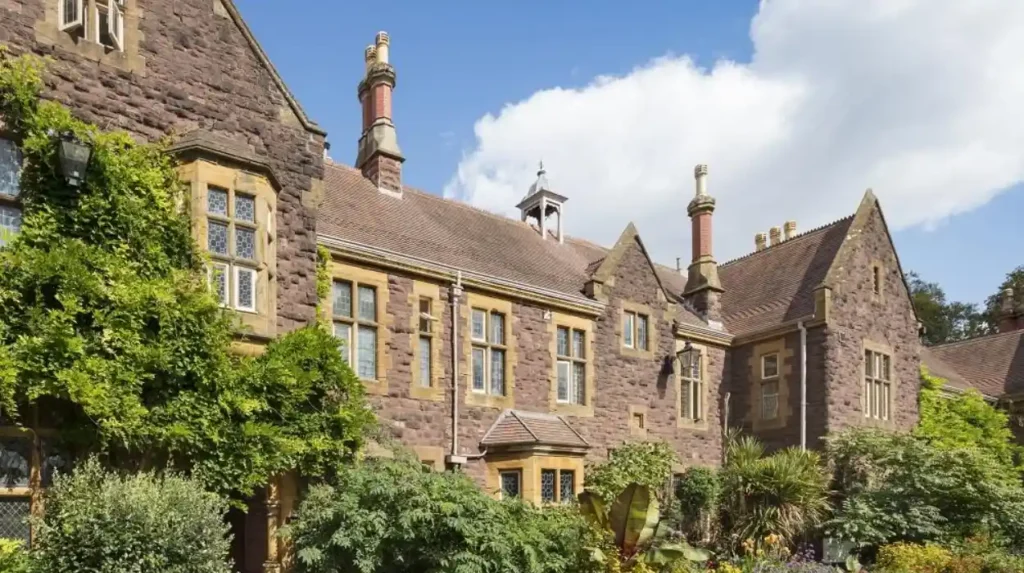
Its historic architecture includes buildings from the seventeenth, eighteenth, nineteenth and early twentieth centuries. Stoke House, for example, dates from 1669 and is listed at Grade II*. It was extended in the eighteenth century and partly refaced in 1872.
Stoke Lodge provides another important architectural reference. The house dates from 1836 and was altered in 1889. Historic England records it as a Grade II listed building.
The area is also strongly associated with the University of Bristol. Several university residences occupy sites in Stoke Bishop, including Churchill Hall, Badock Hall and Wills Hall. The university identifies each as being in Stoke Bishop.
Green space is another defining characteristic. Stoke Bishop provides access to open landscapes and walking routes around the western and northern parts of Bristol.
The combination of heritage, education and open space gives Stoke Bishop a different physical character from denser inner-city districts.
How old is Stoke Bishop?
Stoke Bishop has a history extending from prehistoric settlement through medieval landholding to the development of large country houses and modern suburban Bristol. The Druid Stoke burial chamber dates to the Neolithic period, while surviving houses record later centuries.
The earliest major archaeological evidence is the Druid Stoke burial chamber on Druid Hill. Historic England identifies it as a Neolithic Cotswold-Severn type megalithic chamber tomb. Its origins date to the prehistoric period, around 3500 BC.
The monument is a Scheduled Monument, a legal designation used to protect nationally important archaeological sites. Historic England records archaeological survey and excavation during the 1980s and notes the survival of collapsed stones from the chamber.
The medieval landscape developed around agricultural land, estates and ecclesiastical connections. Stoke Bishop remained distinct from the denser urban core of Bristol for much of its history.
The surviving buildings show how the landscape changed over time.
Stoke House is dated to 1669. Its architectural history includes later extensions and alterations.
Stoke Abbey Farmhouse is dated to 1670. The listed building contains surviving elements associated with its seventeenth-century construction.
The Red House on Coombe Lane is dated to 1654 and was refaced around 1800. Historic England records its earlier fabric and later Georgian alterations.
These buildings demonstrate that Stoke Bishop’s historic character is not based on one period. It contains archaeological evidence from prehistory alongside surviving domestic and institutional architecture from later centuries.
Which historic buildings can you see in Stoke Bishop?
Historic buildings in Stoke Bishop include Stoke House, Stoke Lodge, Stoke Bishop Village Hall, Stoke Abbey Farmhouse, The Red House and Cote. These buildings represent architectural development from the seventeenth century through the nineteenth century.
Stoke House is one of the area’s most significant historic buildings. Historic England lists it at Grade II*, a designation applied to particularly important buildings of more than special interest. The house was built in 1669 and later modified.
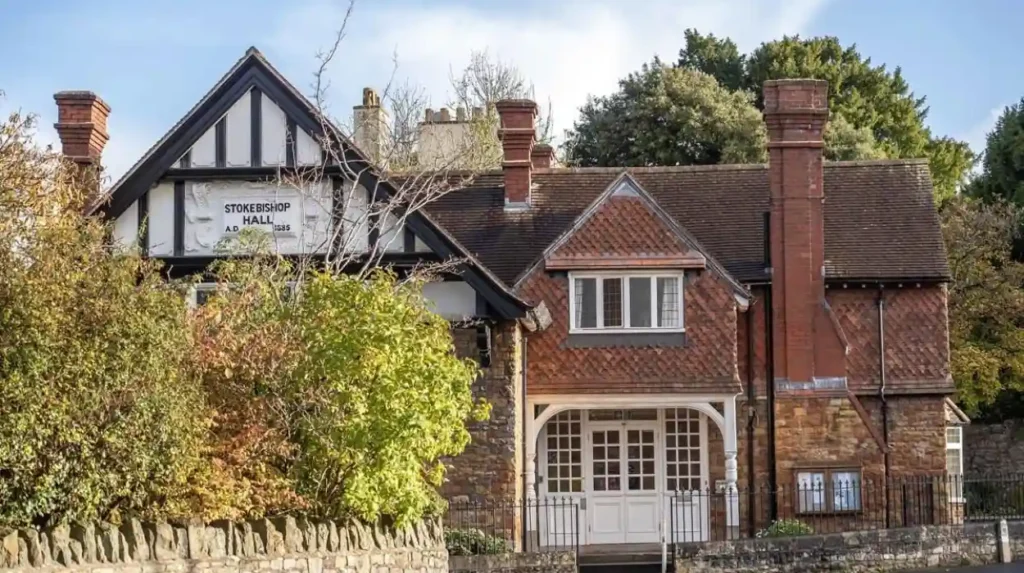
Stoke Bishop Village Hall is another prominent historic structure. The building dates from 1885 and was designed by Edward Gabriel. It is listed at Grade II. Its architecture includes a half-timbered upper gable and a large glazed bay.
The Red House at 40 Coombe Lane dates from 1654. Its later appearance reflects an eighteenth-century or early nineteenth-century transformation, including a Georgian-style frontage.
Cote on Cote Drive dates from around 1720 and is listed at Grade II*. Its architectural features include rusticated pilasters, a modillion cornice and an early Georgian composition.
Stoke Abbey Farmhouse dates from 1670 and retains historic features including its seventeenth-century door.
These properties are primarily viewed from public areas. Listing does not mean that a building is open to visitors. Historic England’s National Heritage List provides the statutory information for protected sites.
What green spaces are near Stoke Bishop?
Stoke Bishop has direct access to several major green spaces in north-west Bristol, including Durdham Downs and the wider Blaise Castle landscape. These spaces provide opportunities for walking, informal recreation, outdoor exercise and access to historic landscapes.
Green space is central to Stoke Bishop’s geographic setting.
Durdham Downs is one of Bristol’s major open spaces and forms part of the wider Downs landscape between Stoke Bishop and Clifton. Its large areas of grassland create opportunities for walking and informal recreation close to the built-up neighbourhood.
Blaise Castle Estate lies to the north-west. The estate combines parkland, woodland, historic buildings and archaeological features. Its landscape provides longer walking opportunities than the smaller green spaces immediately within residential streets.
The wider area also connects with walking routes around Westbury-on-Trym, Henleaze and Sea Mills.
For visitors, these spaces provide an alternative to Bristol’s central attractions. A Stoke Bishop visit can therefore combine architecture, local history and outdoor activity without requiring a journey into the city centre.
For residents, the proximity of large open spaces contributes to the area’s recreational infrastructure.
The importance of green space also relates to Bristol’s wider urban geography. Bristol City Council’s ward data provides information on population, age, housing and other indicators across the city, allowing neighbourhood characteristics to be considered alongside the city’s wider development.
How important is the University of Bristol to Stoke Bishop?
The University of Bristol has a major physical presence in Stoke Bishop through several student residences. Churchill Hall, Badock Hall and Wills Hall are located in the area, linking Stoke Bishop directly with the university’s student accommodation network.
University accommodation forms one of the most recognisable modern features of Stoke Bishop.
Churchill Hall is located on Stoke Park Road. For 2026/27, the University of Bristol lists accommodation ranging from traditional single rooms to studios and records a 38-week tenancy structure for its main buildings.
Badock Hall is also on Stoke Park Road. The university lists undergraduate accommodation at the residence and identifies the location as Stoke Bishop.
Wills Hall is on Parry’s Lane and provides another large university residence in the neighbourhood. The university lists both catered and self-catered accommodation options for 2026/27.
The university presence affects the local demographic profile and daily movement patterns. Students use the area’s roads, buses, walking routes and local services while travelling between halls and university campuses.
Bristol has a substantial higher-education population. Bristol City Council reports 68,800 students registered at the city’s two main universities in 2024/25.
Stoke Bishop therefore forms part of a wider education landscape that contributes significantly to Bristol’s economy, housing market and transport demand.
What is the population profile of Stoke Bishop?
Stoke Bishop has an older population profile than several central Bristol wards, alongside established households and a significant university presence. Bristol City Council reported that 20.6% of Stoke Bishop residents were aged 65 or over in mid-2024 estimates.
Population data needs to be interpreted according to administrative boundaries. Stoke Bishop is a ward, and ward statistics do not represent every person living in the wider informal neighbourhood.
Bristol City Council’s latest population reporting identifies Stoke Bishop among the city’s wards with older population profiles. In the mid-2024 estimates, 20.6% of residents were aged 65 and over.
This contrasts with several central Bristol wards that have high concentrations of residents aged 18 to 24 because of their large student populations. The same council report identifies Clifton Down, Cotham, Central and Hotwells and Harbourside among wards with particularly high proportions of young adults.
Stoke Bishop’s demographic profile therefore combines established residential households with a student population linked to university halls.
This mixture affects the area’s housing, transport and community facilities. It also explains why Stoke Bishop cannot be described solely as either a family suburb or a student district.
What is housing like in Stoke Bishop?
Housing in Stoke Bishop includes established houses, period properties, larger residential buildings and university accommodation. Historic properties sit alongside twentieth-century housing, creating a varied built environment rather than one uniform architectural style.
The area’s housing history is closely connected with its former rural and estate character.
Large historic properties survive around Stoke Hill, Coombe Lane and Parry’s Lane. Examples include The Red House, Cote, Stoke Abbey Farmhouse and Stoke House. Their construction dates range from the seventeenth to eighteenth centuries.
Later residential expansion introduced additional housing forms.
The neighbourhood’s proximity to the University of Bristol also creates a separate student accommodation sector. Churchill Hall, Badock Hall and Wills Hall are institutional residences rather than conventional private housing.
Housing conditions and prices change over time, so current property figures should be checked against recent Land Registry and local market data rather than historical listings.
For people researching the area, the important structural point is the diversity of the housing stock. Stoke Bishop contains historic properties, established suburban homes and purpose-provided university accommodation within the same broad neighbourhood.
What schools and community facilities serve Stoke Bishop?
Stoke Bishop has local education and community facilities serving residents, families and students. Bristol City Council maintains school allocation information for Stoke Bishop Primary School, while Stoke Bishop Village Hall provides an important historic community building.
Stoke Bishop Primary School is a local primary education facility. Bristol City Council publishes annual allocation information for the school, including first-round and second-round allocation statements. The council published specific statements for the 2025 and 2026 admissions cycles.
School admissions depend on the published admission arrangements and the relevant year’s application process. Catchment information and allocation outcomes should therefore be checked directly with Bristol City Council when making a current school decision.
Community life also has a historical physical base in Stoke Bishop Village Hall at 42 Stoke Hill. Historic England dates the building to 1885 and lists it at Grade II.
The hall’s architectural importance reflects the area’s long-established community structure.
Other community facilities and services are distributed across the wider BS9 area rather than concentrated entirely within Stoke Bishop itself. Residents therefore use nearby Westbury-on-Trym, Henleaze, Clifton and other west Bristol districts for additional shopping, healthcare, leisure and services.
How well connected is Stoke Bishop?
Stoke Bishop is connected to central Bristol and surrounding neighbourhoods through local roads, bus services, walking routes and cycling connections. Its position near Clifton, Westbury-on-Trym and Henleaze provides several routes into the wider Bristol transport network.
Stoke Bishop does not have its own railway station. Rail passengers generally use stations elsewhere in Bristol depending on their destination.
The area’s road network includes Stoke Hill, Parry’s Lane, Druid Stoke Avenue, Coombe Lane and Shirehampton Road. These roads connect the neighbourhood with adjacent parts of north-west Bristol.
Bus services provide the principal form of public transport for many local journeys. Service patterns change, so current routes and timetables should be checked before travelling.
Walking also plays an important role because several university residences sit within the neighbourhood. The University of Bristol gives Churchill Hall a published walking time of 45 minutes to Clifton Campus. Badock Hall is listed at 50 minutes walking time to Clifton Campus.
These figures demonstrate the area’s relationship with the university’s main academic district.
Cycling provides another option for journeys toward Clifton and central Bristol, although routes involve hills in several directions. Bristol’s wider cycle network continues to evolve as the city develops transport infrastructure.
What can visitors do in and around Stoke Bishop?
Visitors can combine Stoke Bishop’s historic buildings, archaeological heritage, green spaces and nearby Bristol attractions. A local visit can include Druid Stoke, architectural streets, Durdham Downs and onward journeys toward Blaise Castle Estate, Clifton and Westbury-on-Trym.
The Druid Stoke burial chamber provides the area’s strongest archaeological attraction. It is a scheduled Neolithic monument and represents a rare Cotswold-Severn type chamber tomb. Historic England records it as an important surviving archaeological feature.
Architecture provides another visitor interest.
Stoke Hill contains several listed buildings, including Stoke House and Stoke Bishop Village Hall. Coombe Lane contains The Red House, while Cote Drive contains Cote.
Green-space visits can then extend toward Durdham Downs and Blaise Castle Estate.
The area’s location also makes it suitable for combining Stoke Bishop with a broader Bristol itinerary. Visitors can continue toward Clifton, the Clifton Suspension Bridge area, Westbury-on-Trym or other west Bristol destinations.
The key visitor feature is proximity. Stoke Bishop is not an isolated attraction. It forms part of a connected group of historic, residential and green landscapes in north-west Bristol.
Is Stoke Bishop suitable for families, students and older residents?
Stoke Bishop supports several types of residents because it combines established housing, schools, university residences, green spaces and access to wider Bristol services. Its demographic structure includes older residents, households and a substantial student presence.
Families benefit from access to local education and open space. Stoke Bishop Primary School provides a local primary education option, while nearby districts provide additional schools and services.
Students have a particularly visible presence because of the University of Bristol residences. Churchill Hall, Badock Hall and Wills Hall all operate in Stoke Bishop.
Older residents also form a significant part of the population. Bristol City Council’s mid-2024 estimates put the proportion aged 65 and over at 20.6% in Stoke Bishop ward.
The neighbourhood therefore contains different residential needs within a relatively compact area.
Its green spaces support outdoor recreation. Its roads provide access to surrounding districts. Its historic buildings provide a visible connection to earlier phases of Bristol’s development.
Explore More Area Guide
Westbury-on-Trym Bristol: History, Living, Transport and Things to Do
Henleaze Area Guide: History, Homes, Shops and Transport
What makes Stoke Bishop different from other Bristol neighbourhoods?
Stoke Bishop combines four distinctive characteristics: historic architecture, prehistoric archaeology, university accommodation and access to major green spaces. This combination creates a neighbourhood that links Bristol’s historic landscape with its modern residential and higher-education infrastructure.
Many Bristol neighbourhoods have individual historic buildings or large green spaces. Stoke Bishop combines both with a substantial university presence.
Its archaeological history reaches back to the Neolithic period through the Druid Stoke burial chamber. Its architectural history includes seventeenth-century buildings such as Stoke House and Stoke Abbey Farmhouse. Its nineteenth-century development includes Stoke Bishop Village Hall and Stoke Lodge.
Its modern identity is also shaped by the University of Bristol’s residential infrastructure.
The area therefore has a layered structure. Prehistoric archaeology sits beneath a landscape later shaped by agriculture and estates. Historic houses remain among modern streets. University halls operate beside established homes. Major green spaces remain close to residential development.
That combination defines Stoke Bishop within Bristol’s wider geography.
Why is Stoke Bishop important to Bristol today?
Stoke Bishop remains important because it connects residential Bristol with higher education, heritage and open-space networks. Its current population structure, university residences and historic environment make it relevant to housing, community planning, education, recreation and local tourism.
Bristol continues to grow. Bristol City Council estimates the city’s mid-2025 population at 495,300, with the population projected to reach 526,600 by 2032.
This growth increases the importance of established neighbourhoods such as Stoke Bishop. Housing, transport, schools, green spaces and heritage assets all form part of the city’s long-term planning considerations.
The area also illustrates why local identity cannot be defined only by modern housing. Archaeological remains and listed buildings provide physical evidence of earlier settlement and land use.
At the same time, university accommodation connects Stoke Bishop with one of Bristol’s most important economic and educational sectors.
For residents, Stoke Bishop provides access to established community infrastructure and nearby green space. For students, it provides university accommodation close to the Clifton academic area. For visitors, it offers a route into Bristol’s historic and landscape heritage beyond the central tourist core.
Stoke Bishop is therefore best understood as a north-west Bristol neighbourhood with a long historical record, a strong university presence, established residential streets and direct connections to major green spaces.
Its identity is shaped by the interaction of these features rather than by a single attraction or period of history.
Where is Stoke Bishop in Bristol?
Stoke Bishop is a residential area in north-west Bristol, within the BS9 postcode district. It sits close to Clifton, Westbury-on-Trym, Henleaze, Sea Mills and Durdham Downs.