Bristol is a major student city in South West England. The city combines two large universities, established student neighbourhoods, extensive private rental housing, purpose-built accommodation, green spaces and strong links between residential districts and university campuses.
- Which areas are popular with students in Bristol?
- Why do students choose Clifton?
- Is Redland a good area for University of Bristol students?
- What are Cotham and Kingsdown like for students?
- Why is Stoke Bishop popular with University of Bristol students?
- Are Bishopston and Gloucester Road suitable for students?
- Why do students choose Horfield?
- Is Fishponds a suitable student area in Bristol?
- Why do students consider the Bristol city centre?
- Is Frenchay one of the main areas for UWE Bristol students?
- How should students choose between Bristol neighbourhoods?
- What should students check before renting in Bristol?
- How does Bristol’s student housing landscape compare across the city?
- Which Bristol areas suit different types of students?
- How is Bristol likely to remain important for students?
The University of Bristol and the University of the West of England Bristol (UWE Bristol) attract students to different parts of the city. Bristol City Council reports that 68,800 students were registered at the city’s two main universities in 2024/25. Bristol’s estimated population reached 495,300 in mid-2025, creating a substantial higher-education community within the wider population.
Student housing in Bristol is distributed across several neighbourhoods rather than concentrated in one district. Clifton, Cotham, Redland and Kingsdown sit close to the University of Bristol’s main Clifton campus. Stoke Bishop contains a major concentration of University of Bristol residences. City-centre accommodation serves students who prioritise central access. Frenchay and Fishponds are particularly relevant to UWE Bristol students.
Location affects daily travel, accommodation type, access to shops, green space and social facilities. The most suitable area therefore depends on the university campus, course location, housing requirements and preferred travel pattern.
Which areas are popular with students in Bristol?
Popular student areas in Bristol include Clifton, Redland, Cotham, Kingsdown, Stoke Bishop, Bishopston, Horfield, Fishponds, Southville, Bedminster, the city centre and Frenchay. Each area connects different campuses, housing types, shops, transport routes and local facilities.
The University of Bristol identifies Clifton, Cotham and Redland as popular residential areas close to its campus. It also identifies Stoke Bishop, Bishopston, Horfield, Southville, Bedminster, Montpelier and other districts as areas within walking distance or with established public transport connections.
UWE Bristol has a different geographical pattern. Its main Frenchay Campus is approximately four miles north of Bristol city centre and around a 15-minute Metrobus journey from the centre. Glenside Campus is in Fishponds, while its City Campus covers creative and cultural-industry locations including Bower Ashton, Spike Island, Arnolfini and Watershed.
This campus structure explains why student housing is spread across Bristol. A neighbourhood close to one university campus is not automatically close to another. Students therefore need to identify their principal teaching location before choosing accommodation.
Why do students choose Clifton?
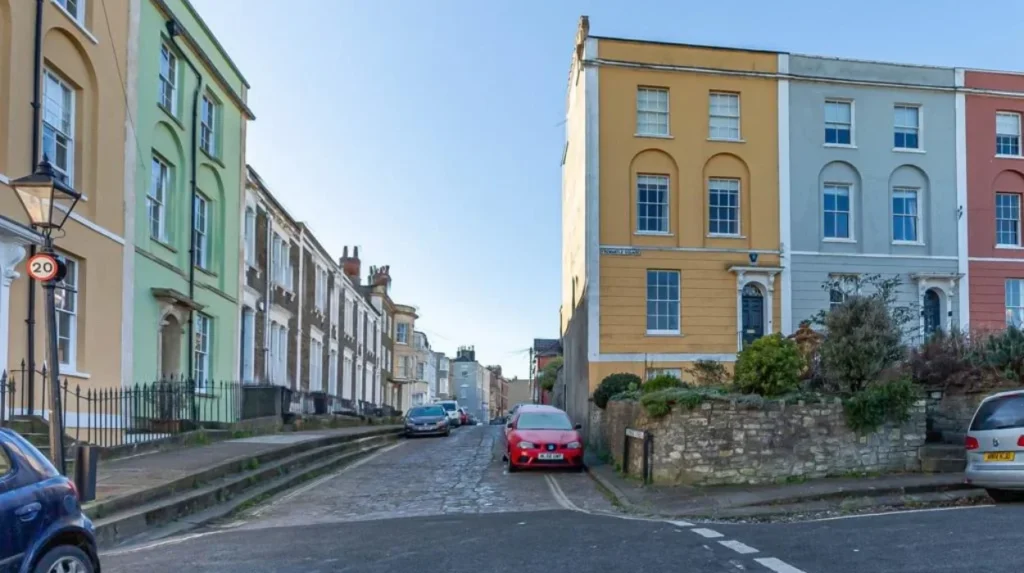
Clifton attracts students because it sits close to the University of Bristol’s main campus and provides shops, cafés, restaurants, green spaces, university residences and established private housing within a compact central-west Bristol neighbourhood.
Clifton is closely associated with the University of Bristol. The university’s main campus is located in the Clifton area, making the neighbourhood a practical base for students with regular teaching commitments around Clifton Campus.
University accommodation is distributed throughout Clifton. Examples include Clifton Hill House, Goldney Hall, Queen’s Road and Campus Houses. Campus Houses on St Michael’s Park are listed by the university as a five-minute walk from Clifton Campus. Queen’s Road accommodation is listed as a 15-minute walk from the campus.
Clifton also contains Clifton Village, a district known for independent shops, cafés and restaurants. Clifton Down provides access to open space, while the wider area connects with landmarks such as the Clifton Suspension Bridge.
Housing costs vary substantially by property type and contract. The University of Bristol describes Clifton as a high-demand residential area and states that it is more expensive than some other parts of Bristol.
Students considering Clifton therefore need to compare private house shares, university residences and purpose-built accommodation rather than treating the whole neighbourhood as one housing market.
Is Redland a good area for University of Bristol students?
Redland is a major University of Bristol student neighbourhood because it borders the Clifton campus area, contains student accommodation and shared houses, and provides local shops, cafés, transport connections and everyday services within residential streets.
Redland sits alongside Clifton, Cotham and Kingsdown in north-east Bristol. The University of Bristol states that a significant number of Redland residents are students. Shared houses are a common feature of the local housing pattern.
The area combines residential streets with commercial activity along routes such as Whiteladies Road and Gloucester Road. Students can access food shops, cafés, restaurants and other everyday services without relying on the city centre for every purchase.
University accommodation also operates in Redland. Woodland Court is located on Belgrave Road and provides postgraduate accommodation. The university lists the residence as a 10-minute walk from Clifton Campus.
Redland Road is another University of Bristol accommodation location. Its residence facilities include bike storage, social spaces, laundry facilities and internet access.
The neighbourhood therefore works particularly well for students who want to remain close to university facilities while living in an established residential district. Private rents differ according to property size, condition, location and sharing arrangements, so individual property comparisons remain important.
What are Cotham and Kingsdown like for students?
Cotham and Kingsdown provide close access to the University of Bristol campus, independent food businesses, cafés and residential streets, making them established student neighbourhoods for people who prioritise walking access to university buildings and central Bristol facilities.
Cotham and Kingsdown sit immediately around the Clifton campus. The University of Bristol describes both as small neighbourhoods surrounding the campus. Many students live in shared houses across the wider area.
Cotham is particularly associated with independent eateries. Cotham Hill contains pedestrianised space and hosts neighbourhood events. Kingsdown is more strongly residential, with St Michael’s Hill forming a prominent local route.
The location creates short journeys to university buildings on Woodland Road and surrounding streets. The same position also provides access towards central Bristol.
The physical geography matters. Bristol has several steep streets, and St Michael’s Hill is one of the steepest routes in the city according to the University of Bristol’s local neighbourhood guide. Students walking or cycling regularly need to account for the terrain when selecting accommodation.
Cotham and Kingsdown are therefore particularly relevant for students whose priorities include proximity to the University of Bristol, local cafés and residential shared housing.
Why is Stoke Bishop popular with University of Bristol students?
Stoke Bishop contains a major concentration of University of Bristol student residences, with more than 2,000 students living in university accommodation and regular bus connections linking the area with Clifton campus and Bristol city centre.
Stoke Bishop is located north-west of the University of Bristol’s Clifton campus. The university describes the area as a strong student community, with many undergraduate students living in its residences.
University residences in Stoke Bishop include Badock Hall, Churchill Hall, Wills Hall and University Hall. The university states that its Stoke Bishop residences are home to more than 2,000 students. Accommodation includes catered, self-catered, en-suite and shared-bathroom options.
The area sits close to green spaces including Clifton Down and provides access towards Blaise Castle Estate. The university also operates Coombe Dingle Sports Complex nearby.
Travel times differ between individual residences. For example, Badock Hall is listed as a 50-minute walk from Clifton Campus, while Wills Hall is listed as a 40-minute walk. Bus connections provide a faster alternative for regular campus journeys.
Stoke Bishop is therefore strongly associated with undergraduate university life and purpose-built or university-managed student accommodation.
Are Bishopston and Gloucester Road suitable for students?
Bishopston and the Gloucester Road corridor provide student-friendly housing, independent shops, cafés, restaurants and transport connections north of central Bristol, with access towards the University of Bristol and other parts of the city.
Bishopston lies north of the central university area and is connected with the Gloucester Road commercial corridor. The University of Bristol identifies Bishopston among areas within a longer walking distance of its main campus.
Gloucester Road is one of Bristol’s established independent retail and food destinations. Students living nearby have access to supermarkets, cafés, restaurants, specialist shops and everyday services.
The area also provides a transition between the university neighbourhoods around Redland and the northern districts of Bristol. This makes it relevant to students who want access to university areas without living directly beside campus.
Travel requirements depend on the exact address. Bristol’s geography changes considerably over short distances, and journey times vary according to walking routes, bus services and cycling conditions.
Bishopston is also close to Horfield and other northern neighbourhoods. Students searching for shared houses therefore have several adjacent districts to compare rather than relying on one postcode.
Why do students choose Horfield?
Horfield gives students access to more residential housing north of the city centre, with connections towards Gloucester Road, Bishopston, University of Bristol facilities and UWE Bristol’s Frenchay Campus depending on the exact location.
Horfield is north of Bristol city centre and sits close to Bishopston, Filton and other northern districts. The University of Bristol identifies Horfield as a residential area with transport links to the university and city.
Its location makes it relevant to students searching beyond the closest and most expensive university neighbourhoods. Shared houses and private rentals form an important part of the housing market across north Bristol.
Horfield also provides access towards major transport corridors serving the northern part of Bristol. Students attending UWE Bristol need to examine the specific bus route and campus location because Frenchay Campus lies further east than the University of Bristol’s Clifton campus.
The practical benefit of Horfield is its position within a larger northern residential area. Students can compare properties across Horfield, Bishopston, Filton and neighbouring districts according to rent, room size, travel time and local facilities.
Is Fishponds a suitable student area in Bristol?
Fishponds is particularly relevant to UWE Bristol students because UWE’s Glenside Campus is located there, while the area also provides shops, cafés, housing and transport links towards Frenchay Campus and central Bristol.
Fishponds is approximately three miles north-east of Bristol city centre. UWE Bristol’s Glenside Campus is located in the area and serves allied health, nursing and midwifery students.
The location creates a direct connection between accommodation and specialist university facilities for students based at Glenside.
Fishponds also sits on routes towards Frenchay. This gives students studying at different UWE campuses an area to consider when comparing accommodation.
UWE Bristol provides accommodation at Glenside as well as Frenchay and city-centre locations. Its accommodation application system allows students to express preferences covering Frenchay, city-centre and Glenside options.
Local facilities include shops, food businesses and services along Fishponds Road and surrounding streets. Students can therefore combine campus access with established neighbourhood amenities.
Fishponds is especially relevant when course location is the main housing consideration. A student based at Glenside has different daily travel requirements from a student studying at UWE’s Frenchay Campus or City Campus.
Why do students consider the Bristol city centre?
Bristol city centre suits students who prioritise central accommodation, access to shops, restaurants, cultural venues, transport connections and multiple university locations rather than living directly beside one suburban campus.
Central Bristol contains a growing supply of purpose-built student accommodation. University of Bristol residences include city-centre locations such as Marketgate and The Courtrooms. Marketgate is listed as a 27-minute walk from Temple Quarter Campus and a 30-minute walk from Clifton Campus.
The Courtrooms is another central residence. The university lists it as a 20-minute walk from both Clifton Campus and Bristol Dental School, with a 25-minute walk to Temple Quarter Campus.
City-centre living also provides direct access to Bristol’s retail, cultural and entertainment infrastructure. Harbourside, Broadmead, St Nicholas Market and major transport corridors are within the central area.
UWE Bristol also offers city-centre accommodation alongside Frenchay and Glenside options. Its accommodation information confirms that students can choose between campus and city-centre locations.
The central location is therefore useful for students whose timetable involves different sites or who want direct access to central services. Accommodation costs vary significantly by building, room type and tenancy length.
Is Frenchay one of the main areas for UWE Bristol students?
Frenchay is a major student location because UWE Bristol’s main campus is four miles north of Bristol city centre, with purpose-built accommodation, university facilities, shops, food outlets, sports facilities and public transport on or near campus.
UWE Bristol describes Frenchay as its largest campus. The university states that it is approximately four miles north of Bristol city centre and around 15 minutes from the centre by Metrobus.
The campus includes the Students’ Union, a 24-hour library, sports facilities, shops, cafés, bars and restaurants. These facilities reduce the need for students to travel into central Bristol for routine campus activities.
UWE provides several accommodation options at Frenchay. Student Village contains space for more than 2,000 students. Wallscourt Park contains more than 900 rooms. Purdown View provides accommodation for 900 students.
The Student Village is within walking distance of lectures, the library and Students’ Union. Nearby facilities include Abbeywood Retail Park, Sainsbury’s and Lidl. Stoke Park Estate is also within walking distance.
Frenchay therefore functions as both an academic and residential student hub. It is particularly relevant for UWE students whose teaching takes place on the main campus.
How should students choose between Bristol neighbourhoods?
Students should compare neighbourhoods using campus distance, accommodation cost, property type, transport, local services, green space and tenancy requirements. The correct comparison starts with the student’s teaching campus and then considers daily travel and housing priorities.
Campus location is the first factor. University of Bristol students commonly compare Clifton, Cotham, Redland, Kingsdown, Stoke Bishop, Bishopston and central Bristol. UWE students commonly compare Frenchay, Fishponds, the city centre and locations connected to Glenside or City Campus.
Accommodation type is the second factor. University-managed halls provide structured contracts and communal facilities. Private rentals include shared houses, flats and rooms within larger properties.
Travel time is the third factor. The University of Bristol states that Clifton, Cotham and Redland are particularly close to campus, while Stoke Bishop, Bishopston and Horfield require longer journeys.
Budget is another important consideration. The University of Bristol identifies Clifton, Cotham and Redland as higher-demand and more expensive areas than some alternatives.
Students should also calculate the complete housing cost. Rent is only one component. Utilities, internet, transport, food, deposits and other household expenses affect the total monthly budget.
What should students check before renting in Bristol?
Students should check the total rent, tenancy length, deposit requirements, utility arrangements, property condition, transport route, walking distance, local services and contract terms before committing to accommodation in any Bristol neighbourhood.
Tenancy length matters because university contracts differ from private rental arrangements. University residences can have fixed academic-year contracts, while private properties use different tenancy structures.
Room type also affects cost. En-suite rooms, shared bathrooms, studios and shared houses represent different accommodation formats. UWE Bristol and the University of Bristol publish specific accommodation prices and contract information for their managed residences.
Students should calculate the journey to their actual teaching building rather than simply measuring distance to the university name. Bristol universities operate across multiple campuses and sites.
The local environment also matters. Students who cycle should check bike storage and route conditions. Students who rely on buses should check the route and timetable. Students who walk should consider hills and evening travel requirements.
Accommodation inspections should cover heating, ventilation, damp, windows, appliances, security, internet availability and communal areas. Private renters should also understand the terms of the tenancy agreement before signing.
How does Bristol’s student housing landscape compare across the city?
Bristol’s student housing landscape ranges from university residences beside major campuses to private shared houses in established neighbourhoods and purpose-built accommodation in central locations, creating different combinations of convenience, housing cost and local amenities.
The University of Bristol operates residences across Clifton, Stoke Bishop, the city centre and other parts of Bristol. Its current accommodation information lists more than 30 named residence locations, including Clifton Hill House, Goldney Hall, Redland Road, Woodland Court, Wills Hall, University Hall, Marketgate and The Courtrooms.
UWE Bristol operates accommodation at Frenchay, Glenside and city-centre locations. Its Frenchay portfolio includes Student Village, Wallscourt Park, Purdown View and Kingfisher Court.
This distribution creates several distinct student housing patterns. Clifton and neighbouring districts concentrate on proximity to the University of Bristol. Stoke Bishop concentrates university residences and undergraduate communities. Central Bristol provides access to city facilities and multiple university sites. Fishponds and Frenchay are particularly important for UWE students.
Bristol’s student population also gives these neighbourhoods long-term relevance. With 68,800 students registered at the city’s two main universities in 2024/25, student accommodation remains an important part of the city’s residential structure.
The strongest location choice depends on the relationship between accommodation and daily routine. Campus distance, housing type, budget, transport and local facilities provide the most useful framework for comparing Bristol student areas.
Explore More Area Guide
Best Areas for Families in Bristol: Top Family Neighbourhoods
Best Areas to Live in Bristol: Top Neighbourhoods
Which Bristol areas suit different types of students?
University of Bristol students often examine Clifton, Redland, Cotham, Kingsdown and Stoke Bishop, while UWE students examine Frenchay, Fishponds, Glenside and central Bristol. Shared-house seekers also consider Bishopston, Horfield, Southville and Bedminster.
Students prioritising University of Bristol campus access have several established neighbourhoods immediately around Clifton Campus. Clifton, Cotham, Kingsdown and Redland provide close access to university buildings and established local services.
Students wanting university-managed undergraduate accommodation frequently encounter Stoke Bishop, where the university has a substantial concentration of residences.
UWE students need to match accommodation with their specific campus. Frenchay is the main campus and contains substantial student accommodation. Glenside serves allied health, nursing and midwifery students. City Campus serves creative and cultural industries courses.
Students seeking shared private housing have a wider geographical choice. Bishopston, Horfield, Southville and Bedminster provide alternatives beyond the closest university neighbourhoods. The University of Bristol includes these districts among areas with walking or public transport connections to its campus.
The result is a broad student housing network rather than one single student quarter. Bristol students can select accommodation according to campus, budget, transport and preferred neighbourhood environment.
How is Bristol likely to remain important for students?
Bristol’s large higher-education population, expanding university facilities, diverse accommodation network and multiple campuses support continued demand for student housing across central, northern, western and north-eastern neighbourhoods.
Bristol’s population is projected by Bristol City Council to reach 526,600 by 2032, representing a projected 10% increase from 2022. The council also records substantial cultural and international diversity across the city, with residents connected to more than 185 countries of birth.
The higher-education landscape is distributed across established campuses and newer development areas. The University of Bristol has accommodation linked to Clifton, Stoke Bishop, the city centre and Temple Quarter. UWE Bristol continues to operate major facilities at Frenchay, Glenside and City Campus locations.
For students, this means neighbourhood selection remains closely connected to campus geography. A property that is convenient for Clifton Campus has a different travel profile from a property near Frenchay or Glenside.
Bristol therefore offers a wide range of student residential environments. Clifton, Redland, Cotham, Kingsdown and Stoke Bishop form important University of Bristol locations. Bishopston and Horfield extend student housing into north Bristol. Fishponds and Frenchay are significant UWE locations. Central Bristol provides a multi-campus and city-centre option.
Students choosing accommodation can use these geographical patterns as a starting point, then compare individual properties using current rent, contract, transport and campus information.
What are the best areas for students in Bristol?
Clifton, Redland, Cotham, Kingsdown, Stoke Bishop, Bishopston, Horfield, Fishponds, Southville, Bedminster, Frenchay and central Bristol are established student areas. The best location depends on the university campus, budget and daily travel requirements.