Bristol is one of the UK’s most recognised destinations for street art, with colourful murals, political graffiti, large-scale wall paintings and experimental urban artwork across its neighbourhoods. The city’s creative identity connects historic graffiti culture, independent artists, community projects and internationally recognised names such as Banksy. From Stokes Croft and Nelson Street to North Street in Bedminster, Bristol’s streets provide an extensive outdoor gallery that reflects the city’s history, social identity and contemporary artistic development.
- What Is Street Art in Bristol?
- How Did Bristol Develop Its Street Art Culture?
- How did the 1980s influence Bristol’s graffiti movement?
- How did Banksy influence Bristol’s street art identity?
- What happened during the 2000s?
- Where Can Visitors Find the Best Street Art in Bristol?
- 1. Stokes Croft
- 2. North Street, Bedminster
- 3. Nelson Street
- 4. Leonard Lane
- 5. Park Street
- 6. East Street and Southville
- Who Are the Most Influential Street Artists in Bristol?
- What Is Upfest and Why Is It Important to Bristol Street Art?
- What Artistic Techniques Are Used in Bristol’s Street Art?
- How Does Street Art Influence Bristol’s Local Communities?
- Community identity and representation
- Supporting independent businesses
- Public access to culture
- Social and political expression
- How Can Visitors Explore Bristol’s Street Art?
- What is a useful city-centre street art route?
- What is a useful Bedminster street art route?
- Are organised street art tours available?
- Can visitors use mural maps?
- Where Can Visitors Learn More About Bristol’s Street Art?
- What Should Visitors Know About Street Art Photography in Bristol?
- How Does Bristol Protect and Maintain Its Street Art?
- Why do some murals disappear?
- How does permission affect street art?
- How can important murals be preserved?
- Why Is Bristol’s Street Art Important to the City’s Future?
Street art in Bristol is more than decorative artwork. It represents a cultural movement shaped by local communities, independent creative organisations, public events and artists who use urban spaces to communicate ideas. The city’s walls showcase different artistic techniques, including spray painting, stencilling, paste-ups, lettering, illustration and large-scale murals.
Visitors exploring Bristol can discover famous Banksy pieces, festival-created murals, experimental graffiti and artwork commissioned by local businesses. Residents also experience street art as part of everyday neighbourhood life, with new works regularly changing the appearance of familiar streets.
What Is Street Art in Bristol?
Street art in Bristol is a form of public visual expression displayed on walls, buildings, bridges, shutters and other urban surfaces. It includes murals, graffiti, stencils and commissioned artwork created by local and international artists. The movement forms an important part of Bristol’s cultural identity.
Street art transforms ordinary urban structures into public spaces for artistic expression. Unlike traditional gallery exhibitions, street artwork is often accessible without an entrance fee or formal booking. People encounter it while walking through residential streets, shopping districts, cultural neighbourhoods and city-centre locations.
Bristol’s street art scene includes several artistic approaches.
Traditional graffiti focuses on lettering, signatures, typography and stylised writing. Artists develop individual lettering techniques and use colour, outlines and complex compositions to distinguish their work.
Stencil art involves cutting shapes or designs into a material and applying spray paint through the openings. This technique creates recognisable images with defined outlines. Banksy is particularly associated with stencil-based artwork.
Large-scale murals cover substantial sections of buildings. These artworks frequently feature portraits, animals, abstract patterns, cultural references and social messages.
Paste-up art uses printed or hand-drawn images attached to walls with adhesive. This technique allows artists to display detailed illustrations without directly painting the surface.
Commissioned street art is produced with permission from property owners, organisations or public authorities. It often forms part of regeneration programmes, cultural events and community projects.
These approaches collectively establish Bristol as a significant centre for contemporary urban art in Britain.
How Did Bristol Develop Its Street Art Culture?
Bristol’s street art culture developed through underground graffiti activity during the 1980s and expanded throughout the 1990s and 2000s. Local creative communities, influential artists, independent venues and organised festivals helped establish the city as an internationally recognised destination.
Bristol’s relationship with graffiti predates its modern reputation as a street art destination. Historical wall writing and public inscriptions demonstrate that people have used urban surfaces to communicate messages for centuries.
Research by historian Stephen Poole, published through the University of the West of England, examines chalking and graffiti in Bristol between 1730 and 1930. This research provides historical context for understanding public writing as an established feature of the city’s social history. uwe-repository.worktribe.com
How did the 1980s influence Bristol’s graffiti movement?
During the 1980s, contemporary graffiti developed through youth culture, music, independent creative networks and urban subcultures.
Bristol became associated with a growing community of graffiti writers who experimented with lettering, spray paint and public walls. The movement developed alongside the city’s alternative music and artistic communities.
These early developments established a foundation for the more diverse street art culture that followed.
How did Banksy influence Bristol’s street art identity?
Banksy became one of the most internationally recognised artists associated with Bristol. The artist emerged from the city’s graffiti environment during the 1990s and helped introduce stencil-based street art to wider audiences.
His work combines visual humour, political commentary and recognisable imagery. Several early works remain important attractions in Bristol.
Banksy’s international reputation also increased attention towards other Bristol artists, demonstrating that the city’s street art identity extends beyond one individual.
What happened during the 2000s?
The 2000s brought greater recognition and organisation to Bristol’s urban art scene.
Upfest was established in 2008, providing an organised platform for street artists and attracting participants from different countries. In 2009, the exhibition Banksy versus Bristol Museum brought Banksy’s work into Bristol Museum and Art Gallery.
These developments connected informal street culture with established cultural institutions.
The following decade introduced additional large-scale public art projects, particularly the See No Evil initiative on Nelson Street in 2011 and 2012.
Where Can Visitors Find the Best Street Art in Bristol?
Visitors can find Bristol’s best street art in Stokes Croft, Bedminster, Southville, North Street, Nelson Street and Leonard Lane. These locations feature Banksy artworks, large-scale murals, independent graffiti and festival-created paintings across accessible public streets.
Bristol’s street art is distributed across several neighbourhoods rather than concentrated in one gallery or exhibition space. Each location offers a different artistic experience.
1. Stokes Croft
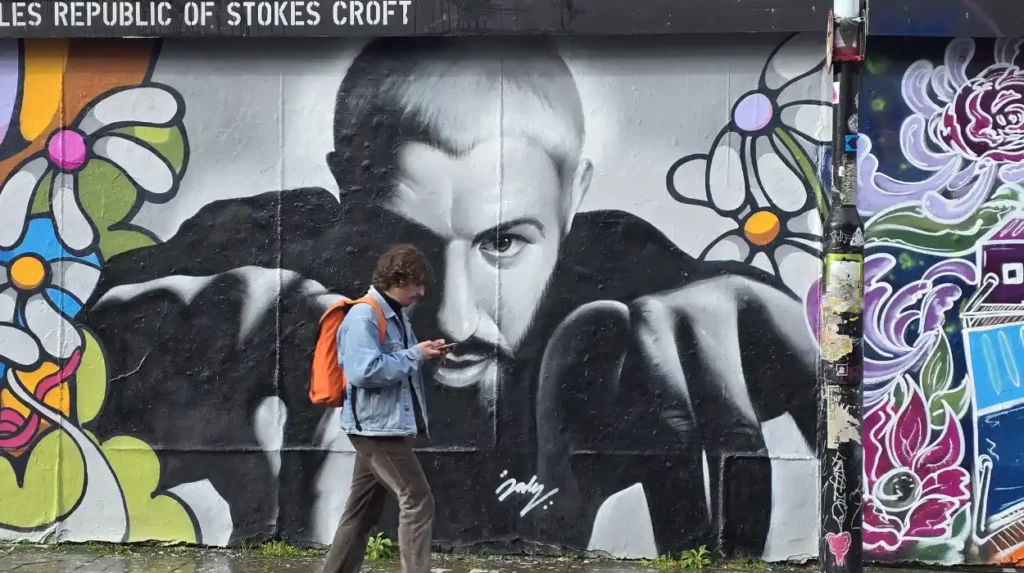
Stokes Croft is one of Bristol’s most recognisable street art destinations. Located between the city centre and Gloucester Road, the neighbourhood has an established independent cultural identity.
The area contains graffiti, commissioned murals, political artwork and constantly changing wall paintings. Independent businesses and community organisations contribute to its creative atmosphere.
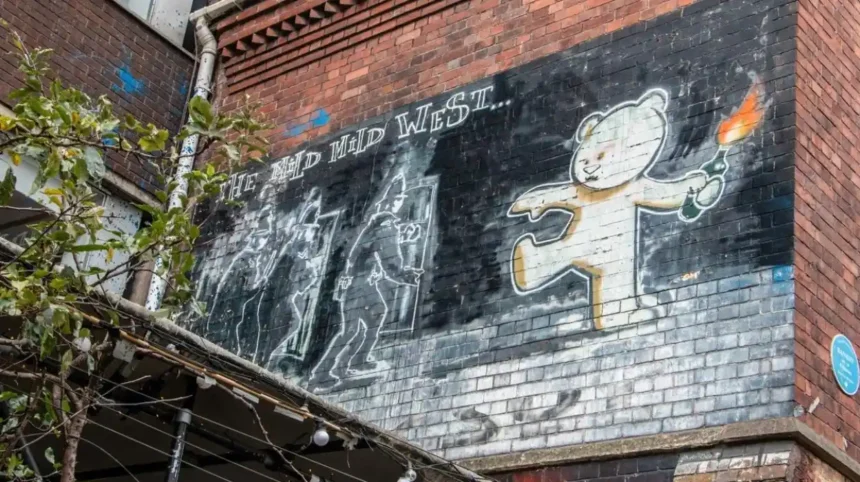
One of its most famous attractions is Banksy’s The Mild Mild West, located at 80 Stokes Croft. The mural depicts a teddy bear throwing a Molotov cocktail towards riot police.
Created in 1999, the artwork combines humour with a reference to social conflict and police confrontation. It remains an important example of Bristol’s connection with politically expressive street art.
Stokes Croft also features artwork associated with local artists and community campaigns. The University of Bristol identifies the neighbourhood as an important centre of countercultural activity and independent businesses. University of Bristol+1
2. North Street, Bedminster
North Street in Bedminster is one of the most important locations for discovering Bristol’s contemporary mural culture.
The street contains large painted walls, colourful shopfronts and artwork created during Upfest. The surrounding Southville neighbourhood also features murals produced by local and visiting artists.
Notable artwork includes The Six Sisters, created by Bex Glover, Lucas Antics, Zoe Power, Gemma Compton, Sophie Long and Ejits.
The Redpoint Climbing Centre and the Tobacco Factory are among the recognised landmarks associated with the area’s wider street art environment.
Visitors can explore numerous works within a relatively compact walking area. This makes North Street particularly suitable for photography, independent shopping and cultural walks.
3. Nelson Street
Nelson Street in central Bristol is famous for its large-scale murals created through the See No Evil street art project.
The project transformed the appearance of this central street during 2011 and 2012. International and British artists contributed enormous paintings to building façades, turning ordinary commercial architecture into a public art destination.
Recognisable works include murals associated with Nick Walker, Aryz, El Mac and Bristol-born artist Inkie.
The scale of the artwork distinguishes Nelson Street from smaller graffiti locations. Some paintings cover several storeys, making the surrounding buildings important parts of the compositions.
The project demonstrated how coordinated artistic commissions can change the visual character of a city-centre location.
4. Leonard Lane
Leonard Lane is a narrow passage in central Bristol known for its layered urban artwork.
Unlike Nelson Street’s enormous building murals, Leonard Lane features smaller-scale visual expressions. Its walls display graffiti lettering, stencils, paste-ups and overlapping artistic marks.
The lane offers a different perspective on Bristol’s street art culture because it demonstrates how artists use restricted urban spaces.
Visitors interested in photography and detailed graffiti techniques can explore the passage while walking through the Old City.
5. Park Street
Park Street is a historic shopping street that connects central Bristol with the Clifton area.
It is particularly famous for Banksy’s Well-Hung Lover, a mural on a building near Frogmore Street. The artwork depicts a man hanging from a window while another man looks outside.
Its location and distinctive visual composition have made it one of Bristol’s most recognisable street art attractions.
Park Street also features other artistic work, including The Florist by Bristol mural artist Jody.
The area combines street art with independent shops, restaurants, historic buildings and cultural attractions.
6. East Street and Southville
East Street and the surrounding Southville area provide additional opportunities to discover Bristol’s evolving street art culture.
The area features painted shutters, wall murals and smaller artistic interventions. Its connection with Bedminster’s wider creative community makes it a useful extension to a North Street walking route.
Visitors can also explore independent shops, cafés and local businesses while discovering different examples of urban artwork.
Who Are the Most Influential Street Artists in Bristol?
Bristol’s street art scene includes internationally recognised artists and established local creatives. Banksy, Inkie, Cheo, Jody, Andy Council, Lucas Antics and Felix Braun represent different approaches to graffiti, illustration, stencil art and large-scale mural production.
The city’s reputation depends on a broad creative community rather than a single artist. Different practitioners contribute distinctive techniques, subjects and artistic styles.
Banksy
Banksy is an internationally recognised street artist closely associated with Bristol.
The artist’s work frequently explores political subjects, consumer culture, conflict, authority and social inequality.
Important Bristol artworks include:
- The Mild Mild West in Stokes Croft.
- Well-Hung Lover near Park Street.
- The Girl with the Pierced Eardrum near Hanover Place.
- Paint Pot Angel, displayed at Bristol Museum and Art Gallery.
Banksy’s 2009 exhibition at Bristol Museum and Art Gallery, Banksy versus Bristol Museum, attracted significant public attention and strengthened the relationship between street art and established cultural institutions.
Inkie
Inkie is a Bristol-born graffiti artist associated with the city’s early graffiti movement.
His work combines traditional graffiti lettering with elaborate decorative compositions. He also contributed to the See No Evil project on Nelson Street.
Inkie’s artistic career demonstrates the development of Bristol graffiti from underground activity into internationally recognised urban art.
Cheo
Cheo is a Bristol graffiti artist known for distinctive characters, colourful illustrations and cartoon-inspired imagery.
His work contributes to the city’s recognisable visual identity and demonstrates the influence of illustration within contemporary graffiti.
Jody
Jody is a Bristol mural artist recognised for detailed and realistic painted compositions.
His work includes portraits, figurative artwork and large-scale murals. The Florist on Park Street is one of the recognised examples of his artistic contribution.
Andy Council
Andy Council is a Bristol-based artist known for imaginative illustrations and complex animal-inspired compositions.
His work frequently combines natural forms, architectural references and detailed visual patterns.
Lucas Antics and Felix Braun
Lucas Antics and Felix Braun are among the artists associated with Bristol’s broader contemporary creative community.
Their contributions demonstrate the diversity of techniques and visual styles found across the city’s street art
What Is Upfest and Why Is It Important to Bristol Street Art?
Upfest is Bristol’s internationally recognised street art festival, established in 2008. It brings together local and international artists to create murals and public artwork, particularly around Bedminster and Southville, strengthening Bristol’s reputation as a major urban art destination.
Upfest has played a significant role in developing Bristol’s contemporary street art culture.
The festival began through the work of people interested in making urban art more accessible to the public. It provides opportunities for artists to create large-scale paintings in visible public locations.
Its importance extends beyond the festival itself because many completed murals remain visible throughout the year.
How does Upfest work?
Upfest brings together artists, organisers, property owners, sponsors and local communities.
Artists work on selected walls and public-facing surfaces, producing original artwork using different materials and techniques.
The festival environment allows visitors to observe artistic processes, including:
- Spray painting and stencil application.
- Large-scale mural development.
- Character illustration and portrait painting.
- Collaborative artwork involving multiple artists.
- Experimental colour and lettering techniques.
For example, murals around North Street provide visible evidence of the festival’s continuing contribution to Bedminster.
Where does Upfest take place?
The festival is strongly associated with Bedminster and Southville.
North Street is a particularly important location because numerous murals are concentrated around its buildings and surrounding streets.
Other nearby walls and community spaces also contribute to the wider festival environment.
How many murals are associated with Upfest?
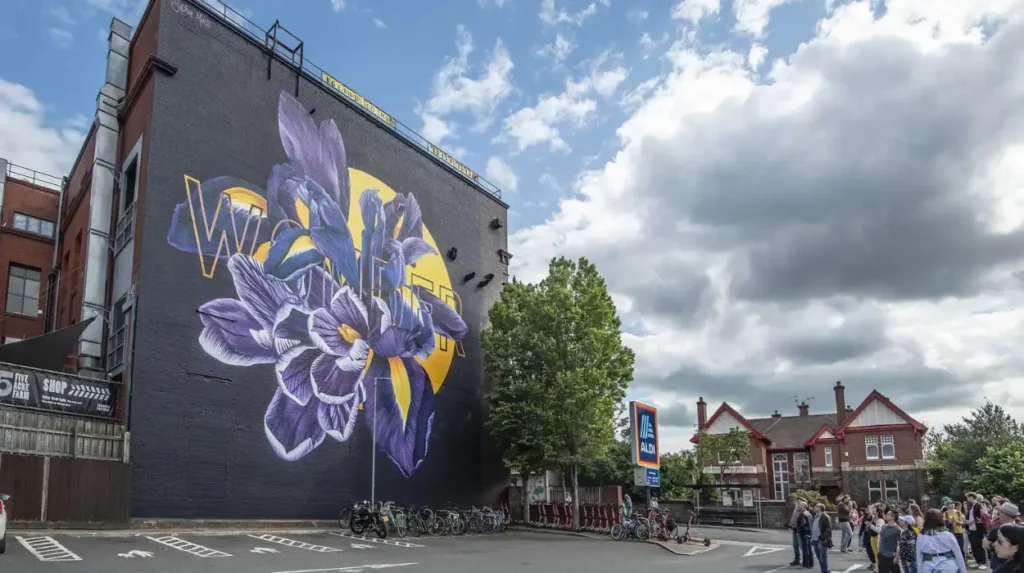
VisitBristol identifies more than 170 murals that visitors can explore around Bedminster and Southville through the Upfest mural collection.
This extensive collection allows visitors to discover artwork beyond the dates of organised festival activities.
Upfest’s 2026 edition was scheduled from 15 to 31 May 2026. Future editions should be checked through the official festival information because event dates and programming change.
What Artistic Techniques Are Used in Bristol’s Street Art?
Bristol street artists use several techniques, including spray painting, stencilling, freehand illustration, paste-ups, lettering and large-scale mural painting. Each technique creates different visual effects and determines how artists develop images on walls and other urban surfaces.
The city’s artistic diversity becomes clear when visitors examine individual murals rather than viewing street art as one uniform style.
Spray painting
Spray painting is one of the most common techniques used in urban art.
Artists apply aerosol paint directly to walls, creating outlines, gradients, lettering and detailed illustrations.
This method is particularly effective for large compositions because it allows artists to cover extensive surfaces efficiently.
Stencil art
Stencil art uses prepared templates to produce repeatable shapes and images.
Artists position the stencil against a wall and apply paint through its cut-out sections.
The technique supports detailed visual messages and recognisable characters. Banksy’s work provides some of Bristol’s best-known examples.
Freehand mural painting
Freehand mural painting involves creating artwork directly on a surface without relying entirely on templates.
Artists use brushes, rollers and spray cans to produce detailed portraits, landscapes, abstract designs and decorative patterns.
This method allows greater flexibility in composition and artistic expression.
Graffiti lettering
Traditional graffiti lettering focuses on stylised written forms.
Artists develop individual letter structures, outlines, shadows and colour combinations. Some designs prioritise readability, while others emphasise complex visual patterns.
Paste-up artwork
Paste-up techniques involve attaching prepared artwork to walls using adhesive.
This method supports detailed printed designs and temporary visual installations.
These different techniques make Bristol’s street art visually diverse and provide opportunities for artists with different creative skills.
How Does Street Art Influence Bristol’s Local Communities?
Street art influences Bristol’s communities by strengthening neighbourhood identity, supporting local creative activity and increasing public engagement with visual culture. Community murals also provide opportunities to communicate social issues, celebrate local history and improve the appearance of shared urban spaces.
Street art has a visible relationship with the communities that surround it.
In neighbourhoods such as Stokes Croft, Bedminster and Southville, public artwork contributes to local identity and distinguishes individual streets from other parts of the city.
Community identity and representation
Murals often reflect the cultural history, social experiences and interests of the surrounding neighbourhood.
Artists produce work that represents local people, community campaigns and important historical subjects.
This creates a connection between public artwork and the everyday experiences of residents.
Supporting independent businesses
Street art also contributes to the visual identity of independent commercial areas.
Businesses commission murals, decorate external walls and use artistic designs to distinguish their premises.
In Stokes Croft, the relationship between independent businesses and street art forms part of the neighbourhood’s distinctive character.
In Bedminster, festival-created murals contribute to the identity of North Street and its surrounding commercial environment.
Public access to culture
Street art provides an accessible way to experience contemporary visual culture.
Visitors do not need museum memberships or exhibition tickets to explore public murals.
The accessibility of these artworks supports informal cultural participation among residents, students and tourists.
Social and political expression
Some Bristol murals communicate political messages and social concerns.
Banksy’s work demonstrates how visual humour and recognisable imagery can challenge established ideas about power, conflict and consumerism.
Research into the graffiti applied to Bristol’s Edward Colston statue also demonstrates how public writing can become connected with historical memory and political debate.
How Can Visitors Explore Bristol’s Street Art?
Visitors can explore Bristol’s street art through self-guided walking routes, organised tours, festival mural maps and photography walks. Starting in Stokes Croft or Bedminster provides access to major concentrations of artwork and allows visitors to discover different artistic styles.
Walking is one of the most practical ways to experience Bristol’s street art because many important works are located along public streets.
A self-guided route also allows visitors to spend additional time examining individual murals.
What is a useful city-centre street art route?
A city-centre route can begin at Stokes Croft before continuing towards Nelson Street and Park Street.
Suggested route:
- Start at 80 Stokes Croft to see Banksy’s The Mild Mild West.
- Explore nearby streets for additional graffiti and commissioned artwork.
- Continue towards Nelson Street to discover the See No Evil murals.
- Walk through Leonard Lane to examine smaller-scale graffiti.
- Continue towards Park Street to see Well-Hung Lover.
This route combines internationally recognised artwork with examples of Bristol’s wider graffiti culture.
What is a useful Bedminster street art route?
Visitors interested in festival-created murals can concentrate on Bedminster and Southville.
Start along North Street and explore its surrounding streets. Look for the Upfest mural collection, including artwork around the Tobacco Factory and Redpoint Climbing Centre.
Continue towards East Street to discover additional public artwork.
Are organised street art tours available?
Yes. Visitors can join guided walking experiences that explain the history, artists and meaning behind important murals.
VisitBristol highlights Bristol Street Art Tours and the Ultimate Bristol Walking Tour as options for exploring the city’s graffiti culture.
Guided experiences provide additional historical context and help visitors understand the techniques and references behind individual artworks.
Cycle the City also offers guided experiences that incorporate street art into wider explorations of Bristol.
Can visitors use mural maps?
Yes. Upfest provides a mural map that helps visitors locate artwork around Bedminster and Southville.
VisitBristol also highlights self-guided Banksy exploration resources, including the Banksy Bristol Trail.
These resources are useful because individual artworks sometimes disappear, become damaged or are replaced by newer paintings.
Where Can Visitors Learn More About Bristol’s Street Art?
Visitors can learn more about Bristol’s street art through museums, guided tours, artist workshops and cultural organisations. Bristol Museum and Art Gallery, M Shed, local creative businesses and organised urban art experiences provide additional historical and artistic context.
Street art becomes easier to understand when visitors explore the institutions and activities connected with its development.
Bristol Museum and Art Gallery
Bristol Museum and Art Gallery provides an important connection between contemporary street art and established museum collections.
The museum hosted Banksy versus Bristol Museum in 2009, an exhibition that brought the artist’s work into a major cultural institution.
It also displays Banksy’s Paint Pot Angel, providing an opportunity to see an example of the artist’s work in a museum environment.
M Shed
M Shed is a museum located on Bristol’s Harbourside.
It explores Bristol’s history, people, industries and social development.
The museum provides broader historical context for understanding the city’s changing identity, including the relationship between public spaces, community expression and contemporary culture.
Banksy’s Grim Reaper, formerly displayed on the hull of Thekla nightclub, is now held at M Shed.
Graffiti workshops
Visitors can also participate in practical urban art workshops.
VisitBristol highlights Graft’s graffiti and stencil spray art workshops, alongside spray-painting experiences offered by Where the Wall.
These activities introduce participants to basic spray-painting techniques and the creative processes involved in producing urban artwork.
Workshops provide a structured environment for learning without painting on unauthorised public or private property.
What Should Visitors Know About Street Art Photography in Bristol?
Bristol provides extensive opportunities for street art photography through large murals, narrow graffiti-covered lanes and colourful neighbourhood walls. Visitors can photograph publicly accessible artwork while respecting property boundaries, pedestrian access, residents and restrictions on commercial photography.
Street art photography is an important activity for visitors exploring Bristol’s creative neighbourhoods.
Different locations offer different photographic opportunities.
Stokes Croft is suitable for capturing layered graffiti, independent shopfronts and political murals.
Nelson Street offers opportunities for photographing large-scale artwork against commercial buildings.
North Street provides colourful compositions featuring festival-created murals and detailed illustrations.
Leonard Lane offers close-up photography opportunities because its narrow layout places smaller artworks within a compact visual environment.
What makes a good street art photograph?
Photographers should consider several practical elements.
Lighting affects the visibility of colours, painted textures and fine details. Natural daylight generally provides clear conditions for documenting murals.
Composition determines how artwork appears within its surroundings. Large murals often benefit from wider framing, while smaller stencils and graffiti details suit closer photographs.
Perspective is also important. Photographing a mural from the opposite side of a street helps capture its full composition.
Visitors should avoid blocking pavements, entering private property or disturbing people who live and work around mural locations.
Explore More Area Guide
Independent Galleries in Bristol: Best Art Spaces to Explore
Art Galleries in Bristol: Best Museums and Contemporary Art Spaces
How Does Bristol Protect and Maintain Its Street Art?
Bristol’s street art exists within a changing urban environment shaped by property ownership, commissioned projects, maintenance decisions and conservation requirements. Some murals remain for decades, while temporary graffiti and painted surfaces change as buildings and neighbourhoods develop.
Street art is not always permanent.
Paintings become damaged through weather exposure, building maintenance, redevelopment and deliberate removal. New artwork also replaces older compositions, creating an evolving public collection.
Why do some murals disappear?
Several factors influence the lifespan of street artwork.
Building owners can repaint external walls or redevelop properties. Some murals are damaged by environmental exposure, while others are covered by newer commissioned work.
Temporary graffiti also forms part of the natural development of urban art environments.
How does permission affect street art?
Permission is an important distinction between commissioned murals and unauthorised graffiti.
Property owners control access to their buildings and external surfaces, subject to applicable laws and regulations.
Artists working on commissioned projects generally receive approval before beginning their work.
Unauthorised graffiti can result in legal consequences. Under the Criminal Damage Act 1971, intentionally or recklessly damaging another person’s property without lawful excuse constitutes a criminal offence.
This distinction allows public art projects to develop while recognising property rights and legal responsibilities.
How can important murals be preserved?
Preservation involves documenting artworks, maintaining suitable surfaces and considering the historical or cultural significance of individual pieces.
Photographic archives and mural maps help record artwork even when physical examples disappear.
Research into graffiti on Bristol’s Edward Colston statue demonstrates how public markings can acquire historical significance and become subjects of conservation debates.
Why Is Bristol’s Street Art Important to the City’s Future?
Bristol’s street art remains important because it connects cultural tourism, independent creativity, public engagement and neighbourhood identity. Festivals, community commissions and emerging artists continue to expand the city’s urban art environment and strengthen its position within Britain’s contemporary creative industries.
Bristol’s street art scene has developed from local graffiti activity into a recognised cultural attraction.
Its future relevance depends on maintaining opportunities for artistic expression while supporting communities and respecting public and private spaces.
Cultural tourism and visitor activity
Street art attracts visitors interested in contemporary culture, photography and independent neighbourhoods.
Stokes Croft, Nelson Street and Bedminster provide distinct experiences that encourage visitors to explore different parts of the city.
These locations also connect with independent cafés, shops, museums and cultural venues.
Opportunities for emerging artists
Festivals and commissioned projects provide opportunities for artists to display their work publicly.
Upfest demonstrates how organised events connect creative practitioners with property owners, local organisations and audiences.
Emerging artists gain exposure through murals and collaborative projects, while established artists continue to contribute to the city’s visual identity.
Digital documentation and cultural discovery
Digital maps, photography archives and online cultural guides make Bristol’s street art easier to discover.
Visitors can plan routes before arriving and identify important murals through location-based resources.
These tools also help document artwork that changes over time.
A changing public art environment
Bristol’s street art continues to develop through new artistic techniques, community projects and creative partnerships.
The relationship between temporary graffiti and permanent commissioned murals ensures that the city’s visual environment remains dynamic.
Its future cultural significance depends on preserving important works, supporting responsible artistic activity and maintaining access to public creativity.
Street art in Bristol represents an important part of the city’s cultural identity and contemporary creative environment. Its history connects underground graffiti activity, influential artists, public art programmes and community-led cultural development.
From Banksy’s Mild Mild West in Stokes Croft to the monumental murals of Nelson Street and the Upfest collection in Bedminster, the city offers an extensive range of publicly accessible artwork.
Artists such as Inkie, Cheo, Jody and Andy Council demonstrate the creative diversity that exists beyond Banksy’s international reputation.
Museums, festivals, walking tours and practical workshops provide additional opportunities to understand the development of Bristol’s urban art culture.
For residents and visitors, exploring these murals offers a direct way to experience the city’s artistic heritage, neighbourhood character and continuing creative development.
Where is the best place to see street art in Bristol?
Stokes Croft, North Street in Bedminster, Nelson Street and Leonard Lane are among the best places to see street art in Bristol. These locations feature colourful murals, graffiti, stencil artwork and large-scale paintings.